Napa has the prestige. The North Fork has the soul. And after visiting both, I’m not sure which one I’d rather drink in.
That’s not a contrarian take for its own sake. It’s something I worked out slowly, over glasses of Cabernet Franc on a Tuesday afternoon in Cutchogue with no one around but the vines and the bay breeze, and then again standing in a Napa tasting room that felt like a bank lobby designed by someone who had never actually suffered. The comparison matters — not because the North Fork needs Napa’s validation, but because it tells you something about what wine is actually for.
Two Regions, Two Origin Stories
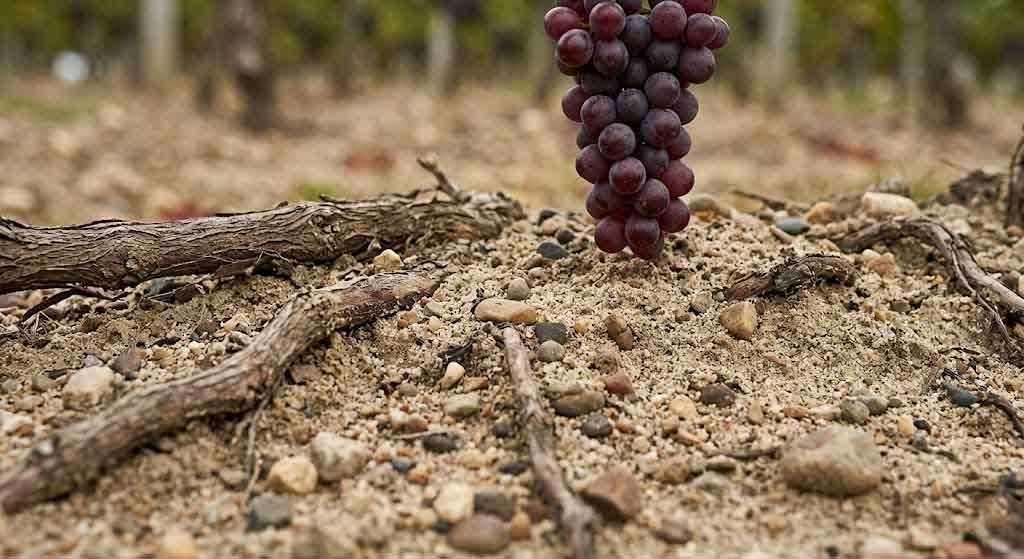
The North Fork’s wine story begins in working soil. Before the first vines went in the ground, this stretch of Long Island from Riverhead to Orient Point was potato country — flat, sandy farmland where immigrant families grew Suffolk County’s most profitable crop for generations. The glacier that retreated here twelve thousand years ago left behind glacial outwash: rocky, well-drained sandy loam that turned out to be remarkably close in character to the great coastal wine soils of Bordeaux. Nobody planned it that way. The land just was what it was.
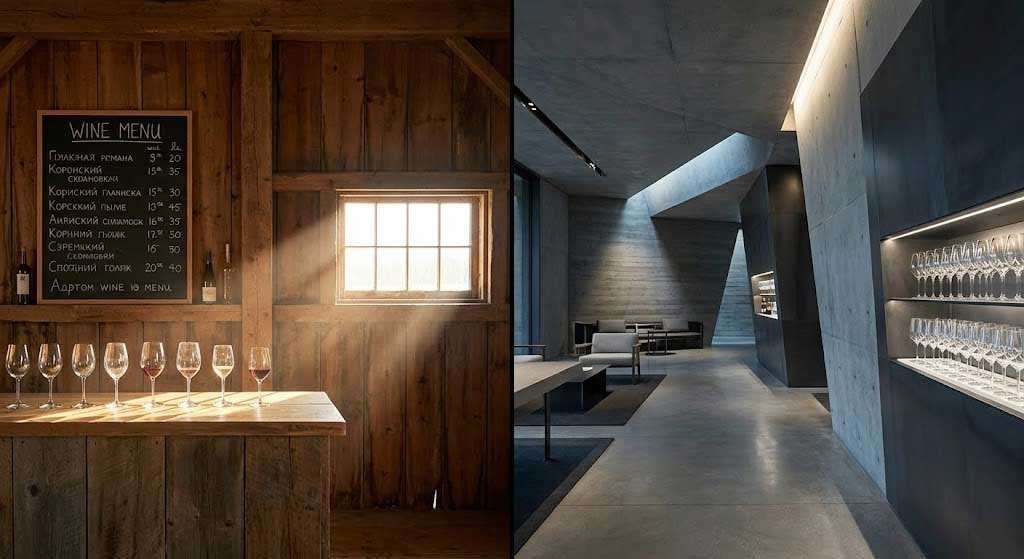
Lenz Winery opened in 1977 on a former potato farm in Peconic, its tasting room still housed in one of the original outbuildings. That barn is not artfully distressed. It is just old. That distinction matters more than it sounds.
Napa’s origin story runs through something closer to mythology — and mythology, by design, is polished. The Judgment of Paris in 1976, when California wines beat French estates blind, launched a half-century of prestige accumulation. By the 1980s, money was pouring into the valley. The barns were torn down. The tasting rooms became temples. Today, some Napa estates charge a hundred dollars just to walk through the door and sit with a sommelier who will talk about volcanic soil without once cracking a smile.
What started as farming became theater. That arc happens everywhere once the money arrives. The North Fork is still closer to the beginning of that arc, which is either its limitation or its gift — depending on what you’re looking for in a glass of wine.
The Terroir Argument Nobody’s Finishing
Wine writers love to compare terroir. They will describe Napa’s soils — the volcanic basalt in the Vaca Range foothills, the alluvial fans at Rutherford, the clay and silt of the valley floor — with the reverence of a geologist presenting a doctoral thesis. The diversity is real. Napa contains nearly half the world’s soil orders in a valley thirty miles long and five miles wide.
But terroir is not just dirt. It is everything the vine feels — air, water, heat, cold, proximity to a body of water that moderates what would otherwise be an unlivable swing between summer and winter.
By that full accounting, the North Fork has one of the more unusual growing environments in the entire country. It is surrounded on three sides by water: Long Island Sound to the north, Peconic Bay to the south, and the Atlantic working its way around Orient Point. This marine presence keeps summer temperatures from ever getting brutal and winter temperatures from finishing off the vines. The growing season extends well into October. The sunlight exposure in Cutchogue — one of the sunniest pockets in New York State — runs between 2,800 and 3,500 growing degree days annually. The result is wine that carries what Bedell Cellars winemaker Marin Brennan describes as a natural saline minerality. You can taste the bay in the wine if you’re paying attention. That’s not a metaphor. It’s chemistry.
Napa’s fruit runs riper, fuller, higher in alcohol. The valley floor traps heat during the day and cools at night thanks to fog that rolls in from San Pablo Bay, which extends the ripening window and allows Cabernet Sauvignon to achieve the density of texture and concentrated dark fruit that made the region famous. At its best, a great Napa Cab is an architectural achievement — structured, layered, built to age for twenty years. It is wine made from mastery of conditions.
North Fork wine is made from negotiation with conditions. The maritime climate is moody. Vintage matters enormously here. A wet September can compromise an otherwise strong year. A winemaker who survives five harvests on the North Fork has learned to read weather patterns the way a fisherman reads water — with earned humility and no safety net. That unpredictability produces wines that vary, that surprise, that are tied to the specific character of a single year in a way that Napa’s winemaking technology and climate consistency can occasionally smooth over.
Cabernet Franc Is the Story
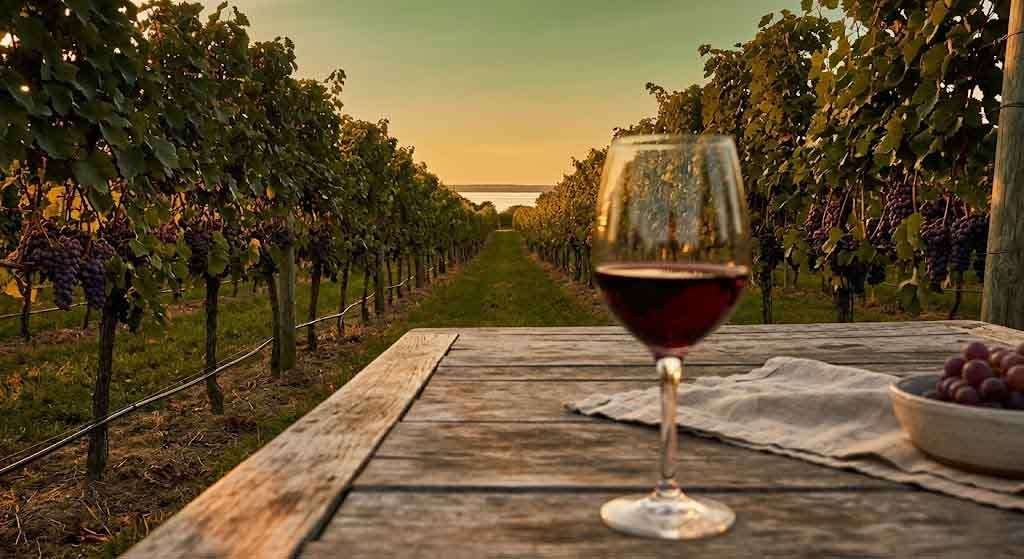
If you want to understand what the North Fork does better than almost anywhere in the country, start with Cabernet Franc. In Napa, Cab Franc tends to show up as a blending grape — a supporting actor to the star Cabernet Sauvignon, added for complexity and aromatics but rarely expected to carry a wine on its own. California’s heat pushes Cab Franc toward ripe, jammy fruit that can lose its defining character.
The North Fork’s maritime cool is almost custom-made for it. Here, Cab Franc is lifted, precise, and herbal without tipping into the harsh green pepper quality that plagues the grape in lesser sites. At its best — a good vintage from a producer like Bedell or Lenz — you get red cherry, dried violets, a flinty mineral edge, and a finish that wants food. Not the tasting-room cracker and wedge of cheese that accompanied it, but a real meal. Roasted duck. A lamb shoulder. The kind of thing my father would have cooked in a kitchen that smelled like oregano and olive oil.
Merlot is the other grape that defines the region, borrowing from the same Bordeaux parallel that the soil suggests. North Fork Merlot, when it’s good, is leaner and more saline than a Napa example — less plush, more focused. It doesn’t try to impress you in the first thirty seconds, which is probably why it doesn’t win as many critics’ competitions. It opens as you drink it.
The Hospitality Gap
Here is the comparison nobody writes honestly. Walk into a Napa tasting room — especially at one of the name estates — and you are entering a designed experience. The architecture, the lighting, the staff trained to discuss malolactic fermentation with the same diction as a concierge at a five-star hotel, the pre-booked reservation required for a twenty-minute “flight,” the gift shop where a single bottle of Cabernet costs three hundred dollars: all of it is engineered to make you feel both privileged and slightly insecure. The hustle is elegant, but it is still a hustle.
Drive out Route 25 on the North Fork and pull into a gravel lot outside a tasting barn. You might be greeted by an actual family member. You might get a pour from a winemaker who wants to talk about what the summer was like, what the soil felt like walking the rows in August, why they made the call to pick early on the Chardonnay. At Coffee Pot Cellars in Cutchogue, they have a twelve-year-old pug. The winemaker stops by in the afternoon. Nobody is performing wealth management.
That informality is not a deficit. It is a style. It belongs to a region that came out of potato farming, not Gilded Age money. The same working-class DNA that built this part of Long Island — the fishermen off Peconic Bay, the farm families who ran stands off Sound Avenue, the communities that never quite gentrified because they were too far east and too practical for it — runs through the way these wineries treat a stranger who walks in on a Wednesday.
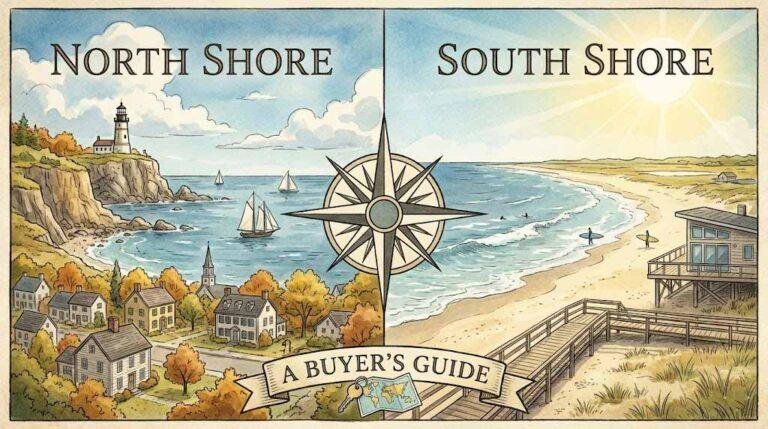
I think about the North Shore vs. South Shore comparison I’ve written about before — the way Long Island’s two shores encode entirely different relationships to class, access, and what “nice” is supposed to mean. The North Fork is the North Shore taken to its logical end: unpretentious, rooted, suspicious of performance. Napa, at this point in its history, is almost entirely performance.
What the Glass Actually Tells You
Tasting notes are the most contentious part of any wine piece because they are half experience and half translation from a sense that resists language. I’ll keep these honest and specific.
Bedell Cellars Merlot, North Fork of Long Island — Dark cherry and dried herbs on the nose, not showy. On the palate, medium body with good tannic structure, a clean acidity, and that saline finish I keep coming back to. It pairs with food the way a good leather briefcase pairs with the right suit: it doesn’t announce itself, it just fits. It ages well and asks nothing of you in the moment.
A Napa Valley Cabernet Sauvignon from the valley floor — Riper on the nose, dark plum, a hint of vanilla from oak that is well-integrated but present. Full-bodied, smooth tannins, long and warm on the finish. Impressive by the glass. Possibly the best wine in the room at whatever event it appears at. Designed for impact.
The Napa wine is the kind of wine that wins arguments. The North Fork wine is the kind of wine that ends evenings well.
Neither of those is a criticism. They are descriptions of two philosophies. Napa makes wine for the moment of presentation. The North Fork makes wine for the table.
What California Could Actually Learn
The answer is not humble. California winemakers are not lacking humility — there are extraordinary, thoughtful producers throughout Napa and beyond. What Napa the region has lost, and what the North Fork still has in abundance, is the relationship between wine and place that is not curated.
The North Fork has the Long Island Sound defining its northern edge, Peconic Bay holding the southern edge, farmland and roadside stands that have been there since the 1940s, and a culture that treats wine as a byproduct of a particular piece of ground rather than a vehicle for selling a lifestyle. That is becoming rarer everywhere. It is still, somehow, the default on the North Fork.
What Napa could learn — what it once knew and traded away for prestige — is that a glass of wine should still be connected to the dirt it came from and the people who worked in it. That when you remove the farming and leave only the brand, something essential goes with it.
The North Fork hasn’t made that trade. Not yet, anyway. And when I’m sitting at a table at the diner on a Saturday afternoon with a glass of North Fork Cab Franc opened an hour before service — a small ceremony I’ve kept for twenty-five years — it tastes exactly like what it is: a glass of something real, from a strip of land that still knows what it’s doing.
That’s worth something. It might even be worth the drive.
You Might Also Like
- North Shore vs. South Shore: The Lifestyle Comparison Nobody’s Done Right
- Rum Row and the Freeport Bootleggers: Long Island’s Clandestine War on the Water
- The Forgotten Montauk Surfman’s Chowder: Cooking with Seawater at the 1800s Life-Saving Stations
Sources
- Long Island AVA Overview and Terroir Profile — Guided Wino: https://guidedwino.com/regional-wine-education/long-island-american-viticultural-areas-avas
- “Long Island Wine Producers Link Grape Experimentation to Sustainability” — SOMM TV Magazine: https://mag.sommtv.com/2022/06/long-island-wine/
- “Three Must-Visit North Fork Wineries” — The Wine Chef: https://www.thewinechef.com/blog/three-must-visit-north-fork-wineries
- “Getting to Know the Long Island Wine Region of NY” — The Michael Pour: https://michaelpour.com/2025/02/04/getting-to-know-the-long-island-wine-region-of-ny/
- Napa Valley Terroir Guide — Wine Folly: https://napa.guides.winefolly.com/terroir/
- “The Essential North Fork Wine Guide” — VinePair: https://vinepair.com/wine-blog/essential-north-fork-wine-guide-map/
- North Fork Wineries Guide — Northforker Vacation Guide: https://vacationguide.northforker.com/topic/wineries/