Revolutions don’t begin with the first shot. They begin long before anyone picks up a weapon — in the slow, quiet collapse of everything that made the old order feel necessary. That’s the argument at the center of The Old Régime and the French Revolution, and Alexis de Tocqueville makes it with the calm precision of a man who has already decided the received version of history is wrong.
Most people understand the French Revolution as a rupture. 1789 arrives, the Bastille falls, the king loses his head, and the world is remade. Before: feudalism, aristocracy, divine right. After: liberty, equality, the modern state. Clean break. New chapter. Tocqueville spent years in the French national archives and came to the opposite conclusion. The Revolution, he argued, was not a rupture at all. It was the completion of a process the Old Régime had already set in motion — centralization, the erosion of local power, the absorption of civil life into the administrative state. The guillotine was theater. The bureaucracy was the revolution.
The Bureaucracy That Outlived the King
What Tocqueville discovered in those archives was not what he expected. The Ancien Régime — the monarchy, the nobility, the Church — had been systematically dismantling intermediate institutions for generations before 1789. The old provincial assemblies, the local guilds, the feudal courts that had once mediated between subject and crown — these had been hollowed out, their authority transferred to a growing apparatus of royal administrators. Intendants appointed from Paris, not elected by anyone, ran local affairs. The king’s government touched daily life in ways it had never done before. And the nobility, stripped of real governing power, had become a decorative class — sitting atop a social hierarchy while the actual machinery of the state hummed underneath them without their involvement.
When the Revolution arrived, it did not dismantle this administrative machine. It inherited it. The same centralized structures that Richelieu and Louis XIV had built, the same impulse to flatten everything into one undifferentiated mass of citizens answerable to the central government — the Revolution absorbed all of it and called it liberation. Tocqueville is almost sardonic about this. The men of 1789 believed they were destroying everything. What they were actually doing was completing the project their enemies had started.
This is the book’s central and most unsettling observation: that revolutionary change and administrative continuity are not opposites. They can coexist. They can even depend on each other. The surface ruptures — the names, the symbols, the rhetoric — while the underlying structure of power persists, strengthens, deepens.
Why the Revolution Happened When It Did
Tocqueville adds a second argument that cuts just as deep. He asks: why 1789? France had lived under the Old Régime for centuries. Why did it crack when it did, at what was, by some measures, a moment of relative improvement?
His answer has become one of the most cited observations in political sociology. Oppression, he argues, is most dangerous not when it is at its worst, but when it begins to ease. When people have lived under a fixed and total system for long enough, they adapt. They lower their expectations. They stop imagining anything different. But the moment that system begins to reform — when the grip loosens slightly, when promises of improvement are made, when the horizon of possibility shifts — that is when fury ignites. The imagination catches fire faster than the reality can change. The gap between what people can now conceive and what they are still living becomes unbearable. Reform does not pacify. It accelerates.
Louis XVI had been making concessions. The Old Régime in its final decades was not the Old Régime at its most rigid — it was an Old Régime in awkward, halting, incomplete reform. And that was exactly the wrong moment to be in. The Bourbon monarchy fell not because it refused to change, but because it changed too little too late, just enough to make people furious.
The Aristocrat Who Looked Straight at the Machine
What makes Tocqueville unusual — and what makes this book something other than a standard political history — is who he was. He was an aristocrat. His family had suffered under the Terror. He had every reason to write a polemic defending the Old Order or romanticizing a nobility that was being swept away. He didn’t. He looked at the historical record and followed where it led, even when it indicted his own class. The nobility, he concluded, had already surrendered most of what made them a governing class by the time the Revolution arrived. They had retained the privileges without retaining the responsibilities. They were tax-exempt but powerless. They occupied a status that could not survive scrutiny. He doesn’t say this with pleasure. But he says it clearly.
This is the quality that separates Tocqueville from most political writers of his era: the willingness to hold his conclusions at a distance from his sympathies. He was not a revolutionary. He was not a reactionary. He was something rarer — a diagnostician. His earlier work, Democracy in America, had already established that he could look at democratic society without either fearing it or worshipping it. He brought the same temperament to the French Revolution.
Equality and the Loss of Liberty
Running underneath the entire book is a tension that Tocqueville never quite resolves — and that, I think, is why it stays with you. The Revolution produced equality. The peasants were no longer serfs. The old hierarchy of birth was abolished. The law, at least formally, treated everyone the same. These were not nothing. These were real.
But what it did not produce — what the administrative centralization actually undermined — was liberty. Local autonomy was gone. The intermediary institutions that had once given individuals and communities some buffer against the central power — the guilds, the provincial estates, the municipal bodies — had been erased. Citizens were equal in their subjection to the state. That is a particular kind of equality, and it is not freedom.
I have read enough political philosophy to know that this tension — between formal equality and genuine liberty — is one of the oldest and least-resolved problems in the tradition. Tocqueville does not solve it. He maps it. He shows you exactly how France arrived at a state where the language of liberation coexisted with the machinery of control, and he does not pretend there is an easy exit from that arrangement.
What He Wrote, and Why It Holds
The book was published in 1856, four years before Tocqueville died. It was unfinished. He had intended it as the first part of a larger study of the Revolution and its aftermath that he never completed. What we have is dense in places — this is not a casual read — and some of the archival chapters on taxation and administrative structure require patience. But the core argument is airtight. And the prose, even in translation, has a quality of controlled intelligence that is rare. Tocqueville writes like a man who is not trying to win an argument. He is trying to understand something. That’s a different posture, and it produces a different kind of book.
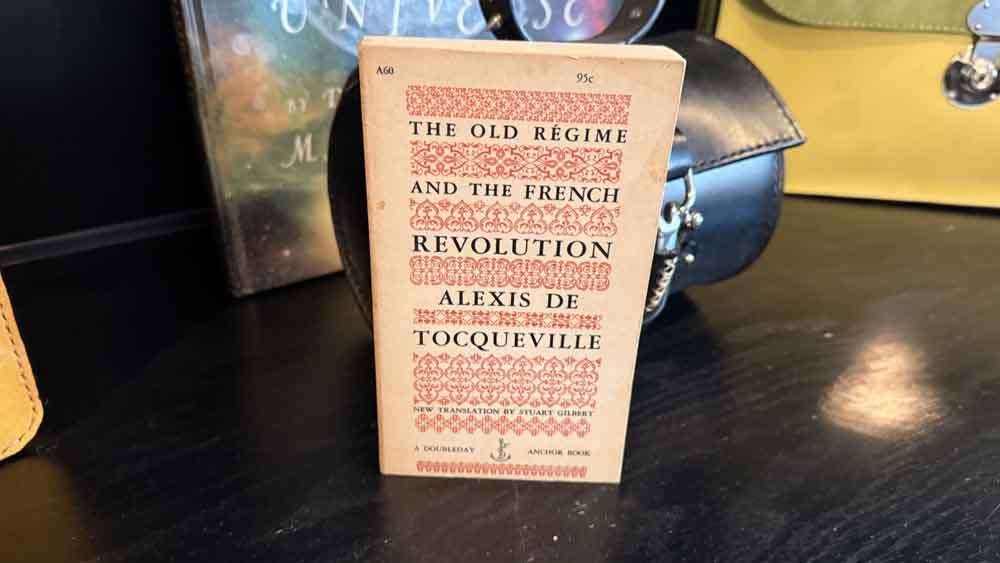
The edition I have is the Doubleday Anchor paperback in Stuart Gilbert’s translation — ninety-five cents on the cover, which tells you something about when I acquired it. It has lived on my shelf through several moves, picked up and put down and picked up again. The argument has only clarified with time.
You Might Also Like
- The Plague by Albert Camus: A Powerful Exploration of the Human Condition in Times of Crisis
- The Grapes of Wrath: A Tale of Hope and Despair in the Great Depression
Sources
- Tocqueville, Alexis de. The Old Régime and the French Revolution. Trans. Stuart Gilbert. Doubleday Anchor, 1955. Archive.org
- Furet, François. Interpreting the French Revolution. Cambridge University Press, 1981.
- Jardin, André. Tocqueville: A Biography. Farrar, Straus and Giroux, 1988.
- Schleifer, James T. The Making of Tocqueville’s Democracy in America. University of North Carolina Press, 1980.
- Skocpol, Theda. States and Social Revolutions. Cambridge University Press, 1979. Cambridge