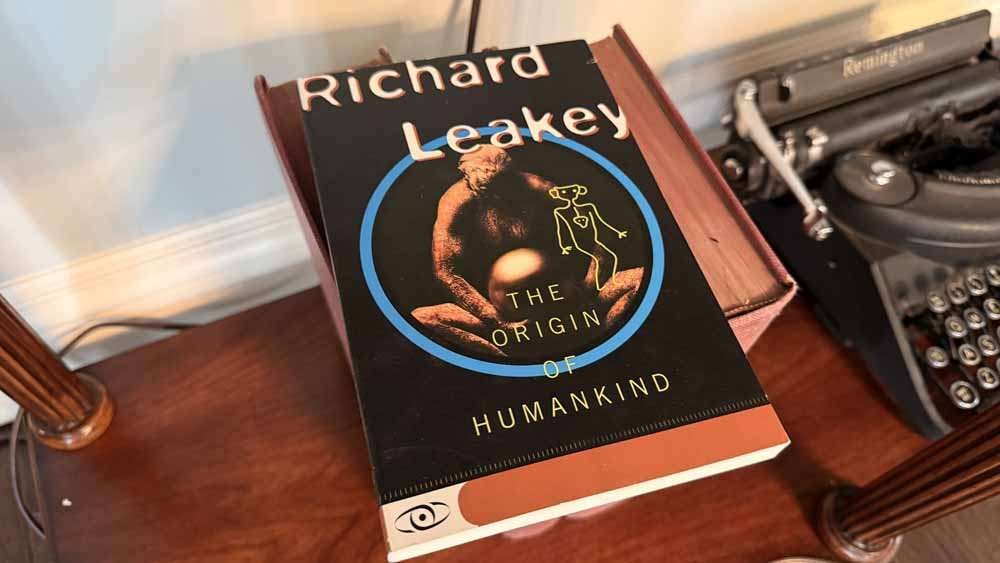
Richard Leakey did not come to paleoanthropology through a library. He came to it through the ground — through cracked sediment and dry lake beds and the peculiar patience of a man who knew that Africa was full of the dead, and that the dead had things to say. His 1994 book The Origin of Humankind carries that weight. It is a book written by someone who has held the evidence in his hands, turned it in the light, argued about it in the field, and occasionally watched a colleague’s theory come apart when a new fragment surfaced three inches from where they were not digging.
That is not how most science books are written. Most science books are written from a comfortable distance. Leakey’s intimacy with his subject — with the bones themselves — makes this one different.
What Leakey Is Actually Arguing
The Origin of Humankind is part of the Science Masters series, which means it is short — under 200 pages — and written for people who are smart but not specialists. Leakey uses that constraint well. He is not trying to write the definitive technical account of human evolution. He is trying to answer the question that every person walking through a natural history museum eventually stops at: where did we actually come from, and how do we know?
His argument is not a single thesis but a guided tour through the contested fossil record, structured around the major questions in paleoanthropology as of the early 1990s. When did our ancestors first walk upright? What drove the explosive growth of the human brain? What was the relationship between Homo habilis, Homo erectus, and anatomically modern humans? Was there a single African origin for our species — the “Out of Africa” hypothesis — or did modern humans emerge in parallel across multiple continents?
On most of these questions, Leakey comes down firmly on the side he believes the evidence supports. But what makes the book valuable is not just his conclusions — it is his willingness to show the argument in progress, including the places where paleoanthropologists have made serious errors and had to walk them back.
Bones, Dates, and the Problem of Inference
The challenge with paleoanthropology — what separates it from, say, molecular biology — is that the fossil record is brutally incomplete. You are working from fragments. A partial skull here. A femur there. Occasional teeth. The entire known inventory of Homo habilis fossils could fit on a kitchen table. From this you are being asked to reconstruct not just anatomy but behavior, social structure, diet, and language capacity. That is an enormous inferential leap, and Leakey is honest about how often the field gets it wrong.
He is particularly candid about the controversies surrounding his own family’s work. His mother, Mary Leakey, discovered Australopithecus boisei at Olduvai Gorge in 1959 — what was then called “Nutcracker Man” for its massive jaw structure. His father, Louis Leakey, championed the find as a direct human ancestor. It wasn’t. Later analysis moved Boisei into an evolutionary dead end — a robust australopithecine that eventually went extinct without producing modern humans. The Leakeys had staked a position, the evidence shifted, and the position had to change. Richard Leakey recounts this not defensively but as an illustration of how the science actually works: accumulation of evidence, contested interpretation, eventual revision.
This is where the book earns its credibility. It would have been easy to write a triumphalist account of the Leakey family’s contributions to paleoanthropology — and those contributions are genuinely enormous, especially the finds at Koobi Fora on the eastern shore of Lake Turkana in Kenya, where Richard Leakey’s own excavations produced some of the most significant Homo erectus specimens on record. Instead he writes something more useful: a book about how difficult it is to read a species’ history from the rocks, and why that difficulty does not excuse sloppiness or motivated reasoning.
The Turkana Boy and the Evidence for Homo Erectus
The most arresting section of the book concerns Homo erectus — specifically the discovery in 1984 of a nearly complete skeleton at Nariokotome, west of Lake Turkana, by Leakey’s colleague Kamoya Kimeu. The skeleton, known as the Turkana Boy or Nariokotome Boy, dates to approximately 1.6 million years ago. He was about eight years old at death and, based on projections from the skeleton, would have stood close to six feet tall as an adult. He looked, in broad anatomical terms, recognizably human.
Leakey’s description of this specimen carries the kind of weight that only comes from proximity. This was not data on a page. It was a boy, dead for a million and a half years, who had a childhood and would have had an adulthood. The Turkana Boy reshaped the understanding of Homo erectus — suggesting a body plan far more modern than the stooped, shambling creature popular imagination had sketched. If Homo erectus was physically close to us, the question of what distinguished early humans from modern ones had to shift from anatomy toward cognition, culture, and language.
This is a point Leakey develops at length. The archaeological record associated with Homo erectus — the Acheulean stone tool tradition, characterized by hand axes shaped to a consistent and clearly intentional design — persists with remarkable uniformity for nearly a million years across Africa, Europe, and Asia. The tools barely change. For Leakey, this stability is significant not as evidence of sophistication but as evidence of its absence. A tool tradition that doesn’t evolve for a million years is not the product of a mind like ours. Something changed, relatively recently, to produce the behavioral modernity we see in the archaeological record beginning around 50,000 years ago — the explosion of symbolic art, complex weapons, long-distance trade, burial ritual. What triggered that change is a question Leakey raises clearly without pretending to fully resolve it.
Out of Africa and the Multiregionalists
The sharpest scientific controversy in the book is the debate between the Out of Africa hypothesis — the position that anatomically modern humans evolved in Africa and then spread outward, replacing archaic populations elsewhere — and multiregional evolution, championed most forcefully by Milford Wolpoff, which holds that modern humans evolved in parallel in multiple regions from local Homo erectus populations.
Leakey is in the Out of Africa camp, and he marshals the evidence clearly. The mitochondrial DNA research associated with Allan Wilson and his colleagues at Berkeley — which traced the maternal ancestry of modern humans back to a single African population — had, by the early 1990s, provided molecular support for what the fossil record suggested. Leakey explains the logic of this research accessibly without dumbing it down: because mitochondrial DNA is inherited only through the maternal line and accumulates mutations at a predictable rate, it functions as a molecular clock. That clock put the common ancestor of all living humans in Africa between 100,000 and 200,000 years ago.
What is notable about this section is how Leakey handles the opposition. He does not dismiss multiregionalism as pseudoscience. He engages Wolpoff’s actual argument — that anatomical continuities between archaic and modern populations in specific regions (certain features of Chinese Homo erectus appearing in modern East Asian populations, for example) are real and require explanation — and explains why he finds the Out of Africa interpretation more coherent given the totality of the evidence. This is intellectual honesty. He thinks Wolpoff is wrong. He explains why without pretending the other side has no case at all.
The Question of Language
The final stretch of The Origin of Humankind turns to the question that, for Leakey, underlies everything: language. His position, developed more fully in The Sixth Extinction (written with Roger Lewin) and Origins Reconsidered, is that language is the key adaptation that separates modern humans from every other species, including our immediate ancestors. Not tool use. Not bipedalism. Not even brain size per se. Language — the recursive, symbolic, open-ended capacity to build and share internal representations of the world — is what changed everything.
He approaches this through the neuroscience of Broca’s area, the region of the left hemisphere associated with language production, and through the archaeological record of symbolic behavior. When humans started making ochre engravings, perforating shells for ornament, burying their dead with grave goods — they were doing something that required shared symbolic systems. That is language, or something functionally indistinguishable from it. The bones of the throat and the architecture of the brain can only tell you so much. The artifacts tell the rest.
Whether you find this persuasive or want to push back — and there are good reasons to push back on the sharpness of the behavioral revolution thesis, given more recent finds that suggest earlier symbolic behavior — the clarity with which Leakey makes the case is itself a lesson in scientific communication. He is not hedging into incomprehensibility. He is stating a position and defending it.
What the Book Still Gets Right
The Origin of Humankind is thirty years old. Parts of it have been overtaken by subsequent discoveries — the Denisovan findings, for example, which added an entirely new archaic human population to the picture, and the growing evidence that Homo sapiens interbred with both Neanderthals and Denisovans before or during the Out of Africa dispersal, complicating the clean replacement narrative Leakey favors. The molecular clock has been recalibrated. New specimens have surfaced. Dating technologies have improved.
None of this makes the book obsolete. What it offers is something that newer, more technically current volumes often sacrifice: the experience of reasoning through the problem from the ground up, with a man who has spent his life in the field and knows the difference between a good fossil and a great one. Reading Leakey is reading someone who was present for the argument as it developed — not summarizing it from a distance, but living it. That is worth something that updated citation counts cannot replace.
For anyone who has read Dawkins on the genetics of evolution — and The Selfish Gene remains the essential gateway on that side of the question — Leakey is the necessary complement. Dawkins explains the mechanism. Leakey shows you the record. Together, they build an account of human origins that is both theoretically rigorous and viscerally grounded in actual earth, actual bone.
The bones have been saying something for a very long time. Leakey was one of the people who learned to listen.
You Might Also Like:
Darwin’s Dangerous Idea by Daniel Dennett — The Book That Finished What Nietzsche and Dawkins Started
Demonic Males: Apes and the Origins of Human Violence — Richard Wrangham & Dale Peterson
Punctuated Equilibrium vs. Gradualism: The Forgotten War in Evolutionary Theory
Sources
Leakey, Richard. The Origin of Humankind. Basic Books, 1994. basicbooks.com
Leakey, Richard, and Roger Lewin. Origins Reconsidered. Doubleday, 1992.
Cann, R.L., Stoneking, M., Wilson, A.C. “Mitochondrial DNA and human evolution.” Nature 325 (1987). nature.com
Walker, Alan, and Pat Shipman. The Wisdom of the Bones. Knopf, 1996.
Wolpoff, Milford H. “Multiregional evolution: the fossil alternative to Eden.” The Human Revolution, Edinburgh University Press, 1989.
Smithsonian Human Origins Program. “Homo erectus.” humanorigins.si.edu
Smithsonian Human Origins Program. “Nariokotome Boy.” humanorigins.si.edu