
Roughly a millennium before the first European boot touched Long Island soil, the Shinnecock and Unkechaug nations were already working the shallow tidal estuaries of what we now call Peconic Bay with the kind of precision that comes from generations of accumulated knowledge. They harvested bay scallops — Argopecten irradians irradians — from the eelgrass beds of the Peconic Estuary, and they cultivated corn in the same coastal soil that would, centuries later, be divided into townships, lot lines, and luxury real estate. These were not two separate culinary traditions running parallel. They were, when the seasons aligned and the harvest permitted, folded together into something remarkably unified: the briny sweetness of the bay meeting the starchy warmth of the field. What modern chefs call “surf and grain” pairings, the peoples of the East End had already long understood as simply dinner.
The Peconic Scallop & Corn Fritter — in its resurrected, contemporary form — is not a chef’s invention. It is, more accurately, a recovery.
The Indigenous Table on the East End
Archaeological evidence confirms that the Shinnecock Indian Nation and the Unkechaug (Poospatuck) people harvested bay scallops from the Peconic Bays as far back as the Late Woodland period, between 1,000 and 1,500 years ago. Large accumulations of scallop shells have been uncovered across sites at Robins Island, Shelter Island, and Orient — the physical evidence of sustained, ritualized harvesting that formed the backbone of the coastal diet. (Wikipedia, Peconic Bay Scallops, 2025; Slow Food Foundation Ark of Taste, Peconic Bay Scallop, 2022)
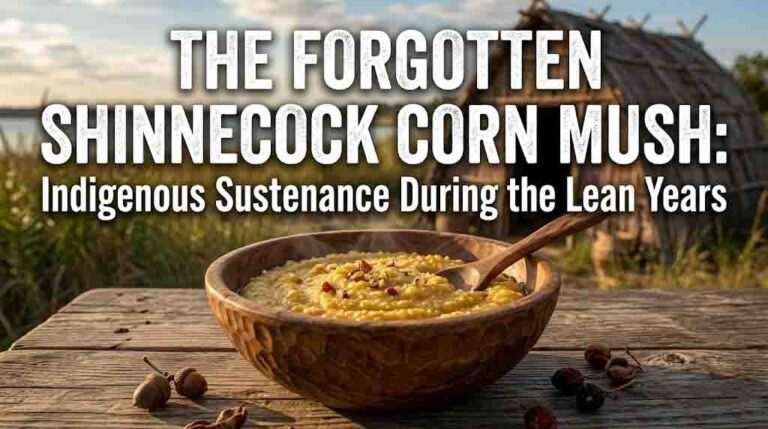
Corn occupied the other pillar of that diet. Among the Algonquian-speaking peoples of Long Island, women tended the agricultural plots while men fished and hunted — a division of labor that produced, in combination, a cuisine built on the dual abundance of sea and soil. The Shinnecock prepared corn as hominy, samp, and “suppawn” (cornmeal mush), but their most developed form of preparation involved hulling the corn with wood ashes, washing it of lye, pounding it in a wooden mortar, and then cooking it as dumplings sometimes mixed with huckleberries or beans. (Native Long Island, Shinnecock Indian Reservation, 2020)
The Three Sisters — corn, beans, and squash — formed what the Shinnecock regard as a sacred trifecta, a nutritionally symbiotic system in which the plants supported one another in the field and complemented one another at the table. Shellfish, particularly scallops and clams, provided the essential coastal protein, often folded directly into corn-thickened broth. According to Roger Williams’ 17th-century primary source documentation, clams were boiled with corn mush (“nasaump”) to create broths that were both a staple drink and a meal base — the original seasoning of eastern Long Island’s kitchen. (Southeastern New England Native Recipes, Plymouth Archaeological Documentation Project)
What is rarely discussed, but deeply relevant, is that this represents a complete, intentional cuisine. As food historian Elisabeth Rozin observed in Blue Corn and Chocolate, “all of American cuisine is fusion cuisine,” and the corn fritter — a form that descends directly from Indigenous preparation traditions — stands as one of its most enduring expressions. Corn fritters, as documented by Abenaki food writer Dale Carson across her three books on Native American cooking, are a continuation of Indigenous methods of combining ground or creamed corn with fats and heat — a technique that predates European contact on this continent by centuries. (National Geographic, Native American Cuisine Returns to Its Roots, 2016; Indian Country Today, Native Cooking: Corn Fritters and a Brief History of the Indigenous Staple)
The Bay Scallop as Cultural Currency
By the 1870s, what had been a subsistence practice for the Shinnecock and Unkechaug had become an economic engine for the East End’s white baymen. The Peconic Bay scallop fishery grew into one of the most consequential commercial shellfish industries on the eastern seaboard, with annual pre-collapse yields averaging 300,000 pounds and a fishery contributing more than $60 million annually to the regional economy at its peak. Baymen sold scallops to Sardi’s, the 21 Club, and Luchow’s in Manhattan during the 1960s — shipped out in five-gallon cans aboard single-engine planes that flew runs to New England restaurants. (Riverhead News Review Archives, The Scallop Industry Has a Rich Past on Eastern Long Island, 2018; Civil Eats, Scientists Scramble to Help Bay Scallops Survive Climate Change, 2023)
The scallop’s market value reflects its rarity. At its peak, a pound of Peconic Bay scallops commanded as much as $30 on the market — a price that signals not mere seafood but something closer to terroir-driven produce, where flavor and provenance are inseparable. East End chef John Ross put it precisely: “The Peconic Bay scallop is not just another local shellfish. It is much more than that.” He described how creative chefs coming to the North Fork found new ways to cook and present these scallops “in a way that preserves our unique heritage and culture,” calling them “one of the most important elements in the emergence of a true North Fork cuisine.” (Gotham Center for New York City History, The Jewel of Eastern Long Island, 2020)
That heritage is Indigenous in its origins — a fact that the contemporary culinary conversation around Peconic Bay tends to underemphasize.
Collapse, Restoration, and the Science of Survival
The story of the Peconic Bay scallop in modern times is one of ecological tragedy and ongoing scientific reckoning. Beginning in 1985, a series of Aureococcus anophagefferens brown tide blooms devastated the eelgrass beds that scallops depend on for juvenile settlement. By 1996, the total commercial harvest in New York had dropped to 53 pounds — compared to a pre-collapse annual average of 300,000 pounds. The U.S. National Oceanic and Atmospheric Administration declared the collapse of the Long Island scallop fishery a federal disaster in 2021. (Wikipedia, Peconic Bay Scallops, 2025)
The Cornell Cooperative Extension (CCE) has led restoration efforts since 2005, partnering with Long Island University and, more recently, Stony Brook University, under a $2 million initial grant from Suffolk County. The program seeded hatchery-raised scallops into the bay to jumpstart natural spawning cycles, and for a period, it worked: commercial fishery landings from 2010 through 2018 averaged more than 1,300% higher than in the years before the restoration program began, generating over $8 million in direct economic benefit to baymen and more than $60 million to the broader regional economy. (Cornell Cooperative Extension, Scallop Program: Overview and Results)
Then, beginning in 2019, mass die-offs returned — this time driven not by algal blooms but by a newly identified parasite called Bay Scallop Microsporidia (BSM), compounded by what researchers now believe is a dangerous lack of genetic diversity in the restored population. “There’s the potential that the founder population was too small, and over time we lost genetic diversity,” CCE aquaculture specialist Harrison Tobi told the East End Beacon in 2024. The hypothesis is that the very act of restoration — seeding millions of scallops from a limited genetic pool — created a population vulnerability that the parasite is now exploiting. (East End Beacon, Genetic Diversity May Be Key to Scallop Survival, November 2024)
The 2025 scallop season opened in November to what baymen bluntly described as a failure for the fifth consecutive year. Scientists at CCE and Stony Brook’s Marine Animal Disease Laboratory are now introducing Moriches Bay scallops — a genetically distinct, parasite-tolerant wild population — into Peconic Bay to broaden the gene pool. The work is painstaking: 300 Moriches Bay scallops were used to produce over two million fertilized eggs, more than one million of which have grown to planting size. The program received $240,000 from New York Sea Grant to continue this selective breeding research. (Dan’s Papers, Selective Breeding Aims to End Peconic Bay Scallop Scarcity, April 2024; CCE, Scallop Program, ccesuffolk.org)
The ecological battle now mirrors, in an almost philosophical sense, the colonial disruption that unraveled the Indigenous relationship with this bay centuries ago. What was once a self-sustaining, intergenerational knowledge system — the Shinnecock and Unkechaug knowing when and how to harvest without destroying — became a commercial fishery, then a collapsed fishery, and now a laboratory experiment in genetic rescue. The fritter on the plate carries all of this history within it.
The Architecture of the Dish
The scallop-corn fritter, as a culinary form, sits at the convergence of several deep American food traditions. The fritter itself — a battered, fried preparation of seafood — has coastal roots across the Atlantic seaboard, from the Harkers Island clam fritters of North Carolina to the colonial johnnycakes of New England. The name derives from the Latin frigere, meaning “to fry,” and historians trace fritter-style preparations through ancient Rome and the medieval Middle East to the European colonists who arrived on eastern Long Island carrying both the technique and the appetite for it. (Coastal Review, Our Coast’s Food: Seafood Fritters, 2022)
What makes the Peconic Scallop & Corn Fritter a specifically East End form, however, is the meeting of cornmeal and bay scallops within a single preparation — two ingredients whose histories on Long Island predate every cookbook that has ever been written about them.
Contemporary kitchen iterations of this dish pair the cornmeal batter with fresh or creamed sweet corn to amplify the sweetness that Peconic Bay scallops already carry naturally. Their flavor profile — small, delicate, and intensely sweet in a way that sea scallops cannot replicate — makes them particularly well-suited to a corn base, where the sweetness reinforces rather than competes. The Slow Food Foundation, which has included the Peconic Bay scallop in its Ark of Taste as a food heritage worth preserving, notes that the scallops are “suitable for grilling, sautéing, and poaching, and can also be eaten raw or added to soups, stews, and ceviche” — but the corn fritter preparation wraps them in something the Slow Food entry does not address: historical resonance. (Slow Food Foundation, Peconic Bay Scallop, 2022)
The technical preparation matters. Peconic Bay scallops are extraordinarily time-sensitive — they must be opened the day they are taken, because unlike oysters their shells don’t close and they spoil rapidly. Their brevity on the plate mirrors their brevity in the fishery: here and then gone, abundance turning without warning to scarcity. A corn fritter preparation — where the scallop is folded into a cornmeal batter and fried quickly at high heat — respects both the speed required and the sweetness that defines the ingredient. Overcooking destroys the texture. Overworking the batter develops gluten and kills the lift. The dish demands the same attention that bay scalloping itself demands: precise timing, restraint, and awareness of exactly when to act. (Sizzlefish, Scallop Fritters)
North Fork Cuisine and the Reclamation of Indigenous Flavor
The contemporary North Fork culinary scene has, over the past two decades, increasingly moved toward provenance-driven, seasonally anchored menus that celebrate the specificity of place. The wine country restaurants of Southold and Greenport, the farm stands along Route 25, the waterfront seafood shacks of Greenport Harbor — all reflect an appetite for food that is rooted in the particular geography of the East End. Within this movement, the Peconic Bay scallop holds near-sacred status: it is the ingredient that East End chefs fight to source in season, that diners plan their November and December visits around, and that defines the difference between a North Fork meal and a generic coastal menu.
What the movement has been slower to do is to acknowledge the deeper historical layer beneath that provenance — the Indigenous agricultural and fishing systems that first demonstrated what the Peconic Estuary could produce and how to harvest it without exhausting it. The Shinnecock Powwow, held annually at Labor Day on the Southampton reservation, remains one of the clearest living expressions of this foodway: corn chowder with hominy, stuffed clams, seafood, cranberry beans — a menu that sounds, in outline, remarkably like a contemporary farm-to-table feast. The connection is not coincidence. It is inheritance. (Edible East End, A Look at Local Indigenous Food Traditions at the Shinnecock Pow Wow, 2017; 27East, A Shinnecock Thanksgiving, 2024)
Resurrecting the Peconic Scallop & Corn Fritter as an intentional, historically anchored dish — rather than a casual appetizer — means holding all of that context on the plate. It means understanding that the corn in the batter has Algonquian agricultural roots on Long Island soil, that the scallop in the center was harvested from the same estuarial system that the Shinnecock mapped over a thousand years ago, and that the combination of the two reflects a logic of place that predates every modern restaurant on the North Fork by at least ten centuries.
The Fritter as a North Shore Dish
From the vantage point of Long Island’s North Shore — from Mount Sinai east through Port Jefferson, Stony Brook, Setauket, and on toward the North Fork — the Peconic Scallop & Corn Fritter represents something specific to this coastal geography. The North Shore has always sat at the intersection of working waterfront and affluent residential community, a place where baymen and artists and academics and restaurateurs have shared the same stretch of coastline for generations. The Route 25A corridor is a living argument for the idea that authentic local culture and high culinary standards are not in opposition.
Incorporating the Peconic Scallop & Corn Fritter into a North Shore menu — whether at a full-service restaurant or a casual waterfront café — is an act of regional culinary stewardship. It supports the baymen fighting to sustain a struggling fishery. It foregrounds the Indigenous history of the ingredient. It uses Long Island sweet corn, one of the East End’s most acclaimed agricultural products, as a structural partner rather than a garnish. And it asks the diner to eat something that carries actual meaning about the place they are sitting in.
The scallop season on Peconic Bay remains precarious heading into 2026. The Cornell Cooperative Extension’s genetic diversity program will take years, possibly decades, to yield measurable population recovery. In the meantime, the scallops that do make it to market — limited in number, extraordinary in flavor — deserve to be treated with the intelligence their history demands.
A corn fritter does that. It frames the scallop not as a luxury protein dropped on a plate but as part of a continuum of place, preparation, and cultural memory that runs from the Shinnecock shell middens of Robins Island to the contemporary kitchens of the North Fork. That is what it means to resurrect a dish rather than simply to cook one.
Sources
- Wikipedia, Peconic Bay Scallops, 2025
- Slow Food Foundation, Peconic Bay Scallop — Ark of Taste, 2022
- Gotham Center for New York City History, The Jewel of Eastern Long Island: Precarity and the Peconic Bay Scallop Industry, 2020
- Riverhead News Review / Suffolk Times Archives, North Fork History Project: The Scallop Industry Has a Rich Past on Eastern Long Island, 2018
- Civil Eats, Scientists Scramble to Help Bay Scallops Survive Climate Change, 2023
- Cornell Cooperative Extension, Scallop Program: Overview and Results
- East End Beacon, Genetic Diversity May Be Key to Scallop Survival, November 2024
- Dan’s Papers, Selective Breeding Aims to End Peconic Bay Scallop Scarcity, April 2024
- East Hampton Star, There May Be Hope Yet for Peconic Scallops, November 2024
- Riverhead News Review, 2025 Peconic Bay Scallop Season Harvest ‘Sucks’, November 2025
- Native Long Island, Shinnecock Indian Reservation, 2020
- Edible East End, A Look at Local Indigenous Food Traditions at the Shinnecock Pow Wow, 2017
- 27East, A Shinnecock Thanksgiving, 2024
- Plymouth Archaeological Documentation Project, Southeastern New England Native Recipes
- National Geographic, Native American Cuisine Returns to Its Roots, 2016
- Indian Country Today, Native Cooking: Corn Fritters and a Brief History of the Indigenous Staple
- Wikipedia, Southern New England Algonquian Cuisine, 2025
- Coastal Review, Our Coast’s Food: Seafood Fritters, 2022
- Sizzlefish, Scallop Fritters
- Shinnecock Indian Nation, Who We Are