Walk into the Long Island Pine Barrens on a January morning and you will find yourself inside one of the most quietly radical landscapes in the northeast. The pitch pines press close, their bark scorched and split from centuries of fire cycles, their needles hanging in tight green clusters above beds of pale sugar sand. European settlers who first entered these barrens in the 1600s looked at this land and saw barrenness — sandy, acidic soil that refused to yield their familiar crops. What they missed, almost fatally in many cases, was the medicine forest hanging right in front of their faces.
Those pine needles contained enough vitamin C to keep a crew of dying sailors alive. The Lenape people of the Pine Barrens, and the Iroquois to the north, had known this for generations. The settlers learned it slowly and, in many cases, not at all — still dying of scurvy through harsh northeastern winters while standing in groves of living, year-round vitamin C.
This is the story of that knowledge: where it came from, what it saved, what was lost, and why it matters again.
The Science of an Evergreen Pharmacy
Pine needles concentrate vitamin C — ascorbic acid — as part of their own survival strategy. Unlike deciduous trees that shed leaves and go dormant in winter, pines maintain living green tissue year-round. That tissue must be protected from oxidative damage, and ascorbic acid is one of the primary antioxidant compounds the tree employs for that purpose.
The numbers are striking. Research from the USDA Forest Service found that Eastern white pine needles (Pinus strobus) contain between 0.72 and 1.87 mg of ascorbic acid per gram of needle, depending on needle age. For comparison, an orange contains roughly 0.53 mg per gram. Year-old needles yield nearly twice the vitamin C of fresh growth; two-year-old needles yield three to four times as much (USDA Forest Service). What this means practically is that the older needles still on the branch — the dark green clusters from previous seasons — are often the most medicinally potent.
Vitamin A adds a second nutritional layer. Pine needles are rich in beta-carotene, which the human body converts to vitamin A — essential for vision, immune function, and cell regeneration. The needles also carry flavonoids, particularly proanthocyanidins, and amino acids including arginine and proline. In 2009, researcher Don J. Durzan published an analysis in the Journal of Ethnobiology and Ethnomedicine showing that conifer decoctions from a harsh winter would have been rich not only in vitamin C but in these nitrogenous compounds — factors that would have accelerated recovery in critically depleted individuals (Durzan, 2009).
The terpenes — alpha-pinene, beta-pinene, beta-phellandrene — are responsible for the tea’s distinctive forest aroma. They are also naturally antimicrobial, and have been used across cultures as expectorants to clear congestion and soothe inflamed airways.
What the Iroquois Knew, and What It Cost the French Not to
The most documented moment in the long history of pine needle medicine is not a subtle one. In the winter of 1535–1536, Jacques Cartier and his crew were locked in the ice near what is now Quebec City. Scurvy had taken hold. As recorded in Cartier’s journals and later analyzed by historians, of his approximately 110 crew members, 8 were already dead by mid-February and more than 50 were beyond what he believed was hope of recovery. Symptoms were severe — swollen limbs, rotting gums, purple-black skin, teeth loosening in the jaw.
Cartier approached a Iroquois man named Domagaia, who had himself recently recovered from scurvy. Domagaia sent women to gather branches from an evergreen tree the Iroquois called Annedda — likely white cedar or a closely related conifer, though Eastern white pine has also been proposed as a candidate. The bark and needles were boiled into a decoction. Cartier and his crew were instructed to drink it every other day, and to apply the spent dregs to their legs.
Within six days, the crew’s recovery was visible. The tree became known in France as the arbre de vie — the tree of life (JSTOR Daily, 2021). Despite the documented miracle, European medicine absorbed the lesson poorly. For the next three centuries, sailors continued to die of scurvy on long voyages, while the British debated lemon juice, the Dutch argued for sauerkraut, and the indigenous peoples of North America continued to brew the same tea they had always made.
The Lenape, who crossed the Long Island Pine Barrens seasonally in their migrations between interior woodlands and the shore, carried similar botanical knowledge. The pitch pine (Pinus rigida) that dominates the Long Island Central Pine Barrens was used medicinally — its resin applied to wounds, its bark and needles made into tonic preparations. By the time European settlers had established permanent communities across Long Island’s south shore and into the barrens, this knowledge was available to them. Most did not seek it.
The Pine Barrens Landscape and Its Pharmacopoeia
The Atlantic Coastal Pine Barrens is not one place but an ecosystem — a chain of geologically related communities stretching from New Jersey’s vast Pinelands National Reserve (over 1.1 million acres) up through Long Island’s Central Pine Barrens (covering significant portions of Suffolk County in the middle of the island) and on to isolated pockets in Massachusetts. What connects them is the same sandy, fire-dependent, acidic ecology.
The dominant pine of the Long Island and New Jersey barrens is the pitch pine (Pinus rigida), identified by its needles in bundles of three and its persistent, knobby cones. It is one of the few pine species capable of sprouting new growth directly from its trunk after fire — a trait that has allowed it to dominate its ecosystem precisely because other species cannot tolerate the same punishment. Eastern white pine (Pinus strobus), with its distinctive five-needle bundles, also appears in and around the Long Island barrens in mixed stands and at old homestead sites.
Both species produce needles suitable for tea — as does the pitch pine specifically, which has a long history of human use. The pitch pine’s resin was so prized by early colonists that the New Jersey barrens became a center of tar and turpentine production through the 18th century, industries that eventually stripped large sections of the forest before collapsing. But the medicinal use of the needles, quieter and less commercially obvious, persisted in folk practice among the “Pineys” — the resilient backcountry families who made the barrens their permanent home and were often dismissed by outsiders as primitive. Many knew the forest as a medicine chest.
How to Brew Pine Needle Tea: Method, Species, and Safety
The preparation is simple, but precision matters — both for chemistry and for safety.
Species identification first. Eastern white pine (Pinus strobus) is the preferred tea species in the northeast and is easily identified: needles come in bundles of five, are three to five inches long, and the tree produces long, graceful cones. A useful mnemonic — “white” has five letters, and white pine has five needles per bundle. Pitch pine has three needles per bundle. Both are appropriate for tea preparation.
What to avoid is equally important. The yew tree (Taxus spp.) is the critical look-alike danger — it is not a true pine but is frequently mistaken for one due to its needle-like foliage. Every part of the yew except the fleshy berry coating contains taxine alkaloids, which cause severe cardiac effects and can be fatal. Yews can often be identified by their flat, dark needles arranged in two ranks, and by the presence of red berry-like structures rather than pine cones. Ponderosa pine (Pinus ponderosa) and lodgepole pine (Pinus contorta) are also widely flagged as species to avoid, though these are primarily western species not found in the Pine Barrens ecosystem. Norfolk Island pine, cypress, and hemlock (not to be confused with the herb) are additional species to bypass (Masterclass).
The method:
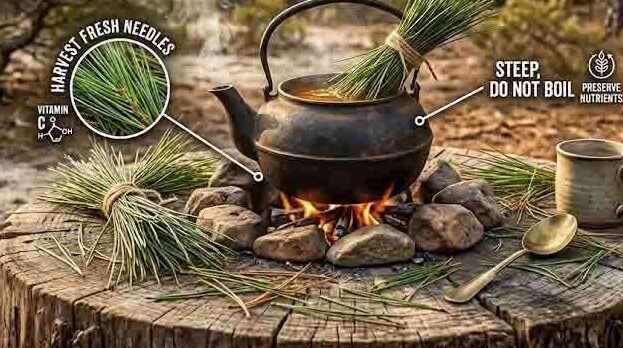
Gather a loose handful of fresh, green needles from the current or previous year’s growth — avoid yellow or brown needles. Remove the papery brown sheath at the base of each needle cluster. Roughly chop the needles into half-inch pieces to open the cell walls and release more ascorbic acid. Use about one-third cup of chopped needles per eight ounces of water.
Here is the most important technique: do not boil the needles. Vitamin C is heat-sensitive, and boiling both degrades ascorbic acid content and releases more terpene compounds, which intensify the resinous quality of the tea into something that can taste more like turpentine than forest. Bring water to just below boiling — around 175 to 185°F — pour it over the needles in a covered cup or vessel, and steep for ten to fifteen minutes. Cover the vessel during steeping to retain the volatile aromatic compounds. Strain and drink. Honey works well as a sweetener; lemon is a natural pairing, both for flavor and additional vitamin C.
Older needles, as the USDA research suggests, contain more ascorbic acid. But younger needles are milder in flavor. The balance depends on what you are brewing for — flavor or pharmacology.
Who should not drink it: Pregnant women are consistently advised to avoid pine needle tea, as certain compounds associated with pine species have been linked to uterine contractions. Individuals with pine pollen allergies may experience cross-reactions. Anyone on blood thinners or diuretic medications should consult a physician before adding a regular pine needle tea practice to their diet (Biology Insights, 2025).
The Chemistry of Recovery: Why It Worked for Cartier’s Crew
The remarkable thing about Cartier’s documented recovery is that his crew boiled the conifer decoction — a preparation that would have destroyed a significant portion of the vitamin C. And yet it worked. The Journal of Ethnobiology and Ethnomedicine analysis offers an explanation: the decoction likely retained substantial levels of arginine, proline, and other amino acids that support tissue repair and immune function, compounds that survive boiling far better than ascorbic acid. The combination of whatever vitamin C remained plus these nitrogenous cofactors, in a crew that had been consuming almost nothing for months, was apparently enough to initiate recovery (Durzan, 2009).
Scurvy, at its biochemical core, is the collapse of collagen synthesis. Collagen requires vitamin C to form the crosslinks that give it structural stability. Without it, connective tissue breaks down — hence the bleeding gums, the opening of old wounds, the swollen joints. The reversal begins quickly once ascorbic acid is reintroduced; the body responds rapidly to what it has been deprived of, and the amino acids in the pine decoction would have accelerated the rebuilding of damaged tissue.
Modern analysis confirms what Cartier’s crew experienced empirically. Pine needle tea made from Eastern white pine by proper steeping method can deliver a meaningful portion of daily vitamin C requirements in a single cup — a fact that remains relevant for anyone living through an extended winter without reliable access to fresh produce, or simply seeking a foraged, functional supplement with deep historical roots.
The Wellness Revival: Pine Needle Tea in the Modern World
After decades of obscurity outside herbalist and foraging circles, pine needle tea has returned to mainstream conversation. Partly this is driven by the broader “back to the land” and ancestral health movements. Partly it is the sustained interest in functional beverages beyond the conventional tea and coffee categories. And partly it is the documented nutritional profile — the vitamin C content, the antioxidant flavonoids, the natural expectorant properties — that integrates cleanly into the language of modern wellness.
Commercially prepared pine needle tea is available from several herbalist suppliers and natural food retailers. For those in the Long Island and New Jersey regions, the Pine Barrens themselves offer one of the most accessible wild-harvesting opportunities on the northeast coast, with pitch pines growing in dense, accessible stands through large portions of Suffolk County. The Long Island Central Pine Barrens, protected by legislation since 1993, remains a living forest rather than a developed landscape — one of the most significant conservation outcomes in New York State history, and a place where foragers with proper identification skills can access the same trees the Lenape used for centuries.
As with any foraged preparation, knowledge is the prerequisite. The botanical literature on pine needle tea is unambiguous: correct species identification is non-negotiable, preparation method affects both safety and nutritional content, and some populations should abstain entirely. But for the knowledgeable forager standing in a pitch pine stand on a cold Long Island morning, the logic is as simple as it was for the settlers who finally learned what the indigenous peoples already knew — that the forest provides, if you know what you are looking at.
The pine needles do not advertise themselves. They hang there through every season, through every frost and nor’easter and fire, holding their vitamin C quietly in place. The settlers who walked past them and died of scurvy in their first winters were not stupid — they were working from the wrong knowledge system. The Iroquois and the Lenape were not lucky — they were the product of generations of careful observation, careful memory, and careful practice. What they knew, they knew exactly.
Pine needle tea is not a curiosity. It is a documented, historically validated source of winter nutrition that sustained entire communities across this continent long before the orange became a staple. The Pine Barrens — those vast, scarred, fire-breathing, misunderstood forests at the center of Long Island and across New Jersey — hold that history in their needles still. Every bundle of five is an invitation to remember it.
Sources
- Durzan, D.J. (2009). “Arginine, scurvy and Cartier’s ‘tree of life.'” Journal of Ethnobiology and Ethnomedicine. https://pmc.ncbi.nlm.nih.gov/articles/PMC2647905/
- USDA Forest Service. Eastern white pine ascorbic acid content study. Referenced via https://www.wildedible.com/pine-needle-tea-natural-vitamin-c
- JSTOR Daily. (2021). “Plant of the Month: Tree of Life.” https://daily.jstor.org/plant-of-the-month-tree-of-life/
- WebMD. “What to Know About Pine Needle Tea.” https://www.webmd.com/diet/what-to-know-pine-needle-tea
- Masterclass. “Pine Needle Tea: How to Forage and Prepare.” https://www.masterclass.com/articles/pine-needle-tea
- Biology Insights. (2025). “Is Pine Needle Tea Safe to Drink?” https://biologyinsights.com/is-pine-needle-tea-safe-to-drink/
- Pinelands Alliance. “Pine Barrens Habitats.” https://pinelandsalliance.org/learn-about-the-pinelands/ecosystem/habitats/
- Wikipedia. “New Jersey Pine Barrens.” https://en.wikipedia.org/wiki/New_Jersey_Pine_Barrens
- Northwest School of Aromatic Medicine. “Pine Needle Tea Benefits.” https://aromaticmedicineschool.com/pine-needle-tea-benefits/