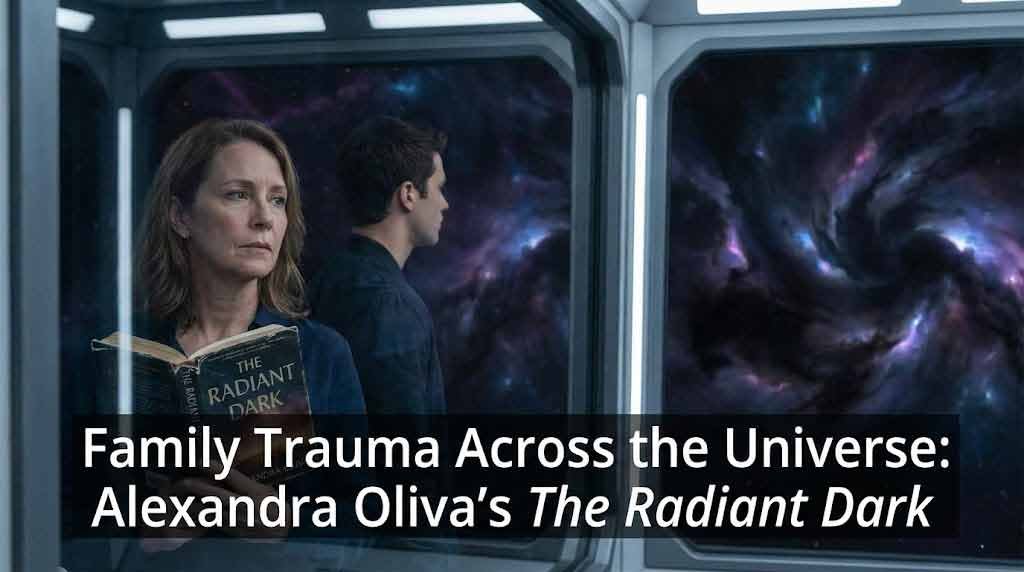
Eleven light-years is a distance so incomprehensible it exists only in the mathematics of cosmology — a number that makes our most ambitious engineering look like children dragging sticks through sand. Yet Alexandra Oliva uses that staggering measure not to write about the cosmos, but to write about a mother, her son, and her daughter. About the slow violence of a parent who abandons her children in plain sight. About a young woman who aims her entire life at the stars because something on the ground broke her heart. That is the genius at the center of The Radiant Dark, Oliva’s third novel and arguably her most ambitious work yet — a book that arrives April 28, 2026, from SJP Lit, and which positions her firmly among the essential American novelists of her generation.
The premise is deceptively simple: in March of 1980, in a small Adirondack town, Carol Girard witnesses an inexplicable flickering of light in the sky. Humanity eventually determines it to be a signal — communication from an intelligent civilization exactly eleven light-years away. And from that single cosmological event, Oliva builds a fifty-year family chronicle that spans from 1980 to 2034, asking with uncommon patience what it does to a family when the universe changes its terms of engagement while the dishes still need washing and the children still need feeding.
The Architecture of Fifty Years
Oliva has always been a structural risk-taker. Her debut, The Last One (Ballantine Books, 2016), which the Seattle Times named one of the best books of that year and which went on to be translated into twenty-five languages, interleaved pre- and post-apocalyptic timelines to devastating effect, forcing the reader to assemble the truth alongside its protagonist. Her second novel, Forget Me Not, continued that interest in perception and fractured reality. With The Radiant Dark, she scales that ambition significantly — asking her readers to track not dual timelines but five full decades of lived experience across three central characters.
The structural challenge is real: Oliva moves through time in large leaps, jumping years and sometimes decades between chapters. A lesser novelist would lose the reader in that white space. Oliva doesn’t. She understands that what matters is not continuity of event but continuity of wound — that a reader will follow a character across twenty years if they understand the specific quality of the pain that character carries from one chapter to the next. Early reader reactions on Goodreads confirm this intuition worked. Reviewers who received advance copies through NetGalley describe the book as one they could not put down, noting that while the first section establishes slowly, by the forty percent mark the novel becomes something close to compulsive.
Three Characters, One Inheritance
The Girard family is the beating heart of the novel. Carol, the mother, is introduced as a woman struggling with new motherhood in 1980 — which is to say she is introduced as a woman already fracturing. The arrival of the alien signal doesn’t create her spiritual crisis; it gives it a direction. She eventually finds her way into something resembling a cult, drawn toward the signal as a source of meaning that the ordinary requirements of family life have failed to provide her. Carol is a character readers will struggle with, and Oliva seems to know this. She is not written for sympathy but for understanding — there is a difference, and Oliva holds the distinction carefully throughout.
Michael, Carol’s son, is her counterweight in every sense. Where Carol turns her eyes skyward, Michael turns toward the ground. He is a man of earth, of tending, of presence — the child who stayed, in every meaning of that word. His arc is quieter and perhaps more devastating for it. Then there is Ro, Carol’s daughter, whose trajectory gives the book its cosmological spine. Ro grows up watching the sky because she has decided the sky is safer than her mother. She builds a career in interstellar communication, and the novel’s final sections, set in the 2020s and 2030s, follow her as her ambitions evolve into something far larger than she anticipated as a girl standing in the Adirondack dark.
Publishers Weekly described the novel as blending a quiet family drama with a spellbinding saga of extraterrestrial contact, and that balance is perhaps Oliva’s most impressive achievement — ensuring neither element overwhelms the other.
First Contact as Mirror
The most intellectually compelling choice Oliva makes is keeping the alien civilization almost entirely opaque. We never truly meet them. We receive signals, interpretations, the decades-long echo of something out there that knows we exist. This restraint is philosophically sophisticated. The novel is not about them — it is about what knowing they exist does to us. To Carol’s searching. To Michael’s rootedness. To Ro’s ambition. The contact event functions as a kind of cosmological inkblot test: each character projects onto it what they most need it to mean.
This approach places The Radiant Dark in conversation with some of the great first contact narratives in contemporary literature. Comparisons to Denis Villeneuve’s Arrival and Charlotte McConaghy’s Wild Dark Shore have followed the book through its pre-publication journey, and they are not without merit. But Oliva’s frame is more domestic, more interested in the kitchen table than the command center. Veronica Roth, the number-one New York Times bestselling author, called it equal parts compassionate and piercing — a profound family portrait set against the history-altering backdrop of First Contact. Lily Brooks-Dalton, author of The Light Pirate, described it as braiding together an alternate past and a distant future with sparkling clarity.
Emotional Inheritance as Science Fiction
What separates The Radiant Dark from genre science fiction is Oliva’s insistence that the most interesting science is the science of how damage travels between generations. Carol’s spiritual hunger becomes Michael’s steadiness and Ro’s ambition. The alien signal may or may not represent salvation; the family dynamics absolutely do represent inheritance. Meg Howrey, author of The Wanderers, described the book as a sensitive and gripping examination of emotional inheritance — and that phrase captures precisely what Oliva is doing. The contact event is the catalyst; the inheritance is the subject.
This is why the novel’s fifty-year sweep feels earned rather than sprawling. Oliva is documenting the arc of a wound. She needs the time. A wound that begins in 1980 does not resolve in a decade. It passes through bodies and into other bodies and evolves new shapes. By the time we reach Ro in the 2030s, standing at the edge of something truly extraordinary, we understand exactly the weight of what she is carrying — because we have watched it accumulate across a hundred pages and half a century.
Alexandra Oliva and the Shape of a Career
Oliva grew up in the Adirondack Mountains of upstate New York — the same mountains in which she sets the Girard family’s world — and earned her BA from Yale University and her MFA in Creative Writing from The New School in New York City. She is a first-generation college graduate, a detail that carries weight when reading a novel so interested in what gets passed down and what gets left behind. She now lives in the Pacific Northwest with her family.
Her trajectory as a novelist is worth noting. The Last One established her as a writer of structural ingenuity and psychological acuity. Forget Me Not deepened that reputation. The Radiant Dark synthesizes everything she has learned about time, perspective, and emotional consequence into a work that is demonstrably her largest in scope and — by early critical consensus — her richest in achievement. Sarah Jessica Parker, whose SJP Lit imprint is publishing the novel, called it incandescent. Adriana Trigiani, bestselling author of The View from Lake Como, described it as a sprawling epic foretold in the stars. Early reader reviews on Goodreads rate it near five stars, with multiple readers citing it as essential for anyone who has spent time wondering about humanity’s place in the universe.
A Novel for This Particular Moment
The Radiant Dark arrives at a time when questions about contact — literal and metaphorical — saturate the culture. The possibility of non-human intelligence, whether artificial or extraterrestrial, is no longer confined to science fiction as a genre; it is a live civic conversation. Oliva wrote a family novel, not a policy document or a technological thriller. But in doing so she arrived at something more durable than any of those forms: a meditation on what humans do when the terms of their isolation change. When the loneliness of the species gets interrupted.
The answer, according to the Girard family, is complicated. It is beautiful and frightening and mundane and transcendent, often in the same chapter. That combination — the cosmic and the ordinary sharing a paragraph — is precisely what great speculative fiction does when it is working at the level this novel is working.
The Radiant Dark by Alexandra Oliva publishes April 28, 2026, from SJP Lit. Pre-order at Amazon, Barnes & Noble, or Bookshop.org. More about the author at alexandraoliva.com.