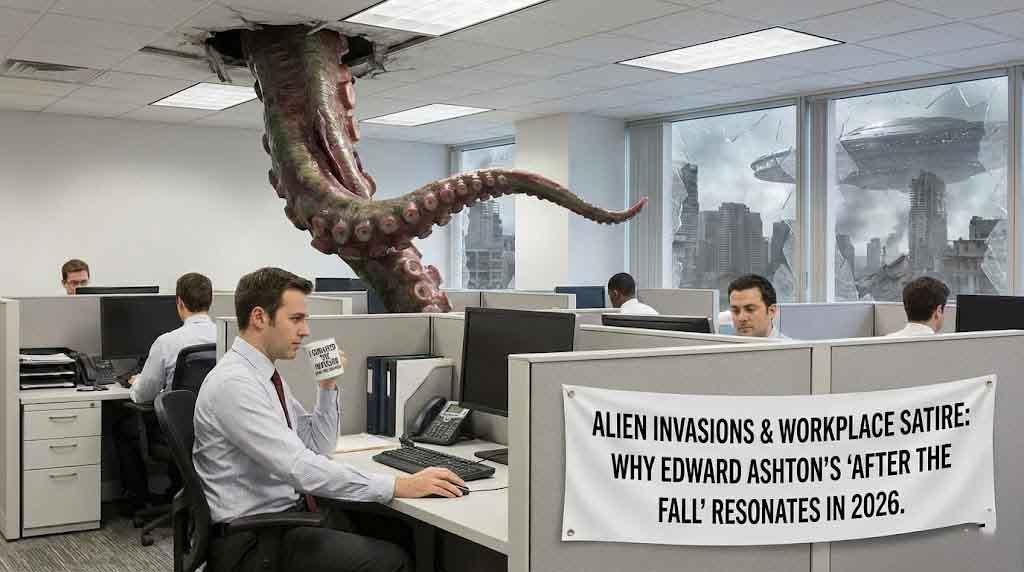
Published today — February 24, 2026 — Edward Ashton’s After the Fall lands at a moment when its central premise feels less like speculative fiction and more like a slightly exaggerated Monday morning. The novel asks a deceptively simple question: would humans really make great pets? One hundred and twenty years after civilization has collapsed — an event referred to plainly as “The Fall” — and a century after an alien species called the Grays swept in to collect what remained of humanity, a man named John has spent his entire life learning three rules. Humans must be silent. Humans must be obedient. Humans must be good.
Most days, John manages all three. Not because the rules are just, but because the alternative is death — or worse, reassignment to a Gray who hunts Bondsmen for sport. John’s owner, Martok, is “one of the good ones”: broke, manic, borderline incompetent, but genuinely fond of John in the way that a well-meaning employer might be fond of an employee they’re about to accidentally destroy with a harebrained business scheme. When Martok puts John’s bond up as collateral to secure an abandoned property he intends to convert into a wilderness retreat for wealthy Grays, the novel pivots from dark existential fable into something rarer and more difficult to pull off: a road trip buddy comedy with genuine philosophical weight at its core.
Ashton — a cancer researcher by day, novelist by night, and the upstate New Yorker whose Mickey7 was adapted by Bong Joon-ho into last year’s Mickey 17 — has spent his career writing fiction about what he calls “exploitative social structures.” The concept has clearly not exhausted itself.
The Architecture of After the Fall
The world Ashton builds is recognizable in its brutality and absurd in its specifics. Human civilization didn’t just collapse — it was ruined by its own hand first, and the Grays arrived afterward, framed not as conquerors but as saviors. The propaganda is seamless: humans should be grateful for their bondage. They were dying anyway. Their lives are better now, protected, housed, fed — provided they remain silent, obedient, and good.
Readers on NetGalley noted that the government propaganda within the novel works hard to make humans feel lucky and loved, to render them disposable pets who feel fortunate not to have been abused physically — even as their lives remain worth less than a business transaction. That dissonance, between the language of benevolence and the mechanics of exploitation, is where the novel draws its sharpest blood.
John is not a rebel. He’s not a revolutionary. He is a man who has made his peace with the shape of his world because the alternative — hope — seems more dangerous than resignation. His arc is not a heroic awakening so much as a slow, reluctant recognition that the rules he has internalized were never designed for his benefit. The novel’s emotional intelligence lies in how long Ashton lets John hold onto his accommodations before the weight of events makes them untenable.
Martok, his Gray owner, works as both foil and unlikely moral center. Part alien invasion story, part buddy comedy, and part workplace satire, After the Fall asks whether humans would really make great pets — and the answer, delivered through the relationship between John and the borderline manic, perpetually scheming Martok, is far more complicated than either yes or no.
Ashton’s Philosophical Architecture
Edward Ashton has described the seed of this novel the same way he described the seed of Mickey7: he wanted to explore what crappy immortality or crappy survival looks like when coupled with an exploitative social structure. The phrase deserves to sit for a moment. Crappy immortality. Most of us have been handed a version of it — the job that continues, the system that persists, the arrangement that keeps us alive in ways we’ve stopped examining too closely.
The novel belongs to a tradition in speculative fiction that uses alien domination as a lens for examining human hierarchies that already exist. H.G. Wells did it with The War of the Worlds. Rod Serling did it every other episode of The Twilight Zone. What Ashton adds to that tradition is tonal precision. The darkness and the comedy coexist without either canceling the other. Booklist called the world-building flawless and the characters delightful. James Rollins, in his blurb for the book, reached for Steinbeck — calling it as harrowing as it is hilarious, a balancing act few dare and fewer execute. The comparison holds. Ashton’s John shares something with Steinbeck’s George Milton: a man whose intelligence is exactly sufficient to understand how trapped he is, and whose decency is exactly the quality that makes the trap humane.
The novel’s satirical register hones in on something specific about workplace dynamics — not just exploitation in the abstract, but the architecture of the good employer. Martok is not a villain. He’s something more disquieting: a well-intentioned incompetent who genuinely cares about John in the way that does not translate into John’s actual liberation. He treats John like a person. He treats John, sometimes, like a friend. And yet when the business scheme requires John’s bond as collateral, it happens. Not out of cruelty. Out of need, out of the ordinary logic of economic necessity, out of the smooth operation of a system that both men exist within and neither fully designed.
Why 2026 Is the Right Moment for This Book
The timing of After the Fall‘s publication is not accidental in the way that all good timing is not accidental. Enterprise venture capitalists surveyed by TechCrunch at the end of 2025 predicted that 2026 would be “the year of agents” — software expanding from making humans more productive to automating work itself, delivering on what one investor called “the human-labor displacement value proposition.” The clinical neutrality of that phrase — human-labor displacement value proposition — is itself a kind of science fiction, a Gray administrator’s language applied to the working lives of actual people.
Goldman Sachs Research noted that unemployment among 20- to 30-year-olds in tech-exposed occupations rose by nearly 3 percentage points since the start of 2025 — notably higher than for counterparts in other trades — corroborating reports that generative AI is contributing to hiring headwinds for recent college graduates in technology. These are not abstractions. They are Johns — capable, adaptive, trained to follow the rules of a system whose logic is moving beneath their feet.
What Ashton’s novel captures, with more precision than most policy papers, is the psychological architecture of accommodation. John doesn’t rail against his bondage. He manages it. He finds the workable arrangement, the Gray owner who won’t kill him on a bad afternoon, the behavioral codes that keep him alive. This is not weakness. This is intelligence applied to constraint. It is the response of a man — or a worker, or a generation of workers — who has assessed the environment and concluded that visible resistance costs more than invisible adaptation.
The novel does not endorse this calculation. But it respects it enough to portray it without contempt.
The Buddy Comedy Structure as Philosophical Method
Where Ashton earns his highest marks is in refusing to let the satire consume the characters. The buddy road-trip structure that carries the second half of the novel — John, Martok, and a younger, considerably sassier Bondsman named Six navigating a series of escalating misadventures on the way to Martok’s doomed resort scheme — could easily tip into genre exercise. It doesn’t, because Ashton keeps the stakes genuinely mortal and the relationships genuinely earned.
One early reviewer noted that the novel raises the question of what we’d do if our animals were actually sentient — and argues that the more uncomfortable callback isn’t pets at all, but human slavery. That uncomfortable doubling — the story is delightful; the subtext is harrowing — is precisely the literary mode that the best speculative fiction deploys. It gets past your defenses with comedy and then asks its questions when you’re not looking.
The three-character dynamic works because Ashton gives each figure a distinct relationship to the system they inhabit. John has made his peace through discipline. Six has made hers through irreverence. Martok operates from within the dominant class with a blindness to his own complicity that is portrayed with empathy rather than condemnation. The novel’s moral seriousness emerges from the friction between these positions rather than from any character serving as its mouthpiece.
Ashton in Context: The Mickey7 Lineage
It would be reductive to read After the Fall only through the lens of its predecessor. Mickey7 was a teletransportation paradox wrapped in an adventure story, exploring what identity means when a body is reprinted after death. After the Fall is structurally different — looser, warmer, more comedic — but it operates from the same philosophical engine: what does it mean to be human when the system you exist within treats humanity as a resource rather than an end?
Ashton has said that what distinguishes his books is that at the end of the day, they’re about people — character-driven stories where the speculative premise serves the emotional and philosophical inquiry rather than overwhelming it. That commitment shows. The Grays feel alien because Ashton has built their language and culture with genuine care — not as props for human drama, but as a civilization with its own internal logic. The result is that John’s experience of bondage is never abstract. It is specific, sensory, and continuous.
The novel’s 288 pages move quickly. Ashton, who spent years publishing short fiction in venues ranging from Escape Pod and Analog to — as his biography cheerfully notes — the newsletter of an Italian sausage company, has a short-story writer’s economy. Nothing is wasted. The comedic beats land cleanly. The dark passages don’t announce themselves.
The Disposability Problem
There is a moment in the novel where John is nearly killed by a passing Gray who simply finds the encounter inconvenient. Not malicious — inconvenient. The Gray’s calculus is frictionless: John’s bond can be paid, another Bondsman can be found, the disruption is minor. This is not cruelty in the sense of intention. It is cruelty in the sense of structure. The system is designed so that the elimination of John requires no more moral weight than the cancellation of a subscription.
That image — a person whose death costs approximately nothing within the logic of the dominant system — is the image that stays. It is also the image that makes After the Fall something other than entertainment, as good as the entertainment is. It is a mirror, tilted at a specific angle, catching the light that contemporary economics produces.
The leather craftsman in me — the one who has spent fifteen years understanding that an object made to last requires a fundamental commitment to the person who will use it — recognizes the counter-argument that Ashton’s novel implies but never states: that disposability is a choice, not a law. The systems that treat people as replaceable resources were designed. They can be redesigned. The Grays didn’t invent exploitation. They inherited it.
The Verdict
After the Fall is Edward Ashton’s best work since Mickey7 — which is to say it is very good, seriously funny, and considerably more disturbing than its surface tone suggests. It belongs in the company of novels like Kazuo Ishiguro’s Never Let Me Go and Gary Shteyngart’s Super Sad True Love Story: literary speculative fiction that uses genre machinery to ask questions about human dignity that the mainstream novel approaches more obliquely.
The buddy comedy frame is not a concession to accessibility. It is the method. You follow John and Martok through their escalating disasters, you laugh at Six’s commentary, you feel the warmth of a found-family dynamic assembling itself in hostile conditions — and then you sit with what the warmth is built on top of, and the warmth doesn’t go away, but it gets complicated, the way most real warmth does.
Ashton publishes today. He deserves to be read immediately.