
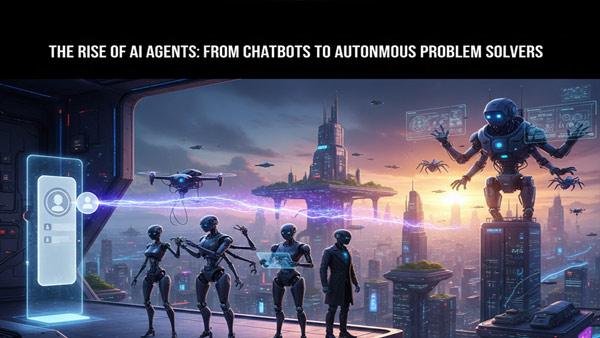
The year 2025 marked a fundamental shift in artificial intelligence. A new paradigm emerged: AI agents—systems capable of autonomous planning, reasoning, and action without constant human prompting.
IBM and Morning Consult surveyed 1,000 developers building AI applications for enterprise, and 99% said they are exploring or developing AI agents. Gartner predicts that 40% of enterprise applications will embed AI agents by the end of 2026, up from less than 5% in 2025.
What Defines an AI Agent?
An AI agent differs fundamentally from chatbots. While traditional AI assistants need a prompt for each task, AI agents can:
- Perceive their environment through sensors, data streams, or API connections
- Reason and plan multi-step approaches to complex problems
- Take autonomous action by executing code, calling APIs, or manipulating systems
- Learn and adapt based on outcomes and feedback
- Use tools strategically, deciding when and how to deploy resources
Real-World Deployments Across Industries
Healthcare and Biotechnology
Genentech built an agentic solution on AWS that automates research processes, enabling scientists to accelerate drug discovery. One biotech firm reported shortening drug development timelines from five years to three.
Financial Services
Rocket Mortgage developed an AI-powered system aggregating 10 petabytes of financial data for personalized mortgage recommendations. AI trading agents achieved annualized returns exceeding 200% with win rates of 65-75%.
Software Development
Coding agents like Cursor, GitHub Copilot, and Claude Code handle real development tasks. The Stanford 2025 AI Index documented that language model agents outperformed humans on programming tasks with limited time budgets.