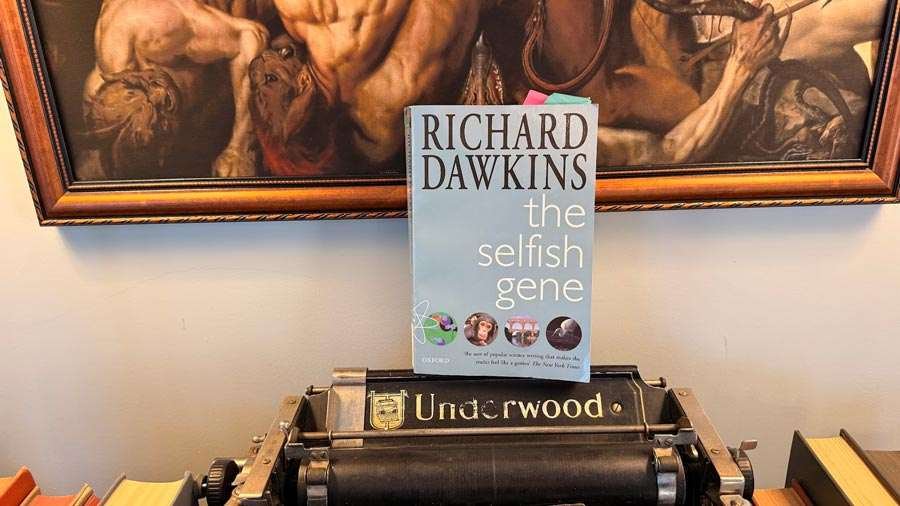
Few books have the nerve to reframe everything you thought you understood about life and then make the reframe feel obvious by the last chapter. Richard Dawkins’ The Selfish Gene — first published in 1976 and still as electrically alive as any book I’ve encountered — did exactly that to me when I found it in my undergraduate years. It didn’t just explain evolution. It handed me a lens I’ve never been able to take off.
I came to Dawkins late and sideways. My first real philosophical earthquake had already happened: Nietzsche’s Thus Spoke Zarathustra had upended the architecture of how I thought about human will, meaning, and the illusion of permanence. But Nietzsche, for all his volcanic brilliance, was still a man writing from within the human frame — morality, power, the Übermensch as a cultural and spiritual project. Dawkins dragged me further back. All the way back to the gene itself. And what I found there rewired something deeper than philosophy. It rewired my understanding of what life actually is.
What the Book Is Actually About
Most people who haven’t read The Selfish Gene assume it’s a book about selfishness in people — a kind of evolutionary justification for greed or competition. That misreading has dogged the book for fifty years. What Dawkins actually argues is at once more elegant and more unsettling: it is the gene, not the organism, that is the fundamental unit of natural selection. We — every living body on earth — are, in his words, “survival machines” built by genes to perpetuate themselves across generations.
The organism is the vehicle. The gene is the replicator. And replicators, by definition, are the things that stick around.
This is not metaphor. Dawkins is making a precise scientific argument, drawing from the work of William D. Hamilton, John Maynard Smith, Robert Trivers, and G.C. Williams. What he adds is the explanatory clarity that transforms technical population genetics into a framework any serious reader can hold and use. By page thirty, you stop reading about genes and start seeing through them.

The Replicator: Why This Concept Changes Everything
The section of The Selfish Gene that hit me hardest — and still does — is Dawkins’ introduction of the replicator concept. Long before DNA existed, in the primordial chemical soup of early Earth, certain molecules accidentally acquired the ability to copy themselves. Once that happened, the logic of natural selection became inevitable. Replicators that copied themselves accurately, quickly, and with longevity simply outcompeted those that didn’t. Everything that followed — every cell, every organism, every nervous system, every act of parental love or tribal war — is downstream of that moment.
What this means is that “purpose” in biology, if we can use the word at all, is not oriented toward the organism’s survival or happiness. It’s oriented toward the gene’s propagation. The organism exists to carry the gene forward. That’s it. That’s the whole game. When a parent sacrifices for a child, when a soldier throws himself on a grenade to save his unit, when a bee dies defending the hive — the genetic accounting makes sense even when the organism-level logic seems irrational. Kin selection, altruism, reciprocity — Dawkins explains all of it with a clarity that makes the world feel freshly assembled.
Darwin Made Legible
I was, before this book, aware of Darwin in the way most educated people are: vaguely, secondhand, half-digested. I knew the basics. Natural selection. Survival of the fittest — a phrase Darwin didn’t actually use, and which Dawkins would likely want to qualify heavily. But I had never truly felt the mechanism. Evolution was a story I’d been told, not a logic I understood from the inside.
The Selfish Gene gave me Darwin in a way no biology class ever had. Dawkins writes as a teacher in the best sense — not simplifying, but translating. He takes the mathematical precision of population genetics and renders it in language that is both exact and vivid. By the time you reach his chapters on game theory and the evolutionarily stable strategy — the iterated arms races between predator and prey, parasite and host, male and female — you start to see those dynamics operating everywhere. On the street. In relationships. In business. In the diner.

The Meme: A Word That Would Change My Life
Here is where the book becomes something else entirely for me — where it stopped being a great science book and became a key that opened a door I would spend years walking through.
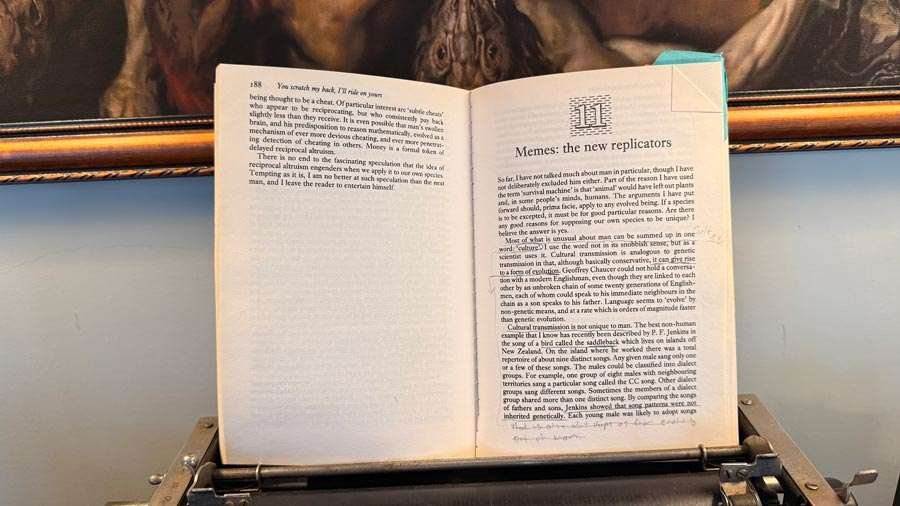
In the final chapter of The Selfish Gene, almost as an afterthought, Dawkins introduces a thought experiment. If genes are replicators operating in the biological domain, are there analogous replicators in the cultural domain? Ideas, songs, catchphrases, rituals, technologies — things that spread from mind to mind, competing for cognitive real estate, mutating and adapting and dying out just as genes do in the population? He called this unit of cultural transmission the meme. He coined the term in this book. Fifty years later, the word is everywhere — usually stripped of its original precision, reduced to internet jokes — but the original concept is among the most generative ideas in modern intellectual history.
I didn’t know it when I first read it, but that chapter handed me the project I would spend most of my graduate years working through. At The New School, I was researching how memes — in Dawkins’ rigorous sense — operate across media and technology. How ideas replicate, mutate, and achieve dominance in information ecosystems. How platforms function as selective environments. How a concept spreads not because it is true but because it is fit for the medium it inhabits. Dawkins didn’t know he was writing a theory of the internet. But he was.
Reading his The God Delusion years later, I saw how deeply memetics ran through all of Dawkins’ work — his understanding of religion as a particularly resilient meme complex is one of the most analytically useful frameworks in that book, whether you agree with his conclusions or not.
What the Critics Got Wrong
The Selfish Gene has never been without controversy. Philosophers like Mary Midgley attacked it sharply after publication, arguing that Dawkins was committing a category error — attributing intentionality and selfishness to molecules that have no minds. Dawkins responded, reasonably, that “selfish” was always shorthand for a behavioral tendency, not a psychological state. The gene does not want anything. It simply acts as if it does, because the ones that don’t act that way are no longer here.
The deeper criticism — that gene-centric thinking diminishes the complexity of organisms, development, and ecological context — has more contemporary force. Scientists like Eva Jablonka and the proponents of the Extended Evolutionary Synthesis argue that evolution operates at multiple levels simultaneously, that epigenetic inheritance and niche construction are not fully captured by the gene-centered view. The picture is more tangled than Dawkins’ framework suggests. His own discussion of horizontal gene transfer and lateral genetic exchange opens cracks in the elegant tree-of-life model.
None of this diminishes The Selfish Gene as a work of scientific explanation and intellectual vision. It means it is a starting point — perhaps the most clarifying starting point in popular evolutionary literature — not the final word.
Why This Book Still Matters
What separates the books that change you from the books that merely inform you is the degree to which they alter the questions you ask. Before The Selfish Gene, I asked: what happened in evolution? After it, I asked: what is the mechanism, and where else does that mechanism operate? That shift — from event-level thinking to process-level thinking — is the real gift of the book.
I think about it in ways that have nothing to do with biology. The question of what replicates, what persists, what gets copied forward through time — that’s a question that applies to culture, to craft, to institutions, to neighborhoods. The Heritage Diner has survived twenty-five years on the North Shore not because it won a single moment but because it refined something replicable: a standard of quality and community that regenerates itself through every plate that leaves the kitchen, every regular who returns. That’s not biology. But it’s the same logic. The replicator, at any level, is the thing that lasts.
The Selfish Gene is a book you read once and carry forever. Pick up the 40th or 50th anniversary edition — Dawkins added substantial endnotes that update the science and engage the critics — and begin with Chapter One. By Chapter Two, you’ll understand why I’ve never looked at living things the same way since.
Sources
- Dawkins, Richard. The Selfish Gene. Oxford University Press, 1976 (40th Anniversary Edition, 2016). Oxford University Press
- Hamilton, W.D. “The Genetical Evolution of Social Behaviour.” Journal of Theoretical Biology, 1964. ScienceDirect
- Maynard Smith, John. Evolution and the Theory of Games. Cambridge University Press, 1982.
- Jablonka, Eva & Lamb, Marion J. Evolution in Four Dimensions. MIT Press, 2005. MIT Press
- Blackmore, Susan. The Meme Machine. Oxford University Press, 1999. Oxford University Press
- Midgley, Mary. “Gene-Juggling.” Philosophy, Vol. 54, No. 210, 1979. Cambridge University Press