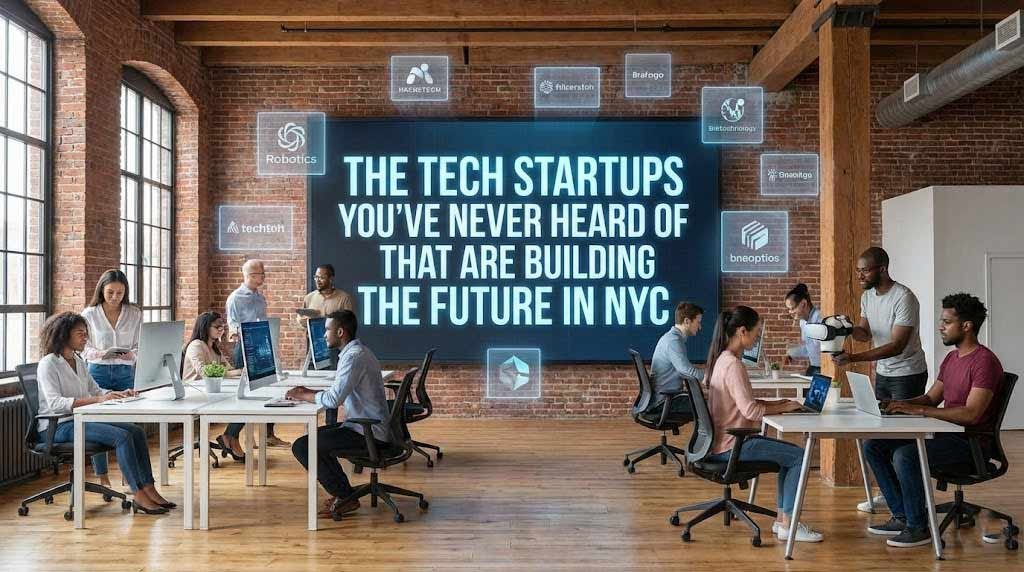
Everyone knows about Google’s massive NYC headquarters. Most people have heard of Spotify, Uber, and the other tech giants with offices in New York. But ask about Orderific, Rhizome AI, or Mantis, and you’ll get blank stares.
These aren’t household names. They’re not unicorns yet (though some will be). You won’t see their logos on Times Square billboards. But these companies and dozens like them are quietly building technologies that will reshape industries — from how restaurants operate to how drugs get FDA approval to how buildings monitor structural integrity.
Welcome to New York’s hidden tech scene: the startups solving unglamorous but essential problems, the companies building infrastructure rather than consumer apps, the founders grinding away in Brooklyn warehouses and Midtown co-working spaces while Silicon Valley chases the next social media trend.
These are the companies that actually matter in 2026.
Why Nobody Talks About Them
There’s a reason these startups stay under the radar.
First, many build B2B (business-to-business) software. They don’t have millions of users to generate viral buzz. Their customers are other companies — restaurants, hospitals, manufacturers, logistics firms — not consumers who tweet about apps.
Second, they work in industries that sound boring: supply chain management, regulatory compliance, waste analytics, healthcare data interoperability. These aren’t sexy topics. But they represent trillions of dollars in economic activity and desperately need technological innovation.
Third, they’re genuinely early-stage. Many of these companies have raised seed or Series A funding ($1-10 million) and employ 10-50 people. They’re building, iterating, and finding product-market fit. Media coverage comes later — if they survive to scale.
But survival odds are decent. Y Combinator reports that 496 NYC-based startups have gone through their program. Built In tracks over 3,000 tech companies in NYC. Seedtable identifies 69 particularly promising startups as of January 2026. The ecosystem is massive.
Let’s meet some of the most interesting ones you’ve definitely never heard of.
Orderific: Making Restaurants Finally Work
What They Do: Orderific provides AI-powered point-of-sale systems specifically designed for restaurants. Their platform offers smart menus that customers access via QR codes, AI-driven upsell recommendations based on order history, real-time inventory tracking, and multilingual support.
Why It Matters: The restaurant industry is notoriously low-margin and inefficient. Manual ordering systems cause errors, waste time, and miss upselling opportunities. Orderific automates the entire front-of-house process while increasing average order values through intelligent recommendations.
In pilots, restaurants using Orderific saw 15-20% increases in revenue from AI upsells alone. Order accuracy improved by 40%. Wait times decreased. Most importantly, it required zero additional staff.
The Insight: Restaurants have been technology laggards. While retail embraced e-commerce and logistics automated warehouses, restaurants still operated like it’s 1995. Orderific recognized this gap and built specifically for the restaurant use case rather than trying to retrofit generic POS systems.
They’re not solving a sexy problem. But there are 660,000 restaurants in the United States. Even capturing 1% of that market generates $6+ billion in revenue. As of 2026, Orderific is rapidly expanding across NYC and has begun national rollout.
Rhizome AI: Navigating FDA Bureaucracy
What They Do: Rhizome AI helps pharmaceutical and biotech companies understand FDA requirements by analyzing regulatory documents. Their system pulls data from terabytes of FDA databases, answers specific regulatory questions, and provides citations to source documents.
Why It Matters: Getting a drug approved by the FDA is extraordinarily complex and expensive. Companies spend years and hundreds of millions of dollars navigating regulatory requirements. One mistake or misunderstanding can delay approval by years.
Rhizome AI doesn’t replace regulatory experts, but it makes them dramatically more efficient. Instead of manually searching through thousands of pages of FDA guidance documents, regulatory specialists query Rhizome’s AI, which has already indexed and analyzed everything.
The Story Behind It: Founder Chetan Parvatikar previously worked at EvolutionaryScale (a biotech AI company) and saw countless drug discovery startups struggle not with the science but with the regulatory process. He realized AI could solve this specific bottleneck.
Rhizome’s first customer was a mid-sized biotech firm trying to understand FDA thinking on a specific drug class. The traditional approach would have required weeks of research and consultants costing $50,000+. Rhizome provided comprehensive analysis in 48 hours for a fraction of the cost.
The market is enormous: pharmaceutical companies spend over $100 billion annually on regulatory affairs. Even a small efficiency improvement saves billions industry-wide.
Mantis: Digital Twins for Human Bodies
What They Do: Mantis builds “digital twins” of human anatomy and physiology. They unify data from motion capture sensors, biometric devices, medical imaging, and training logs to create comprehensive digital models of individual humans.
Why It Matters: Healthcare, sports science, and biotech research all need better ways to model human bodies. How will this patient respond to a specific treatment? How can this athlete optimize their training? How do we test medical devices without expensive clinical trials?
Mantis enables all of this. Their platform simulates human anatomy in software, validated against real-world outcomes. Researchers can run thousands of virtual experiments before conducting a single physical test.
The Applications: Medical device companies use Mantis to simulate how implants will interact with specific patient anatomies before surgery. Sports teams use it to predict injury risk and optimize training protocols. Pharmaceutical companies use it to model drug effects on diverse populations.
The company emerged from MIT research and moved to NYC to be closer to both medical institutions (Mount Sinai, NYU Langone) and the biotech industry. They raised a seed round in 2025 and are expanding rapidly.
Palace: Making Trucking Efficient
What They Do: Palace automates back-office work for trucking fleets. Their AI handles load assignment, appointment management, route optimization, customer communication, and exception resolution — all the manual work that consumes dispatch teams.
Why It Matters: The trucking industry moves $800 billion worth of goods annually in the US alone. But trucking companies operate with razor-thin margins (2-6%). Every efficiency gain directly impacts profitability.
Palace customers increase revenue per driver by 10-20% while reducing administrative headcount. Drivers spend more time driving (and earning) rather than waiting for dispatch instructions. Customers get better service.
The Team: Founders Leeds and Derek previously worked on Amazon’s robotic logistics systems. They saw how Amazon automated warehouse operations and asked: why can’t trucking back-office work be automated the same way?
They built Palace to answer that question. The system uses AI to make the thousands of micro-decisions that dispatch coordinators make daily: which driver should take which load, how to handle appointment delays, when to reroute for traffic.
Early customers report that Palace feels like hiring five additional dispatch coordinators for the price of one software subscription.
Keye: Due Diligence at Machine Speed
What They Do: Keye provides AI-powered due diligence software for private equity firms. Their system analyzes potential acquisitions 10x faster than traditional methods, with higher accuracy.
Why It Matters: Private equity is a $5 trillion industry. When PE firms evaluate acquisition targets, they conduct extensive due diligence — analyzing financials, operations, legal issues, and market position. This process takes weeks or months and involves armies of analysts.
Keye automates much of this work. Upload target company documents, and Keye’s AI extracts key information, identifies red flags, and produces comprehensive reports. What took a team of analysts three weeks takes Keye three days.
The Competitive Angle: Better due diligence leads to better investment decisions. PE firms that can evaluate deals faster can make more offers and win competitive processes. Keye customers report closing deals that would have otherwise gone to competitors because they could move faster.
The founders came from Goldman Sachs and understood the due diligence process intimately. They built Keye to solve their own pain points, then realized every PE firm faced the same problems.
YipitData: Alternative Data for Investors
What They Do: YipitData analyzes billions of data points daily to provide insights on e-commerce, ridesharing, payments, and other “disruptive economy” sectors. Their clients are investment funds and corporations trying to understand market dynamics.
Why It Matters: Traditional market research is too slow for modern investing. By the time Gartner or Forrester publishes a report, the opportunity has passed. Investors need real-time data on which e-commerce platforms are gaining share, how ridership is trending for Uber vs. Lyft, or whether digital payment volumes are accelerating.
YipitData provides this information. They license data from various sources, clean it, analyze it, and deliver actionable insights. A hedge fund might use YipitData to time an investment in a logistics company. A retailer might use it to understand competitive dynamics.
The Scale: YipitData raised $475 million from The Carlyle Group at a $1+ billion valuation. They’re one of NYC’s rare unicorns — and most people outside finance have never heard of them. That’s by design; their customers value the competitive advantage YipitData provides.
Chasi: 24/7 VIP Treatment for Equipment Dealers
What They Do: Chasi provides AI-powered customer service for equipment dealers (construction equipment, agricultural machinery, etc.). Their system handles customer inquiries 24/7 across all channels, resolving issues and routing complex questions to human staff.
Why It Matters: Equipment dealers operate in a highly competitive, relationship-driven business. A tractor breakdown at 9 PM can cost a farmer thousands in lost productivity. But dealers can’t afford 24/7 call centers.
Chasi bridges the gap. Their AI handles routine questions (“What’s my maintenance schedule?”), helps with troubleshooting (“The engine warning light is on”), and escalates appropriately (“I need emergency service”).
The Market Insight: Equipment dealers represent a massive, underserved market. There are hundreds of thousands of dealers globally selling billions in equipment annually. They desperately need better customer service tools, but nobody’s building for them — everyone focuses on flashier B2C applications.
Chasi recognized this gap. They’re building software specifically for an overlooked industry, capturing market share by being the only company that actually understands dealer workflows.
Misprint: Pricing Collectibles with Math
What They Do: Misprint builds AI-powered pricing infrastructure for collectibles markets — Pokémon cards, sports cards, comics, and similar items. Their platform provides fair, transparent pricing based on sophisticated financial analysis.
Why It Matters: Collectibles represent a multi-billion dollar market, but pricing is opaque and inefficient. How much is a rare Pokémon card actually worth? Depends who you ask. Misprint applies quantitative finance techniques (similar to those used on Wall Street) to create defensible valuations.
The Origin: Founder Eva ran a successful Pokémon card business that generated $500K in annual revenue. She experienced the pricing problem firsthand — sellers didn’t trust existing pricing tools, and buyers couldn’t verify fair value. With a background in finance, Eva realized collectibles pricing could be solved with proper quantitative modeling.
Misprint is small but growing fast. As collectibles markets mature and institutional investors enter, demand for sophisticated pricing tools will skyrocket. Misprint is positioning itself as the Bloomberg Terminal for collectibles.
Common Patterns: What Makes These Startups Work
Looking across these companies, several patterns emerge:
They Solve Real, Expensive Problems: None of these startups are building social networks or gaming apps. They’re attacking genuine inefficiencies in large industries. Orderific saves restaurants money. Rhizome AI speeds drug approval. Palace makes trucking more profitable. These are problems worth billions.
They Leverage AI Appropriately: Every company uses AI, but not as a gimmick. They apply AI to specific, well-defined problems where automation genuinely helps: regulatory research, logistics optimization, due diligence, customer service. This is AI as a tool, not AI for its own sake.
They’re Built by Domain Experts: Nearly every founder comes from the industry they’re disrupting. The Rhizome founder worked in biotech. Palace founders built Amazon’s logistics algorithms. Misprint’s founder ran a collectibles business. They intimately understand customer pain points.
They’re B2B, Not B2C: Consumer startups get the headlines, but B2B startups often have better economics. Selling software to businesses means higher prices, longer contracts, and more predictable revenue. It’s less sexy, but it works.
They Chose NYC Deliberately: These companies are in New York because New York offers specific advantages: access to industries (finance, healthcare, logistics, restaurants), diverse talent, and investor proximity. They didn’t choose NYC by accident.
The Broader Ecosystem: Startups Across Every Sector
The companies profiled above represent a tiny fraction of NYC’s startup scene. Let’s sample a few more across different sectors:
FinTech:
- Capchase: Provides non-dilutive financing to SaaS companies through recurring revenue financing
- Mesh Payments: Cardless corporate payment solutions for SaaS companies
- Landa: Allows real estate investing with as little as $5
HealthTech:
- Clarion: AI communication layers for healthcare clinics (handling calls/messages)
- Codes: Automates medical record retrieval using AI
- Nitra: Healthcare industry financing
AI Infrastructure:
- Agentio: AI agent development platform ($56M raised, $340M valuation)
- OffDeal: AI-native investment banking for small business sales
Data and Analytics:
- Domino Data Lab: Enterprise MLOps platform for data science
- Augury: Machine health monitoring using wireless sensors
Developer Tools:
- Diode: Automates circuit board design for hardware companies
- Payload CMS: Modern, open-source content management system
The diversity is striking. NYC startups span literally every sector. This reflects the city’s economic diversity — startups emerge to solve problems in whatever industries are present locally.
Why These Companies Will Matter More Than FAANG
Here’s a controversial take: the companies above will collectively have more impact on the economy than Google, Facebook, or Amazon.
Not because they’re bigger or more valuable. But because they’re solving fundamental problems in massive, underserved industries. When Orderific helps restaurants operate more efficiently, that affects 660,000 businesses and millions of workers. When Palace optimizes trucking logistics, that touches $800 billion in commerce. When Rhizome speeds drug approval, that means life-saving medications reach patients faster.
FAANG companies are incredible, but they’ve mostly captured their markets. Google dominates search. Facebook dominates social. Amazon dominates e-commerce. The easy growth is gone.
The startups above are attacking inefficient, technology-lagging industries ripe for disruption. They’re in the early stages of massive growth curves. And collectively, they represent the future of the economy more than Big Tech’s 20-year-old business models.
The Long Island Connection: Why This Matters Locally
For Long Island residents, these startups represent opportunity in multiple ways:
Employment: These companies are hiring — engineers, product managers, salespeople, operations staff. Many offer remote or hybrid work, making them accessible to Long Island residents.
Entrepreneurial Inspiration: If you have industry experience (logistics, healthcare, hospitality), you’re qualified to start a company attacking those sectors. You don’t need to be a Stanford CS grad building consumer apps. Domain expertise is valuable.
Investment Opportunity: Some platforms like Republic and AngelList allow non-accredited investors to fund startups. Investing small amounts in multiple NYC startups diversifies risk while participating in potential upside.
Ecosystem Spillover: As NYC’s startup scene grows, some companies will open satellite offices on Long Island for cost savings. This trend is already beginning in Brooklyn and Queens — Long Island could be next.
What Separates Winners from Failures
Let’s be realistic: most startups fail. Even among the companies above, many won’t exist in five years.
What determines success?
Product-Market Fit: Does the product actually solve the problem customers pay for? Many startups build things nobody wants. The successful ones obsessively validate customer demand before scaling.
Timing: Is the market ready? Rhizome AI works because AI technology finally matured enough to handle regulatory complexity. Ten years ago, the technology wasn’t ready. Five years from now, the market might be saturated. Timing matters.
Execution: Can the team build, sell, and scale effectively? Great ideas fail constantly due to poor execution. The successful companies have founders who can sell, recruit talent, manage finances, and make thousands of good decisions under pressure.
Capital: Do they have enough runway to reach profitability or the next funding round? Many startups die not because the business failed but because they ran out of money before achieving milestones.
Market Size: Is the addressable market big enough to justify venture returns? A $10M market won’t interest VCs. A $10B market will. The companies above target massive markets with clear paths to $100M+ revenue.
The Future: What Happens Next
The companies profiled here are at inflection points. Some will scale dramatically and become household names. Others will quietly build profitable businesses without headlines. A few will fail and fade away.
But collectively, they represent the next chapter of NYC’s tech evolution. The first wave was consumer internet (social media, e-commerce). The second wave is B2B SaaS and infrastructure. The third wave will be AI-powered verticalized solutions — exactly what these startups are building.
In 2030, look back at this list. Some of these companies will be worth billions. Orderific might be the Square of restaurants. Rhizome could be essential infrastructure for pharma. Palace might run logistics for half the trucking industry.
Or completely different companies will win, solving problems we haven’t imagined yet. That’s how early-stage investing works — lots of bets, a few big winners, constant evolution.
But the principle holds: the future is being built by companies you’ve never heard of, solving problems that sound boring, in the world’s second-largest tech hub.
Pay attention.
How to Learn More and Get Involved
If these companies sound interesting, here’s how to follow NYC’s startup ecosystem:
Startup Directories:
- Built In NYC (builtin.com/nyc)
- Y Combinator Company List (ycombinator.com/companies)
- Wellfound (formerly AngelList)
Events and Meetups:
- NY Tech Meetup (largest tech meetup in the US)
- TechDay NYC
- Various accelerator demo days (Techstars, ERA, etc.)
News Sources:
- TechCrunch (covers major NYC startups)
- Built In NYC blog
- AlleyWatch (NYC startup news)
Job Boards:
- Wellfound Jobs
- Built In NYC Jobs
- Startup job boards on LinkedIn
The NYC startup ecosystem is vibrant, growing, and accessible. You don’t need to work at Google to participate in cutting-edge tech. You just need to know where to look.
Related Articles
- How to Get a Job at a NYC Tech Startup
- Understanding Startup Funding: From Seed to Series C
- Should You Join a Startup or Big Tech in 2026?
- NYC Tech Salaries: What Startups Actually Pay
Sources
- Y Combinator – NYC Startup Directory 2026
- Built In NYC – Top Startups to Watch
- Wellfound (AngelList) – NYC Startup Jobs and Companies
- StartUs Insights – Top 10 Tech Companies in New York
- Seedtable – Best Startups in New York
- TRUiC – New York Startups: 22 Top NYC Startups 2026
Watch: Inside New York’s Startup Ecosystem https://www.youtube.com/watch?v=l3NOYlX9HH0