
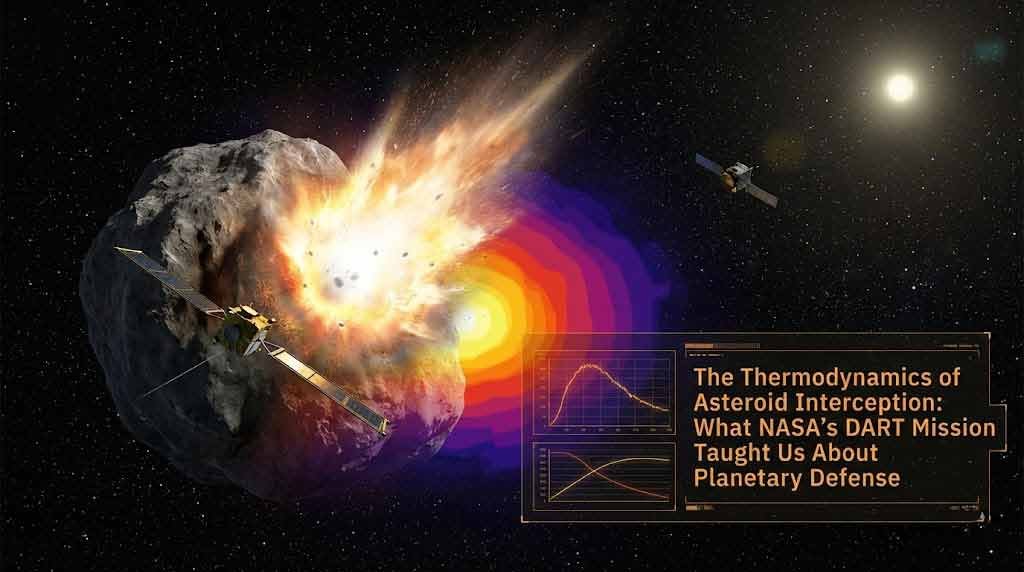
Somewhere in the cold black between us and Mars, on the evening of September 26, 2022, a 1,340-pound spacecraft traveling at roughly 15,000 miles per hour ceased to exist — and in doing so, changed history. Not with a nuclear warhead. Not with science-fiction-grade laser technology. With nothing more than mass, velocity, and the oldest law in physics: momentum is transferable.
NASA’s Double Asteroid Redirection Test — DART — was the agency’s first full-scale demonstration that humanity could, in fact, nudge a celestial body off course. The target was Dimorphos, a 525-foot-wide moonlet orbiting the larger asteroid Didymos some 6.8 million miles from Earth. Neither posed any threat to our planet. That was precisely the point. You don’t test fire extinguishers when your kitchen is already burning.
What DART taught us goes far beyond the headline accomplishment. It forced the scientific community to confront something humbling and profound: the universe doesn’t always obey the equations we write about it. It obeys its own logic, and sometimes, if we’re paying close enough attention, that logic reveals something far more elegant than we planned for.
Kinetic Impactors and the Physics of Deflection
The principle behind DART is elegant in its simplicity. A kinetic impactor is exactly what it sounds like — you hit the thing. No explosives, no elaborate orbital mechanics, just a direct transfer of kinetic energy from the spacecraft to the asteroid. The resulting change in velocity, even a fraction of a millimeter per second applied years in advance, translates across the vast geometry of deep space into a dramatically different trajectory.
DART’s pre-mission success threshold was defined as an orbital period change of at least 73 seconds. The spacecraft exceeded that benchmark by more than 25 times. Dimorphos’s orbit around Didymos was shortened by 33 minutes and 15 seconds, from 11 hours and 55 minutes down to 11 hours and 22 minutes. The mission didn’t just work — it overperformed to a degree that forced scientists to rethink their models.
The reason for that overperformance leads to perhaps the most fascinating discovery the mission produced.
The Ejecta Effect: When the Debris Does More Work Than the Bullet
Here is where thermodynamics enters the picture in ways that reframe the entire mission. When DART struck Dimorphos, the impact didn’t just transfer the spacecraft’s momentum to the asteroid. It excavated an enormous cloud of material — over 16 million kilograms of dust, gravel, and rock — and launched it into space. That eruption of debris, behaving like the exhaust of a rocket engine firing in reverse, delivered a secondary thrust to Dimorphos that dwarfed the force of the spacecraft itself.
Scientists measured what they call the momentum enhancement factor, denoted as beta. A beta of 1.0 would mean the asteroid received exactly the momentum carried by DART and nothing more. The measured beta for this impact ranged between 2.2 and 4.9, depending on estimates of Dimorphos’s mass. In practical terms, the ejecta amplified the deflection by anywhere from two to nearly five times the force of the original impact.
Think of it this way: if you press your thumb firmly against a piece of clay, the clay moves in proportion to the force you applied. But if the clay is loose and particulate and it erupts outward from the contact point like a small explosion, the material flying away from you pushes the remaining mass in the opposite direction with considerably more force than your thumb alone provided. That is, in its essence, what happened at Dimorphos. The asteroid’s own loosely-bound rubble pile structure became a force multiplier.
What “Rubble Pile” Architecture Means for Planetary Defense
Dimorphos is classified as a rubble pile asteroid — not a solid monolithic rock, but a loose, porous aggregate of boulders and granular material held together weakly by gravity. The DART spacecraft captured images of the surface just two seconds before impact, revealing an irregular landscape strewn with boulders of varying sizes. No craters. No sign of internal cohesion beyond gravity’s patient insistence.
This classification has enormous implications for how we think about deflecting dangerous asteroids in the future. A solid iron-nickel asteroid would absorb an impact very differently than a loosely-bound pile of rubble. The same force applied to both bodies would yield radically different results. DART gave scientists their first real-world data point on rubble pile dynamics at scale.
The mission also revealed that the shape of Dimorphos itself changed. Post-impact analysis suggests the asteroid may have been deformed from an oblate spheroid into a more elongated ellipsoidal form, and it may have entered a tumbling rotational state. The ESA’s Hera mission, launched in October 2024 and due to arrive at the Didymos system in late 2026, will conduct detailed surveys of the crater and measure Dimorphos’s mass with precision — giving us the full picture of what DART actually accomplished at the molecular level.
The Heat We Don’t Talk About: Thermal Forces in Deep Space
When most people consider asteroid deflection, they think of collisions and explosions. Few consider the slower, subtler forces at play in the asteroid environment — particularly thermal forces. The Yarkovsky effect is the phenomenon by which sunlight absorbed by an asteroid is re-emitted as heat in a slightly different direction due to the body’s rotation, creating a minuscule but persistent thrust over millennia. For small asteroids tracked over long periods, the Yarkovsky effect is not negligible. It is, in fact, one of the primary reasons orbital prediction models carry uncertainty over century-scale projections.
DART’s data, combined with Hera’s upcoming measurements, will help scientists calibrate how the thermal re-radiation profile of a post-impact Dimorphos differs from its pre-impact state. A change in shape, rotation rate, or surface composition all affect the body’s thermal emission pattern. The mission is thus not just a demonstration of kinetic deflection — it is a master class in the interconnected physics of heat, momentum, gravity, and time.
Planetary Defense as Long-Term Thinking
There is a certain philosophy embedded in the design of a mission like DART. It is, fundamentally, an act of preparation for an event that has not yet happened and may not happen in any of our lifetimes. As of early 2023, only about 42 percent of near-Earth asteroids larger than 140 meters have been identified. That means the majority of the objects capable of regional devastation remain uncharted. DART was built not for the asteroid we know about, but for the ones we haven’t found yet.
There is a discipline in that. A willingness to invest resources, intellect, and engineering prowess into a problem that offers no immediate return. It is the same discipline that governs any truly long-range endeavor — the understanding that the choices made today, quietly and without immediate validation, are what determine outcomes decades from now.
Knowing how asteroid deflection really works — not in simulation but in the actual physics of deep space — means that if and when a threatening object is identified, humanity will not be starting from zero. We will have data, models, and a proof of concept. We will have DART.
What Comes Next: Hera, ESA, and the Second Chapter
The story of Dimorphos is not over. ESA’s Hera mission represents the forensic follow-up to DART’s kinetic experiment. Where DART asked “can we do this?”, Hera asks “what exactly did we do, and what does it tell us?” The spacecraft will conduct high-resolution surveys of both Didymos and Dimorphos, measure the size and depth of the impact crater, and obtain a precise determination of Dimorphos’s mass — the one variable that remains uncertain in the current momentum transfer calculations.
Hera carries two companion CubeSats that will descend closer to the asteroid surface than the main spacecraft, mapping terrain and composition in detail that no prior mission has attempted on a body this small. The mission also represents a deepening of international collaboration in planetary defense — a quiet acknowledgment that the consequences of a major asteroid impact do not stop at national borders, and neither should the infrastructure designed to prevent one.
There is a certain sobriety to that awareness. The universe is not hostile, but it is indifferent. Asteroids do not aim. They simply travel their ancient paths, governed by laws that predate human language. Our only advantage is that we can learn those laws, model those paths, and — as DART proved — intervene.
Planetary defense is not science fiction. It is orbital mechanics, thermodynamics, and the controlled transfer of momentum applied at the right moment, in the right direction, with enough lead time for physics to do the rest. What DART demonstrated above Dimorphos on that September evening was not spectacle. It was engineering at civilizational scale — the first time our species deliberately changed the motion of another world, not for conquest, not for commerce, but for survival. The mission’s true lesson is not the 33-minute orbital change. It is the proof that preparation, precision, and the long view are the only real defense against a universe that runs on its own schedule.