Sixty miles east of where the island narrows and the Hamptons begin their slow surrender to wilderness, a steel tower rises above the scrub oak and sea wind at Montauk Point — and refuses to let you look away.
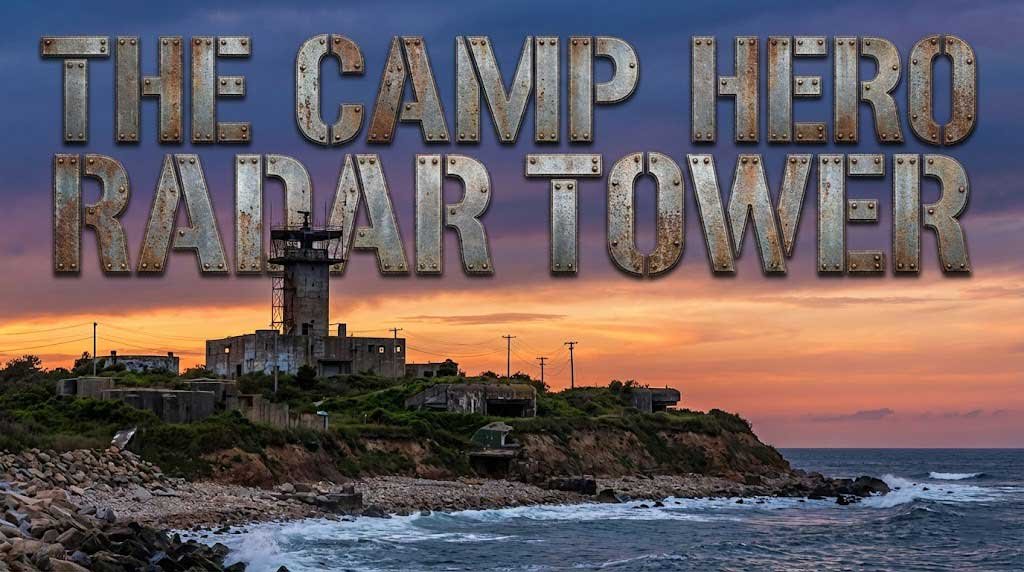
The AN/FPS-35 SAGE radar tower at Camp Hero stands more than 120 feet above the bluffs, its 70-ton dish frozen in place since 1981, the last of its kind in the entire country. The other eleven were dismantled. This one survived, reportedly because local fishermen used it as a landmark. That’s the official story. Nothing about Camp Hero has ever stayed purely official.
Built to Watch the Sky
Camp Hero’s origins are rooted in the most rational of wartime calculations. The U.S. military constructed the base in 1942 as a coastal defense installation, disguising it — brilliantly, madly — as a New England fishing village, complete with Cape Cod–style houses painted in faded clapboard colors. The deception was architectural theater: hide a military fortress in plain sight by making it look like the kind of place where nothing of consequence ever happens.
The Cold War brought the radar tower. The SAGE system — Semi-Automatic Ground Environment — was designed to deliver thirty minutes of warning time in the event of Soviet bombers crossing the Atlantic. Every twelve seconds, the dish rotated. And every twelve seconds, Montauk residents watched their television sets blip, their radios cut out, and their animals grow inexplicably agitated. The tower was powered by six 100-horsepower motors and operated at frequencies powerful enough to interfere with every receiver for miles. The Air Force held an Armed Forces Day open house. It was, they insisted, no secret. And yet.
What the Ground Won’t Say
The base officially closed in 1981. New York State eventually absorbed it as Camp Hero State Park in 2002. Hikers now walk trails past sealed bunkers, eroded concrete gun emplacements, and signs warning of potentially live landmines still buried in the earth. Manholes of uncertain depth dot the grounds. A small building disguised as a church was, in reality, a gymnasium. The layers of concealment, even mundane ones, have a cumulative effect: you start to wonder what else isn’t what it appears to be.
Into that uncertainty stepped Preston Nichols. His 1992 book, The Montauk Project: Experiments in Time, ignited a mythology that has never fully extinguished itself. Nichols claimed that beneath the radar tower lay underground laboratories where kidnapped children were subjected to mind control experiments, where time travel was tested, where psychic warfare was developed as a weapon. He connected Camp Hero to the 1943 Philadelphia Experiment — the alleged Navy attempt to render the USS Eldridge invisible — claiming the two projects were continuous, the thread running from wartime secrecy straight into the Cold War’s darkest corners.
The claims are not supported by FOIA documents, government audits, or any physical evidence uncovered during the state’s environmental surveys of the site. What explorers have found are sealed tunnels, fire control rooms partly flooded with seawater, and graffiti that reads, unnerving in its simplicity: Stranger Help Me. The Duffer Brothers found enough in this folklore to originally title their Netflix series Montauk before relocating the story to fictional Hawkins, Indiana. The spirit of the place migrated intact.
The Weight of a Structure That Endures
What I keep returning to is not the conspiracy but the architecture of belief that surrounds objects which outlast their purpose. There’s something philosophically precise about a tower that was built to watch for threats that never came, that stopped spinning forty-four years ago, and that still dominates the horizon as though it’s waiting for something.
I think about craft and permanence often — in my own work building English bridle leather briefcases at Marcellino NY, clients sometimes ask why the lead time exceeds six months. Part of the answer is that anything built to last, built to develop character and patina over decades, resists acceleration. The Camp Hero tower was built with that same uncompromising intention: to be unmissable, unignorable, structurally absolute. That it became a vessel for myth rather than a monument to military deterrence says something about the human need to fill permanent structures with meaning — especially when the original meaning has been classified, redacted, or simply allowed to erode.
The Park the Tower Became
Today, Camp Hero State Park is open to anyone willing to drive to the eastern edge of Long Island. The hiking trails are legitimately beautiful. The Atlantic crashes against bluffs below the cliffs with the kind of indifference that makes Cold War anxieties feel geologically small. Surfers work the shoreline. Fishermen cast from the rocks.
And the tower stands behind its chain-link fence, inaccessible, weathered, still. The underground, if it exists as the theorists describe it, remains sealed. The official record says there is nothing below worth examining. The landscape says otherwise — not because it confirms any particular theory, but because sealed things in remote places have always invited the question of why they were sealed at all.
That question is Camp Hero’s most durable export. More durable, it turns out, than the military mission that built it.
Camp Hero State Park 50 South Fairview Avenue, Montauk, NY 11954 nysparks.com
Sources:
- Roadtrippers Magazine, Camp Hero and the Montauk Project: Conspiracy Theories, Mind Control, and Stranger Things Inspiration, September 2025: roadtrippers.com
- Wikipedia, Montauk Project: en.wikipedia.org/wiki/Montauk_Project
- Montauk Library Archives, Throwback Thursday – The Camp Hero Craze, December 2025: montauklibrary.org
- Montauk Library Archives, Throwback Thursday – Montauk Tower No Mirage: montauklibrary.org
- Dan’s Papers, Camp Hero and the Montauk Project Mystery, 2014: danspapers.com
- Spyscape, Camp Hero: Secrets of the Creepy Montauk Laboratory That Inspired Stranger Things: spyscape.com
- On Montauk, The History & Legend of Camp Hero: onmontauk.com