
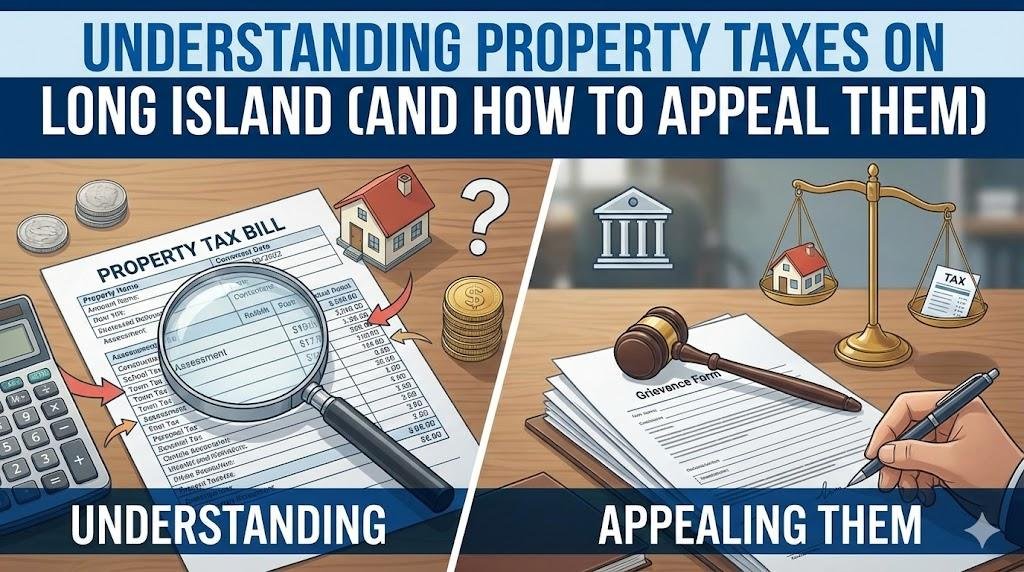
It is the “Long Island Premium.” You find the perfect colonial in Smithtown or a ranch in Massapequa, you fall in love with the school district, and then you see the number.
Property taxes on Long Island are among the highest in the nation. For new buyers moving from NYC or out of state, the bill can be a shock—often ranging from $12,000 to over $25,000 annually depending on the hamlet. But here is the secret that longtime residents discuss over coffee at the Heritage Diner: You don’t just have to pay it. You can fight it.
The “Grievance” process is not a loophole; it is a homeowner’s right. As we head into the 2026 tax season, understanding how to challenge your assessment is the single most effective way to lower your monthly housing costs without refinancing.
Here is the complete guide to navigating the Nassau and Suffolk tax mazes in 2026.
1. The “Two-Bill” System: Where Does the Money Go?
To lower your taxes, you first have to understand what you are paying. On Long Island, you don’t get one bill; you get two (and they arrive at different times).
- The General Tax Bill: Covers police, fire, parks, county services, and town operations.
- The School Tax Bill: Covers the local school district.
The Stat: On average, 60% to 70% of your total property tax bill goes to the school district. This is why a home in the Three Village School District might have significantly different taxes than a similar home three miles away in a different district. You are paying for the “Niche A+” rating.
2. The Golden Rule: You Are Fighting the Value, Not the Rate
A common misconception is that you are complaining about the tax rate (the percentage set by the town). You aren’t. You are challenging the assessment (the town’s opinion of your home’s market value).
The Pie Analogy:
Think of the town budget as a pizza. The size of the pizza (the total tax revenue needed) is set by voters and politicians. You cannot change that. But your assessment determines the size of your slice. By filing a grievance, you are essentially arguing, “My slice is too big; my house isn’t worth that much.” If you win, your slice gets smaller, but the pizza stays the same size.
3. The 2026 Deadlines (Write These Down)
If you miss the filing window, you are locked in for another year. The dates are strictly enforced.
| County | 2026 Filing Deadline | Who Handles It? |
| Nassau County | March 2, 2026 | Assessment Review Commission (ARC) |
| Suffolk County | May 19, 2026 | Local Town Assessors (e.g., Smithtown, Brookhaven) |
Note: In Suffolk, you file with your specific town (e.g., Town of Islip, Town of Brookhaven), whereas Nassau has a centralized county-wide system.
4. The “Market Value” Test
How do you know if you have a case?
Ask yourself this simple question: “Could I sell my house today for the amount the town says it is worth?”
If the town assesses your home at $950,000, but homes on your block are selling for $825,000, you are over-assessed. You are paying taxes on “phantom equity.”
- Expert Tip: This is where a Comparative Market Analysis (CMA) is vital. Before you file, reach out to a broker like Paola Meyer at Realty Connect USA. She can run the “comps” (comparable sales) to see exactly what similar homes in your neighborhood are selling for, giving you the ammunition you need to prove your case.
5. DIY vs. The “50%” Firms
You have likely received junk mail from law firms offering to grieve your taxes. Here is the breakdown of doing it yourself versus hiring a pro.
The DIY Route:
- Cost: Free.
- Process: You file specific forms (like the RP-524 in Suffolk or the online ARC application in Nassau). You must submit evidence of comparable home sales.
- Pros/Cons: You keep 100% of the savings, but the paperwork can be dense and bureaucratic.
The Tax Grievance Firm:
- Cost: usually 50% of the first year’s savings. If they save you $1,000/year, you pay them $500 once. If they save you nothing, you pay nothing.
- Process: They handle everything, including court dates if necessary.
- Pros/Cons: It is risk-free and hands-off, but you forfeit half of that first year’s “win.”
6. The “Star” Relief and Exemptions
Before you even grieve, ensure you are getting the basic discounts.
- STAR (School Tax Relief): Available to almost all homeowners with an income under $500,000. It knocks hundreds off your school tax bill.
- Enhanced STAR: For seniors (65+) with specific income limits.
- Veterans Exemption: Significant savings for those who served.
- Note: Grievance is separate from exemptions. You can (and should) do both.
Conclusion: It’s Business, Not Personal
Filing a grievance doesn’t mean you dislike your town or your schools. It is a standard financial maintenance task, like changing your oil or checking your credit score. In a year where every dollar counts, ensuring you are paying your fair share—and no more—is smart homeownership.
Watch: How the Property Tax Grievance Process Works
This video explains the mechanics of the “assessment ratio” and how challenging your value actually lowers your bill.
How to Grieve Your Property Taxes Explained
Need to check your home’s value?
- Get a Professional Valuation: Contact Paola Meyer at Realty Connect USA
- Official Forms: NYS Department of Taxation & Finance
- Local Insight: Grab a booth at the Heritage Diner to hear what your neighbors are paying.