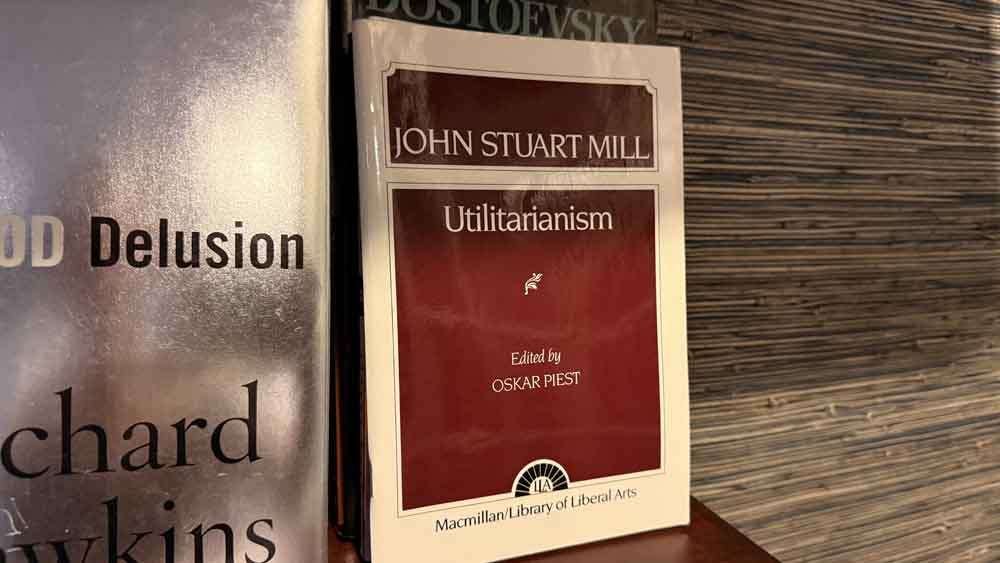
Utilitarianism was first published in 1863. On Liberty came four years earlier, in 1859. Together they form a philosophical pair that has never fully left my thinking — partly because they sit in such productive tension with each other, and partly because the tension they contain is one I have never been able to resolve in my own life. I have always been pulled in two directions at once: toward the good of the collective, toward the power of the individual. Mill is the only thinker I have encountered who seems genuinely haunted by the same problem.
That is not a minor thing to say. Nietzsche, whose Thus Spoke Zarathustra I wrote about in an earlier review, was never haunted by it at all. He resolved the tension with a sledgehammer. The individual was the point. The collective was the obstacle. Full stop. For years I found that clarifying, even liberating. But the older I get — the longer I sit with what it actually takes to build something that works not just for me but for the people around me — the more I find myself reaching back to Mill, who refused the sledgehammer and chose the harder path instead.
What the Book Is, and What It Isn’t
Utilitarianism is a short work — barely a pamphlet by modern standards, five chapters, less than a hundred pages in most editions. It was written not as an academic treatise but as a defense, an attempt to clarify and rescue Jeremy Bentham’s greatest happiness principle from the caricatures that had already begun to accumulate around it. Bentham had argued, crudely, that morality was a matter of calculation: add up the pleasures, subtract the pains, and whatever produces the largest net happiness for the largest number of people is the right thing to do. The criticism practically wrote itself. Is pushpin as good as poetry? Is the happiness of a satisfied fool equal to the suffering of an intelligent man who sees the world clearly? Bentham’s answer, uncomfortable in its honesty, was essentially yes. Mill’s answer was no — and that single departure from his mentor changed everything.
Mill’s revision was elegant. Not all pleasures are equal, he argued. There are higher pleasures and lower pleasures, and any person who has experienced both will reliably prefer the higher ones — even if those higher pleasures come with more difficulty, more dissatisfaction, more suffering. The line he wrote to make this point is one of the most-quoted in all of philosophy: it is better to be Socrates dissatisfied than a fool satisfied. Better, that is, to possess the capacity for richer experience even when that capacity brings pain, than to be incapable of the pain because you are incapable of the depth. That is not the argument of a man who thinks happiness is just comfort. That is the argument of a man who has spent considerable time thinking about what human beings are actually capable of becoming.
The Problem of Higher Pleasures — and Who Gets to Decide
The strength of Mill’s revision is also its most vulnerable point, and he knew it. If we accept that higher pleasures exist and are genuinely preferable to lower ones, we immediately face the question: who determines which pleasures are higher? Mill’s answer is that the judgment belongs to those who have experienced both. A person who has known only simple pleasures cannot meaningfully compare them to intellectual or creative or moral ones. But those who have had access to both — who have tasted the full range of what human experience offers — will consistently choose the higher pleasures, even at greater cost.
This is a persuasive argument, but it carries within it a seed of elitism that Mill never fully defused. The philosopher and political theorist Isaiah Berlin, one of the sharper readers of Mill’s legacy, observed that any framework which assigns higher value to certain pleasures must eventually confront the question of who decides the hierarchy — and that the answer to that question has enormous consequences for political life. Mill tried to sidestep this by grounding the judgment in experience rather than in class or education, but the line between the two is blurry in practice. The objection matters. It is not fatal to Mill’s project, but it is a real crack in the edifice, and ignoring it would be dishonest.
Where On Liberty Enters — and Why It Changes Everything
Here is where Mill becomes genuinely complicated, and genuinely interesting. Utilitarianism, read alone, can feel like a theory of benevolent management — a philosophy designed to help rational people make collective decisions that produce the most aggregate good. It is a social calculus. And a social calculus, however refined, seems to leave limited room for the irreducible stubbornness of the individual will.
But Mill wrote On Liberty as well, and On Liberty is a different kind of book entirely. Its argument, at its core, is that the free development of individuality is not just a personal good but a social one — that a civilization composed of people who have been allowed to develop their own characters, think their own thoughts, and choose their own paths will outperform one composed of conformists, regardless of how comfortable or orderly that conformity looks on paper. In Mill’s own words, it is only the cultivation of individuality which produces, or can produce, well-developed human beings. This is not a contradiction of utilitarianism. It is a deepening of it. Mill is saying that the collective is genuinely better off when it contains real individuals — people who think, who dissent, who push back against received wisdom. A society of sheep optimizes for a kind of happiness that is, by his own framework, lower rather than higher.
This is the insight that I find myself returning to most often. Not because it resolves the tension I feel between individual and collective, but because it names the tension precisely. The strongest version of a collective is not the one that subordinates individuals to the group’s interests. It is the one that produces individuals capable of genuinely contributing to something larger than themselves — not out of compulsion, not out of conformity, but out of developed character. Mill believed, perhaps with more optimism than the evidence always supports, that these two things could be reconciled. That being a full human being and being a useful member of society were not competing projects.
Nietzsche’s Objection — and Why It Only Gets You So Far
Nietzsche read Mill. He found him contemptible. In Beyond Good and Evil, Nietzsche dismissed utilitarian well-being as something that “makes man ridiculous and contemptible” — a philosophy for what he called the English, by which he meant anyone who confused comfort with meaning, who confused the absence of pain with the presence of a life worth living. His sharper accusation was that utilitarianism was the philosophical arm of herd morality: in Beyond Good and Evil, he concluded that slave morality is essentially a morality of utility — that the entire framework of maximizing collective happiness was the ressentiment of the weak dressed up in rational clothes, a system designed not to elevate humanity but to protect the mediocre majority from the dangerous few who might otherwise surpass them.
It is a spectacular argument. It is also, in important ways, an unfair one — because it is aimed at Bentham, not at Mill. Nietzsche accused the utilitarians of flattening human experience into a calculus of comfort and ignoring the necessity of suffering, struggle, and hierarchy for the development of genuinely great human beings. But Mill had already made a version of this point from inside the utilitarian tradition. The higher pleasures Mill described — the pleasures of intellect, creativity, moral courage, genuine connection — are not the pleasures of the contented pig. They are precisely the pleasures that come with difficulty, that require cultivation, that belong to what Nietzsche would recognize as a more developed type of person. Mill would not have used the phrase “will to power.” But he was not describing a world of last men either.
Where Nietzsche’s objection does land, and lands hard, is on the question of what happens when genuine individuality and collective welfare are actually in conflict — not theoretically but in practice. Mill’s framework requires that the collective be capable of recognizing and protecting the individual who dissents, who thinks differently, who refuses conformity. Mill himself worried about this: he argued that democratic ideals could produce a tyranny of the majority — a pressure not of law but of opinion, far more suffocating in some ways than legal coercion because it operates on the level of social belonging rather than force. He saw the danger clearly. He did not, in my reading, fully solve it.
Nietzsche’s solution was to say: stop expecting the collective to protect the individual. The great person creates their own values, operates beyond the reach of majority approval, and does not require the permission of the herd to become what they are. It is a bracing position. It is also, practically speaking, a philosophy for the very few — and it offers nothing to anyone who has to actually run something, build something, sustain something with other people over time.
The Tension I Cannot Resolve, and Why I’ve Stopped Trying
Running a diner for twenty-five years teaches you things about collective welfare that no amount of reading philosophy prepares you for. You learn, viscerally, that the wellbeing of the people working with you matters to the quality of everything that comes out of the kitchen. You cannot optimize for your own vision at the expense of the room. The greatest happiness principle, stripped of its academic dressing, is something you discover empirically before you encounter it in a book.
But you also learn, just as viscerally, that a room full of people who have surrendered their individual judgment to the comfort of consensus produces nothing worth having. The best decisions I have made in this business came from someone being willing to say something unpopular. The worst came from everyone agreeing. Mill understood this. What he called the higher pleasures of individuality and independent thought are not luxuries for the philosophically inclined. They are the engine of any genuinely functioning collective — including, as it turns out, the kind that serves eggs and sourdough on a weekday morning in Mount Sinai.
My intuition, which I held long before I could articulate it — that an ideal collective would be made of true individuals and not sheep — turns out to be closer to Mill’s actual argument than to Nietzsche’s. Nietzsche would give you the individual. Mill would give you both, if you were willing to do the harder work of building the kind of collective that could actually contain real people. The first position is a philosophy. The second is a project.
I have not resolved the tension. But I have decided that a tension worth living with is more honest than a resolution that abandons half the problem. Mill understood something that Nietzsche, brilliant as he was, chose not to: that the full development of individual human beings is not the enemy of a good society. It is its only reliable foundation.
I will return to On Liberty in a separate review — it deserves the full room. But read Utilitarianism first. Read it knowing that the man who wrote it was also writing On Liberty, and that you cannot fully understand either one without the other.
You Might Also Like:
- Thus Spoke Zarathustra by Friedrich Nietzsche — The Book That Rewired My Understanding of Everything
- Civilization and Its Discontents by Sigmund Freud — The Book That Saw the Twentieth Century Coming
- No Exit by Jean-Paul Sartre — The Play That Diagnosed Modern Life Before Modern Life Knew It Was Sick
Sources
- Mill, John Stuart. Utilitarianism. Originally published 1863. Available via Project Gutenberg
- Mill, John Stuart. On Liberty. Originally published 1859. Available via Project Gutenberg
- Mill, John Stuart. On Liberty, Utilitarianism and Other Essays. Oxford World’s Classics, edited by Mark Philp and Frederick Rosen. Oxford University Press / Amazon
- Nietzsche, Friedrich. Beyond Good and Evil. Trans. Walter Kaufmann. Random House, 1966
- Anomaly, Jonny. “Nietzsche’s Critique of Utilitarianism.” Journal of Nietzsche Studies. Project MUSE
- “John Stuart Mill.” Stanford Encyclopedia of Philosophy. plato.stanford.edu
- “Nietzsche’s Moral and Political Philosophy.” Stanford Encyclopedia of Philosophy. plato.stanford.edu
- “On Liberty.” Wikipedia. en.wikipedia.org
- LSE Undergraduate Political Review: “Is Mill’s Principle of Liberty Compatible with His Utilitarianism?” blogs.lse.ac.uk