
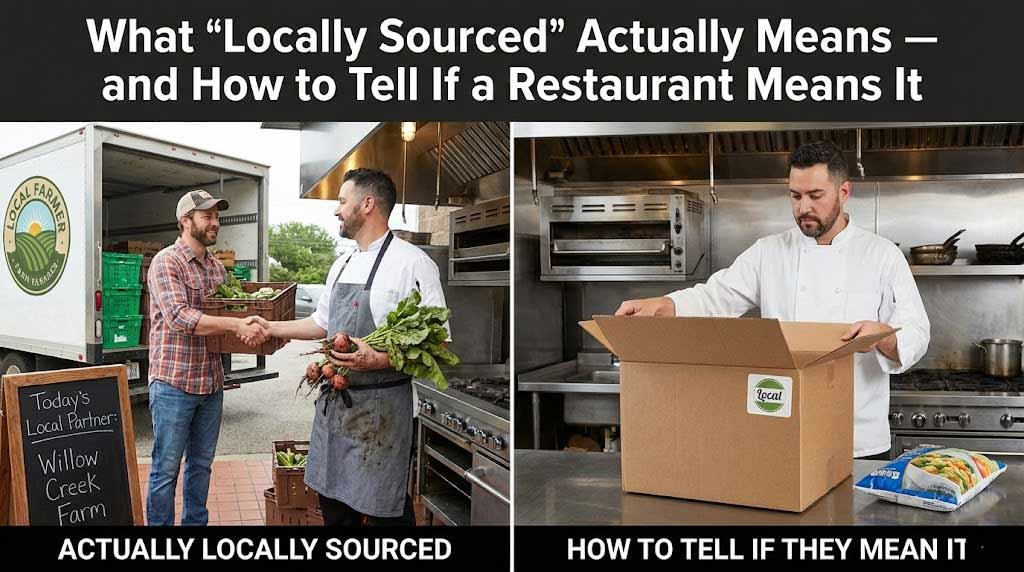
For years, “locally sourced” has been one of the most powerful phrases in the food world. It evokes images of early‑morning farmers’ markets, chefs shaking hands with growers, and ingredients that traveled fewer miles than your morning commute. But as the term has exploded in popularity, so has confusion about what it really means — and how diners can tell when a restaurant is genuinely committed versus simply riding a trend.
This long‑form report breaks down the history, economics, logistics, and realities behind local sourcing, drawing on USDA research, supply‑chain studies, and real‑world restaurant case studies. It also includes practical tools for diners who want to verify authenticity — and avoid falling for “greenwashed” menu language.
What Counts as “Local”? The Truth Behind the Label
There is no single legal definition of “locally sourced.” That ambiguity is part of the problem — and part of the opportunity.
According to the USDA Economic Research Service, local food systems are generally defined by geographic proximity between producer and consumer, but the distance varies widely depending on region and context (USDA ERS, 2025).
Industry norms typically fall into these ranges:
- 100–250 miles: A common standard used by many restaurants and regional food networks (Connolly, 2025).
- Up to 500 miles: Some restaurants stretch the radius, especially in areas with fewer farms.
- County or bioregion‑based: Increasingly popular among sustainability‑focused chefs.
- Percentage‑based definitions: Many restaurants aim for 30–40% of their menu to be locally sourced before using the term publicly (Connolly, 2025).
The lack of regulation means restaurants can technically call a dish “local” even if only one ingredient — say, the garnish — comes from a nearby farm. That’s why transparency matters more than labels.
A Brief History: From Farm‑to‑Table Idealism to Mainstream Marketing
The modern local‑food movement gained momentum in the early 2000s, fueled by authors like Michael Pollan (The Omnivore’s Dilemma, 2006) and documentaries such as Food, Inc. Their work highlighted the environmental and ethical costs of industrial agriculture, inspiring chefs to reconnect with regional producers.
By the 2010s, “farm‑to‑table” became a national phenomenon — and, inevitably, a marketing tool. Investigations in cities like New York, Tampa, and Las Vegas uncovered restaurants falsely claiming to use local farms that had never heard of them. The term “local‑washing” entered the lexicon.
Today, diners are more informed, and restaurants face greater pressure to back up their claims with real sourcing practices. The good news: many do.
Why Restaurants Source Locally: The Real Benefits
Local sourcing isn’t just a feel‑good trend. Research shows it has measurable impacts on flavor, community, and sustainability.
1. Fresher, Higher‑Quality Ingredients
Shorter travel times mean produce can be harvested at peak ripeness. A 2022 supply‑chain study found that local distribution networks significantly reduce spoilage and improve ingredient quality (Paciarotti et al., 2022).
2. Stronger Community Economies
Money spent on local farms circulates within the region, supporting small producers and rural jobs. USDA reports show rising consumer demand for local food systems and strong financial performance among experienced local producers (USDA ERS, 2021–2025).
3. Environmental Impact
Local sourcing reduces transportation emissions and encourages diversified regional agriculture. Urban case studies show that restaurants using local networks strengthen community relationships and reduce supply‑chain vulnerabilities (Hartman, 2025).
4. Menu Storytelling
Diners increasingly want to know where their food comes from. Restaurants that can name their farms — and tell their stories — build trust and loyalty.
The Hidden Challenges: Why Local Sourcing Isn’t as Simple as It Sounds
Behind every “local” menu item is a complex logistical puzzle.
Seasonality
Chefs must adapt menus to what’s available — which may mean no tomatoes in February or no strawberries after July.
Cost Pressures
Local ingredients often cost more due to small‑scale production. Restaurants must balance authenticity with financial sustainability.
Supply‑Chain Complexity
Urban restaurants face unique challenges: inconsistent supply, limited delivery windows, and the need for multiple small vendors. Case studies show that restaurants often struggle with logistics, requiring careful planning and flexible menus (Hartman, 2025).
Scaling Issues
A restaurant may be able to source local eggs or herbs, but not necessarily beef or grains. That’s why transparency — not perfection — is the real marker of integrity.
How to Tell If a Restaurant Is Truly Locally Sourcing
Here’s the part diners care about most: how to separate genuine local sourcing from marketing fluff.
1. Look for Specific Farm Names
Authentic restaurants proudly list their partners. If a menu says “local greens” but doesn’t name the farm, ask.
2. Check for Seasonal Menus
A restaurant with the same “local tomato salad” in January and July is waving a red flag.
3. Ask Staff Simple Questions
Try: “Which farms do you work with?” If the answer is vague, it usually means the sourcing is too.
4. Look for Transparency on Websites
Many restaurants now publish sourcing pages, supplier lists, or weekly farm deliveries.
5. Follow the Restaurant on Social Media
Real local sourcing often shows up in behind‑the‑scenes posts: deliveries, farm visits, or seasonal harvests.
6. Compare Claims to Geography
If a restaurant in a dense urban area claims “100% local,” be skeptical — even the best programs rely on regional distributors.
The Future of Local Sourcing: Tech, Transparency, and Traceability
The next wave of local sourcing is being shaped by technology and consumer demand.
Digital Supply‑Chain Platforms
Research in 2022 proposed food‑hub models that streamline distribution between farms and restaurants, reducing costs and improving reliability (Paciarotti et al., 2022).
QR‑Code Traceability
Some restaurants now use QR codes that link directly to farm profiles, harvest dates, and sustainability metrics.
Climate‑Driven Menu Design
As extreme weather affects crop availability, chefs are shifting toward resilient local crops — a trend already visible in 2025–2026 restaurant reports.
Consumer Pressure
Diners are more informed than ever. Restaurants that fake it risk public backlash, especially in the age of TikTok exposés and local‑news investigations.
Recommended Videos for Further Insight
- “How Local Food Systems Work” –
https://www.youtube.com/watch?v=QG7FZq8K0iE(youtube.com in Bing) - “Farm‑to‑Table: The Truth Behind the Trend” –
https://www.youtube.com/watch?v=6K5ZxJZ6K8E(youtube.com in Bing) - “Inside a Modern Sustainable Farm” –
https://www.youtube.com/watch?v=1o2iFJ7wY9E(youtube.com in Bing)
Where This Leaves Us
“Locally sourced” is more than a buzzword — but only when restaurants treat it as a commitment, not a marketing tactic. The best establishments don’t just buy local ingredients; they build relationships, adapt to seasons, and tell honest stories about where their food comes from.
As diners, we have power. By asking questions, supporting transparent restaurants, and learning how local food systems work, we help strengthen the very communities we eat from.
For more food‑culture deep dives, check out: Why Sourdough Is Taking Over Long Island A Local’s Guide to Breakfast in Mt. Sinai How Restaurants Choose Their Equipment