
Every culture has a culinary password — a phrase that signals you belong. In New York, and on Long Island specifically, that password is rattled off so fast it collapses into a single percussive word: baconeggandcheesesaltpeppaketchup. Deli workers across the North Shore have been decoding that verbal blur for generations, scrawling “BEC SPK” on wax paper before handing over a warm, slightly steam-softened package that somehow feels like home even before you’ve opened it. What’s inside is deceptively simple — bacon, eggs, American cheese, a seeded roll, salt, pepper, ketchup. But simplicity, as any craftsman will tell you, is where the hardest work hides.
This is not a sandwich you improve by getting clever with it. You improve it by understanding it. And once you do, replicating it at home stops being guesswork and becomes something more like a discipline.
The Roll: Why Nothing Else Will Do
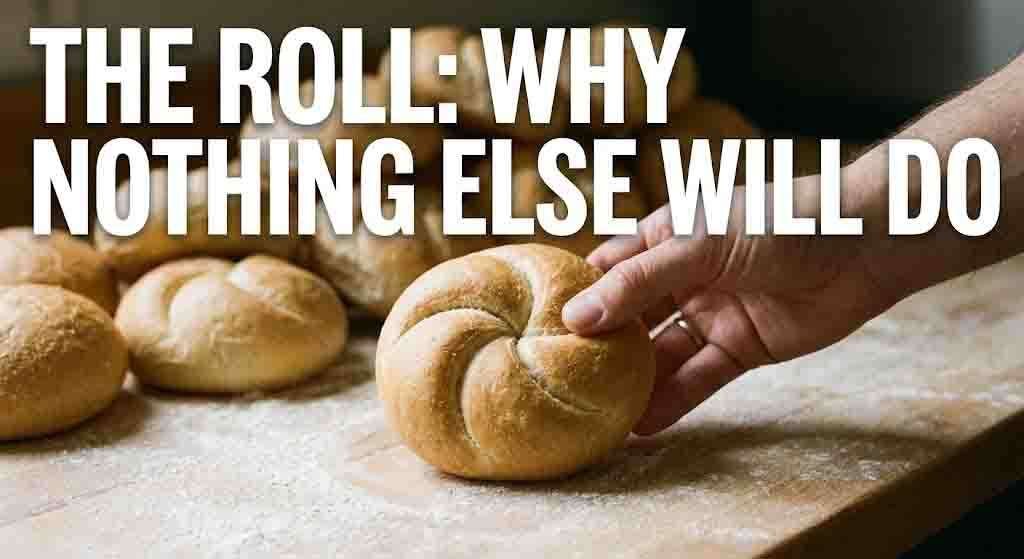
Walk into any deli in the New York area and you’ll hear guests ordering “baconeggandcheesesaltpeppaketchup” — as if it were one long glorious word. In minutes, they’re handed a paper-wrapped sandwich with “BEC SPK” scrawled on top. That paper-wrapped experience begins and ends with the bread, and the bread, more than any other component, is what makes this sandwich impossible to properly replicate anywhere west of the Hudson.
The roll in question is the New York deli hard roll — an Austrian-descended kaiser stamped with that iconic five-petal star, then baked until its crust nearly shatters and its interior achieves a cloud-white, impossibly airy pull. Hard rolls rely on bread flour’s higher protein content, which produces a sturdier, less soft texture; they spend closer to half an hour in the oven, then get an additional five minutes purely for crust development. The characteristic crust texture is largely a function of baking technique — commercial bakeries use steam-injection ovens that a standard home oven simply cannot replicate.
That steam matters enormously. The moisture in the oven’s initial baking phase gelatinizes the surface starches of the dough before they set, delaying crust formation and allowing maximum oven spring. When the steam is removed, the now-expanded surface dries rapidly and crisps into that distinctive crackling shell. At home, you can approximate this by placing a pan of water in the bottom of a preheated oven and spritzing the rolls with water just before they go in.
For the home cook, sourcing matters. Seek out a local Italian bakery or a delicatessen that bakes its own rolls — the difference between a day-old supermarket kaiser and a freshly baked poppy seed hard roll from a North Shore deli is not subtle. If you’re baking your own, use high-gluten bread flour, an egg white (not a whole egg) for structure without richness, and a brief overnight cold retard in the refrigerator for flavor development. Diastatic malt powder, available at baking supply stores, will give you the subtle fermented depth and golden color that industrial bakeries achieve through their own proprietary processes.
The Bacon: Fat Rendering and the Case for Restraint
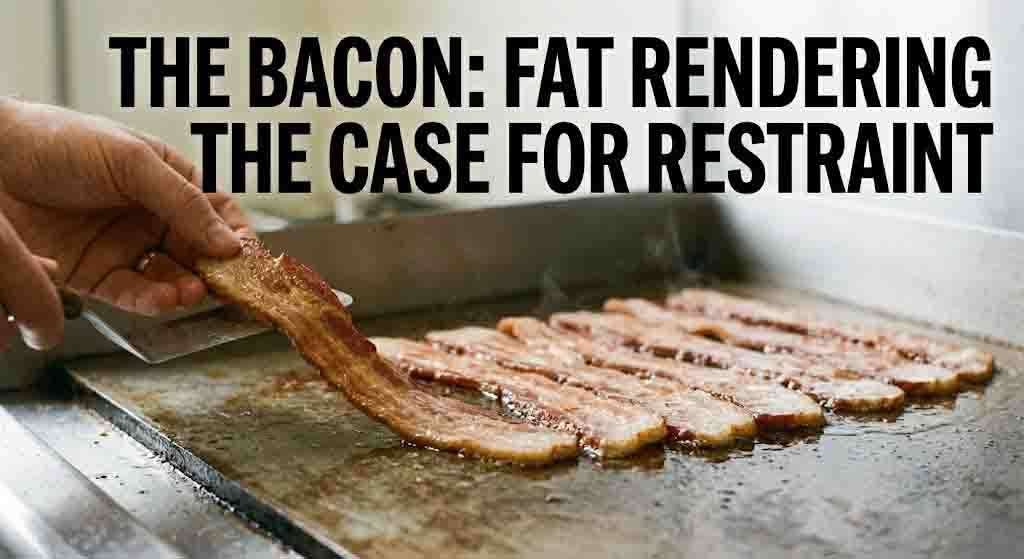
Bacon on a BEC is not the star — it is a structural and textural counterpoint. Too thick and you’re chewing through the sandwich; too thin and it vanishes into the egg. The classic deli BEC uses standard-cut streaky bacon: center-cut strips with a reasonable fat-to-lean ratio that renders properly on a flat griddle surface.
The science here is about water removal and Maillard browning working in sequence. Bacon crisps when enough water has been cooked out of it, and to get that kind of moisture cook-out, you need high heat. Browning is driven by the Maillard reaction — a process wherein amino acids present in proteins break down in the presence of heat to create color and flavor molecules. Specifically, the Maillard reaction begins in earnest around 280–300°F, which means a flat griddle held at 375°F is doing two things simultaneously: driving off water from the fat and creating those hundreds of new aromatic compounds that give properly cooked bacon its deep, almost savory-sweet complexity.
The mistake home cooks make is cooking bacon in a cold pan or at too low a temperature, which causes the fat to render slowly without achieving proper browning. Start your skillet or griddle over medium-high heat. Lay the strips flat without crowding — crowding introduces steam and steaming is the enemy of crispness. When the bacon has rendered its fat and developed good color on both sides, remove it to a rack, not a paper towel, so air can circulate and it crisps evenly as it rests.
On a BEC, the bacon is typically folded in half so it fits the roll without overhang. Two strips, folded. That’s the geometry.
The Egg: Protein Science on a Hot Griddle
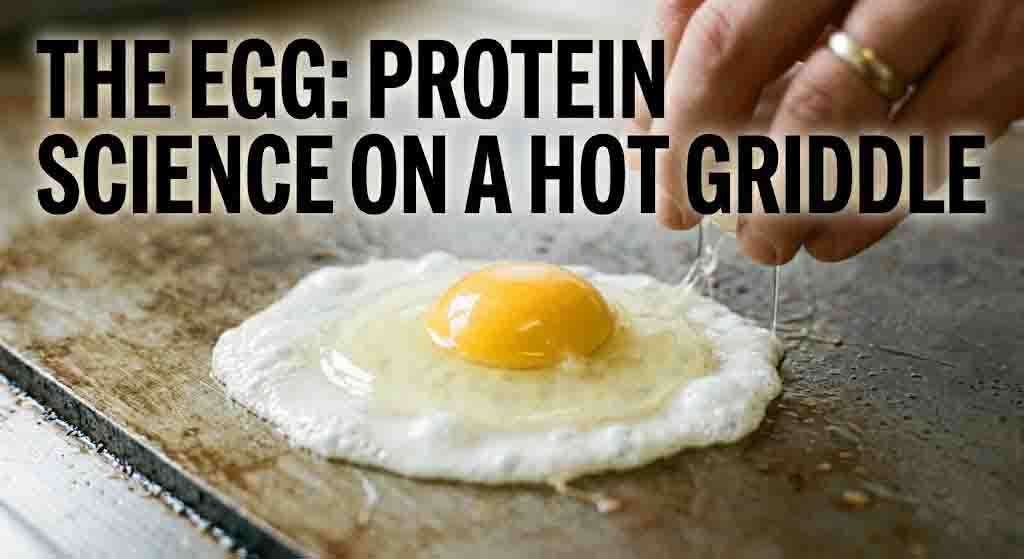
This is where the BEC diverges sharply from its pretenders. The deli egg is not scrambled. It is not poached. It is cracked directly onto a hot, lightly greased flat surface and broken — yolk pierced, white spread — then folded once as it sets. The result sits somewhere between a fried egg and a very thin omelet: fully cooked through (no running yolk on a BEC, that’s not the sandwich), with a slightly browned underside and soft, yielding interior.
When an egg hits a 375°F griddle surface, the proteins in both the white and the yolk immediately begin to denature — their long-chain structures unfurl and cross-link with neighboring proteins, turning what was liquid to solid. The browning on the underside of a deli-style fried egg is actually the Maillard reaction occurring between proteins and the small amount of reducing sugars present in the egg — eggs contain about 1% carbohydrate, much of which is glucose.
For the home version: use room-temperature eggs (cold eggs hit a hot pan unevenly and the whites spread too thin before setting). Crack two eggs onto a lightly buttered skillet over medium-high heat. Break the yolks immediately with your spatula. Let the white set for about 30 seconds, then fold the egg over itself once, cutting it into a rough square shape roughly matching the diameter of your roll. Press gently to ensure full contact with the pan. The egg should be fully set but still have a slight give — not rubbery. Season with salt and pepper directly on the egg before the cheese goes on.
The Cheese: American Cheese and the Emulsification Advantage
Let’s settle this permanently: the cheese on a BEC SPK is American cheese. Not cheddar, not provolone, not aged Gruyère. American cheese. And the reason isn’t nostalgia — it’s chemistry.
American processed cheese contains emulsifying salts, most commonly sodium citrate, which fundamentally alter how the cheese behaves under heat. The tight-knit proteins in natural cheese are bonded to each other with calcium ions. When you warm processed cheese, the sodium in sodium citrate substitutes itself for some of that calcium, allowing the proteins to separate and reform into a stable, smooth emulsion — a melt with no lumps, no grease, no leaks.
Natural cheeses, by contrast, tend to break when heated on a sandwich. The fat separates, the proteins seize, and you end up with greasy pools and rubbery clumps where a silky, enveloping veil should be. American cheese is formulated with an optimized pH level and carefully calibrated emulsifying salts that ensure a uniform, flowing melt — which is exactly why it’s been the default choice for diner and deli sandwiches for a century.
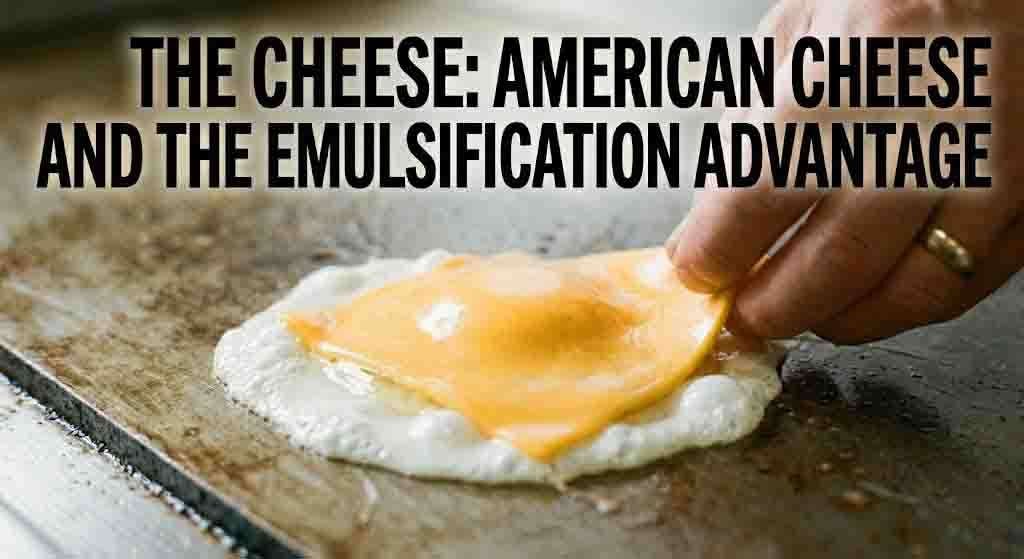
One slice goes on top of the hot egg while it’s still on the griddle or in the pan. Cover the pan for 20 to 30 seconds to trap steam and complete the melt. The cheese should drape over the egg like a curtain — fluid, glossy, inseparable. That’s what you’re after.
The SPK: Salt, Pepper, Ketchup and Why the Order Matters
The SPK modifier isn’t decorative — it’s structural. Each element plays a distinct role in the finished sandwich’s flavor profile.
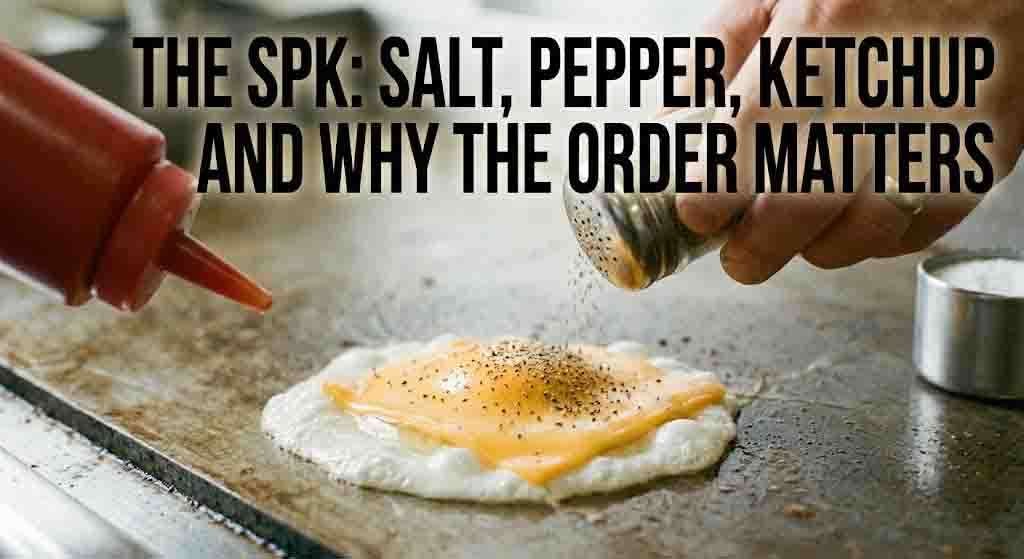
Salt applied directly to the egg while it’s still in the pan draws out a small amount of moisture and seasons the protein at the point of maximum surface area. Kosher salt, applied while the egg is still soft, melts into it. Table salt sprinkled later on a fully cooked egg stays on the surface.
Pepper on a BEC is black pepper, coarsely ground or cracked if possible. Freshly cracked black pepper contains volatile aromatic compounds — primarily terpenes — that dissipate quickly once ground. The sharpness those compounds provide is what cuts through the richness of the egg and cheese. Pre-ground pepper from a shaker that’s been sitting on a diner counter for six months will technically fulfill the request and deliver almost nothing.
Ketchup is the most controversial and the most essential. It provides acidity to cut fat, sweetness to balance the salt, and umami depth from its tomato base. The ketchup goes on the top half of the roll — never on the egg itself, which would cause sliding — and it is applied in a thin, wall-to-wall layer. Heinz is non-negotiable. Generic ketchup on a BEC is the culinary equivalent of bad acoustics in a concert hall — the right notes are technically there, but something fundamental is missing.
The assembly sequence: bottom roll receives the egg-and-cheese stack directly from the pan, bacon is placed on top of that, ketchup goes on the top roll’s inner face, sandwich is closed, cut diagonally, wrapped in the wax paper if you have it. The diagonal cut is not optional — it changes the geometry of every bite, the ratio of roll to filling, the angle at which your teeth meet the crust.
The Heritage Perspective: What 25 Years Behind the Counter Teaches You
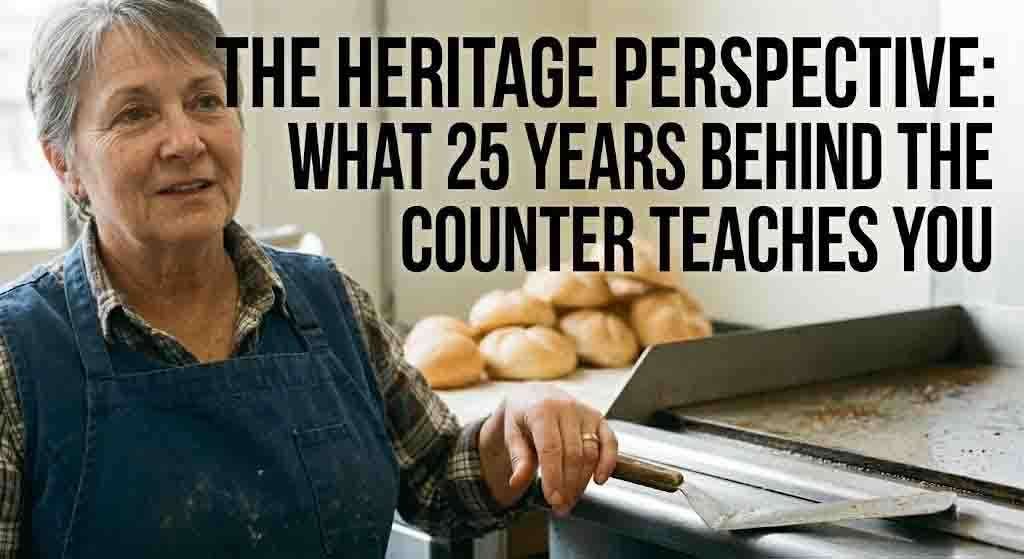
Running The Heritage Diner in Mount Sinai for over two decades — starting with my father back in 2000 — has given me an education in the mechanics of the breakfast sandwich that no culinary school replicates. You learn quickly that the BEC is not a forgiving dish. It rewards consistency and punishes shortcuts. The customer who orders it every Tuesday morning for fifteen years will know, without knowing why, the morning you switched bacon brands or your griddle ran three degrees cooler than usual.
What the diner teaches you is this: quality of ingredients at each individual level compounds. Better bacon renders more cleanly. A fresh-baked roll absorbs the steam from the egg and cheese without going soggy. A properly maintained griddle surface maintains even Maillard browning from the first egg of the morning to the last. At the Heritage, we’ve recently incorporated our slow-fermented sourdough into the breakfast program, which has opened up interesting new territory for egg plates — the tang of a properly fermented loaf does something remarkable as a backdrop for salt-cured pork and melted cheese. But for the BEC in its classic form, the poppy seed hard roll remains irreplaceable.
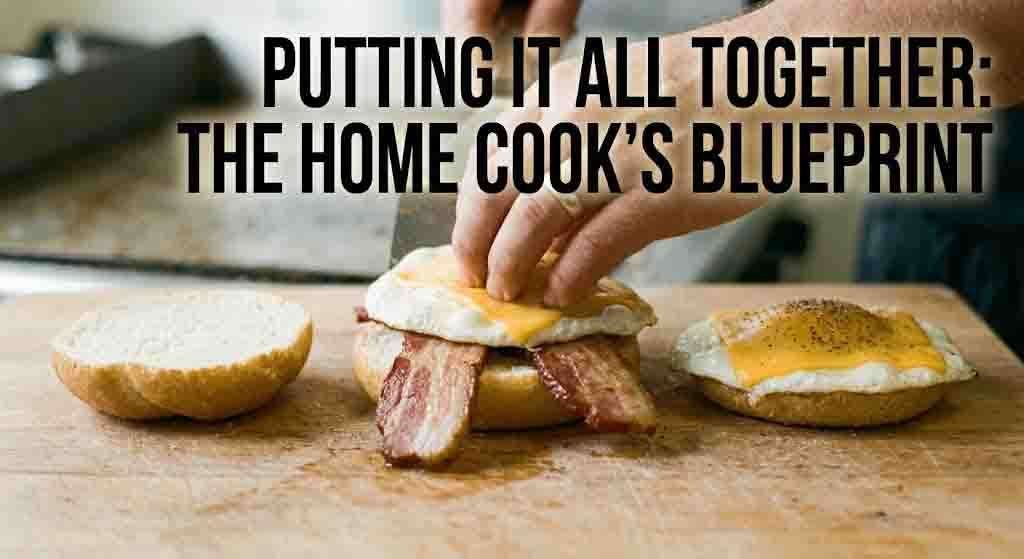
Putting It All Together: The Home Cook’s Blueprint
The perfect home BEC SPK requires no specialized equipment and no obscure ingredients. What it requires is attention, and the understanding that each component has been engineered — by decades of deli culture — to behave in a specific way.
Source a fresh hard roll from a local bakery. Use center-cut bacon, standard-cut, two strips per sandwich. Cook your bacon at medium-high heat until properly browned and rendered, then rest it on a rack. Set your pan to medium-high, add a small amount of butter, and crack two room-temperature eggs onto the surface. Pierce the yolks, spread the white, season with kosher salt and freshly cracked black pepper. Fold once. Lay one slice of American cheese on top while the egg is still in the pan, cover for 20–30 seconds, then transfer to the bottom roll. Add the bacon. Spread Heinz ketchup on the inside face of the top roll. Close, cut diagonally.
Wrap it in foil if you want the full effect. Let it sit for 90 seconds before unwrapping — the carryover steam inside the foil does something to the roll that no amount of deliberate technique can fully replicate. The eggs might differ slightly in doneness, the yolks in precise set — but always, the sandwich should be cut before it is wrapped. That final resting moment inside the foil isn’t wasted time. It’s the sandwich finishing itself.
The BEC SPK is Long Island’s morning handshake. It asks nothing of you except that you make it right.
Sources
- Sip and Feast — Bacon Egg and Cheese Sandwich — New York Deli Style
- Tasting Table — Kaiser Rolls Vs. Hard Rolls: What’s The Difference?
- The Fresh Loaf — NY Hard Rolls — Help
- Food52 — Best Kaiser Rolls Recipe
- America’s Test Kitchen / Cook’s Illustrated — Sodium Citrate Explained
- Agristuff — American Cheese: How It’s Made, Meltability, and Best Sandwiches
- ThermoWorks Blog — How to Griddle Better: Diner-like Results at Home
- SciFood Blog — Cooking 101: How to Fry an Egg
- Orlando Sentinel — D’Amico & Sons’ Bacon-Egg-and-Cheese Sandwich Is “The One”
- Greater Long Island — This Long Islander Brought the BEC to Tampa