Rumors travel faster than truth. Always have. A man named Friedrich Nietzsche spent his life writing about strength, individuality, and the necessity of creating your own values — and within a decade of his death, his name had been stamped onto a movement he would have despised. That’s not irony. That’s how ideas work when the wrong people get hold of them first.
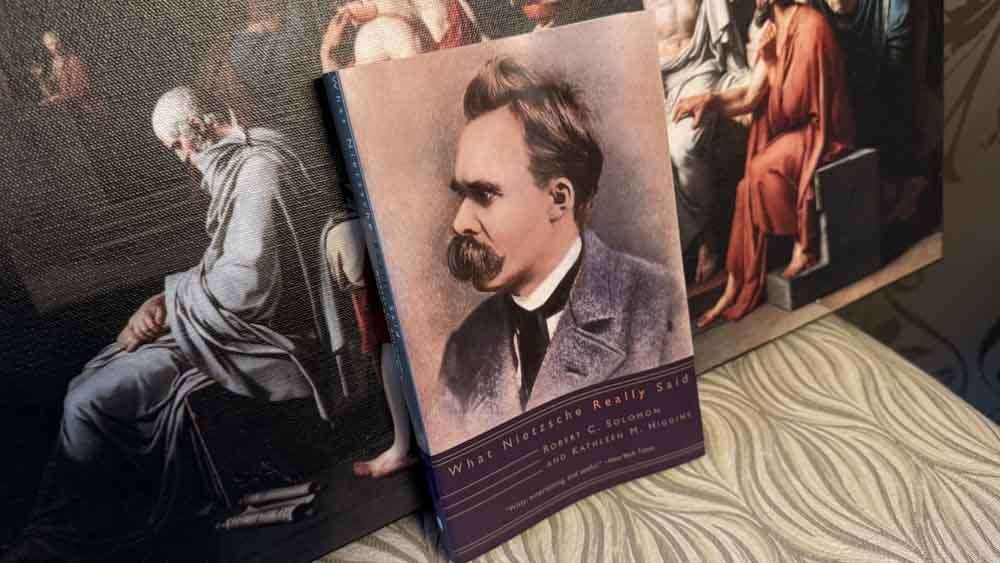
Robert C. Solomon and Kathleen M. Higgins wrote What Nietzsche Really Said in 2000 as a corrective — a slim, sharp volume designed to cut through a century of distortion. Both philosophy professors at the University of Texas at Austin, both serious Nietzsche scholars, they had every credential to do the job. What makes the book worth reading isn’t just that they know their material. It’s that they understand why the myths took hold. And they go after them without flinching.
How a Dead Man Gets Blamed for What He Didn’t Say
Nietzsche collapsed in Turin in January 1889. He spent the last eleven years of his life in mental incapacitation, unable to defend or clarify anything he had written. His sister, Elisabeth Förster-Nietzsche, stepped in. She controlled his archive, edited his unpublished papers, and shaped his legacy with a very particular agenda. Elisabeth was a German nationalist. Her late husband had been a virulent anti-Semite who led a failed colonial project in Paraguay built on racial ideology. Nietzsche had mocked both of them in his letters with withering precision.
None of that stopped Elisabeth. She assembled a text from her brother’s unpublished notebooks — fragments, rough drafts, discarded ideas — and published it as The Will to Power, presenting it as Nietzsche’s masterwork. It wasn’t. It was a collage. And because it arrived after the real books, framed by a sister with ideological motives, it became the lens through which many readers encountered everything else. When the Nazis came to power in the 1930s, they found exactly what they needed waiting for them in Elisabeth’s archive. She gave Mussolini a copy of Nietzsche’s works. She welcomed Hitler to the Nietzsche archive in Weimar in 1934. She died in 1935. Hitler attended her funeral.
Solomon and Higgins lay all of this out in their opening chapter — titled, with appropriate weariness, “Rumors: Wine, Women, and Wagner” — and they don’t rush past it. They understand that this story isn’t just biographical backstory. It is the central problem. Nietzsche’s actual texts were never secret. They were sitting there the whole time. On the Genealogy of Morals, Beyond Good and Evil, Twilight of the Idols — these are not obscure documents. But the rumor was louder than the book. The myth was more useful than the man.
What the Man Actually Said
The core project of What Nietzsche Really Said is to reintroduce Nietzsche’s actual philosophy to readers who think they already know it. Solomon and Higgins take the major concepts one at a time — the death of God, the will to power, master and slave morality, the Übermensch, eternal recurrence — and in each case they perform the same essential operation: they strip away the cartoon and show the argument underneath.
Take the will to power. In the popular imagination this means dominance, aggression, the strong crushing the weak. What Nietzsche actually meant was closer to the opposite. He was describing a drive toward self-mastery — the internal force that pushes a person toward excellence, creativity, becoming more fully themselves. It is not about domination of others. It is about the refusal to be diminished. The person with genuine will to power is not the bully. The bully is, in Nietzsche’s framework, weak — compensating through aggression for an absence of genuine self-overcoming.
The Übermensch gets similarly rehabilitated. This is not a master race. It is an aspirational ideal — a human being who has created his own values rather than inherited them, who does not need external validation or divine sanction to know who he is and what matters. Nietzsche’s model was Goethe, not a military conqueror. And “God is dead” — probably the most quoted, most misunderstood line in philosophy — was not a celebration. It was a diagnosis. If the moral framework that held Western civilization together for two thousand years collapses, what do you replace it with? That was Nietzsche’s genuine terror and genuine question.
Solomon and Higgins handle all of this with precision and patience. Where Nietzsche’s own prose — brilliant and deliberately provocative, aphoristic to the point of self-contradiction — tends to produce more heat than light in first-time readers, their commentary steadies the temperature. They explain context. They explain the rhetorical strategy. They explain what Nietzsche was reacting against in each case, because Nietzsche almost always wrote in reaction — to Christianity, to Kant, to Schopenhauer, to the German nationalism around him. Without that context, the reactions read as pure provocation. With it, they read as arguments.
The Question of Nietzsche’s Style
One of the book’s most valuable sections deals with what the authors call Nietzsche’s ad hominem method — his habit of attacking not just ideas but the psychological motives behind them. He doesn’t simply argue that Christian morality is logically flawed. He asks why a person would need such a morality. What does it do for the weak against the strong? What does it do for the resentful against those they can’t compete with directly? This is what he called ressentiment — a French word he used deliberately for a very specific psychological mechanism: the transformation of powerlessness into moral superiority.
It’s a ruthless analytical tool. And it’s also why Nietzsche reads as cruel when encountered cold. He is not generous with people who, in his view, construct elaborate ethical systems to compensate for weakness. He names the mechanism and drags it into the light. Solomon and Higgins don’t apologize for this. They contextualize it. They point out that Nietzsche applied the same scrutiny to himself — that his philosophy demanded self-examination before it demanded anything else.
This connects to what drew me to Nietzsche in the first place, years before I had the language to name it. I grew up around people who told you how to think, what to believe, where you stood in the order of things. Nietzsche was the first philosopher I read who said: stop. Ask who benefits from you thinking that way. Ask what you actually believe, underneath all the inherited noise. That kind of reading doesn’t leave you.
Amor Fati and the Affirmative Philosophy
The most underappreciated dimension of Nietzsche’s work — and the one What Nietzsche Really Said handles best — is what Solomon and Higgins call his affirmative philosophy. This is not the Nietzsche of bleak nihilism. It is the Nietzsche of amor fati: love of fate. The idea that you embrace your life not despite its suffering but including it. That you say yes to the whole thing — not because it’s easy but because saying no is a smaller, diminished way to live.
This is connected to the concept of eternal recurrence: the thought experiment Nietzsche posed in The Gay Science and deepened throughout his work. If you were told that you would live your life again, exactly as it has been, an infinite number of times — every joy, every failure, every loss, every humiliation — would you choose it? Not as a metaphysical claim about time. As a test. As the hardest question you can ask about whether you are actually living the way you want to be living. Robert Solomon himself described, in a lecture late in his life, how this question hit him first as a student and never left. He understood it as Nietzsche intended: not despair, but a demand.
The book closes with a section on what Nietzsche’s philosophy opened in the modern mind — his influence on psychology, on literature, on existentialism broadly. The comparison with Kierkegaard is worth making here, though Solomon and Higgins don’t dwell on it: where Kierkegaard turned inward toward faith as the answer to the void, Nietzsche turned outward toward creation and self-making. Both were responding to the same collapse of certainty. Both ended up in places that shaped the entire twentieth century.
What the Book Is and Isn’t
What Nietzsche Really Said is not a substitute for reading Nietzsche. Solomon and Higgins are clear about this and the book is designed with that clarity in mind. Every chapter ends with guidance for reading the primary texts. The appendix includes brief annotations of Nietzsche’s works. The glossary — they call it “Nietzsche’s Bestiary” — unpacks his most loaded images and recurring metaphors so that when you encounter them in the original you’re not reading in the dark.
What the book does is remove the static. It strips out the noise that a century of misuse, misquotation, and outright fabrication has layered onto Nietzsche’s actual arguments. Arthur Danto of Columbia called it a survival kit for anyone venturing into Nietzsche territory — which is about right. You want to know what you’re walking into before you walk into it.
The rumors spread because they were useful. The man who actually wrote that “what does not kill me makes me stronger” also wrote that pity is corrosive, that the herd mentality is a disease, that the greatest danger in life is the smallness of our ambitions. Those ideas make people uncomfortable. The myth of the proto-fascist was more manageable. It let you dismiss him without having to argue with him.
Solomon and Higgins don’t let you dismiss him. That’s the book’s real value. They put you in the room with the actual ideas — unfiltered, unflinching, and more alive than the rumors ever were.
Sources
- Solomon, Robert C. and Kathleen M. Higgins. What Nietzsche Really Said. Schocken Books, 2000. https://www.amazon.com/What-Nietzsche-Really-Said-Robert/dp/0805210946
- Philosophy Now, Issue 29. Review of What Nietzsche Really Said. https://philosophynow.org/issues/29/What_Nietzsche_Really_Said_by_Robert_Solomon_and_Kathleen_Higgins
- Penguin Random House. What Nietzsche Really Said — book page. https://www.penguinrandomhouse.com/books/170215/what-nietzsche-really-said-by-robert-c-solomon-and-kathleen-m-higgins/
- Nietzsche, Friedrich. The Gay Science (1882). Various editions.
- Nietzsche, Friedrich. On the Genealogy of Morals (1887). Various editions.