[On Certainty — Ludwig Wittgenstein | Available on Amazon and Barnes & Noble*]
Knowledge has a foundation problem. Not in the abstract, physicist-at-a-chalkboard sense, but in the sense that the things you are most certain about — your name, the existence of your hands, the year you were born, the reliability of the floor beneath you — have never once been tested. You have never subjected them to scrutiny. You accepted them the way a child accepts language: not through proof, but through immersion. And yet these unexamined certainties are the very bedrock on which every claim to knowledge you have ever made is quietly resting.
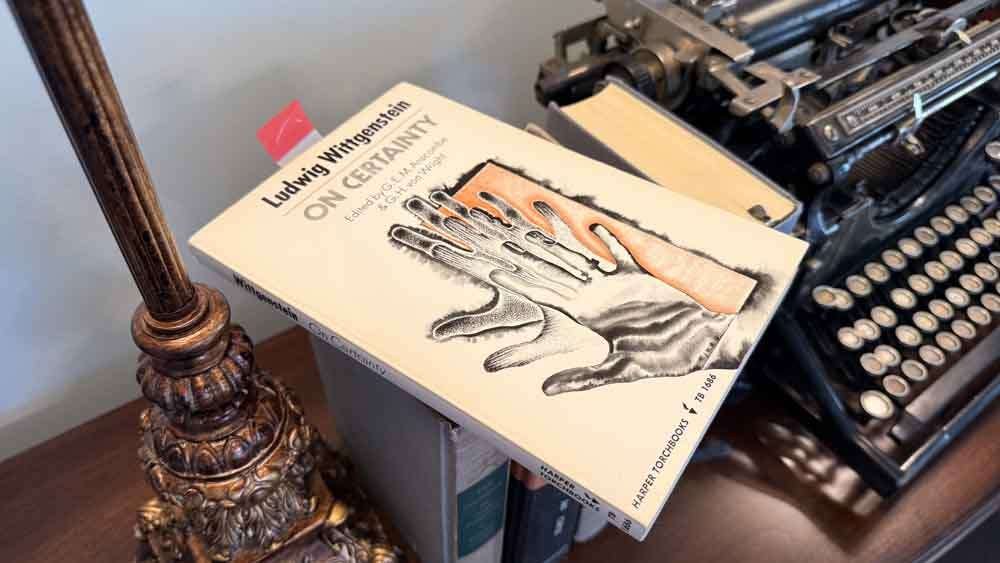
This is the terrain Ludwig Wittgenstein walked into during the last eighteen months of his life. On Certainty is not a finished book. It is a philosophical notebook — 676 numbered remarks, written between 1949 and April 27, 1951, two days before his death. It was never prepared for publication. His literary executors G.E.M. Anscombe and G.H. von Wright assembled it posthumously, and what they gave us is something rarer than a polished treatise: the raw thinking of one of the twentieth century’s most formidable minds as it grappled, with full urgency, with what it means to know anything at all.
The Book That Started the Argument
On Certainty was written in direct response to the British philosopher G.E. Moore, specifically his essays “Proof of an External World” (1939) and “A Defence of Common Sense” (1925). Moore had argued, against Cartesian skepticism, that he could prove the existence of the external world simply by holding up his hands and saying: “Here is one hand, and here is another.” This, Moore believed, constituted a valid proof. We know the external world exists because we can point to it. Common sense, he insisted, is not a philosophical position to be defended — it is simply the ground we all stand on.
Wittgenstein found this both compelling and deeply confused at the same time. He agreed that Moore was onto something — that there is a category of propositions so foundational that doubting them makes no practical or linguistic sense. But he thought Moore’s attempt to prove these things was itself a category error. You cannot prove your own hands exist. Not because the claim is false, but because proof requires a context, a system of rules, a framework of accepted practices — and the existence of your hands is prior to all of that. It is what Wittgenstein called a hinge proposition: the door swings on it; you cannot simultaneously swing the door and examine the hinge.
Hinge Propositions and the Architecture of Belief
The most generative concept in On Certainty is precisely this: hinge propositions. Wittgenstein writes, in remark 341, that the questions we raise and our doubts depend on the fact that some propositions are exempt from doubt, functioning like axles around which our inquiries rotate. These are not beliefs we have consciously adopted. They are not the conclusions of arguments. They are the invisible scaffolding of thought itself.
Consider: you believe that the earth existed before you were born. You have never verified this. You cannot verify it — you weren’t there. And yet you would not describe your acceptance of this as “faith” in any religious sense, nor as a “hypothesis” in any scientific sense. It simply lies outside the domain of doubt. To doubt it would not be philosophical rigor; it would be the suspension of the very language game in which doubt has meaning.
This is Wittgenstein’s deepest move in the book. He is not a skeptic. He is not saying we cannot know anything. He is saying that the structure of knowledge is not a pyramid of justified beliefs resting on a foundation of self-evident truths (the Cartesian model), nor a coherence web of mutually supporting propositions (the coherentist model). It is more like a river and its bed. The water flows — that is inquiry, science, doubt, revision. But the riverbed does not flow; it holds the shape of the river. And crucially: the riverbed is not made of something harder or more certain than the water. It is just older, more embedded, more integrated into the landscape of practice. It can shift — but only slowly, and only as the river moves it over time.
Remark 97 captures this with economy: “The mythology may change back into a state of flux, the river-bed of thoughts may shift. But I distinguish between the movement of the waters on the river-bed and the shift of the bed itself; though there is not a sharp division of the one from the other.”
The Grammar of Doubt
One of the most clarifying threads running through On Certainty is Wittgenstein’s insistence that doubt is not free-floating. Doubt is a move within a language game — a practice — and it requires context, stakes, and intelligibility to function. A doubt that could apply to everything simultaneously is not a philosophical position. It is nonsense wearing the costume of rigor.
This cuts directly at Descartes, the architect of modern epistemology’s anxiety. Descartes, in the Meditations, peeled away everything that could be doubted until he reached the bedrock of cogito ergo sum — I think, therefore I am. From that single certainty, he attempted to reconstruct the edifice of knowledge. Wittgenstein’s reply, scattered across the remarks of On Certainty, is not that Descartes was wrong about the cogito — it is that the project itself was misconceived. You cannot get outside your language, your practice, your form of life, and evaluate your beliefs from nowhere. There is no nowhere. The attempt to doubt everything simultaneously is not more rigorous than ordinary knowing; it is less coherent, because it severs doubt from the very conditions that give doubt its meaning.
Remark 115 makes this plainly: “If you tried to doubt everything you would not get as far as doubting anything. The game of doubting itself presupposes certainty.”
This is not an argument for intellectual laziness. It is a description of how minds actually work — and an implicit challenge to examine which of your unexamined certainties might, in fact, be worth moving to the water rather than leaving permanently in the riverbed.
Knowledge, Language, and the Community of Practice
On Certainty is also, quietly, a book about community. Wittgenstein is insistent that certainty is not a private psychological state — it is not what happens inside a single skull. It is a feature of social practice. We are trained into certainty. We learn, through participation in forms of life, which propositions are treated as hinge propositions by the community we belong to. A child is not taught to doubt that tables exist; the child is trained into practices that presuppose tables. That training is epistemic — it is how knowledge begins.
This has a radical implication that Wittgenstein does not dramatize but allows the reader to draw: the certainties of one form of life may not translate to another. A proposition that functions as a hinge in one community may be genuinely up for question in another. This does not make knowledge relative in the nihilistic sense — it does not mean all propositions are equally groundless. But it means that the shape of knowledge is always partly a portrait of the community that holds it.
For those already interested in how culture, structure, and practice shape what we call truth, this theme connects On Certainty to broader conversations in philosophy of science, anthropology of knowledge, and even to books like Thomas Kuhn’s The Structure of Scientific Revolutions — which, notably, was published in 1962, eleven years after Wittgenstein’s death, and reached strikingly parallel conclusions by a different route.
The Deathbed Quality
It would be dishonest to review On Certainty without acknowledging what it is, formally: a document written by a man who knew he was dying. Wittgenstein was diagnosed with prostate cancer in 1949. He wrote through his illness, at the home of his doctor in Cambridge, until two days before the end. He reportedly said to the doctor’s wife on his final evening: “Tell them I’ve had a wonderful life.”
That context does not sentimentalize the text — On Certainty is not an emotional document; it is rigorous to the last remark. But it lends the book a particular gravity. The question Wittgenstein chose to spend his final intellectual energy on was: what does it mean to know something, and why do we treat some things as beyond all doubt? There is something fitting, even beautiful, about a philosopher returning at the end of his life not to comfort or closure, but to the hardest possible version of the most fundamental question. Not: is there life after death? But: what is the structure of the certainty that underlies all our thinking about everything?
In that sense, On Certainty reads not as a finished argument but as a mind at full power, mid-stride, thinking in public. Philosopher Ray Monk, in his biography Ludwig Wittgenstein: The Duty of Genius, describes the final notebooks as evidence that Wittgenstein was entering entirely new philosophical territory at the moment death interrupted him. Whether he would have refined, retracted, or expanded these ideas is one of philosophy’s irreducible losses.
Who Should Read This Book
On Certainty is not a casual read, but it is not impenetrable. Unlike the Tractatus Logico-Philosophicus — Wittgenstein’s early work, famously dense and aphoristic — the late Wittgenstein writes in a mode that is genuinely exploratory, almost conversational with itself. He circles back. He refines. He says “I want to say…” and then questions whether that is quite right. It has the quality of watching someone think in real time, and that is, paradoxically, more accessible than a polished argument.
Those who will find it most rewarding: anyone who has had the experience of discovering that a belief they considered obvious was, on examination, fragile — a conviction that turned out to be a habit rather than a conclusion. Those who have read and been moved by Nietzsche’s Thus Spoke Zarathustra (reviewed here on the blog) will find in Wittgenstein a useful counterweight: where Nietzsche smashes foundations through force of will, Wittgenstein examines the very concept of foundation with surgical patience. The two books together form a remarkable pair.
Anyone engaged with questions of AI, consciousness, and the nature of machine “knowledge” will also find On Certainty unexpectedly relevant. If knowledge is not a matter of holding justified true beliefs but of participating in practices — of being trained into forms of life — then the question of whether a language model “knows” anything becomes much more interesting, and much more strange. Wittgenstein, who died in 1951, had no way of anticipating the current moment. But his framework for thinking about knowledge, certainty, and practice may be among the most useful tools available for thinking through it clearly.
The Verdict
On Certainty is one of the most honest books in the philosophical canon — honest in the sense that it refuses to dress thinking up as something tidier than it is. It will not give you the reassurance of a conclusion. What it will give you is a finer instrument: a way of noticing which of your certainties are hinges and which are water, and a clearer sense of why that distinction matters more than almost any formal argument you could construct on top of it.
Wittgenstein is not telling you that you don’t know anything. He is telling you something harder and more useful: that the knowing you do without noticing is the most powerful knowing there is — and that until you examine it, you are not fully in possession of your own mind.
You Might Also Like:
- Brave New World by Aldous Huxley — A Review
- Thus Spoke Zarathustra by Nietzsche
- The God Delusion by Richard Dawkins — A Review
Sources
- Wittgenstein, Ludwig. On Certainty. Edited by G.E.M. Anscombe and G.H. von Wright. Harper Torchbooks, 1972. Amazon
- Moore, G.E. “Proof of an External World.” Proceedings of the British Academy, 1939.
- Moore, G.E. “A Defence of Common Sense.” In Contemporary British Philosophy, 1925.
- Monk, Ray. Ludwig Wittgenstein: The Duty of Genius. Free Press, 1990. Amazon
- Descartes, René. Meditations on First Philosophy. 1641.
- Kuhn, Thomas S. The Structure of Scientific Revolutions. University of Chicago Press, 1962. Amazon
- Stanford Encyclopedia of Philosophy — Wittgenstein: https://plato.stanford.edu/entries/wittgenstein/