Darwin said it first. Right there in The Expression of the Emotions in Man and Animals, published in 1872, thirteen years after On the Origin of Species had already upended everything. He noted that the Indian elephant is said sometimes to weep. He didn’t hedge it into oblivion. He put it down and moved on, the way a man does when he’s confident the evidence will catch up with the observation. It didn’t. Not for over a hundred years. Science took a hard left into behaviorism and never looked back — and the emotional lives of animals became the kind of thing serious researchers weren’t supposed to touch.
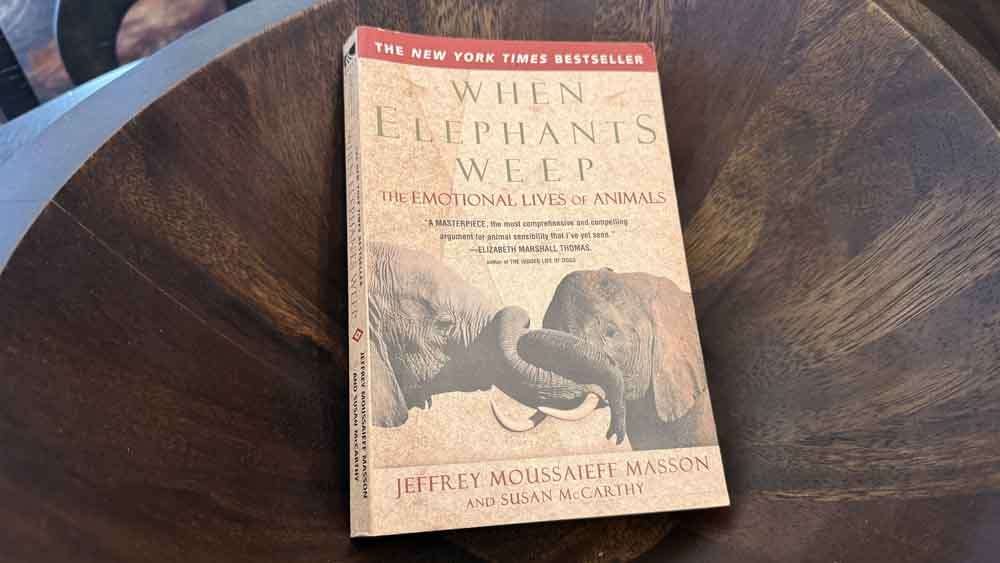
When Elephants Weep: The Emotional Lives of Animals by Jeffrey Moussaieff Masson and Susan McCarthy, published in 1995, is the book that picks up Darwin’s unfinished sentence. It is not a gentle book, though its subject is gentleness. It is a deliberate provocation aimed at a scientific establishment that spent the better part of a century training itself not to ask the obvious question: if natural selection shaped the body, why wouldn’t it shape the inner life?
Darwin and the Road Not Taken
When Darwin published The Expression of the Emotions, the continuity of life was already his central argument. If humans descended from earlier animals, then human traits didn’t appear from nowhere — they deepened and elaborated over time. Emotion, Darwin insisted, was no exception. He documented grief in dogs, affection in primates, fear across dozens of species, with the same methodical attention he gave to beak variation and finch populations.
The behaviorists disagreed. In the early twentieth century, the field drew a hard line: you could study what animals do, never what they feel. Feeling was unmeasurable. Feeling was contamination. The word for attributing human emotions to animals — anthropomorphism — became the worst insult you could level at a colleague. Masson’s argument is that this prohibition was never purely scientific. It was ideological. It protected a set of practices — factory farming, laboratory experimentation, trophy hunting — that would become much harder to justify if the creatures involved were understood to have genuine inner lives.
That is the thread Masson pulls. And once you see it, you can’t unsee it.
What the Animals Actually Do
The middle of the book is where Masson and McCarthy do their real work. Chapter by chapter — love, joy, anger, fear, shame, compassion, loneliness — they stack the evidence. Not proof in the laboratory sense, but something closer to testimony. Jane Goodall’s observations of chimpanzees in grief. Cynthia Moss’s documentation of elephants standing vigil over their dead, returning to the bones of family members years later and handling them with what can only be described as reverence. An elephant attempting to lift a mired baby rhinoceros despite repeated charges from the rhino’s mother — the rhino calf not her kind, not her kin, not her problem. She helped anyway.
Then there is Alex, an African grey parrot with a working vocabulary and apparently the social awareness to use it. When left at a veterinarian’s office, he called out to the humans leaving him behind. The words, according to observers, were: Come here. I love you. I’m sorry. I’m sorry.
You can decide what to do with that. Masson doesn’t demand you conclude anything. He demands you stop pretending the question is closed.
The gorilla Koko, proficient in sign language, played house with dolls when she thought no one was watching. Dolphins mourn. Cows form bonds. Wolves show what researchers who let themselves describe it can only call compassion. Masson and McCarthy accumulate these accounts until the sheer weight of them makes the official scientific silence feel less like rigor and more like willful blindness.
The Psychoanalyst Who Walked Away
Masson’s biography matters here. He was not always an animal advocate. He was a Sanskrit scholar, a trained psychoanalyst, projects director of the Sigmund Freud Archives — and then he found documents suggesting Freud had suppressed his own early findings about childhood sexual abuse, abandoned the seduction theory under social pressure, and reframed trauma as fantasy. Masson published his findings. The psychoanalytic community destroyed him professionally. He lost his appointment, his position, his standing in the field.
He landed, eventually, in the study of animal emotions.
There is something in that arc that the book never states but that you feel running through it. A man who watched an institution choose comfort over truth, who paid the price for saying what the evidence said — that man is not going to be particularly impressed by a scientific consensus built on avoidance. The same mechanism that made Freud’s colleagues look away is the one Masson is identifying in animal behavioral science. The stakes are different. The move is the same.
The Discomfort Masson Earns
This is where the book becomes genuinely difficult. Not intellectually — the argument is clear and the evidence is substantial. Difficult personally. Because Masson doesn’t let you finish the book and return to your life unchanged. The final chapters push the implications outward: toward laboratory experimentation, toward the meat on your plate, toward every zoo and circus and aquarium you have ever walked into and found charming.
I grew up in a world where animals were food and labor and sometimes company. My parents came from a culture where the slaughter of animals was practical, unsentimental, and annual. You did not name what you were going to eat. That is not cruelty — it is a certain honesty, a way of keeping the transaction clear. But Masson complicates even that framing. He is not asking whether you are cruel. He is asking whether the animal knows the difference.
The Kirkus review called the book “entertaining, if undefinitive.” That word — undefinitive — is doing a lot of work. It is technically accurate. Masson himself admits the anecdotes are not proof in the strict experimental sense. But the bar of proof here has been set precisely high enough to keep the question permanently open, which is its own kind of answer. We did not demand the same level of proof before we built the slaughterhouse.
What Got Lost in a Hundred Years
The gap between Darwin’s 1872 observation and Masson’s 1995 book is not a gap of evidence. Researchers in the field — Goodall, Fossey, Cynthia Moss — were watching and documenting all along. The gap is a gap of permission. The scientific community simply decided, early in the twentieth century, that emotional life in animals was not a legitimate subject of inquiry, and that consensus held for generations regardless of what the observers kept seeing.
Emotion, from an evolutionary frame, is not decoration. It is strategy. Fear keeps the organism alive. Love binds the social group. Grief may be the cognitive system processing the loss of something the organism depended on for survival. These are not human inventions. They are adaptations so old they predate us by hundreds of millions of years. The behaviorist prohibition on animal emotion is not just philosophically wrong — it is evolutionarily incoherent. Darwin understood that in 1872. It took the rest of the field until the 1990s to begin catching up, and it needed a disgraced psychoanalyst to force the conversation.
Masson makes this point without making it quite this way. He’s not working from gene-centered theory. He is working from observation. But the conclusions converge.
A Book That Stays With You
When Elephants Weep is not a perfect book. The chapters are uneven. Some of the anecdotes carry more weight than others, and Masson’s advocacy occasionally tips into polemic in ways that give the skeptic exactly the ammunition they want. The Kirkus reviewer was not wrong to note the undefinitive quality. But perfect books rarely do anything. This one does something. It reopens a question that should never have been considered closed, and it does so with enough accumulated evidence that the burden shifts. The question is no longer whether animals have emotional lives. The question is why we spent a century not asking.
Darwin never finished the sentence. Masson and McCarthy finished it for him. Where you go after that is your business.
Sources
- Masson, Jeffrey Moussaieff, and Susan McCarthy. When Elephants Weep: The Emotional Lives of Animals. Delacorte Press, 1995. https://www.amazon.com/When-Elephants-Weep-Emotional-Animals/dp/0385314280
- Darwin, Charles. The Expression of the Emotions in Man and Animals. John Murray, 1872. https://darwin-online.org.uk/content/frameset?itemID=F1142&viewtype=text&pageseq=1
- Kirkus Reviews. “When Elephants Weep.” May 12, 1995. https://www.kirkusreviews.com/book-reviews/jeffrey-moussaieff-masson/when-elephants-weep/
- Goodall, Jane. Endorsement of When Elephants Weep. Penguin Random House. https://www.penguinrandomhouse.com/books/108934/when-elephants-weep-by-jeffrey-moussaieff-masson-with-susan-mccarthy/
- Thomas, Elizabeth Marshall. “A masterpiece.” Endorsement via publisher.
- Masson, Jeffrey. Official author site. http://www.jeffreymasson.com/books/when-elephants-weep.html