Ancient armor materializes inside a Rochester gallery. A Smithsonian exhibition on American democracy sets up in a rural Tennessee library. A curated survey of Japanese Edo-period prints finds a temporary home inside a Texas university. These are not flukes or compromises — they are the deliberate architecture of a cultural movement that has been reshaping how communities experience art, history, and antiquity for decades. Museum-curated traveling exhibitions, and the pop-up festivals that bring institutional-grade art and artifacts into public community spaces, represent one of the most democratically vital innovations in modern cultural life.
The walls of great museums were always porous, if you looked closely enough. The question being answered more urgently today is: what happens to a community when world-class curatorial intelligence comes to them?
The Oldest Ambassador in the Room
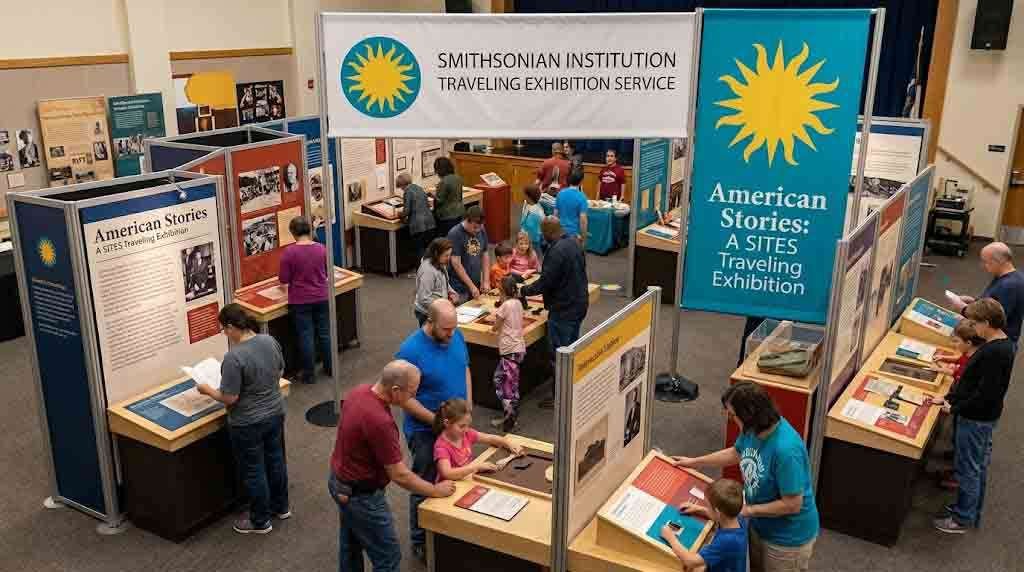
No organization has answered that question more systematically than the Smithsonian Institution Traveling Exhibition Service, known as SITES. Founded more than 65 years ago, SITES is the oldest traveling exhibition operation in the world. Each year, it travels approximately 40 exhibitions to hundreds of American cities and towns, where they are viewed by millions of people. Its venues span mainstream museums, university galleries, science centers, botanical gardens, aquariums, libraries, community recreation centers, and municipal buildings — wherever people live, work, and gather.
The range is not accidental. It reflects a foundational belief that curatorial expertise should not be tethered to geography or income. SITES’ Museum on Main Street program, launched as a pilot with a single exhibit and five states, had by 2017 welcomed Smithsonian exhibitions into nearly 1,700 rural communities in 48 states and Guam. Its most recent initiatives include Voices & Votes: Democracy in America, which toured through libraries and historical societies in 2024 and 2025, using large-scale images, audio recordings, and artifacts to explore American democracy from the Revolution to the present. In New Hampshire, River Valley Community College hosted the Smithsonian’s Crossroads: Change in Rural America exhibition from October through December 2024, pairing it with community roundtables on workforce development and creative entrepreneurship — proof that a traveling exhibition, when embedded thoughtfully, can catalyze civic conversation well beyond the gallery walls.
The lesson embedded in SITES’ model is architectural: the institution doesn’t ask communities to come to it. It comes to the community, and trusts the community to rise to the occasion.
The Grand Migration of Permanent Collections
While the Smithsonian has long championed the democratic distribution of art, major international museums have increasingly joined the movement — and the stakes have grown correspondingly higher. The Worcester Art Museum is currently touring 89 pieces from its John Woodman Higgins Armory Collection, one of the largest collections of arms and armor in the Americas, to venues including the Memorial Art Gallery in Rochester, NY through March 2026. The same institution recently sent 150 prints and paintings from its Edo-period Japanese collection — works by Katsushika Hokusai and Utagawa Hiroshige — on the road to institutions across the United States and Asia.
The United States Holocaust Memorial Museum has committed its Americans and the Holocaust traveling exhibition — a 1,100-square-foot survey challenging assumptions about American awareness during the genocide — to 100 libraries across the country between 2021 and 2026, in partnership with the American Library Association. The exhibition touches communities from Stony Brook to Hawaii, from rural Arkansas to Wilmington, Delaware. It arrives not as a soft cultural amenity but as a provocation: a mechanism for forcing communities to reckon with their own historical relationship to atrocity and inaction.
This is the double promise of the traveling exhibition. It brings beauty and craft to spaces that might otherwise never host them. And it brings discomfort — the intellectual friction that is the precondition for genuine learning.
Antiquities in Motion: The Case for Bringing the Ancient World to Local Spaces
Among the most compelling category of traveling exhibitions are those involving antiquities — objects that carry the physical weight of centuries. The Getty Villa in Los Angeles has maintained a long-running exhibition of Egyptian sculptures through January 2027. The British Museum’s current Sufi: Life and Art exhibition, running through July 2026, has already generated plans for international travel. The Museum of Fine Arts in Budapest is currently hosting a survey of first Chinese emperors’ terracotta warriors. The Louvre mounted a landmark Jacques-Louis David retrospective in 2025 that, by consensus of the critical community, is unlikely to be repeated in a generation.
These are not small objects or minor histories. They are the primary artifacts of human civilization — and the institutions that hold them are increasingly asking whether those artifacts can be shared more widely without being diminished. The answer, structurally and philosophically, is yes. A Roman sculpture carries its authority into a community center as readily as it does into a marble gallery. The patina of 2,000 years does not care about the address.
The American Journal of Archaeology maintains a comprehensive calendar of current and upcoming exhibitions involving ancient cultures — a resource worth bookmarking for anyone tracking where the ancient world is traveling in the present one.
Long Island’s Living Exhibition Ecosystem
Long Island is not a passive recipient of traveling culture. It is an active participant in a regional ecosystem of institutions that both receive and generate exhibition content. The Long Island Museum at 1200 Route 25A in Stony Brook — a Smithsonian Affiliate — is currently preparing exhibitions tied to the 250th anniversary of the American Revolution, with programming anchored to the Island’s specific role in the fight for independence. It has also participated in the “A New Agora for New York” project, a humanities discussion initiative using the Smithsonian’s Voices & Votes as a launchpad for community dialogue about American identity.
The Parrish Art Museum in Water Mill is mounting a year-long series of exhibitions in 2025-2026 tied to the nation’s founding values. Its recent presentation of Nina Yankowitz: In the Out/Out the In — organized by the Museum of Fine Arts in St. Petersburg, Florida, and traveling to the Parrish — explicitly recognized Yankowitz’s importance to Long Island’s East End art community: a traveling exhibition returning something of its original formation back to the place that helped shape it.
The Nassau County Museum of Art in Roslyn Harbor operates one of the most significant regional exhibition programs in the tri-state area, rotating major shows through its 145-acre estate while serving as a democratizing force for Long Island residents who might not otherwise engage with world-class visual art regularly. Its current Real, Surreal, and Photoreal exhibition runs through March 2026. The Heckscher Museum of Art in Huntington recently hosted a roundtable on three pathbreaking American sculptors — Emma Stebbins, Edmonia Lewis, and John Rhoden — tracing their journeys across exhibitions and archives in ways that only institutional collaboration makes possible.
What these institutions share is an understanding that Long Island is not a satellite of New York City’s cultural life. It is a distinct cultural ecosystem with its own history, its own artistic lineage, and its own appetite for serious engagement with the art and artifacts of the wider world.
The Economics of Art on the Move
The movement of art through communities is not merely a cultural gift. It is a measurable economic engine. According to Arts & Economic Prosperity 6, the most comprehensive national study of its kind, conducted by Americans for the Arts, the nonprofit arts and culture industry generated $151.7 billion in economic activity in 2022 — supporting 2.6 million jobs, generating $101 billion in personal income, and producing $29.1 billion in tax revenue. The average attendee at a cultural event spends $38.46 per visit beyond the cost of admission — at local restaurants, parking garages, retail stores.
Cultural travelers, specifically, stay at their destinations 60 percent longer and spend 60 percent more than other travelers, according to data cited by the Americans for the Arts. Chicago’s Cows on Parade — a temporary public art installation — brought an estimated two million additional visitors to the city during its three-month run and generated approximately $500 million in associated spending. One store reported $40,000 over its weekly projections during that period alone.
The lesson is not subtle: when institutional art enters a community space, it doesn’t just elevate the cultural temperature. It drives foot traffic, extends stay length, and generates commerce for every business in its gravitational field. A traveling exhibition at a library draws diners to the diner across the street. A pop-up antiquities festival draws families who then browse the shops, fill the parking lots, and return to neighborhoods that they had not previously considered destinations.
For North Shore Long Island, a region whose real estate values are inseparable from perceived quality of life, the presence of institutional cultural programming is not incidental to property desirability. It is foundational to it.
What Makes a Traveling Exhibition Transcend the Ordinary
Not every box of artifacts shipped across state lines constitutes a meaningful cultural event. The traveling exhibitions that become genuinely transformative share certain qualities. They carry intellectual specificity — a thesis, an argument, a curatorial perspective that demands engagement rather than mere observation. They bring educational infrastructure: wall text that contextualizes, programming that activates, and facilitating materials that help host institutions extend the exhibition’s reach into schools, libraries, and civic organizations.
The Bedford Gallery in Walnut Creek, California, has built its entire institutional identity around this model — producing modular, traveling exhibitions that come with educational guides, press kits, and installation instructions calibrated to venues of all sizes, from community art spaces to large-scale museums. The Kauffman Museum received a 2025 Award of Excellence from the American Association of State and Local History for its traveling exhibit A Day With the Birds: Community Science & the Audubon Christmas Bird Count — a recognition that the standard of craft applied to the exhibition itself matters as much as the content it carries.
The best traveling exhibitions are not diminishments of their permanent counterparts. They are reconfigurations — art and artifact freed from the expectation of a formal pilgrimage, brought instead to the streets where history was lived and the libraries where communities gather to understand themselves.
The Gift of Proximity
There is something philosophically distinct about encountering a 3,000-year-old artifact in a space that is already yours — your library, your community center, your town’s main street exhibition hall. The great museums of the world were built, in part, to sanctify the objects they hold: to communicate, through the grandeur of their architecture, that what lives inside deserves reverence. There is value in that framework. There is also a cost. The museum as temple creates distance. It filters its audience by geography, income, and cultural comfort.
The traveling exhibition dismantles that filter without diminishing the object. The ancient sculpture does not become less ancient because it stands inside a community library. The Holocaust artifact does not lose its moral gravity because it arrived in Stony Brook rather than Washington. What changes is not the object’s authority — it is the audience’s access to it. And access, across the span of cultural history, has always been the precondition for impact.
Communities that engage consistently with serious art and serious history develop what scholars of public culture sometimes call civic capacity — the ability to hold complicated narratives, to reason across time, and to recognize themselves as participants in something larger than the immediate present. The traveling exhibition, at its best, is not a cultural amenity. It is a civic infrastructure. It builds the kind of community that can sustain the institutions worth building.
Sources
- Smithsonian Institution Traveling Exhibition Service (SITES). Factsheet.
- Americans for the Arts. Arts & Economic Prosperity 6, 2022. Summary via Arts Consulting Group.
- Americans for the Arts. Arts + Tourism Fact Sheet, 2025.
- Project for Public Spaces. “How Art Economically Benefits Cities.”
- United States Holocaust Memorial Museum. Americans and the Holocaust Traveling Exhibition.
- Worcester Art Museum. Traveling Exhibitions.
- American Journal of Archaeology. Current and Upcoming Museum Exhibitions.
- Long Island Museum. Smithsonian Affiliate, Stony Brook, NY.
- Parrish Art Museum. Water Mill, NY.
- Nassau County Museum of Art. Roslyn Harbor, NY.
- Heckscher Museum of Art. Huntington, NY.
- Bedford Gallery. Traveling Exhibitions Program.
- Kauffman Museum. Traveling Exhibits.
- North Carolina Humanities. Smithsonian Traveling Exhibitions.
- Artsy. “11 Must-See Museum Exhibitions in 2026.”
- Art News. “The 12 Biggest Museum Moments of 2025.”