In a Long Island real estate market where median prices hover around $831,000 and inventory sits at a mere 2.08 months supply, one Suffolk County town consistently outperforms: Smithtown. With a median home price of $940,000 (up from pre-pandemic levels), homes selling in an average of 22 days, and properties receiving an average of 4 offers each, Smithtown isn’t just holding its value—it’s appreciating faster than most of Long Island.
But why? What makes Smithtown the town that families save for, that professionals aspire to, and that real estate agents consistently recommend?
The answer isn’t one factor. It’s the rare convergence of top-rated schools, genuine community feel, central location, family-friendly safety, and that indefinable “quality of life” that makes residents stay for decades. Here’s the comprehensive breakdown of why Smithtown continues to be one of Long Island’s most sought-after towns in 2026—and why that’s unlikely to change anytime soon.
The Foundation: Top-Rated Schools That Justify the Price
Let’s start with what drives Long Island real estate more than anything else: schools.
Smithtown Central School District: The Numbers
Niche 2026 Rating: A overall, A- for individual schools
Key Statistics:
- 9.7:1 student-to-teacher ratio (Smithtown High School West)
- 50.17% of adults hold bachelor’s or graduate degrees
- Graduation rate: 95%+
- College readiness: High
- Extracurricular offerings: Extensive
What this means in practice:
Smithtown offers what Long Island parents desperately seek: A public school education that rivals private options, college preparation that’s genuinely rigorous, and enough extracurricular variety that kids can explore interests without paying for expensive outside programs.
The Schools Within the District
Elementary Schools:
- Accompsett Elementary
- Great Hollow Middle School
- Mills Pond Elementary
- Mt. Pleasant Elementary
- Nesaquake Middle School
- St. James Elementary
- Smithtown Elementary
Middle Schools:
- Accompsett Middle School
- Nesaquake Middle School
- Great Hollow Middle School
High Schools:
- Smithtown High School East
- Smithtown High School West
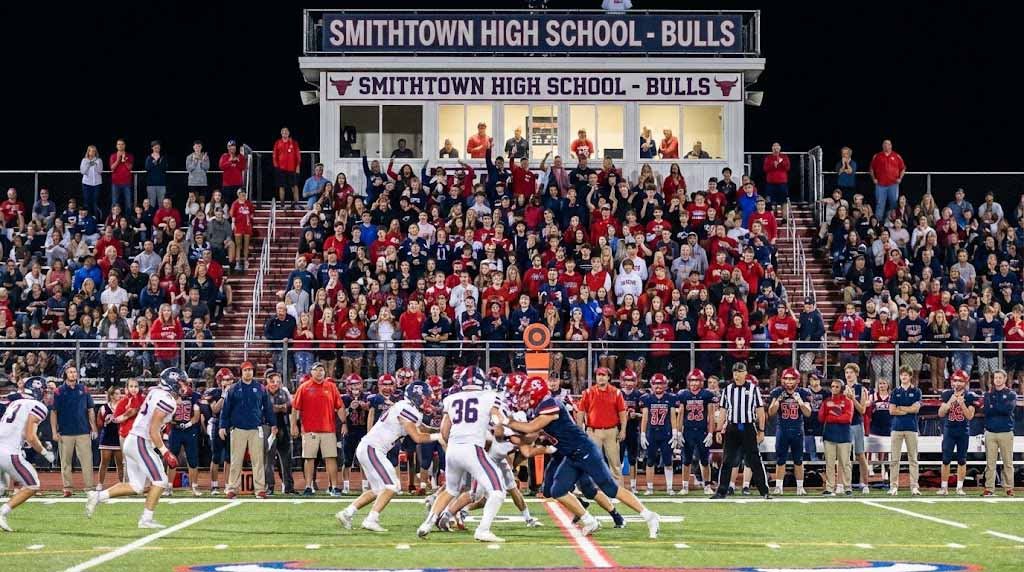
Both high schools have strong reputations, advanced placement offerings, competitive sports programs, and impressive college acceptance rates. The bifurcated high school system means smaller school sizes despite serving a town of 25,000+.
What Parents Actually Say
Beyond the rankings, Smithtown parents cite:
- Teachers who know students by name
- Responsive administration
- Active parent-teacher organizations
- Strong special education support
- Competitive but not cutthroat academic environment
- Excellent music, arts, and athletics
The trade-off: High expectations. This isn’t a “coast through” district. Students are expected to perform, parents are expected to be involved, and the academic culture reflects that.
Location, Location, Central Location
Smithtown occupies a geographic sweet spot that few Long Island towns can match.
The Commute Equation
To Manhattan:
- LIRR Smithtown Station (Port Jefferson Branch): ~50 minutes to Penn Station during peak
- Driving to Queens border: ~45-50 minutes (traffic dependent)
Why this matters: 50 minutes is psychologically manageable for NYC professionals. It’s not convenient, but it’s within the “acceptable commute” window for most people.
Recent enhancement: Grand Central Madison (opened 2023) provides East Side access, making Smithtown viable for midtown east professionals who previously avoided Long Island.
Access to… Everything
Smithtown’s location advantages:
North Shore beaches: 15-20 minutes
(Sunken Meadow State Park, Nissequogue River State Park, Short Beach)
South Shore beaches: 25-30 minutes
(Robert Moses, Jones Beach)
MacArthur Airport: 15 minutes
(Convenient for domestic travel)
Major highways:
- Long Island Expressway (LIE): 10 minutes
- Jericho Turnpike (Route 25): Through town
- Northern State Parkway: 15 minutes
- Sagtikos Parkway: 10 minutes
Shopping/amenities:
- Smithtown has its own commercial districts
- 10-15 minutes to Walt Whitman Shops
- 20 minutes to Smith Haven Mall, Roosevelt Field
- Target, Whole Foods, Starbucks all local
What this means: Smithtown residents can work in Manhattan, weekend in the Hamptons, fly out of MacArthur, reach either shore in under 30 minutes, and shop locally for daily needs. It’s the rare Long Island town that doesn’t feel isolated.
The Safety Factor: Crime Statistics That Reassure
NeighborhoodScout Crime Score: 2 out of 10
(Lower is better—Smithtown is safer than 98% of American communities)
What this translates to:
- Violent crime: Rare (well below national average)
- Property crime: Low (package theft happens, but home burglaries uncommon)
- Safe for kids: Parents comfortable with children walking/biking
Visible community safety:
- Active neighborhood watch programs
- Responsive police department
- Well-lit streets
- Community events that build social cohesion
The subjective feeling: Walk through Smithtown at night and you’ll see joggers, dog walkers, teenagers hanging out. It feels safe, which matters as much as statistics.
Community Character: More Than Just Houses
Here’s where Smithtown differentiates from comparable towns. It’s not just a bedroom community—it has genuine town identity.
Historic Roots That Matter
Founded: 1665
Named after: Richard “Bull” Smith (according to legend, he rode a bull to claim land boundaries)
Historic sites that connect residents to history:
- Caleb Smith State Park Preserve
- Blydenburgh County Park (historic buildings, museum)
- Smithtown Historical Society
- Original Judge’s building
Why this matters: Towns with historical identity feel more cohesive than planned communities. Residents aren’t just living somewhere—they’re part of something.
The Parks & Recreation System
Major parks:
- Caleb Smith State Park: 543 acres, nature center, trails
- Blydenburgh Park: 627 acres, Stump Pond, historic grist mill
- Hoyt Farm Town Park: Athletic fields, playground
- Nissequogue River State Park: Kayaking, fishing
- Multiple neighborhood parks
Recreation programs:
- Smithtown Parks & Recreation offers programs for all ages
- Summer camps
- Sports leagues (youth to adult)
- Cultural events, concerts
- Senior programs
What families appreciate: Kids can be busy year-round without expensive private programs. Parents can meet other families through park activities. Teenagers have places to go.
The “Everybody Knows Everybody” Effect
Population: ~25,600 (large enough for amenities, small enough to feel community)
From NeighborhoodScout: “More residents of the Smithtown North neighborhood live here today that also were living in this same neighborhood five years ago than is found in 96.3% of U.S. neighborhoods.”
Translation: People don’t move to Smithtown temporarily. They move and stay.
What this creates:
- Social continuity
- Generational connections (parents who grew up here move back)
- Institutional knowledge
- Stable property values (demand from people who already know/love town)
Housing Stock: The Good, The Bad, The Expensive
What $940K Gets You
Typical Smithtown home:
- 3-4 bedrooms
- 2-2.5 bathrooms
- 2,000-2,500 square feet
- 0.25-0.5 acre lot
- Built 1950s-1970s (most common), with 1980s-2000s options
Architectural styles:
- Colonials (most common)
- Ranches
- Split-levels
- Some contemporaries
Construction era breakdown:
- Pre-1939: 5.34%
- 1940-1969: 56.42% (majority—post-WWII boom)
- 1970-1999: 30.41%
- 2000+: 7.84%
What this means: Most Smithtown homes are 50-70 years old. Well-maintained but expect:
- Updating needed (kitchens, baths from 1990s-2000s)
- HVAC systems nearing end of life
- Some electrical/plumbing updates needed
The premium for turnkey: Updated homes command 15-20% premiums. Dated homes sit longer or sell below ask.
Property Types Breakdown
From NeighborhoodScout:
- Single-family detached: 88.26%
- Large apartment complexes: 6.68%
- Townhouses/attached homes: 2.39%
- Small apartment buildings/conversions: 1.68%
What this means: Smithtown is overwhelmingly single-family. If you want condo/townhouse, options are limited. This keeps inventory tight and supports values.
Homeownership Rate: 86.70%
Why this matters:
- Stability (renters move more frequently)
- Community investment (owners maintain properties)
- School enrollment predictability
- Property value support
Lot Sizes: Space That’s Increasingly Rare
While not massive by old Long Island standards, Smithtown lots (0.25-0.5 acre typical) offer:
- Actual yards (kids/dogs can play)
- Landscaping opportunities
- Privacy from neighbors
- Parking for multiple cars
Comparison: Many Nassau County suburbs have 50×100 lots (0.11 acres). Smithtown’s slightly larger lots feel noticeably more spacious.
The Demographic Sweet Spot
Population: 25,629
Large enough to support:
- Multiple supermarkets, restaurants
- Variety of schools (4 elementary, 3 middle, 2 high)
- Parks & rec programs
- Local businesses
Small enough to maintain:
- Community feel
- Low crime
- Manageable traffic (mostly)
Median Age: 46.1
What this tells us:
- Established families (not young singles or retirees)
- Mix of parents with school-age kids and empty nesters
- Stable, not transient
- Economically productive age group
Income Levels
Median household income: ~$170,000
Per capita income: $65,014
What this means:
- Dual-income professional families typical
- Teachers, healthcare workers, managers, small business owners
- Mix of NYC commuters and local employment
- Enough income to support $940K median home price
Ethnic Diversity (Moderate)
Racial/Ethnic Breakdown:
- White (Non-Hispanic): 79.7%
- Asian: 3.5%
- Hispanic: ~11% (various backgrounds)
- Two or more races: 5%
- Black/African American: 3.32%
What residents say: More diverse than stereotypical Long Island suburb, less diverse than Queens. Community is welcoming but homogenous enough that minority residents notice.
Ancestral Heritage
Top ancestries:
- Italian: 34.0%
- Irish: 24.8%
- German, English, Polish follow
Why this matters: Strong Italian and Irish heritage creates cultural cohesion, neighborhood festivals, and specific community character.
The Cost of Living: What Buyers Need to Know
Property Taxes: The Smithtown Reality
Average annual property tax: $14,000-$18,000 (for median-priced home)
Breakdown:
- School district: ~60-65%
- Town/general: ~20-25%
- Library, fire, other: ~10-15%
Monthly impact: $1,167-$1,500 added to mortgage payment
Is it worth it?
- Top schools (yes, for families with kids)
- Excellent services (parks, library, safety)
- Property value support (taxes correlate with desirability)
Long-term consideration: Property taxes increase annually (~2-4%). Budget accordingly.
Total Monthly Housing Cost (Typical)
For $940,000 home with 20% down:
- Principal & Interest (6.15% rate): $4,572
- Property Taxes: $1,250
- Homeowners Insurance: $250
- PMI: $0 (20% down)
- Total: $6,072/month
Income required (28% DTI rule): $260,000 household income
Reality: Most Smithtown buyers earn $180K-$220K and push DTI to 35-40%.
Other Costs of Living
Utilities:
- PSEG electric/gas: $250-$400/month (depending on home size, season)
- Water: $100-$150/month
- Internet/cable: $150-$200/month
Commuting:
- LIRR monthly pass: ~$350-$400 (Zone 7)
- Gas/tolls if driving: $400-$600/month
Smithtown-specific:
- Beach parking permits (local beaches): ~$50-$100/season
- Parks & rec programs: Reasonable ($50-$300/season depending on activity)
Quality of Life Factors: Why People Stay
The Intangibles
Walkability:
- Not a “walkable town” by urban standards
- Can walk to local shops in some neighborhoods
- Walk Score: Moderate (car still necessary for most errands)
Traffic:
- Manageable compared to western Long Island
- Route 25/Jericho Turnpike can backup during rush hour
- LIE access means quick escape to anywhere
Dining & Entertainment:
- Local restaurants (mix of chain and independent)
- Not a foodie destination but solid options
- Close to Huntington Village (20 mins) for more variety
Healthcare:
- St. Catherine of Siena Medical Center (Smithtown)
- Stony Brook University Hospital (20 minutes)
- Numerous medical practices locally
Library System:
- Smithtown Library: Excellent system, multiple branches
- Programs for all ages
- Community hub
The “Raise Your Kids Here” Factor
Parents consistently cite:
- Safe neighborhoods (kids walk/bike independently)
- Other families everywhere (playdate opportunities)
- Quality schools (don’t need to pay private)
- Parks/sports (keeps kids active/social)
- Suburban bubble (sheltered from city issues)
The flip side: Some find it too insulated. Teenagers complain about lack of excitement. Young singles find limited social scene.
The “Retire Here” Factor
Empty nesters and retirees stay because:
- Paid-off homes (or significant equity)
- Familiar community
- Healthcare nearby
- Parks/recreation for active seniors
- Property tax exemptions for 65+ (STAR, senior exemption)
The question: Do they downsize?
- Some move to condos/townhouses locally or nearby
- Many stay in family homes (cheaper than moving given low mortgage/paid off)
- Property taxes still high (even with exemptions)
The Market Reality: Supply vs. Demand
Why Inventory Stays Tight
Reasons people don’t sell:
- Low mortgage rates (locked in 2020-2021)
- Love the community (no reason to leave)
- Kids in school (don’t want to disrupt)
- Built equity (but new home would cost more)
Reasons people do sell:
- Downsizing (kids graduated, house too big)
- Job relocation (only factor that overrides all others)
- Divorce/life changes
- Upgrading within Smithtown
Net effect: More buyers than sellers, every year.
Buyer Competition
February 2026 data:
- Average 4 offers per home
- Selling in 22 days
- Sold-to-list ratio: ~100-105% (some go over asking)
What this means:
- Pre-approval essential
- Offer within 48 hours of seeing home
- Competitive terms (appraisal gap coverage, flexible closing)
- Information-only inspections becoming common
Price Trajectory
Historical context:
- Pre-pandemic (2019): ~$600K median
- Pandemic peak (2021): ~$850K median
- Q1 2026: ~$940K median
Appreciation rate: 5-10% annually (varies by year, well above Long Island average)
Will it continue?
- Short term (2026-2027): Likely 3-5% annual appreciation
- Long term: Depends on rates, broader economy
- Downside risk: Low (unless major economic collapse)
The Challenges: What Buyers Should Know
It’s Expensive (And Getting More So)
No sugarcoating it:
- $940K median means $188K down payment (20%)
- $6,000+/month housing costs
- Requires top 15-20% income to afford
- Locks out first-time buyers unless family help
It’s Competitive
Reality of buying in Smithtown:
- You will lose bids (probably multiple)
- Perfect homes get 6-8 offers
- Cash buyers have advantage
- Need to be decisive (can’t “think about it overnight”)
Housing Stock Is Aging
Maintenance realities:
- 50-70 year old homes need upkeep
- Budget $5K-$15K annually for maintenance/repairs
- Major systems (roof, HVAC, water heater) have lifespans
- Dated kitchens/baths common
Commute Is Real
50-minute train ride sounds manageable until:
- You’re doing it 5 days/week
- Add door-to-door time (10-15 mins each end)
- Factor in delays, weather, schedule changes
- Real commute: 75-90 minutes each way
That’s 12.5-15 hours per week. Over a year: 650-780 hours. Nearly a full month of your life on trains.
It’s Not Diverse
If diversity matters to you:
- Town is 80% white
- Limited ethnic restaurants/cultural offerings
- Some minority residents report feeling “other”
Teens Can Feel Trapped
The complaint:
- Nothing to do (compared to city)
- Car-dependent (can’t get anywhere without parents/driving)
- Same people since kindergarten (everyone knows everyone)
- Limited job opportunities for teenagers
The Verdict: Who Should (and Shouldn’t) Buy in Smithtown
Smithtown Is Perfect For:
Families with school-age children:
- Top schools justify premium
- Safe neighborhoods for independent play
- Community programs keep kids busy
- Other families everywhere (social opportunities)
Professionals with stable careers:
- Can afford $170K+ household income requirement
- Comfortable with 50+ minute commutes
- Value work-life balance (suburban vs. city stress)
People who want long-term stability:
- Plan to stay 10+ years (justify cost/effort of moving)
- Want to plant roots, build community
- Value property value stability
Those who prioritize safety and quality of life:
- Low crime = peace of mind
- Green space, parks, recreation
- Community feel vs. anonymity
Smithtown Might Not Be Right For:
First-time buyers on tight budgets:
- $940K median = $188K down payment required
- Total costs exceed $6,000/month
- Better entry-level options elsewhere on Long Island
People who hate commuting:
- 50 minutes each way is real
- Won’t improve (no new infrastructure planned)
- Work-from-home options help but if you must go in 3-5x/week, factor this heavily
Those seeking diversity and culture:
- Homogenous population
- Limited ethnic diversity
- Quiet suburban life (not vibrant urban energy)
Young singles/couples without kids:
- Social scene limited (not like Huntington or Long Beach)
- Premium for schools you’re not using
- Might be better off closer to NYC
Anyone expecting bargains:
- Smithtown is premium-priced and will stay that way
- “Deals” are dated homes that need $100K in work
- Value is long-term, not short-term savings
The Future: Why Smithtown Will Stay Desirable
Fundamentals That Won’t Change
1. Location: Geography doesn’t change. Central Suffolk with access to both shores and NYC will always be valuable.
2. Schools: As long as Smithtown maintains school quality, families will pay premium.
3. Safety: Low crime, strong community investment in safety infrastructure.
4. Housing stock: Limited new construction (town is built-out) means inventory stays tight.
5. Community character: Established identity, long-term residents create continuity.
Risks to Watch
Property tax increases: If taxes rise faster than income, affordability suffers. Smithtown taxes already high; further increases could price out middle-class.
School district changes: If quality declines (budget cuts, teacher turnover, demographic shifts), premium evaporates.
Economic recession: High-priced suburbs suffer most when economy tanks. Smithtown buyers need stable, high income.
Remote work reversal: If companies force return-to-office 5 days/week, 50-minute commutes become untenable for some.
Climate/infrastructure: Long Island faces flood risk, aging infrastructure. Major climate events could impact property values.
The Likely Scenario (2026-2030)
Best guess:
- Smithtown remains top-tier Long Island suburb
- Appreciation 3-5% annually (slowing from recent highs)
- Inventory stays tight (demographic factors unchanged)
- Premium narrows slightly if rates drop (other towns become affordable)
- Schools remain strong (property values support funding)
Smithtown in 2030: Still one of Long Island’s most sought-after towns, still expensive, still competitive, still delivering what families want: excellent schools, safe streets, community feel, and the suburban dream that justifies the premium.
Related Articles:
- Long Island Real Estate Market Update: Q1 2026
- Best Commuter Towns on Long Island for NYC Professionals
- The Complete Guide to Long Island School Districts
- How to Win a Bidding War in a Low-Inventory Market
- Is Smithtown Worth the Premium? A Cost-Benefit Analysis
Sources:
- Redfin Smithtown Market Data (2025-2026)
- NeighborhoodScout Smithtown Analysis
- Niche School District Rankings (2026)
- PropertyShark Q4 2025 Smithtown Report
- Smithtown Historical Society
- U.S. Census American Community Survey Data