
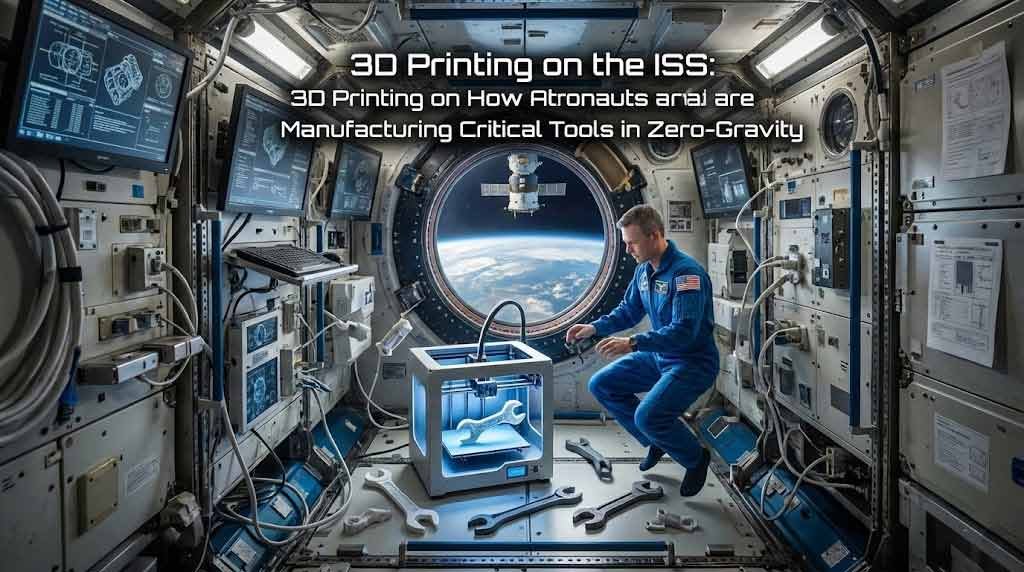
Manufacturing has always been a mirror held up to civilization’s ambitions. The Romans cast bronze in desert heat. The industrial revolution pressed steel into forms that reshaped continents. And now, 250 miles above Earth’s surface, aboard a pressurized aluminum cylinder traveling at 17,500 miles per hour, astronauts are doing something that would have seemed absurd a generation ago — printing the tools they need, on demand, out of nothing but wire, light, and code.
This is not a metaphor. It is not a research prototype gathering dust in a university lab. It is happening right now, and it is one of the most consequential manufacturing leaps since Gutenberg replaced hand-copying with moveable type. The International Space Station has quietly become the most advanced fabrication workshop in human history, and what’s being learned inside it will redefine how we think about making things — not only in orbit, but on the Moon, on Mars, and eventually on factory floors here on Earth.
The Problem That Made This Necessary
To understand why 3D printing in space matters, you first have to sit with the logistics of the problem it solves.
Every kilogram launched from Earth costs, on average, approximately $2,700. A critical spare part for a pump system — a specific valve, a bracket, a threaded fitting — might weigh a few hundred grams. Multiply that by the sheer catalogue of components that could fail on a six-month mission, and you begin to understand why every supply mission to the ISS is a masterwork of prioritization and compromise. You don’t bring what you might need. You can’t. You bring what you calculated you will need, and you pray the calculation holds.
For missions to the Moon or Mars, the equation becomes existential. A resupply mission to the lunar surface takes days. A resupply mission to Mars, depending on orbital alignment, takes anywhere from six to nine months — if one is even available. The Mars transit window opens roughly every 26 months. If something breaks between windows, the astronaut crew must either improvise with what they have or wait. In some failure scenarios, waiting is not an option.
This is the founding logic of in-space manufacturing: rather than launching a vast library of spare parts that may never be used, launch a printer and a spool of feedstock, and manufacture precisely what is needed, when it is needed. NASA estimates this approach could reduce mission launch mass by as much as 30 percent — freeing payload capacity for fuel, food, scientific instruments, and the kind of redundancy that turns close calls into non-events. (NASA Marshall Space Flight Center, ISS Research Program, 2025)
From Plastic Wrenches to Stainless Steel: A Decade of Progress
The story begins in September 2014, when NASA, in partnership with the California-based startup Made In Space, launched the first 3D printer to the ISS. The machine was modest — roughly microwave-sized, using a process called Fused Filament Fabrication, feeding a continuous thread of plastic through a heated extruder onto a tray, layer by layer — but what it demonstrated was profound. Within weeks of installation, a ratchet wrench was designed on the ground, the file transmitted digitally to the station 200 miles above, and the tool was printed and used by the crew. The physical object had been emailed to space.
That wrench was plastic. It was not, by any engineering standard, a high-performance component. But the principle it validated — that you could design something on Earth and manufacture it in orbit within hours — was the keystone of everything that followed.
Made In Space (later acquired and rebranded under Redwire Space) followed the initial printer with the Additive Manufacturing Facility in 2016, a permanent commercial manufacturing installation aboard the ISS capable of printing with a broader range of polymers. The AMF produced functional antenna components, bracket adaptors, and parts used in the station’s oxygen generation system. The Italian Space Agency contributed the Portable On Board Printer in 2015, expanding the research base. And Redwire’s R3DO program pushed further still, developing a material recycler that could melt down waste plastic — used wrenches, spent brackets, packing foam — and convert it back into printing feedstock, moving the ISS toward something approaching a circular manufacturing economy. (3YOURMIND Industry Analysis, 2023)
But plastic, for all its utility, has a ceiling. The critical systems of a space station — pumps, valve housings, structural connectors, electrical components — are metal. And printing metal in zero gravity is a challenge of an entirely different magnitude.
The Metal Breakthrough: August 2024
In January 2024, ESA astronaut Andreas Mogensen installed a 180-kilogram machine inside the Columbus module of the ISS. It had been developed through a collaboration between Airbus Defence and Space, Cranfield University, AddUp, and Highftech Engineering. It was the first metal 3D printer ever designed specifically for microgravity operations. The engineering choices it embodied were not obvious ones.
Metal printing on Earth typically uses powder — fine metallic dust suspended in a chamber, selectively fused by laser into solid form. In zero gravity, powder doesn’t fall to the bed. It floats. It contaminates filters, clogs ventilation, creates hazards. The ESA printer discarded the powder-based approach entirely. Instead, it feeds thin stainless steel wire into a sealed nitrogen-filled chamber, where a high-powered laser — operating at approximately 1,200 degrees Celsius — melts the wire drop by drop, depositing it in precise layers. The nitrogen atmosphere prevents oxidation. Without it, superheated metal near oxygen in a pressurized cabin is a fire scenario no mission planner wants to contemplate.
The engineering challenge didn’t end with the printing mechanism. On Earth, molten metal is guided by gravity — it settles, it flows predictably, it fills voids in ways that thousands of years of metallurgical experience have calibrated. In orbit, nothing settles. The molten material floats. Early engineers feared this would make uniform deposition impossible. The results surprised them. The absence of gravity’s downward pull means the material forms more uniformly in some respects — fewer air bubbles, less porosity, more consistent layer adhesion. Some researchers now suspect that certain components printed in microgravity may actually be structurally superior to their Earth-manufactured counterparts. (Orbitalxploration.com, January 2025)
By August 2024, the ESA printer produced its first fully realized metal object in space: a small round part with cylindrical features, printed in 316L stainless steel. A second object followed in December. The first-ever metal part fabricated in orbit was returned to Earth, where it arrived at the European Space Research and Technology Centre in the Netherlands for analysis. ESA technical officer Rob Postema described the achievement plainly: “If successful, the strength, conductivity and rigidity of metal would take the potential of in-space 3D printing to new heights.” (ZME Science, March 2025)
Firmware updates delivered via the SpaceX CRS-33 mission in September 2025 further refined material flow control, addressing early dimensional tolerances that had produced errors of up to 0.2 millimeters — sufficient, in precision applications, to affect fit and function. By late 2025, industry analysts were projecting routine metal printing aboard the ISS by 2028, with standard deployment on lunar missions by 2032.
The Living Printer: Bioprinting Tissue in Orbit
The most disorienting frontier in this story is not the printing of metal tools. It is the printing of living tissue — and it is happening aboard the same station, in adjacent modules, driven by a logic that turns out to be intimately related.
Bioprinting on Earth is extraordinarily difficult for a reason that has nothing to do with the biology and everything to do with gravity. When you extrude living cells in a hydrogel medium, layer by layer, building toward a three-dimensional tissue structure, the layers slump. Gravity deforms them before they can set. Complex vascular networks — the branching channels through which blood must eventually flow to keep tissue alive — collapse under their own weight before the print can cure. Engineers compensate with scaffolding, armatures of biocompatible material that hold the structure in shape while it matures. But scaffolding introduces its own complications, affecting cell behavior, tissue geometry, and final function.
In orbit, there is no slump. No collapse. The printed structure floats freely in its chamber, maintaining its geometry without any external support. The microgravity environment that makes metal powder printing impossible turns out to be the exact condition that makes scaffold-free bioprinting viable.
Redwire’s 3D BioFabrication Facility, launched to the ISS in 2022, has become the centerpiece of this work. In 2024, researchers from the Uniformed Services University of the Health Sciences used the BFF to successfully print meniscus tissue in microgravity — the first anatomically shaped tissue construct ever fabricated in orbit. The tissue was printed using a collagen-based hydrogel ink mixed with mesenchymal stem cells, cultured aboard the station for two weeks, then returned to Earth for analysis. Shape fidelity was confirmed. Cell distribution was good. The structure held. (Klarmann et al., Life Sciences in Space Research, November 2024)
The same year, Redwire bioprinted live human heart tissue in orbit and returned the sample to Earth. The Wake Forest Institute for Regenerative Medicine followed with an August 2025 investigation, launched aboard SpaceX CRS-33, focused on vascularized liver tissue — constructs with gel-like channels that mimic blood vessel architecture, designed to remain functional far longer than Earth-printed equivalents had managed. “By leveraging bioprinting technologies,” said WFIRM professor James Yoo, “we’ve created gel-like frameworks with channels for oxygen and nutrient flow that mimic natural blood vessels, opening up new possibilities for medical treatments both on Earth and in space.” (ISS National Laboratory, August 2025)
The implications reach far beyond space medicine. The donor organ shortage on Earth is not a logistical problem. It is a biological bottleneck — the human body rejects foreign tissue, and suitable donors are scarce. Bioprinted organs constructed from a patient’s own cells would, theoretically, sidestep rejection entirely. The ISS is serving as a proving ground for techniques that may eventually allow a surgeon on Earth to print a custom knee meniscus, a liver lobe, or a patch of cardiac muscle on demand.
Regolith, Titanium, and the Architecture of Other Worlds
Beyond tools and tissue, the most ambitious application of in-space manufacturing is construction itself — not aboard the ISS, but on the surfaces of other worlds.
The Moon’s surface is covered in regolith: fine, sharp, abrasive particulate, a product of billions of years of micrometeorite bombardment with no atmosphere to smooth the edges. It is chemically rich in titanium oxide, iron, silicon, and aluminum. It is also, potentially, the raw material for printing lunar habitats.
NASA’s Redwire Regolith Print investigation tested simulated lunar regolith as 3D printing feedstock aboard the ISS, establishing initial proof-of-concept for using in-situ planetary material rather than transported raw stock. ICON, the Austin-based construction technology company, has developed the Olympus system — a planetary-scale 3D printing platform that uses a laser process called Laser Vitreous Multi-material Transformation to melt lunar or Martian soil directly into hard, ceramic-like structural elements. In February 2025, ICON launched the Duneflow experiment aboard a Blue Origin rocket to study how lunar regolith simulant behaves in reduced gravity, comparing behavior to actual Apollo-era lunar samples. (3DPrint.com, May 2025)
NASA’s Moon to Mars Planetary Autonomous Construction Technology initiative, headquartered at Marshall Space Flight Center, is coordinating this work with ICON and academic partners toward a goal of fully autonomous construction systems capable of building habitats, landing pads, and roads before human crews arrive. The Mars Dune Alpha simulation habitat at Johnson Space Center — a 1,700-square-foot printed structure serving as a long-duration Mars analog — is already housing crews in simulated planetary conditions.
The philosophical arc here is worth pausing on. Humanity has, for all of its technological history, carried its materials with it when it moved to new places. The colonists brought seeds. The settlers brought tools. The missionaries brought books. The paradigm of in-situ resource utilization — using what is already at the destination — is not merely logistically convenient. It is the thing that transforms exploration into habitation.
What Earth Learns From Orbit
One of the stranger dynamics of space manufacturing research is how consistently the discoveries flow backward — from orbit to the factory floor, rather than the reverse.
The microgravity environment strips away assumptions so thoroughly embedded in terrestrial manufacturing that engineers didn’t know they were assumptions. The way powder behaves when it isn’t pulled down. The way molten metal cools when convection is disrupted. The way living cells organize when they are freed from constant gravitational compression. Each anomaly identified in orbit points toward a corresponding variable in Earth-based processes that had always been present but never isolated.
Metal parts printed in orbit have shown, in preliminary testing, structural characteristics that differ meaningfully from Earth-printed equivalents — and in some cases favorably. The automotive, aeronautical, and maritime industries are watching. Orbital manufacturing platforms — private ventures like Vast Space, alongside government programs — are being positioned not only as supply infrastructure for space missions, but as production facilities for high-value components whose manufacturing quality benefits from the absence of gravity. Fiber optics, semiconductor wafers, pharmaceutical compounds, and biological materials are all candidates for microgravity production. (AMFG Industry Guide, June 2025)
The ISS National Lab has made this bidirectional knowledge transfer a core part of its mandate. The station is not merely a research facility for space exploration. It is a manufacturing laboratory whose lease on a unique physical environment — sustained microgravity, 16 sunrises per day, exposure to the vacuum of space through its external experiments — produces insights that cannot be replicated at any price on the surface.
The Philosophy of Making Without Ground Beneath You
There is a Heideggerian concept — thrownness — the idea that we find ourselves already placed in a world not of our choosing, already conditioned by gravity, by atmosphere, by the physical parameters of the planet that made us. Every manufacturing process ever developed by human beings has been conditioned by Earth’s 9.8 meters per second squared. The lathe, the forge, the CNC mill, the injection molder, the casting bed — all of them assume gravity as a given, as an invisible collaborator in the shaping of material.
What the ISS experiments are revealing, methodically and without fanfare, is that when you remove that collaborator, you are left with different constraints and different possibilities. The metal flows differently. The tissue builds differently. The powder behaves differently. And in confronting those differences, engineers are being forced to understand which aspects of their craft were responses to gravity, and which were responses to material and geometry alone — a distinction that had never needed to be made before.
This is what makes 3D printing in space something more than an engineering milestone. It is a philosophical one. It represents the first time in history that human manufacturing has had to interrogate its own deepest assumptions about the nature of making things — because the ground that everything was built on is no longer there.
The wrench printed in 2014 was plastic, and it was modest. But it was printed in a place where no manufacturing had ever taken place, using materials sent from Earth, by people who had bet that the act of making things did not require a planet beneath them. That bet is paying off.
By 2028, metal 3D printing is expected to become routine ISS operations. By 2032, lunar missions will carry additive manufacturing systems capable of using native materials. By mid-century, if the trajectory holds, the first permanent habitats on another world may be built not by robots shipped from Earth, but by machines that arrived before the humans, printed their shelters from the ground they stood on, and waited.
The unseen detail, as always, is what makes the difference between a tool that works and one that doesn’t — between a mission that succeeds and one that runs out of something that could have been printed.