The River Café — 1 Water Street, Brooklyn, NY 11201
Forty-eight years moored beneath the Brooklyn Bridge, floating on an East River barge that city officials once swore would sink before it served a single plate — The River Café is not merely a restaurant. It is an argument, written in Dover sole and dark chocolate, that conviction can transform a derelict waterfront into one of the most celebrated dining rooms on earth. When Michael “Buzzy” O’Keeffe hauled a decommissioned Baltimore and Ohio Railroad coffee barge to a vacant lot in what was then an industrial no-man’s-land between Brooklyn Heights and the docks, he wasn’t just opening a restaurant. He was performing an act of urban alchemy so audacious that it eventually catalyzed the entire neighborhood now known as DUMBO — Down Under the Manhattan Bridge Overpass — into Brooklyn’s most expensive zip code (Wikipedia, 2026; Edible Brooklyn, 2013).
I’ve spent twenty-five years operating The Heritage Diner on Route 25A in Mount Sinai, and I understand viscerally what it means to anchor a business to a place that others overlook. O’Keeffe’s twelve-year campaign to obtain city permits for a fine dining establishment on a Brooklyn barge makes my own battles with the Suffolk County health department look like a minor disagreement over griddle temperatures. But it’s that very stubbornness — the refusal to abandon a vision when every rational voice counsels retreat — that separates restaurants that survive a quarter century from those that vanish in their first five years. In New York City, roughly eighty percent of restaurants close within that window (Laura Peruchi NYC, 2024). The River Café has now operated for nearly half a century. That isn’t luck. That’s philosophy made tangible.
The Visionary on the Barge: Buzzy O’Keeffe and the Founding
Michael “Buzzy” O’Keeffe was a former Wall Street executive — not a chef, not a hospitality lifer — when he and his friend Roger Baumann stumbled upon the Brooklyn waterfront beneath the bridge in the mid-1960s. The area was desolate. Trucks queued to enter the piers. No residential buildings, no foot traffic, no reason for any sane restaurateur to sign a lease. O’Keeffe saw something else entirely: the most spectacular unobstructed view of the Manhattan skyline that any dining room could ever frame (River Café Official History, 2024; Edible Brooklyn, 2013).
It took twelve years of bureaucratic warfare before the city granted permission to begin construction in 1974 — the same year New York teetered on the edge of bankruptcy. Advisors told O’Keeffe that building on the Brooklyn waterfront was dangerous, that no one from Manhattan would cross the East River for dinner. He proceeded anyway, having the old railroad barge towed to the site and building a restaurant atop it. The River Café opened in the summer of 1977, and the skeptics were proven wrong almost immediately.
What O’Keeffe understood — and what I’ve witnessed firsthand in my own twenty-five years behind the counter — is that a restaurant’s location isn’t just geography. It’s a philosophical statement. When you build where nobody else will, you aren’t competing with the market. You’re creating one. At Marcellino NY, my leather workshop in Huntington, I apply the same principle to briefcase making: hand-saddle stitching English bridle leather in a world that has largely surrendered to machine production. The craftsman and the restaurateur share this conviction — that the inconvenient path, the one requiring patience measured in years rather than quarters, produces something no shortcut can replicate.
The Harvard Business School of the Culinary World
No American restaurant has graduated more world-class chefs than The River Café. The New York Times’ Bryan Miller famously called it “the Harvard Business School of the culinary world,” and the alumni roster justifies the comparison (Edible Brooklyn, 2013). Larry Forgione, Charlie Palmer, David Burke, Rick Laakkonen, Rick Moonen, Dan Budd, Aaron Bashy — each of these chefs passed through O’Keeffe’s kitchen before establishing their own legendary establishments.
The most consequential of these was arguably Larry Forgione, who arrived in 1979 fresh from the Connaught Hotel in London. O’Keeffe famously rejected Forgione’s first proposed menu — French-inflected, following the conventions of the era — and told him flatly that he’d been hired to cook American. Forgione complied, and in doing so launched a revolution. He cultivated relationships with small upstate farmers, insisting on ingredients sourced domestically and regionally at a time when fine dining in New York meant French ingredients and French technique. When a farmer named Paul Kaiser walked into the kitchen carrying a basket of multi-colored eggs from chickens raised outdoors, Forgione saw the answer to a problem that had plagued him: how to serve a chicken with genuine flavor. He convinced that farmer to raise birds the old way — outside, scratching in grass — and within a year, he coined a term for the result that would permanently alter American food culture: “free range” (Cuisinenet, 2022; Edible Brooklyn, 2013).
That phrase was invented at The River Café. The entire farm-to-table movement that now defines Brooklyn’s culinary identity — the movement that makes artisanal producers and small-farm sourcing a baseline expectation rather than a novelty — traces a significant portion of its DNA to what happened on O’Keeffe’s barge in the early 1980s. The River Café was also the first restaurant in New York to name specific farms and varietals on its menu, a practice now ubiquitous in fine dining worldwide. Meanwhile, sommelier Joseph “Joey D” DeLissio stocked the wine cellar with premium Napa Valley bottles at a time when every serious wine list in Manhattan was exclusively French territory, pioneering an American wine program that predated the broader California wine boom by years (River Café Official History, 2024).
Executive Chef Brad Steelman and the Seasonal New American Menu
Brad Steelman has helmed The River Café’s kitchen since 2000, making his tenure one of the longest of any executive chef at a Michelin-recognized New York restaurant. His approach is less flamboyant than some of his predecessors but rooted in the same foundational principle O’Keeffe established at the beginning: the finest American ingredients, prepared with technical precision and classical restraint, allowed to speak for themselves (OpenTable, 2025; Michelin Guide, 2025).
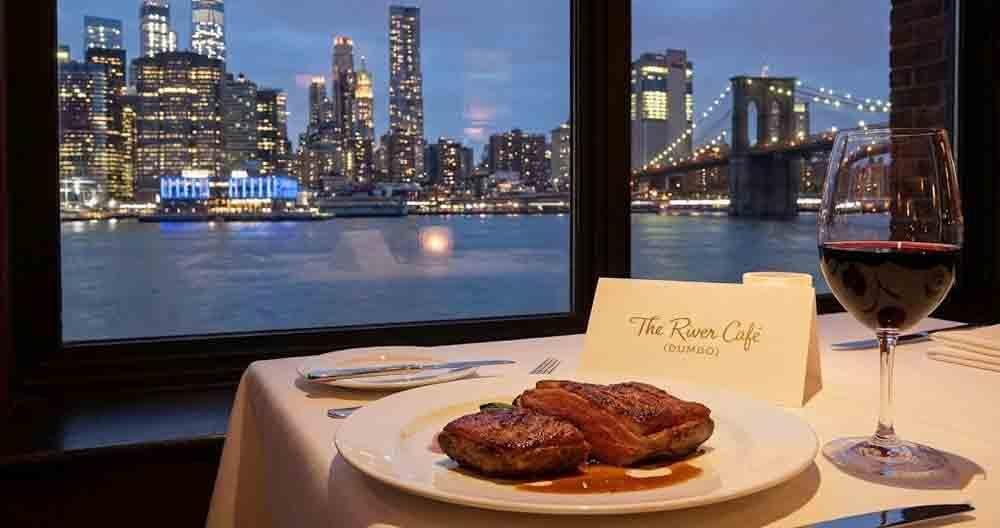
The current dinner menu — a prix fixe, three-course affair — opens with appetizers that showcase Steelman’s commitment to provenance. Hudson Valley duck foie gras arrives with warm griddled toast batons, duck prosciutto, shallot jam, and a spiced maple cider reduction. Pacific blue shrimp and Alaskan King Crab sit on a bed of leek fondue with whipped corn hominy, finished tableside with a pour of smoked shrimp jus. Nantucket Bay scallop ceviche pairs with mango, lime, Australian abalone in citrus ponzu, and Skookum oysters on the half shell with cucumber champagne mignonette. The slow-cooked Heritage pork belly — seared alongside a Maine sea scallop with pink pineapple, toasted macadamia, and smoky pork jus — demonstrates the kitchen’s ability to balance richness with acidity, a skill I appreciate deeply as someone who has spent decades calibrating the seasoning of cast-iron griddles for Heritage Diner burgers.
Main courses include Dover sole in Burgundy truffle sauce and preparations of duck, rabbit, and premium beef that rotate seasonally. The dessert course features The River Café’s most iconic creation: the Chocolate Brooklyn Bridge, a dark chocolate marquise sculpted in the shape of the bridge itself, served with passion fruit ice cream, banana-macadamia ganache, and banana spuma. It has been ordered at birthdays, anniversaries, and engagements for decades, and it remains the single most photographed dessert in Brooklyn (GAYOT, 2024; OpenTable, 2025).
The restaurant has accumulated a staggering list of accolades: a Michelin Star, the Restaurant Hall of Fame Award, the Ivy Award of Distinction from Restaurant and Institutions Magazine, the Distinguished Restaurants of North America Award, the New York Parks Council Award, the Municipal Arts Society Award, multiple Wine Spectator Awards, and selection by the French culinary guide Gault Millau as one of the five best restaurants in New York (River Café Official History, 2024).
Dom Salvador: The Godfather of Brazilian Soul at the Steinway
Every great restaurant has a soul beyond its kitchen, and at The River Café, that soul has sat at a Steinway grand piano near the windows overlooking the East River for nearly half a century. Dom Salvador — born Salvador da Silva Filho in Rio Claro, Brazil, in 1938 — began his residency at The River Café in 1977, the same year the restaurant opened. It is widely regarded as the longest continuous musical residency in New York City history, surpassing even Bobby Short’s legendary tenure at Café Carlisle (Wax Poetics, 2021; Jazz Is Dead, 2022).
Salvador’s backstory reads like a novel that no editor would believe. He was one of eleven children. He helped create bossa nova. He mentored Elis Regina. He performed with Jorge Ben. He formed the pioneering Afro-Brazilian soul group Abolição during the height of Brazil’s military dictatorship, recording the landmark album Som, Sangue e Raça in 1971 — a record that laid the groundwork for the entire Brazilian funk movement and later influenced Banda Black Rio. He served as Harry Belafonte’s musical director, performing for Queen Elizabeth II’s Silver Jubilee. And then, in 1977, he walked into a barge restaurant under the Brooklyn Bridge and sat down at the piano (Jazz Foundation of America, 2021; Local 802 AFM, 2006).
For over four decades, Salvador performed five nights a week, drawing from a repertoire of approximately four thousand jazz standards, accommodating patron requests, and playing with the understated mastery of a man who had spent his entire life in music. He commuted from Port Washington on Long Island — taking the train to Penn Station, then the subway to Brooklyn, returning home around two in the morning. Tony Bennett, Frank Sinatra, and Billy Joel have all listened to him play between courses (Grokipedia, 2024). When Michael O’Keeffe was asked about Salvador’s artistic freedom at the restaurant, his response was characteristically direct: he can do whatever he wants.
As someone who values the patina of time in everything from leather to relationships, Salvador’s story resonates profoundly. At Marcellino NY, I tell clients that a briefcase made from English bridle leather takes years to develop its full character — the grain opens, the surface mellows, the color deepens with handling. Dom Salvador at The River Café is that principle made human. His music didn’t just accompany the dining experience; it became inseparable from the institution’s identity, a living artifact of commitment and craft.
Surviving Sandy: Resilience Written in Floodwater and Mold
On October 29, 2012, Hurricane Sandy drove a catastrophic storm surge up the East River and directly into The River Café. The flooding corroded electrical wiring, destroyed the restaurant’s collection of antiques, ruined the piano, spoiled food and wine inventories, and saturated the walls with moisture that later bred extensive mold requiring full wall replacement. The restaurant — which had operated continuously for thirty-five years — went dark (Wikipedia, 2026; Edible Brooklyn, 2013).
The closure lasted over a year. O’Keeffe initially hoped to reopen by the fall of 2013, perhaps on the anniversary of the storm or around Thanksgiving, but the damage proved more extensive than anticipated. The River Café finally reopened in February 2014 with a refreshed wine program and a dining room rebuilt to the same exacting standards that had defined it since 1977. The Michelin Guide immediately reinstated its star (Wikipedia, 2026).
In an industry where a three-month closure frequently means permanent death, The River Café’s recovery from Sandy is a masterclass in institutional resilience. Any restaurateur who has survived a crisis — a fire, a flood, a pandemic — understands the psychological toll of watching your life’s work submerged. I remember watching Long Island businesses shutter permanently after Sandy, establishments that lacked either the capital or the conviction to rebuild. O’Keeffe possessed both, and the fact that The River Café reopened not diminished but renewed speaks to something deeper than financial resources. It speaks to a relationship between a man and a place that transcends the transactional calculus of profit and loss.
The Garden, the View, and the Art of Occasion
Approaching The River Café on foot means crossing cobblestone streets and walking through a garden that looks, as one writer memorably observed, as though it were airlifted from a Thomas Kinkade painting — fairy lights threaded through every tree, lush plantings framing the path, the massive steel geometry of the Brooklyn Bridge arching overhead. Before a single plate arrives, the experience has already begun (The Infatuation, 2025; Gourmadela, 2016).
Inside, the dining room maintains a deliberate formality that has become increasingly rare in New York. Jackets and collared shirts are required for gentlemen; ties are preferred. Casual jeans, athletic attire, and sandals are not permitted. In an era when most fine dining establishments have relaxed their dress codes to the point of irrelevance, The River Café’s insistence on sartorial standards isn’t anachronistic — it’s a curatorial choice, preserving the atmosphere that makes a Tuesday dinner feel like an event. Floor-to-ceiling windows frame the Manhattan skyline. White tablecloths anchor generous floral arrangements. Nightly live piano music fills the room. The overall effect is a restaurant that functions less as a place to eat and more as a stage for the important moments of human life: engagements, anniversaries, milestone birthdays, reconciliations, the dinner where someone finally says the thing they’ve been meaning to say for years (Michelin Guide, 2025; OpenTable, 2025).
Jennifer Lawrence and Cooke Maroney held their engagement party here in 2019, with Emma Stone among the attendees (Wikipedia, 2026). But the celebrity anecdotes, while colorful, are secondary to the deeper truth about The River Café’s social function. This is a restaurant where ordinary people mark extraordinary passages. The couple celebrating their twenty-seventh wedding anniversary. The family returning from London for the third consecutive year to honor a father’s birthday. The grandmother in her nineties who remembers when Brooklyn was still a place Manhattanites refused to visit for dinner.
That social function — the restaurant as witness to a community’s private rituals — is something I think about constantly as Paola and I prepare to launch Maison Pawli, our boutique real estate venture on the North Shore, in 2026. Property value is driven by many factors: school districts, commute times, tax rates. But culture — the presence of institutions that give a neighborhood its emotional architecture — is the factor that real estate spreadsheets consistently fail to capture. The River Café didn’t just benefit from DUMBO’s gentrification. It caused it. O’Keeffe’s barge was the first bright spot in a neighborhood that had nothing going for it, and the luxury apartments, tech startups, and artisanal cafés that now define the area all followed the trail he blazed.
Practical Information and Contact Details
Address: 1 Water Street, Brooklyn, NY 11201 (under the Brooklyn Bridge, DUMBO)
Telephone: (718) 522-5200
Website: rivercafe.com
Reservations: Available via OpenTable or directly through the restaurant’s website. Reservations accepted from same-day to one year in advance (Valentine’s Day excluded). Request a window table at time of booking for optimal skyline views at sunset.
Hours (as of early 2026): Wednesday – Sunday: 5:00 PM – 9:30 PM Monday – Tuesday: Closed
Dress Code: Jackets and collared shirts required for gentlemen; ties preferred. Casual jeans, athletic attire, and sandals are not permitted.
Parking: Valet parking available for guests with reservations. If arriving by taxi, insist your driver take you past the cobblestones directly to the front door roundabout.
Transit: A/C train to High Street; 2/3 train to Clark Street; F train to York Street; Bus B25 to Old Fulton Street/Cadman Plaza West.
Private Events: The Terrace Room accommodates 30–100 guests for weddings, corporate dinners, and private celebrations. Contact: privateevents@rivercafe.com
Social Media: @therivercafe on Instagram (97K+ followers)
Delivery: The River Café does not offer delivery or takeout — this is an experience that requires your physical presence.
Nearly five decades after Buzzy O’Keeffe convinced New York City to let him build a restaurant on a barge that bureaucrats swore would sink, The River Café remains moored beneath the Brooklyn Bridge, unchanged in its essential conviction that dining should be an act of deliberate beauty. The kitchen has been a launching pad for chefs who reshaped American cuisine. The piano bench held a Brazilian jazz master whose residency outlasted entire eras of the city’s cultural life. The dining room survived a hurricane that would have destroyed any institution lacking the will to rebuild. And the view — that staggering, cinematic panorama of the Manhattan skyline reflected in the East River at dusk — remains as arresting today as it was when the neighborhood was nothing but trucks and vacant lots.
As someone who builds briefcases designed to last a hundred years and runs a diner that has served the same community for a quarter century, I recognize The River Café for what it truly is: proof that the unseen details — the twelve years of permit battles, the farmer persuaded to raise chickens differently, the pianist who showed up five nights a week for four decades, the walls rebuilt after the flood — are what separate a restaurant from a monument. O’Keeffe built both.
Peter — Heritage Diner, Mount Sinai | Marcellino NY, Huntington | Maison Pawli, 2026 Peter holds graduate degrees in Philosophy from Long Island University and The New School in New York City.