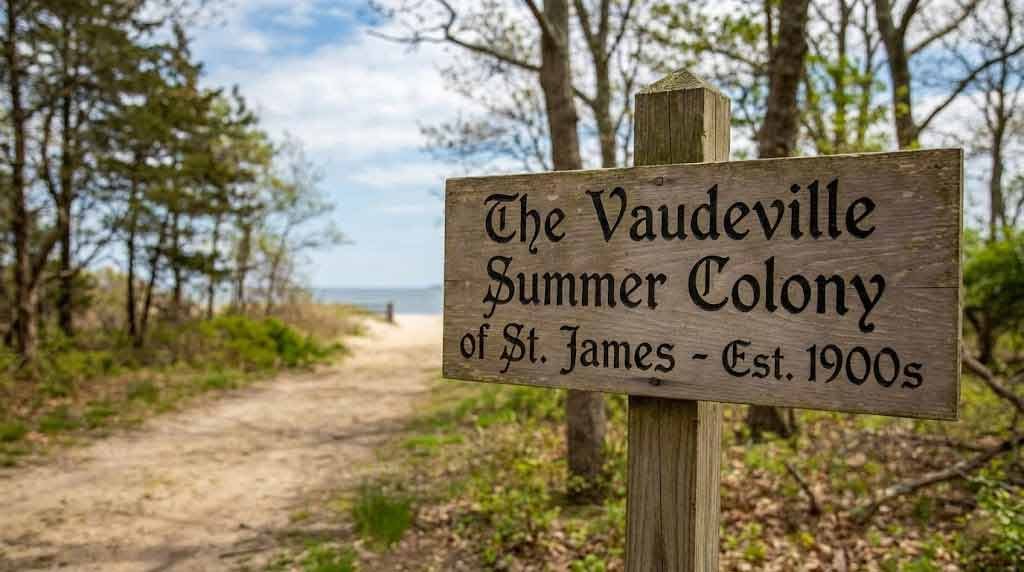
Before the Hamptons became a cultural shorthand for Long Island wealth and celebrity, before the Gold Coast mansions of the North Shore entered the popular imagination, there was a small hamlet called St. James — a farming village carved from the glacial moraines of Suffolk County where, in the early decades of the twentieth century, the most luminous names in American entertainment quietly made their summer homes. Buster Keaton. Lionel, Ethel, and John Barrymore. Myrna Loy. Irving Berlin. The architecture of American performance, assembled among apple orchards and salt air, not far from a general store that had been selling dry goods since 1857.
That convergence was not accidental. It was the product of geography, infrastructure, and a particular cultural hunger — the need of a new class of American celebrities to escape the combustible noise of New York City without entirely leaving behind the world that had made them famous. What they built in St. James, without formally naming it, was something the era’s sociologists would later call a “colony” — an enclave defined not by blood or ethnic heritage but by profession, temperament, and a shared taste for the unhurried rhythms of North Shore life.
Its legacy echoes in the land values today.
The Railroad That Made It Possible
Every colony needs an artery, and St. James found its in the Long Island Rail Road. When the Smithtown and Port Jefferson Railroad — an LIRR subsidiary — completed the St. James station in 1873, the hamlet gained something more consequential than transit. It gained proximity. The Steamboat Gothic-style station building, funded in part by local residents and still standing today, made Manhattan an afternoon’s journey away. For a vaudevillian finishing a Saturday night show at the Palace Theatre on Broadway, Sunday morning could begin on a Long Island porch.
The station’s arrival produced competing anxieties. Some locals feared it would bring land speculators and rampant suburban sprawl, the permanent dissolution of the agrarian character the community had maintained since Richard “Bull” Smith’s descendants first laid claims here in the colonial era. That sprawl never came — not for another half century, at least. What came instead was a more selective migration: celebrities, architects, composers, and public figures who arrived not to develop the land but to disappear into it, at least for the summer.
The St. James General Store at 516 Moriches Road — established in 1857 by Ebenezer Smith, a descendant of the town’s founding family, and recognized today as the oldest continuously operating general store in the United States — serves as the hamlet’s living ledger of this era. Its old ledgers contain names that read like a theatrical billing sheet: Lionel Barrymore, silent film actor and playwright Willie Collier, former New York City Mayor William Jay Gaynor. Men and women of consequence, buying dry goods alongside local farmers, the social and economic worlds of an earlier America briefly overlapping without ceremony in a narrow wooden-floored room.
Stanford White and the Architecture of Aspiration
Before the theatrical colony fully formed, a different kind of creative genius had already staked his claim on St. James soil. Stanford White — the most celebrated American architect of the Gilded Age, a partner in the legendary firm of McKim, Mead & White — married Bessie Smith of Smithtown in 1884 and began what would become a twenty-two-year obsessive renovation of a modest farmhouse on Carmon Hill.
The result was Box Hill, a rambling, multi-gabled estate that White treated as his personal laboratory — a place to experiment with the same design vocabulary he deployed for Carnegie Hall patrons and Newport society matrons, now applied to a home his wife described primarily as a gathering place for family and friends. In 1903, he encased the entire exterior in a technique he called “pebble dash” — beach stones pressed into wet mortar, chosen specifically because the Long Island Sound stones captured light in a way no manufactured material could replicate. “It’s all about texture,” his great-grandson Samuel White, also an architect, would later say of the approach.
White filled Box Hill’s interiors with Japanese temple ornaments, Turkish carpets, Dutch tiles, and Moroccan mashrabiya screens — not as decoration but as a kind of three-dimensional argument about what American domestic life could aspire to become. He sourced antique Italian fireplaces and had local stone carvers restore the missing sections. He planted allées of trees along the approach road. He drew up plans, eventually rejected by Bessie, to float a pair of monumental Corinthian columns across Long Island Sound as a driveway entrance.
Box Hill remains in the White family to this day — privately held, structurally unchanged in its essential character, and listed on the National Register of Historic Places since 1973. It is one of only two McKim, Mead & White residential commissions still in the possession of the original family. As an artifact of North Shore provenance, it is without parallel. As a signal to the theatrical community that would follow, it was a powerful one: St. James was a place where serious people took their leisure seriously.
The Colony Assembles
The Barrymores arrived as the hamlet’s theatrical pedigree was already establishing itself through quieter names — Willie Collier, whose face appeared in the general store ledgers, had been drawing theatrical figures to the area for years. But when Lionel Barrymore began summering in St. James, he brought with him the gravitational weight of America’s most celebrated theatrical dynasty.
The Barrymores were, in the words of one cultural historian, as close to an old-fashioned aristocracy as America produced — a lineage stretching back through the Drew family to the earliest days of the American stage. Maurice Barrymore, the patriarch, had been the first major American legitimate stage star to appear in vaudeville. His children Lionel, Ethel, and John carried the dynasty forward across stage, screen, and radio well into the middle of the twentieth century. Lionel in particular had toured vaudeville extensively before transitioning to film, developing the kind of physical and emotional range that would eventually earn him an Academy Award for Best Actor for A Free Soul in 1931.
That Lionel chose St. James as his retreat — and that Ethel and John followed — was both a personal and a social declaration. The North Shore of Long Island, in the first three decades of the century, occupied a particular cultural position: close enough to the city to maintain professional connections, far enough removed to allow the kind of intellectual and creative recuperation that sustained careers across decades.
Buster Keaton, whose career traced an almost mythological arc from a childhood vaudeville act called “The Three Keatons” through the greatest comedic filmmaking of the silent era — The General, Sherlock Jr., Steamboat Bill, Jr. — also found his way to St. James. Keaton had a long relationship with the concept of the performer’s colony, having spent summers of his vaudeville years at the Actors’ Colony in Muskegon, Michigan. The instinct toward communal professional retreat was, for his generation, as natural as the need for a winter engagement in New York.
Irving Berlin, composing at a pace that would eventually yield well over a thousand songs, and Myrna Loy, whose elegance would make her one of the defining faces of Hollywood’s golden decade, rounded out a summer roster that would be extraordinary in any era. That it assembled in a hamlet of modest farmhouses and salt-water inlets, rather than in the grand estates of the North Shore’s earlier Gilded Age chapters, says something important about the difference between inherited wealth and earned celebrity.
What the Colony Left Behind
The vaudeville summer colony of St. James did not leave behind a visible architectural legacy in the way that Stanford White’s Box Hill did, or the way the Gold Coast estates of Nassau County still dominate their hilltop positions. What it left behind was subtler and, in some respects, more durable: a cultural reputation that attached itself to the land and has never entirely dissipated.
Reputation, in real estate, is a form of value — one that operates on timescales far longer than a market cycle. The North Shore communities between Port Washington and Port Jefferson have maintained a price premium over comparable South Shore communities for as long as the modern market has been tracked, and that premium is not explained entirely by commute times or school district ratings. It has something to do with the particular story these communities tell about themselves: a story of discretion, of cultural seriousness, of proximity to a history that predates the suburban era entirely.
The St. James General Store, purchased by the Suffolk County Department of Parks in 1990 and operated in coordination with the Suffolk County Historic Trust, is now structurally unchanged since 1894. Its narrow wooden floors, original display counters, and second-floor collection of Long Island history books are not museum artifacts — the store remains fully operational, stocked with candy, handcrafts, and goods from Long Island artisans. Walking through it is one of the few genuinely immersive historical experiences available on a populated stretch of the Northeast corridor.
Celebrate St. James, a community preservation initiative, continues to organize programming specifically around the hamlet’s theatrical heritage, including summer concert series and educational events focused on the vaudeville era. The civic investment in historical memory here is not nostalgic for its own sake — it is an understanding, increasingly common among sophisticated North Shore communities, that origin stories are among the most defensible forms of property value.
The Real Estate Inheritance
The contemporary North Shore luxury market has absorbed the legacy of the St. James colony in ways that are both explicit and atmospheric. Data from the first half of 2025 places Nassau’s North Shore submarket median prices at approximately $1.3 to $1.4 million — reflecting year-over-year appreciation in the range of twelve to twenty percent depending on the quarter, driven by constrained inventory and sustained demand from cash buyers and equity rollers largely insulated from mortgage rate volatility. Suffolk County, which encompasses St. James and the broader Smithtown area, reached a median price of $725,000 in 2025, with luxury segment thresholds — the top ten percent of transactions — crossing $1.35 million and rising.
These numbers reflect the present. The underlying conditions that produced them are older. The North Shore’s desirability is not a recent discovery; it is the accumulated consequence of over a century of selective migration by people who understood, intuitively or deliberately, that some landscapes hold their quality across time. Stanford White understood it when he pressed Long Island Sound beach stones into the walls of Box Hill. Lionel Barrymore understood it when he chose a Suffolk County hamlet over a Westchester estate. Irving Berlin understood it when he composed in earshot of Stony Brook Harbor rather than the Hudson River.
What they collectively established was something more valuable than any individual property: they established that St. James was a place where serious people chose to be. That reputation, invisible on any title document, invisible in any Zillow data field, is the deepest driver of North Shore real estate value — and the hardest for any neighboring market to replicate.
A Living Hamlet
St. James today is a census-designated place of roughly 13,500 residents, bisected by Route 25A — the North Country Road designated as a New York State Historic Corridor — with Stony Brook University sitting immediately to its east and Port Jefferson Harbor a fifteen-minute drive to the northeast. The Long Island Museum of American Art, History and Carriages in adjacent Stony Brook provides an institutional anchor for the region’s cultural identity. The Saint James Historic District, listed on the National Register of Historic Places in 1973, encompasses Box Hill, the General Store, and a cluster of contributing structures that together represent one of the most coherent surviving examples of pre-suburban North Shore village character anywhere on Long Island.
The theatrical colony itself is gone — dissolved, as all colonies eventually dissolve, into the broader current of American cultural history. Buster Keaton’s stone-faced genius is now studied in film schools. The Barrymore name persists in the culture through Drew Barrymore, the dynasty’s latest chapter. Irving Berlin’s catalogue is among the most commercially durable in American music. Myrna Loy’s wit and precision set a template for the American screwball comedy that filmmakers are still borrowing from.
None of them left monuments in St. James. They left something better: the precedent that a quiet farming village on a glacial moraine, served by a Steamboat Gothic train station and provisioned by the oldest general store in the country, was a place worth choosing. That precedent has compounded, quietly, for over a hundred years.
The St. James General Store is located at 516 Moriches Road, St. James, NY 11780. Visit the Suffolk County Parks Historic Sites page for current hours and programming.
For North Shore real estate inquiries, current market data is available through Zillow’s Long Island listings and local brokerage resources.