
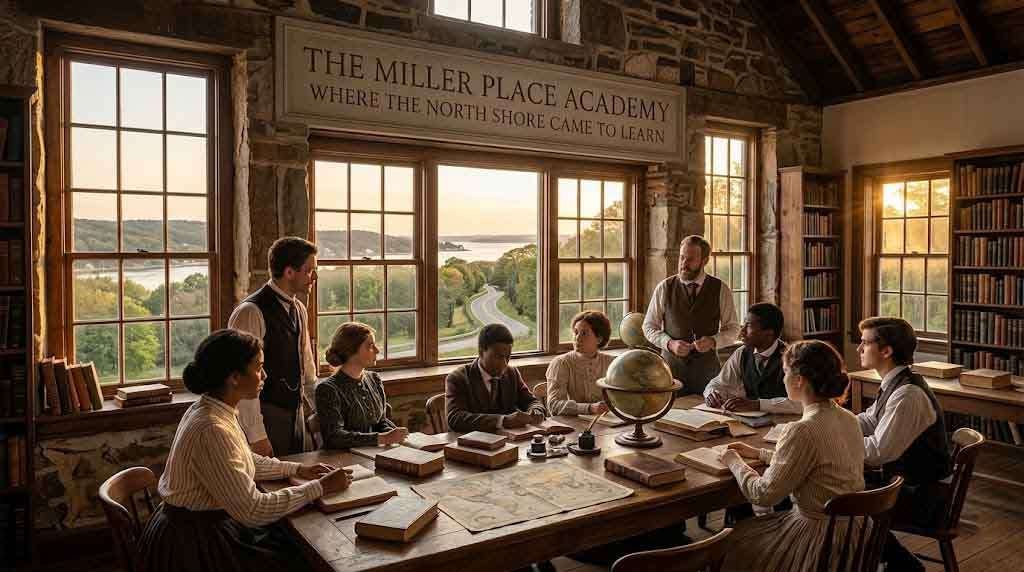
Long before the North Shore of Long Island became the province of commuters and strip malls, it was a tight-knit world of farmers, seafarers, and families who understood that civilization required more than fertile soil and proximity to the Sound. It required a place to educate its children. In 1834, the community of Miller Place answered that call by erecting what would become the defining architectural and intellectual institution of the hamlet’s golden era — the Miller Place Academy, a private school on North Country Road whose two-story white facade still stands today, nearly two centuries later, as both a monument to the ambitions of a nineteenth-century North Shore community and a quiet challenge to a twenty-first century one.
This is its story.
The World That Built It
To understand the Academy, you have to understand Miller Place as it existed in the decade before the building went up. The hamlet had been settled since the 1660s, named after Andrew Miller, a cooper from East Hampton who purchased a 30-acre plot in 1679 and whose family would expand across the northern half of the hamlet through the 18th century (Wikipedia: Miller Place, New York). By the early 1800s, the community had evolved into what a period observer would later describe, in 1874, as “a compact settlement of thirty-five houses…one of the most beautiful villages along the north side,” with residences and farmhouses displaying “a uniform appearance of neatness and unostentatious beauty” (Miller Place Historic District, National Register of Historic Places).
The Town of Brookhaven had established its first local school district — District #6 — back in 1813, with a modest public school that by 1818 was enrolling 47 students (Miller Place Union Free School District, Wikipedia). But a one-room schoolhouse was not sufficient for a community that understood, in the way that merchant families and landed agricultural families have always understood, that formal education was the difference between a generation that maintained wealth and one that built it. Something more serious was needed.
The Founding: A Yale Graduate and a Community Investment
In 1834, the Miller Place Academy was established as a private school under the leadership of a Yale graduate. Wikipedia The identity of that founding headmaster has not survived in commonly accessible records, but the credential is significant. In antebellum America, a Yale education was among the highest distinctions a scholar could carry. Yale had been chartering graduates since 1718 and by the 1830s was producing lawyers, ministers, and educators who fanned out across the young nation to establish institutions of learning in communities that were ready to support them (Yale University, Wikipedia). That Miller Place could attract — and retain — such a figure speaks to the social and financial weight the hamlet’s founding families carried.
The building itself was financed through a shareholder model that was common among subscription schools of the era. The Miller Place Academy was built by families who purchased shares to construct it in 1834, and those founding families’ descendants still operate the institution today. TBR News Media This was not a civic endowment or a government project. It was a private investment made by North Shore families who believed that the institution they were funding was worth preserving across generations — a conviction that, remarkably, has held.
The Architecture: Federal Symmetry on North Country Road
The building the shareholders built is itself worth examining as a piece of craft. The National Register of Historic Places describes the Academy as “a fine example of Federal architectural symmetry — a two-story frame structure, three bays by four bays, exhibiting twelve-over-twelve double hung windows, fine dentil cornices, a fanlight in its gable end, and an open pyramidal belfry.” Living Places
Federal-style architecture, the dominant American idiom of the early 19th century, was itself a democratic statement — an adaptation of the neoclassical forms that had defined the great institutions of England and Europe, translated into wood-frame construction suitable for a young republic. The fanlight above the gable end and the dentil cornices weren’t decorative whims; they were signals. They announced to every family in the hamlet that this building housed something serious: learning, formal rhetoric, classical knowledge. The pyramidal belfry called students to class the way a church bell called the faithful to worship. In many communities of that era, the functions were not entirely separate.
The Miller Place Historic District, of which the Academy building is a part, contains 27 contributing buildings and encompasses a concentration of rural vernacular architecture characteristic of Long Island from the mid-18th through late 19th century. Listed on the National Register of Historic Places in 1976, it was the first national historic district in the Town of Brookhaven. Wikipedia
Thirty-Four Years of Classes: What the Academy Taught
The Academy operated as a private school for 34 years, from 1834 until 1868. Historical records from the mid-century give us a glimpse of the enrollment: by 1852, fifty children were being taught within the hamlet’s various school facilities (Jolie Powell Realty, Miller Place community history). The Academy drew from the landowning and merchant families of Miller Place, Mount Sinai, and the surrounding North Shore communities — households whose children were being prepared not merely for farm labor or trades, but for the law, commerce, ministry, and civic leadership.
The private academy model was the standard vehicle for serious education in 19th-century America outside of urban centers. These institutions taught classical languages, rhetoric, natural philosophy, and mathematics at a level far beyond what common district schools offered. A student who completed a full course at an academy like Miller Place’s would emerge prepared to enter a college such as Yale or Columbia, or to enter directly into a professional apprenticeship in law or medicine. The presence of a Yale-trained headmaster guaranteed that at least some portion of the curriculum would reflect the classical rigor of the Northeast’s most prestigious colleges.
By 1874, a period account described the Academy as one that “has enjoyed an average degree of prosperity” — a characteristically understated 19th-century endorsement of an institution that had become part of the community’s identity. Living Places
The Pivot Points: 1868, 1897, and 1938
The Academy closed as a private school in 1868, before reopening in 1894 as a public school to serve as the replacement for the hamlet’s very first schoolhouse. It became the Miller Place Free Library in 1938. Wikipedia
Each of those pivot points tells a distinct story about how communities adapt institutions when the original mission can no longer sustain itself financially. The closure in 1868 likely reflected a combination of factors common to private academies of that era: competition from the expanding public school system, the economic disruptions of the Civil War years, and the difficulty of maintaining tuition-based institutions in rural communities without a sustained wealthy donor class. Rather than abandon the building, the community repurposed it — first for public education, then for the democratic diffusion of knowledge in its most accessible form: a free library.
In 1934, the academy’s centennial celebration drew representatives from two notable old North Shore families — Corinne M. (Davis) Tooker of Port Jefferson and Elihu S. Miller of Wading River — marking a century of the building’s place in the community’s life. TBR News Media
The Free Library: Knowledge Without Gatekeepers
Since 1938, the Miller Place Academy Free Library has occupied the building as its own nonprofit entity, entirely separate from the corporate nonprofit that the shareholders’ descendants continue to operate as stewards of the structure itself. The library is open on weekends and hosts school trips and children’s reading sessions, and in a recent year nearly 4,000 books were circulated from its shelves. Volunteers handle everything from cataloguing books to chopping wood for the iron stove. TBR News Media
That last detail — the iron stove, the chopped wood — is not a quaint anachronism. It is a direct line back to the 1834 building itself, a reminder that this institution operates with a fidelity to its original material conditions that is almost unheard of in contemporary institutional life. Books are replenished through subscription clubs and donated collections from other libraries. The volunteer corps, as of recent years, has been composed entirely of retirees, and the board acknowledges the challenge of attracting younger hands to the work. For the families that love the Academy building, the possibility of it slipping toward obscurity is simply not acceptable — not for the sake of heritage alone, but for the community at large. TBR News Media
A Living Landmark: What Survives and Why It Matters
The Miller Place Academy sits at the heart of the Miller Place Historic District on North Country Road — the same thoroughfare that lines the oldest surviving homes in the hamlet, including the William Miller House, whose oldest section dates to 1720 (Miller Place-Mount Sinai Historical Society, mpmshs.org). To walk that stretch of North Country Road is to move through compressed time, from the shingle-and-clapboard vernacular domestic architecture of the 18th century to the Federal formality of the Academy’s 1834 facade.
What makes the Academy unusual — and genuinely rare — is the continuity of its stewardship. The Academy is still operated by the descendants of the original families who bought shares to construct the building in 1834. TBR News Media There is no other way to describe that except as a remarkable act of collective memory, sustained across seven or eight generations of North Shore families who have chosen, repeatedly and in each new decade, not to sell, not to demolish, and not to forget. That is not nostalgia. That is conviction.
The Challenge of Continuity in the 21st Century
The tension the Academy’s stewards navigate today is the same tension that every genuinely old institution faces in an era that privileges novelty and digital access over physical presence and analog depth. A small free library with an iron stove, weekend hours, and a volunteer corps of retirees does not fit easily into the attention economy of 2026. It does not have a TikTok presence. It cannot compete with the Port Jefferson library’s digital catalog or Comsewogue’s modern reading programs.
But the Academy was never built to compete. It was built to endure. The 12-over-12 double-hung windows that let in the Long Island Sound light in 1834 still let in the same light today. The fanlight in the gable end still catches the afternoon sun on North Country Road. The pyramidal belfry still rises above the tree line, even if no bell rings inside it to call a class to order.
What the community owes this building is not sentiment. It is attention — active, organized, financially committed attention of the kind that the founding shareholders gave in 1834 when they pooled their resources to build something they believed their children and grandchildren would need. The Miller Place-Mount Sinai Historical Society (mpmshs.org) continues its preservation work at 75 North Country Road and remains the primary institutional guardian of the hamlet’s built history. Volunteers, donations, and public engagement are the mechanisms by which a building like the Academy survives another century.
What 190 Years Teaches
Walk past the Miller Place Academy on a winter afternoon, when the North Country Road elms have shed their leaves and the white two-story facade is sharp against a gray Long Island Sound sky, and you are standing in front of nearly two centuries of unbroken community intention. A Yale graduate stood at the front of a classroom in that building in 1834 and taught Latin and rhetoric to the children of North Shore farmers and merchants. A retired schoolteacher served as its librarian in the 1970s. A man named Thomas Cramer laid bricks with his own hands in 2020 to build a bench in honor of his mother, who had first walked into that building as a child, and never really left.
That is what institutional longevity looks like when it is not corporate, not civic, and not funded by an endowment. It is personal. It is inherited. It is chosen, again and again, by people who believe that a community without memory is not really a community at all.
The Miller Place Academy Free Library is located on North Country Road, Miller Place, NY 11764. The Miller Place-Mount Sinai Historical Society can be reached at mpmshs.org.