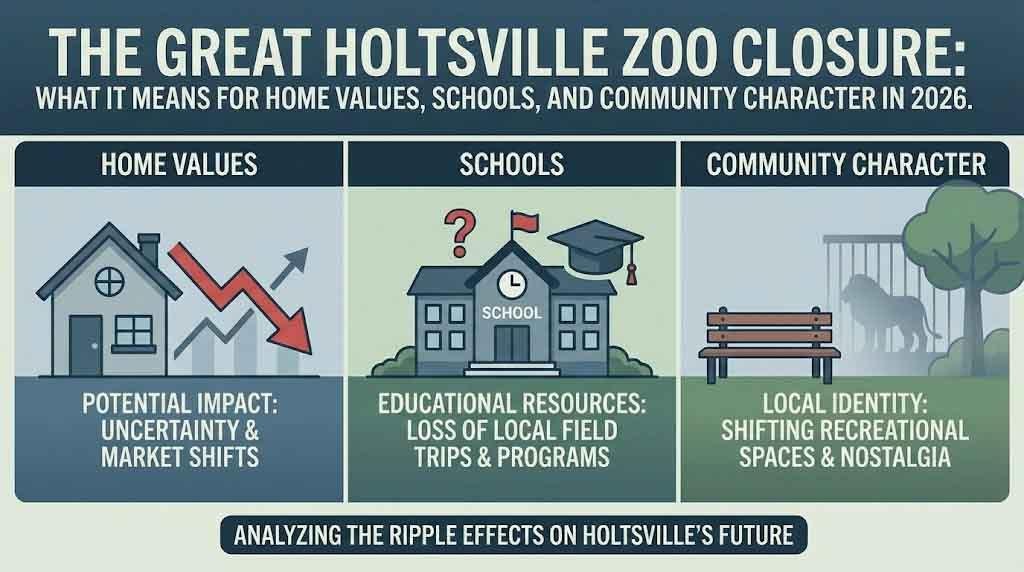
After nearly 47 years as a beloved Long Island institution, the Holtsville Ecology Site is closing its doors this month, marking the end of an era for thousands of families who grew up visiting the free zoo and animal preserve. The facility, which opened in 1979 on a former landfill site, is set to complete its closure by the end of February 2026 as part of Brookhaven Town’s budget realignment—a decision that will save taxpayers approximately $2 million annually but leaves residents grappling with an uncomfortable question: what happens to property values when a community loses one of its signature amenities?
For homeowners in Holtsville and surrounding communities, the closure represents more than just the loss of a weekend destination. It’s a case study in how the removal of community amenities impacts real estate markets, school programs that relied on the facility for hands-on learning, and the intangible “character” that makes a neighborhood desirable. With median home prices in Holtsville currently at $499,000 according to February 2026 data—down 9% from last year—and the market already showing signs of cooling, timing couldn’t be more critical for understanding these dynamics.
What Made the Holtsville Ecology Site Special
The Harold H. Malkmes Wildlife & Ecological Education Center, as it was formally known, was far more than a small municipal zoo. Built on the rehabilitated grounds of a former landfill that closed in 1974, it represented what Brookhaven Town once described as “a shining example of environmental transformation.”
The facility housed more than 100 animals across its grounds on Buckley Road, from goats and bison to foxes, owls, peafowl, and the now-deceased black bear “Honey,” whose 2024 euthanization became a rallying point for animal welfare advocates. Beyond the animals, the Ecology Site offered:
- Environmental Education Programs: Gardening workshops, composting demonstrations, and nature education that aligned with local school curricula
- Holiday Light Spectacular: An annual tradition that drew thousands of families each winter
- Free Admission: Unlike commercial zoos, the Ecology Site was completely free to visit, making it accessible to families across all economic brackets
- School Field Trips: Generations of students from Sachem Central School District and surrounding areas visited as part of science and environmental education programs
- Community Events: The site hosted seasonal celebrations, including the beloved tradition of celebrating “Holtsville Hal” on February 2nd
The Numbers Tell a Story
According to Brookhaven Town Supervisor Dan Panico, who announced the closure in September 2025 as part of the 2026 town budget, the facility cost taxpayers more than $2 million annually to operate. Staffing, veterinary care, facility maintenance, and animal feed added up to a significant municipal expense—particularly for a program run by the Highway Department rather than a parks or recreation department.
“It’s so far out of the scope of what the town government should be doing,” Panico explained, “that especially in these budgetary times, you should dedicate the precious tax dollars you get toward the operation of the building department and parks and things of that nature.”
The closure timeline was methodical: staff remained funded through the first quarter of 2026 to allow for proper animal relocation. Brookhaven officials identified several sanctuaries willing to accept animals, including Quogue Wildlife Refuge, Hoyt Farm in Commack, and Sweetbriar Nature Center in Smithtown.
The Controversy: Why the Closure Became Inevitable
The decision to close the Holtsville Ecology Site didn’t happen in a vacuum. For years, the facility faced mounting criticism from animal welfare advocates, former employees, and watchdog groups who alleged substandard conditions and inadequate veterinary care.
Whistleblower Allegations and Investigations
Humane Long Island, led by President John Di Leonardo, campaigned for over a year for the site’s closure, documenting what they described as systemic animal neglect. More than a dozen whistleblowers—including former animal caretakers—came forward with disturbing allegations:
- Animals dying from painful ailments without proper veterinary treatment
- Some animals allegedly freezing to death
- Unlicensed staff performing medical procedures without painkillers, antiseptics, or antibiotics
- Animals confined on concrete substrates leading to chronic infections
- Potential lead contamination from the underlying uncapped landfill affecting animals’ health
- Multiple animal escapes, including a fox named Hunter who bit the head caretaker before allegedly dying from medical neglect
These claims led to investigations by both the Suffolk County District Attorney’s Office and the New York State Department of Environmental Conservation. Former animal caretaker Emma Sanwald described the conditions in stark terms: “A park built on a retired landfill, with lead infecting the animals and garbage moving up the soil into their pens, was never supposed to be built in the first place.”
The Shifting Social Tide
Beyond the specific allegations, Supervisor Panico noted a broader cultural shift: “I think people’s attitudes [about zoos] in general in society have changed.”
Indeed, the debate over municipal zoos reflects larger questions about animal welfare, government responsibilities, and appropriate uses of taxpayer dollars. What was once viewed as an educational asset is now seen by many as an outdated model of animal captivity—particularly when run by a highway department rather than wildlife professionals.
Di Leonardo praised the closure as “a compassionate decision” that would allow animals to “live more natural lives” in professional sanctuaries. However, this perspective clashed sharply with residents who cherished the facility as a community cornerstone.
The Real Estate Question: Do Community Amenities Really Impact Home Values?
For Holtsville homeowners, the immediate question is practical: will losing this amenity affect property values?
The relationship between community amenities and real estate prices is well-documented in academic research. According to a comprehensive analysis by the National Association of Realtors, properties near desirable amenities typically command premium prices. However, the impact varies dramatically based on several factors:
What the Research Shows
The Proximity Premium: Research from Redfin reveals that “in U.S. cities, homes within walking distance of schools, shopping, parks and other urban amenities sell for an average of 23.5%, or $77,668, more than comparable properties that are car dependent.”
Parks and Green Spaces Matter: Studies consistently show that proximity to parks increases property values. The amenity value of natural spaces—even when artificially created, like the Ecology Site on former landfill—adds appeal that measurably impacts market prices.
The Type of Amenity Matters More Than Quantity: Not all amenities create equal value. Research shows:
- Educational facilities: Schools and learning centers consistently boost values
- Recreational spaces: Parks, playgrounds, and community centers show positive impacts
- Cultural amenities: Libraries, museums, and unique local attractions add value
- Negative amenities: Industrial facilities, wastewater treatment plants, and sources of noise/pollution decrease values
Distance Decay Effect: The Urban Institute’s study on affordable housing found that amenity impact follows a distance pattern: “Affordable housing units in Alexandria are associated with an increase in property values of 0.09 percent within 1/16 of a mile [one city block] of a development” with “no effect on properties between 1/16 of a mile and 3/16 of a mile.”
For Holtsville Zoo, this suggests the most significant impact would be on properties within roughly a half-mile radius, with diminishing effects beyond that distance.
The Holtsville Market Context
Understanding the closure’s potential impact requires examining current market conditions:
Current Market Statistics (February 2026):
- Median Home Price: $499,000 (down 9% from January 2025)
- Price Per Square Foot: $353
- Days on Market: 32 days (23% faster than February 2025)
- Market Status: Described as “very competitive” with many homes receiving multiple offers
- Typical Sale Price: Homes sell for approximately 2% above list price
- Inventory: 21-29 homes currently listed
Longer-Term Appreciation: According to NeighborhoodScout data, Holtsville has experienced strong appreciation over the past decade:
- 10-Year Cumulative Appreciation: 96.98% (top 50% nationwide)
- Average Annual Appreciation: 7.01%
- Recent 12-Month Appreciation: 11.98% (higher than 97.63% of U.S. cities)
This strong appreciation history suggests the Holtsville market has fundamental strengths beyond any single amenity.
Factors That May Mitigate Impact
Several factors suggest the zoo closure may have limited impact on Holtsville home values:
1. Free vs. Revenue-Generating Amenity: The Ecology Site was free to visit, meaning it didn’t generate the same economic activity as commercial attractions. Research shows amenities that bring spending (restaurants, shopping) have stronger value impacts than passive recreational sites.
2. Alternative Amenities Remain: Holtsville retains other desirable features:
- Highly rated Sachem Central School District (spending $27,131 per student annually)
- Holtsville Park and other green spaces
- Low crime rates (safer than national average)
- Convenient access to LIRR Ronkonkoma Station with express service to NYC
- Proximity to LIE (Interstate 495) for commuters
- Diverse dining and shopping options
3. Regional Context: The closure doesn’t affect Holtsville’s geographic advantages or school quality—the two factors most strongly correlated with property values.
4. The “Nostalgia vs. Use” Gap: Many residents who express sorrow about the closure may not have visited regularly. Unlike schools or parks that affect daily life, the zoo was an occasional destination.
Factors That May Amplify Impact
Conversely, some aspects could create headwinds:
1. Perception and Psychology: Real estate markets are driven by perception. If potential buyers view the closure as a sign of community decline or reduced amenities, it could affect demand even if the actual impact is minimal.
2. Family Appeal: The Ecology Site was specifically valuable to families with young children—a key demographic for suburban homebuying. Parents specifically mentioned the loss in interviews: “It’s important for them to have these places to get hands-on learning and first-hand experience they wouldn’t get anywhere else,” said parent Jennifer Dugan.
3. Unique Selling Point: The zoo was a differentiator—something Holtsville had that neighboring communities didn’t. Real estate agents could highlight it as a “free family attraction minutes from your home.” Losing that talking point matters.
4. Timing with Market Softening: The closure coincides with a broader market cooldown (prices down 9% year-over-year). In a declining market, losing amenities can accelerate negative momentum.
Impact on Schools and Educational Programs
Perhaps the most tangible impact of the closure affects local schools, particularly within Sachem Central School District—the second-largest suburban school district in New York State with approximately 13,500 students.
The Educational Value of Hands-On Learning
For decades, the Holtsville Ecology Site served as an outdoor classroom for environmental education. Elementary and middle school students from across the district visited the facility for programs aligned with New York State science standards.
Sachem Central School District Context:
- Elementary Schools: 10 schools serving K-5, including Waverly Avenue School (470 students) and Chippewa Elementary in Holtsville
- Middle Schools: 3 schools serving grades 6-8, including Sagamore Middle School in Holtsville (898 students)
- High Schools: 2 schools (Sachem East and Sachem North) serving grades 9-12
- District Spending: $27,131 per student annually
- Academic Performance: 42% of elementary students proficient in reading, 58% in math
The Ecology Site provided experiential learning opportunities that complemented classroom instruction—particularly valuable given research showing hands-on environmental education improves student outcomes in science, environmental stewardship, and critical thinking.
The Cost of Replacement Programming
Schools now face a choice: eliminate these field trip experiences or find alternatives that will likely cost more. Options include:
Nearby Alternatives:
- Quogue Wildlife Refuge (approximately 50 miles east): Specializes in rehabilitation and education but requires longer bus trips
- Sweetbriar Nature Center in Smithtown (approximately 15 miles): Offers education programs but charges fees
- Cold Spring Harbor Fish Hatchery & Aquarium (approximately 25 miles west): Marine-focused education with admission fees
- Long Island Game Farm in Manorville (approximately 25 miles east): Commercial zoo charging admission
Each alternative involves increased costs (admission fees, longer bus trips requiring more fuel and driver time) and logistical complications. For a district already managing tight budgets—Sachem cut $2.5 million from custodial staff, athletics, and extracurriculars in 2015 and closed three schools in 2016 due to budget gaps—these additional expenses matter.
The Curriculum Gap
Environmental education programming built around the Ecology Site must now be redesigned. Teachers who developed lesson plans expecting hands-on animal interactions, composting demonstrations, and habitat observations must find new approaches.
Some educators argue this could be an opportunity—driving innovation in classroom-based environmental education. Others worry that screen-based or book learning can’t replicate the impact of seeing animals close-up, observing ecosystems in action, or participating in conservation activities.
Property Value Connection
The relationship between school quality and property values is among the strongest in real estate research. While losing one field trip destination doesn’t change test scores or district ratings, it contributes to a broader narrative about resource constraints and programming cuts.
Parents house-hunting in Holtsville might ask: “If the district lost this resource, what else might be cut?” In competitive real estate markets, perception shapes decisions—and a narrative of declining amenities (whether true or not) can influence buyer psychology.
The Intangible Loss: Community Character and Identity
Beyond dollars and property values lies something harder to quantify: the loss of community character.
What Makes a Neighborhood a “Place”?
Urban planners and sociologists distinguish between “space” and “place.” Space is physical geography. Place is space imbued with meaning, memory, and identity. The Holtsville Ecology Site, for nearly five decades, helped transform Holtsville from a suburban space into a distinctive place.
Three generations of families visited the zoo. Parents who went as children brought their own children, creating multi-generational memories. Christina Vargas articulated this sentiment: “I would never thought this place would ever shut down. That’s a big disappointment.”
The Nostalgia Factor
Resident Leo Goscinsky of Farmingville reflected the emotional attachment: “I go and visit the animals once in a while.” These visits weren’t just recreational—they represented continuity, tradition, and connection to the community’s history.
Nostalgia isn’t economically meaningless. Research in behavioral economics shows that places with strong community identity and local traditions attract and retain residents who pay premiums for that intangible sense of belonging.
The Former Landfill Success Story
The Ecology Site also represented something symbolically important: environmental redemption. A toxic landfill, closed in 1974, was transformed into green space, gardens, and animal habitats. It embodied the idea that damaged land could be restored and serve the public good.
Ironically, that same landfill origin became part of the closure rationale. The uncapped landfill allegedly contributed to animal health problems (lead contamination, exposure to garbage seeping through soil). What was once celebrated as transformation became viewed as fundamentally flawed.
This narrative shift—from “inspiring environmental recovery” to “unsuitable location from the start”—changes how residents perceive their community’s history and future.
What Replaces a Closed Institution?
The physical space won’t disappear. Brookhaven Town owns the land and infrastructure. The question is: what comes next?
Possible Futures:
- Enhanced Park Space: Convert animal areas to additional gardens, walking trails, or natural habitats
- Community Center Expansion: Repurpose buildings for community programming
- Private Development: Sell or lease the property for residential or commercial development
- Nothing: Leave facilities abandoned or underutilized due to budget constraints
Each scenario carries different implications for property values and community character. Enhanced public space could maintain or increase amenity value. Abandonment or inappropriate development could create negative impacts.
The Comparative Case: How Other Communities Fared
Holtsville isn’t the first community to lose a beloved local amenity. Examining similar situations provides insight into likely outcomes.
Successful Transitions
Example 1: Catoctin Zoo Closure, Maryland (2019)
When Catoctin Wildlife Preserve closed after 50 years, surrounding property values initially dipped 2-3% as sellers emphasized the loss in listings. However, within 18 months, values recovered as the land was repurposed as a nature preserve with hiking trails. The transition maintained green space while reducing animal care concerns.
Example 2: Bridgeport Beardsley Zoo Renovation Closure, Connecticut (2016-2017)
Temporarily closed for renovations, nearby properties saw minimal impact because the closure was communicated as temporary improvement rather than permanent loss. The key: clear communication about future plans.
Cautionary Tales
Example 1: Storyland Closure, New York (2021)
When the beloved Glen, New Hampshire amusement park closed permanently, surrounding property values dropped 5-7% over two years. The impact was strongest on homes marketed to families, as the park had been a major draw for family-oriented homebuyers.
Example 2: Community Pool Closures, Multiple Locations
Research on municipal pool closures shows average property value impacts of 3-5% within a half-mile radius, with effects persisting for 3-5 years until alternative amenities develop or buyers adjust expectations.
The Pattern
Communities that successfully navigate amenity closures share common characteristics:
- Clear Communication: Explaining why the closure happened and what comes next
- Replacement Programming: Offering alternative services or facilities
- Narrative Control: Framing the change as strategic evolution rather than decline
- Community Investment: Demonstrating continued commitment to quality of life
Those that struggle typically feature uncertainty about the future, lack of alternative amenities, and perception that the closure signals broader community decline.
What Holtsville Homeowners and Prospective Buyers Should Know
For current homeowners and prospective buyers, here’s the practical guidance based on research and market analysis:
For Current Homeowners
Don’t Panic: The zoo closure alone is unlikely to crater property values. Holtsville’s fundamentals—strong schools, convenient location, established neighborhoods—remain intact.
Document Other Amenities: If selling, emphasize remaining advantages in listings:
- Top-rated Sachem schools
- Low crime rates
- LIRR access for NYC commuters
- Proximity to shopping, dining, and parks
- Strong community character
Monitor Market Trends: Pay attention to median sale prices and days-on-market statistics over the next 6-12 months. If the market softens beyond general Long Island trends, the closure may be a factor.
Engage in Community Planning: Attend town meetings about the Ecology Site’s future. Advocating for positive redevelopment can influence outcomes.
Consider Timing: If planning to sell within 1-2 years, be aware that the closure is fresh in potential buyers’ minds. In 3-5 years, it will be “old news” with less psychological impact.
For Prospective Buyers
Look for Opportunity: If the market overreacts to the closure, there may be buying opportunities. Properties near the Ecology Site might be undervalued if sellers panic.
Evaluate Alternatives: Research nearby facilities (Sweetbriar, Quogue, Game Farm) to determine if losing the free zoo matters to your lifestyle.
Assess School Fit: The zoo was one amenity; school quality is more fundamental. Sachem’s programs, despite budget challenges, remain strong.
Examine Broader Trends: Look at Holtsville’s long-term appreciation (96.98% over 10 years). Short-term market fluctuations matter less than decade-long trajectories.
Consider the Upside: If Brookhaven repurposes the site positively (enhanced parks, community center, conservation area), proximity could become valuable again.
For Real Estate Agents
Frame Honestly: Don’t ignore the closure, but contextualize it:
- “The Ecology Site is transitioning, but Holtsville retains strong amenities including…”
- “While the zoo closed, the park system and school quality remain excellent…”
Emphasize Remaining Features: Help clients focus on what Holtsville still offers rather than what it lost.
Provide Comparable Data: Show how Holtsville’s appreciation compares to similar Long Island communities. If the trajectory remains strong, the closure hasn’t fundamentally changed the market.
Manage Expectations: For sellers near the Ecology Site, acknowledge that initial buyer questions are likely. Prepare compelling responses about the property’s intrinsic value.
Looking Forward: The Next Chapter for Holtsville
The Holtsville Ecology Site closure marks a transition point, not an ending. Communities evolve, amenities change, and real estate markets adapt.
Short-Term Outlook (6-12 Months)
Expected Impacts:
- Minimal to Modest Price Effect: Properties within a half-mile of the Ecology Site may experience 1-3% softer pricing as the closure dominates local news. This effect will likely fade as attention shifts.
- Slower Absorption: Homes marketed primarily to families with young children may take slightly longer to sell, particularly if agents emphasize the zoo’s loss.
- Perception Challenge: Sellers may face buyer questions about “what else is Brookhaven cutting?” requiring proactive responses about community strengths.
Medium-Term Outlook (1-3 Years)
Likely Scenarios:
- Market Normalization: As the closure becomes old news, buyer focus returns to fundamental factors (schools, location, home features).
- Site Redevelopment Clarity: Brookhaven’s plans for the property become clear, either alleviating or confirming concerns about the space.
- Adaptation: Families adjust expectations, discovering alternative educational resources and recreational destinations.
Long-Term Outlook (3-5+ Years)
Probable Outcomes:
- Full Market Recovery: Assuming the site is repurposed positively, property values return to trend lines based on regional appreciation rather than the closure.
- New Identity Formation: Holtsville develops a new community narrative that incorporates but moves beyond the zoo’s closure.
- Generational Shift: New residents who never knew the Ecology Site don’t perceive its absence as a loss.
The Bigger Picture
The Holtsville Zoo closure reflects broader tensions in American suburban life:
- Fiscal Sustainability: Can municipalities afford amenities built in more prosperous times?
- Changing Values: How do shifting attitudes about animal welfare reshape community institutions?
- Generational Transition: What happens when facilities meaningful to older residents become burdensome rather than treasured?
- Resource Allocation: Should town governments operate zoos, or focus exclusively on core services?
These aren’t unique to Holtsville. Across Long Island and suburban America, communities grapple with similar questions as budgets tighten, demographics shift, and priorities evolve.
The Bottom Line:
The Holtsville Ecology Site closure will impact the community emotionally and psychologically more than financially. Property values may dip modestly in the short term—particularly for homes near the facility marketed to young families—but Holtsville’s strong fundamentals (excellent schools, convenient location, established neighborhoods, and impressive long-term appreciation) suggest resilience.
For homeowners, the closure is unlikely to significantly affect wealth. For prospective buyers, it represents neither crisis nor opportunity—simply one variable among many in evaluating whether Holtsville meets their needs.
The real story isn’t about property values. It’s about how a community processes loss, adapts to change, and writes its next chapter. Whether Holtsville emerges stronger, weaker, or unchanged depends less on the zoo’s closure than on how residents, officials, and stakeholders respond to this transition.
As Supervisor Panico noted, “people’s attitudes in society have changed.” Perhaps that’s the ultimate lesson: communities, like real estate markets, never stand still. They evolve, adapt, and find new identities. The question for Holtsville isn’t whether it can survive losing the Ecology Site—it will. The question is what it chooses to become next.
Related Articles:
- Understanding How School Quality Impacts Home Values on Long Island
- The Complete Guide to Buying in Sachem School District
- Long Island Real Estate Market Trends 2026: What Buyers Need to Know
- How Community Amenities Shape Property Values in Suffolk County
- The Truth About Property Taxes and Home Values in Brookhaven
Further Reading & Sources:
- Brookhaven Town 2026 Budget Documents
- Humane Long Island: “Holtsville Ecology Site Campaign” (2025)
- National Association of Realtors: “Effects of Amenities on Property Values”
- NeighborhoodScout: “Holtsville Real Estate Market Analysis 2021-2026”
- Sachem Central School District: “About Us – District History”
- Suffolk County District Attorney’s Office: Investigation Records (Public)
- Urban Institute: “How Affordable Housing Makes Communities Wealthier” (2022)
- Redfin: “The Impact of Walkable Amenities on Home Prices”