Published: February 5, 2026
Click here for webcast (opens in new window)
Q4 2025 AMZN Earnings Release(opens in new window)
Presentation(opens in new window)
Executive Summary
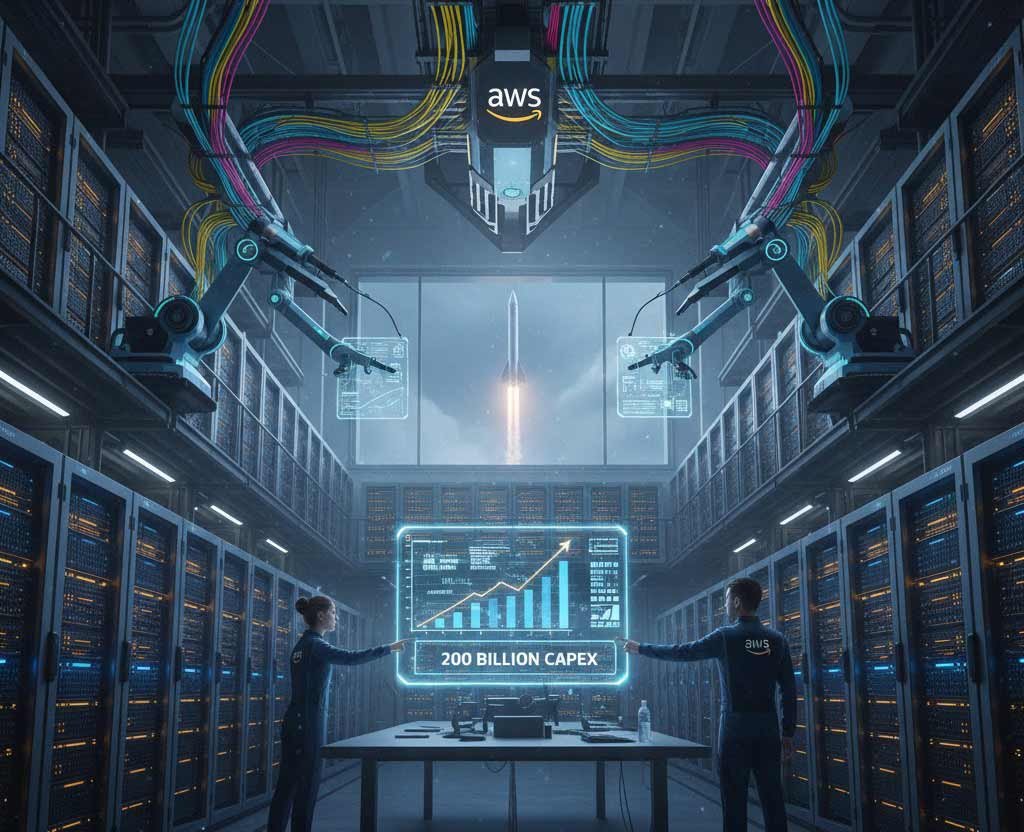
Amazon has just announced an eye-popping $200 billion capital expenditure plan for 2026, sending shockwaves through Wall Street and setting a new benchmark in the tech industry’s unprecedented AI infrastructure buildout. This represents a staggering 52% increase from the company’s 2025 spending of approximately $131 billion, and far exceeds analyst expectations of around $146 billion.
The announcement comes on the heels of similar massive spending commitments from Google parent Alphabet ($175-185 billion), Meta ($115-135 billion), and Microsoft (expected to exceed $97 billion), signaling that the AI arms race among Big Tech is accelerating rather than slowing down. Combined, the top four hyperscalers are now expected to spend over $630 billion on AI infrastructure in 2026 alone.
Amazon’s Bold $200 Billion Bet
The Numbers That Shocked Wall Street
On February 5, 2026, Amazon delivered its Q4 2025 earnings report with record-breaking revenue of $213.4 billion—but it was the 2026 capital expenditure guidance that sent shares tumbling nearly 9% in after-hours trading.
CEO Andy Jassy didn’t mince words about the company’s ambitions:
“With such strong demand for our existing offerings and seminal opportunities like AI, chips, robotics, and low earth orbit satellites, we expect to invest about $200 billion in capital expenditures across Amazon in 2026, and anticipate strong long-term return on invested capital.”
Key Highlights:
- 2026 Capex Guidance: $200 billion (vs. analyst consensus of $146.11 billion)
- 2025 Actual Capex: $131.82 billion
- Year-over-Year Growth: ~52%
- Primary Focus: Amazon Web Services (AWS), which saw 24% growth in Q4—its fastest in 13 quarters
Where the Money Is Going
The vast majority of Amazon’s 2026 spending will be directed toward AWS infrastructure, according to Jassy. The company is racing to meet exploding demand for:
- AI Compute Capacity: Custom Trainium chips (Trainium 3 and upcoming Trainium 4)
- Data Centers: Building capacity to support AI workloads and traditional cloud services
- Project Kuiper (Leo): Low earth orbit satellite constellation for global broadband
- Robotics: Automation for fulfillment centers and logistics
During the earnings call, Jassy emphasized the urgency: “We’re seeing very strong demand for Trainium 3, and expect nearly all of our Trainium 3 supply of chips to be committed by mid-2026 even though we’re still building Trainium 4.”
Market Reaction: A Reality Check
The market’s negative reaction to Amazon’s announcement reflects growing investor anxiety about massive AI spending without immediately proportional returns. Several factors contributed to the sell-off:
- Guidance Below Expectations: Q1 2026 operating income forecast of $16.5-21.5 billion fell below analyst estimates of $22.04 billion
- Profit Pressure: Operating margins are being compressed as infrastructure costs grow faster than revenue
- Return on Investment Concerns: Investors are increasingly scrutinizing whether AI spending will translate to proportional profit growth
As analyst Dave Wagner from Aptus Capital Advisors noted: “The market just dislikes the substantial amount of money that keeps getting put into capex for these growth rates.”
The Broader Tech Landscape: A Comparison
Alphabet (Google): Setting New Records at $185 Billion
Just one day before Amazon’s announcement, Google parent Alphabet stunned Wall Street with its own massive spending plan.
2026 Capex Guidance: $175-185 billion (up from $91.4 billion in 2025)
This represents more than a doubling of spending year-over-year, and at the high end would exceed Amazon’s commitment. The announcement initially sent Alphabet shares down as much as 7% in after-hours trading, though the stock later recovered.
CFO Anat Ashkenazi broke down the spending priorities:
“The planned 2026 capex spend will go toward investing in AI compute capacity for Google DeepMind and to meet significant cloud customer demand as well as strategic investments in other bets.”
What Alphabet Is Building:
- 60% Servers: GPUs, custom TPU chips, and computing hardware
- 40% Infrastructure: Data centers and networking equipment
- DeepMind Expansion: Capacity to train and deploy advanced AI models
- Google Cloud: Meeting enterprise demand that’s created a $240 billion backlog
Performance Metrics Supporting the Investment:
- Google Cloud revenue grew 48% YoY to $17.66 billion in Q4 2025
- Cloud backlog increased 55% sequentially and more than doubled YoY
- Gemini AI app reached 750 million monthly active users
CEO Sundar Pichai acknowledged ongoing constraints: “I do expect to go through the year in a supply constrained way,” indicating that even with the massive spending increase, demand will likely outstrip capacity.
Meta: The $135 Billion “Superintelligence” Push
Meta took a different approach, announcing its ambitious spending plans a week earlier—and the market actually rewarded the company with a 7-10% stock jump.
2026 Capex Guidance: $115-135 billion (up from $72.2 billion in 2025)
This 73% year-over-year increase is dedicated to what CEO Mark Zuckerberg calls “Meta Superintelligence Labs,” a reorganization of the company’s AI efforts aimed at delivering “personal superintelligence” to its 3.58 billion daily active users.
Why Meta’s Announcement Was Better Received:
- Strong Revenue Growth: Q4 revenue hit $59.89 billion, up 24% YoY
- Profitable Core Business: Advertising revenue of $58.14 billion demonstrated ability to fund AI investments
- Clear ROI Story: AI-driven “Advantage+” advertising tools are already improving advertiser performance
- Operating Cash Flow: $115.8 billion in 2025, allowing the company to fund expansion internally
Zuckerberg framed the spending as essential: “This is going to be a big year for delivering personal superintelligence, accelerating our business infrastructure for the future and shaping how our company will work going forward.”
Key Projects:
- Project Avocado and Mango: Next-generation Llama models with agentic capabilities
- Custom Silicon: Reducing reliance on Nvidia GPUs
- Nuclear-Powered Data Centers: Planning energy infrastructure for massive computing needs
- Reality Labs Reorganization: Shifting focus to wearables while trimming 10% of metaverse staff
Microsoft: Steady Expansion Amid Azure Constraints
Microsoft has been more measured in its public guidance, though capex continues to climb at a rapid pace.
Recent Performance:
- Q2 FY2026 Capex: $37.5 billion (up 66% YoY)
- Expected FY2026 Total: ~$97-99 billion
- Azure Revenue Growth: 39% in constant currency
CFO Amy Hood indicated spending would increase sequentially and that FY2026 growth would exceed FY2025 levels, reversing earlier guidance that suggested a moderation in spending growth.
Microsoft’s Challenge:
- Capacity Constraints: Demand continues to outstrip supply across Azure
- Stock Pressure: Shares fell 5-7% after earnings despite beating expectations
- ROI Scrutiny: Investors questioning whether spending is growing faster than returns
The company added nearly 1 gigawatt of data center capacity in Q2 alone, with CEO Satya Nadella emphasizing: “As fast as we are installing this AI capacity, it’s getting monetized.”
Strategic Advantages:
- OpenAI Partnership: Revised deal grants Microsoft a 27% stake valued at ~$135 billion plus $250 billion Azure commitment
- Diversified Revenue: Strong Office 365 and Enterprise businesses provide stable cash flow
- Copilot Adoption: Over 15 million paid seats for Microsoft 365 Copilot
The Big Picture: An Unprecedented Investment Cycle
Total Spending: Over $600 Billion
The collective investment from the top hyperscalers is staggering:
| Company | 2025 Capex | 2026 Capex (Est.) | Growth Rate |
|---|---|---|---|
| Amazon | $131.8B | $200.0B | +52% |
| Alphabet | $91.4B | $175-185B | +91-102% |
| Meta | $72.2B | $115-135B | +59-87% |
| Microsoft | $88.2B (FY25) | $97-99B (FY26) | +10-12% |
| Total | ~$383B | ~$587-619B | +53-62% |
According to Goldman Sachs Research, analyst estimates for hyperscaler 2026 capex have risen from $465 billion at the start of Q3 earnings season to $527 billion currently—and these estimates have proven too conservative for two years running.
Historical Context
To put this in perspective:
- 2024 Total Hyperscaler Capex: ~$256 billion
- 2025 Total: ~$443 billion (+73% YoY)
- 2026 Projected: ~$602 billion (+36% YoY)
As a percentage of GDP, AI-related capex has reached approximately 1.2-1.3% of U.S. GDP in recent quarters. While significant, this is still below historical technology investment peaks:
- Railroad boom (1880s): ~6% of GDP
- Telecom boom (late 1990s): ~1.5% of GDP
This suggests there could be substantial room for continued growth, though some analysts caution about potential overcapacity.
What’s Driving the Spending
1. AI Infrastructure (75% of Total Spend)
Approximately $450 billion of the 2026 spending will go directly to AI-related infrastructure, including:
- High-performance GPUs (Nvidia H100, H200, B200 series)
- Custom AI chips (Google TPUs, Amazon Trainium, Microsoft Maia)
- Specialized cooling and power systems
- Networking equipment for distributed training
2. Capacity Constraints
Every major hyperscaler has reported supply constraints:
- Microsoft: “Demand continues to outstrip supply”
- Alphabet: “Will go through the year in a supply constrained way”
- Meta: “Will face capacity constraints through much of 2026”
- Amazon: “Trainium 3 supply committed by mid-2026”
3. Competitive Pressure
The AI race has created a “spend or fall behind” dynamic. Companies are making massive bets to:
- Secure market share in the rapidly growing AI infrastructure market
- Maintain technological leadership in model training and deployment
- Lock in enterprise customers with long-term cloud commitments
4. Long-Term Revenue Potential
While spending is massive, the companies see even bigger revenue opportunities:
- AWS: Anthropic projects reaching $17B+ in revenue for 2026, largely powered by AWS
- Google Cloud: $240 billion backlog represents years of committed revenue
- Microsoft Azure: $625 billion demand backlog, more than doubled YoY
- Meta: AI-enhanced advertising showing measurable ROI improvements
Investor Concerns: The AI Bubble Debate
The Bear Case
Critics point to several worrying trends:
1. Capital Intensity at Historic Highs
- Oracle’s capital intensity reached 57% of revenue
- Microsoft’s reached 45%
- These levels are “previously unthinkable” according to CreditSights
2. Spending Outpacing Revenue Growth
- Amazon’s capex growth (+52%) significantly exceeds revenue growth (~14%)
- Meta’s capex (+73%) outpaces revenue growth (+22%)
- This divergence creates margin pressure
3. Unclear Path to Profitability
- OpenAI, despite raising billions, is not yet profitable
- Many AI applications still searching for sustainable business models
- Risk of overcapacity if adoption slows
4. Interdependent Ecosystem
- Hyperscalers, chipmakers, and AI companies are all locking into long-term partnerships
- This creates “self-reinforcing hype” that may not reflect true demand
- Potential for cascading problems if any link in the chain falters
The Bull Case
Supporters argue the spending is justified:
1. Demonstrated Demand
- Multi-hundred-billion-dollar backlogs at cloud providers
- Capacity constraints limiting growth, not demand
- Enterprise AI adoption accelerating across industries
2. Strong Balance Sheets
- Most spending funded from operating cash flow
- Meta’s $115.8B operating cash flow easily covers $135B capex via internal funds and modest debt
- Alphabet generated $170B in operating cash flow in 2025
3. Early Monetization Success
- Microsoft’s Copilot generating billions in incremental revenue
- Meta’s AI advertising tools driving measurable improvements
- AWS growing 24% with AI workloads as key driver
4. Historical Precedent
- Previous technology booms (railroads, telecom) generated long-term value despite near-term volatility
- Companies that didn’t invest (e.g., IBM in cloud) were left behind
- “The risk of underinvestment is greater than overinvestment”
What This Means for Different Stakeholders
For Enterprise Customers
Opportunities:
- More computing capacity becoming available
- Price competition among providers could improve economics
- Faster model training and inference capabilities
- More sophisticated AI services and tools
Challenges:
- Potential for vendor lock-in as companies commit to multi-year contracts
- Need to navigate multiple competing platforms and standards
- Uncertainty about which technologies will emerge as standards
For Chip Manufacturers
Winners:
- Nvidia: Remains dominant supplier of AI GPUs despite custom chip efforts
- Broadcom: Benefiting from networking and custom silicon demand
- TSMC: Manufacturing capacity is critical bottleneck
- AMD: Gaining share with MI300 series chips
Challenges:
- Custom chip development by hyperscalers could reduce third-party chip sales
- Manufacturing capacity constraints limiting growth
- Geopolitical risks around Taiwan-based production
For Energy Infrastructure
The massive data center buildout is creating unprecedented energy demand:
- Amazon adding 1GW of capacity per quarter
- Meta exploring nuclear-powered data centers
- Google and Microsoft investing in renewable energy projects
- Power availability becoming a limiting factor in some regions
For Software Companies
Mixed implications:
- Positive: More computing power enables new applications
- Negative: AI tools may displace existing software (30% decline in software sector in recent months)
- Uncertain: Whether AI enhances or replaces traditional software businesses
Key Quotes from Industry Leaders
Andy Jassy, Amazon CEO:
“AWS growing 24% (our fastest growth in 13 quarters), Advertising growing 22%, Stores growing briskly across North America and International, our chips business growing triple digit percentages year-over-year. This growth is happening because we’re continuing to innovate at a rapid rate, and identify and knock down customer problems.”
Sundar Pichai, Alphabet CEO:
“We are in a very, very relentless innovation cadence, and I think we are confident about keeping that momentum as we go through 2026. The companies who are seizing the moment, I think, have the same opportunity ahead.”
Mark Zuckerberg, Meta CEO:
“We had strong business performance in 2025. I’m looking forward to advancing personal superintelligence for people around the world in 2026.”
Satya Nadella, Microsoft CEO:
“All up, we added nearly one gigawatt of total capacity this quarter alone. As fast as we are installing this AI capacity, it’s getting monetized.”
Analyst Jesse Cohen, Investing.com:
“Long-term investors in the company were likely to view 2026 as a necessary transitional year where Meta’s advertising business continued to generate sufficient cash flow to fund its AI transformation.”
Analyst Dave Wagner, Aptus Capital Advisors:
“We wanted to see more of a consecutive cadence of strong earnings growth and that’s just not happening here. The market just dislikes the substantial amount of money that keeps getting put into capex for these growth rates.”
The Road Ahead: What to Watch in 2026
Key Metrics to Monitor
1. Revenue Growth Acceleration
- Can cloud revenue growth justify the spending?
- Are AI-specific products driving incremental revenue?
- What percentage of new revenue is from AI vs. traditional workloads?
2. Operating Margin Trends
- How much margin compression will investors tolerate?
- When will economies of scale start improving margins?
- Can companies maintain profitability while scaling AI?
3. Capacity Utilization
- How quickly is new capacity being filled?
- Are there signs of oversupply in any segments?
- What’s the ratio of AI vs. traditional workloads?
4. Return on Invested Capital (ROIC)
- Are returns meeting company projections?
- How does AI infrastructure ROIC compare to traditional cloud?
- What’s the payback period for new investments?
Potential Risks
Near-Term:
- Further stock price volatility as investors digest spending levels
- Increased regulatory scrutiny of Big Tech market power
- Potential economic slowdown reducing enterprise IT budgets
- Energy and power constraints limiting data center expansion
Medium-Term:
- Technology shifts making current infrastructure obsolete
- Emergence of more efficient AI architectures requiring less compute
- Competitive dynamics changing with new entrants
- Geopolitical tensions affecting supply chains
Long-Term:
- Fundamental questions about AI’s economic value creation
- Potential for “AI winter” if returns don’t materialize
- Stranded assets if demand doesn’t keep pace with supply
- Regulatory changes affecting AI development and deployment
Opportunities
For Investors:
- Companies successfully monetizing AI could see significant upside
- Infrastructure plays (power, cooling, networking) benefiting from buildout
- Potential for value creation comparable to cloud computing revolution
For Businesses:
- Access to unprecedented computing resources
- New capabilities for automation, analysis, and customer service
- Competitive advantages from early AI adoption
For Society:
- Potential productivity gains across industries
- Scientific advances enabled by AI capabilities
- New jobs and economic opportunities in AI ecosystem
Conclusion: A Defining Moment for Tech
Amazon’s $200 billion capex announcement, combined with similar massive commitments from Alphabet, Meta, and Microsoft, represents one of the largest coordinated industrial buildouts in history. The combined spending of over $600 billion in 2026 alone dwarfs many national economies and rivals the great infrastructure projects of the past century.
The stakes could hardly be higher. Companies are betting that AI will fundamentally transform computing and create trillions of dollars in new value. If they’re right, current spending levels will look prescient. If demand materializes more slowly than expected, some of these investments could turn into costly mistakes.
What’s clear is that the competitive dynamics have created a situation where companies feel they cannot afford to fall behind. As Sundar Pichai noted, “The companies who are seizing the moment, I think, have the same opportunity ahead.”
For now, the AI infrastructure race continues to accelerate. The question isn’t whether companies will spend less in 2026—it’s whether even these record-breaking numbers will prove sufficient to meet demand. As Amazon’s Andy Jassy put it, despite planning to invest $200 billion, demand still exceeds what they can supply.
The coming months will be crucial in determining whether this represents a sustainable investment cycle or an unsustainable bubble. Either way, the decisions being made today will shape the technology landscape for years to come.
Useful Resources & Links
Company Investor Relations:
- Amazon Investor Relations
- Alphabet Investor Relations
- Meta Investor Relations
- Microsoft Investor Relations
News Coverage:
- CNBC: Alphabet resets the bar for AI infrastructure spending
- Investing.com: Amazon stock slides 9% as 2026 capex guidance blows past expectations
- Fortune: Alphabet is confident about plans to double capex spending
Analysis:
- Goldman Sachs: Why AI Companies May Invest More than $500 Billion in 2026
- CreditSights: Technology Hyperscaler Capex 2026 Estimates
Video Resources: While specific earnings call videos vary, most companies post their quarterly earnings calls on their investor relations pages within 24 hours of the announcement. Look for:
- Amazon Q4 2025 Earnings Call (February 5, 2026)
- Alphabet Q4 2025 Earnings Call (February 4, 2026)
- Meta Q4 2025 Earnings Call (January 28, 2026)
- Microsoft FQ2 2026 Earnings Call (January 28, 2026)
Disclaimer: This blog post is for informational purposes only and should not be considered investment advice. All financial data and quotes are sourced from public company filings, earnings calls, and reputable financial news sources as of February 5, 2026.