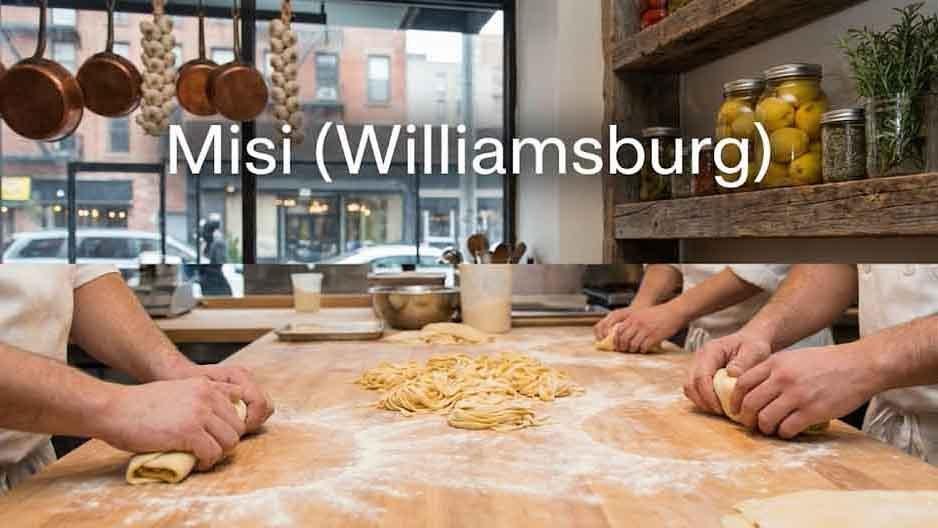
Flour, water, and twenty-five egg yolks. That is the entirety of what holds Misi together — and yet anyone who has sat at the kitchen counter on Kent Avenue, watching sheets of golden dough glide through the sheeter behind floor-to-ceiling glass, understands that the equation produces something far beyond arithmetic. Chef Missy Robbins opened Misi in September 2018 on the ground floor of a newly constructed building at the storied Domino Sugar Refinery site in South Williamsburg, and within months the restaurant had earned three stars from The New York Times — the same extraordinary distinction already bestowed upon Robbins’s first restaurant, Lilia, just a twenty-minute walk north along the waterfront (The New York Times, 2018). Peter from the Heritage Diner here: when I think about what Misi represents, I think about the philosophy I’ve practiced for twenty-five years behind my own griddle on Route 25A — the conviction that restraint, not excess, is the hallmark of mastery. A ten-item pasta menu and a ten-item vegetable menu. Nothing more. Nothing less. That kind of discipline is the culinary equivalent of what we do at Marcellino NY when we commit to a single type of stitch on a single species of leather. It is the confidence to say “this is enough.”
The Chef: Missy Robbins and Three Decades of Italian Devotion
Missy Robbins was born in 1971 and raised outside New Haven, Connecticut, in a household where shopping trips to the Italian pastifici of the New Haven corridor planted an early and permanent reverence for simple food done with impossible care. She graduated Georgetown University in 1993 with a degree in Art History and a minor in Psychology — credentials that might have led anywhere — but a pivotal dinner at a friend’s restaurant during college turned her irrevocably toward the kitchen (Wikipedia, 2024). Robbins enrolled at Peter Kump’s New York School of Cooking, now the Institute of Culinary Education, and from there began a trajectory that would carry her through kitchens both rustic and Michelin-starred on two continents.
Her formative years were split between New York apprenticeships under Wayne Nish at March and Anne Rosenzweig at Arcadia, and a transformative period training in Northern Italy — from family-run trattorias in Emilia-Romagna to a Michelin-starred restaurant in Friuli. That Italian immersion shaped everything that would follow. Returning stateside, Robbins took the helm at Tony Mantuano’s Spiaggia in Chicago, where she won the coveted William R. Rice Most Promising Chef Award in 2005 and cooked for regulars who happened to include a senator from Illinois named Barack Obama and his wife Michelle (James Beard Foundation, 2024). In 2008, she moved back to New York as Executive Chef of A Voce, maintaining Michelin stars at both the Madison Avenue and Time Warner Center locations and earning a spot on Food & Wine’s Best New Chefs list in 2010 (Grovehouse Hospitality, 2024).
Then came what Robbins has described as a necessary reckoning. She left A Voce in 2013 at age forty-two, uncertain whether she would ever open her own place — but certain she needed to try. After nearly three years of research, travel, and soul-searching, she co-founded Grovehouse Hospitality Group with longtime friend and former neighbor Sean Feeney and opened Lilia in early 2016. The rest became Brooklyn restaurant history.
The Birth of Misi: A Pasta Bar for the Neighborhood
Misi — an Italian rendering of the chef’s own first name, pronounced “Missy” — was conceived as a more focused, more casual counterpoint to Lilia. Where Lilia’s wood-fired ovens and broader Italian menu demanded a certain formality, Robbins envisioned Misi as a place where a local resident could stop in at four in the afternoon for a beer and a bowl of pasta and be on their way (Michelin Guide, 2018). The restaurant’s home at 329 Kent Avenue sits within the sprawling Domino Sugar Refinery redevelopment, a corner of South Williamsburg being reimagined as a residential and cultural destination along the East River waterfront.
The space itself presented both a challenge and an opportunity. Unlike Lilia, which occupied a converted garage with inherent architectural charisma — sixteen-foot ceilings, giant windows, industrial character — Misi was built from scratch inside a brand-new structure with no natural soul to inherit. Robbins and her team had to manufacture intimacy from nothing. The solution was a pale, minimalist aesthetic: white walls, white formica tabletops, and a luminous openness that channels attention toward the only elements that truly matter — the food and the people making it. A glass-enclosed pasta production room faces the street, offering passersby a view of the pastaio working sheets of dough through the sheeter in an almost meditative rhythm. Inside, ninety-eight seats are distributed between the main dining room, a fifteen-seat bar for walk-ins, and a thirty-five-seat kitchen counter that remains one of the most coveted perches in Brooklyn dining.
The Menu: Ten and Ten
The architecture of Misi’s menu is an exercise in creative limitation that any student of philosophy would recognize. As someone with graduate degrees from Long Island University and The New School University in New York, Peter can tell you that Heidegger wrote extensively about the way constraint reveals essence — the idea that by narrowing the frame, you illuminate what actually matters. Robbins applies that principle with surgical precision. Ten vegetable dishes. Ten pasta dishes. Every one handmade, every one seasonal, every one calibrated to let a single ingredient or technique command the foreground.
Current offerings rotate with the seasons, but the menu’s structural DNA remains consistent. On the vegetable side, expect preparations like trumpet mushrooms sott’olio with whipped ricotta crostini, grilled baby artichokes with mint salsa verde, marinated leeks with anchovy and pistachios, and slow-cooked butter beans with lacinato kale and Calabrian chili (Misi New York, 2026). These are not afterthoughts or appetizers meant to occupy your hands while waiting for the main event — they are fully realized dishes that stand as equals to the pasta.
The pasta program itself is where Misi achieves transcendence. Fettuccine with buffalo butter and extra-aged Parmigiano-Reggiano. Mezze rigatoni with a thirty-clove pomodoro and basil. Spaghetti with sea urchin, Calabrian chili, and breadcrumbs. Spinach and mascarpone-filled tortelli. Each shape is produced in-house in the glass-walled pasta room, and the textures are calibrated to a degree that separates professional craft from home cooking — the chew of the fettuccine, the way the rigatoni catches sauce in its ridges, the delicate membrane of the tortelli giving way to reveal its filling. Desserts, including the now-legendary olive oil gelato, close the meal with a lightness that leaves you wanting to return rather than recover.
The Grovehouse Empire: Lilia, Misipasta, MP Grocery, and Fini Pizza
Misi does not exist in isolation. It is one node in the expanding ecosystem of Grovehouse Hospitality Group, the company Robbins co-founded with Sean Feeney — a Springsteen-loving former investment banker whose complementary skill set has proven essential to the enterprise’s growth (Fast Company, 2023). The portfolio now includes Lilia, Misi, Misipasta (a retail pasta shop and aperitivo bar), MP Grocery (a specialty food store selling Italian imports and prepared goods), and Fini Pizza (a nod to the classic New York slice). All are located within walking distance of each other in Williamsburg, creating a self-reinforcing neighborhood ecosystem that functions less like a restaurant group and more like a small Italian village transplanted to the Brooklyn waterfront.
Robbins has also published two cookbooks: Breakfast, Lunch, Dinner…Life! (2017) and Pasta: The Spirit and Craft of Italy’s Greatest Food, with Recipes (2021), the latter co-authored with her partner Talia Baiocchi, editor-in-chief of PUNCH. The Pasta cookbook received a James Beard Award nomination in 2022 and was named one of the ten best cookbooks of the year by the San Francisco Chronicle and the Boston Globe. Bloomberg called it a commanding volume on one of the world’s most beloved foods (Bloomberg, 2021). Ina Garten offered perhaps the most succinct endorsement, noting that Robbins’s restaurants Lilia and Misi are two of the best in the world (Penguin Random House, 2021).
Awards, Accolades, and the Weight of Three Stars
The list of recognition is formidable. Robbins won the James Beard Award for Best Chef: New York City in 2018, the same year Misi opened — an award for which she had been a finalist the previous year (James Beard Foundation, 2018). Esquire named her Chef of the Year. Both Lilia and Misi received three-star reviews from The New York Times, placing them in the upper echelon of New York dining. Robbins maintained Michelin stars at both A Voce locations during her tenure there and was one of only ten female chefs in the United States to hold a Michelin star at the time (Wikipedia, 2024). She was also a contestant on Season Four of Top Chef Masters, though she withdrew during the first episode after cutting her finger badly enough to require a skin graft — a detail that speaks to the physical reality of this profession that the glossy awards tend to obscure.
What strikes me most, as someone who has spent a quarter century running a diner on Long Island’s North Shore, is that Robbins’s success is built on the same principle that sustains any neighborhood institution: presence. In the early years of Lilia, she expedited service every single night. When staff or guests expressed surprise at finding the chef-owner actually in her own kitchen, Robbins would respond with characteristic directness: where else would she be? That is the philosophy of every successful restaurateur I have ever known — the ones who build something that lasts are the ones who refuse to leave the floor.
The Dining Experience: Practical Information
Misi operates on reservations through Resy, with bookings released thirty days in advance at 10:00 AM. Walk-ins are accommodated at the fifteen-seat bar on a first-come basis, and counter seats occasionally open throughout the evening for those willing to take their chances. The restaurant offers lunch service Friday through Sunday from 11:30 AM to 2:30 PM, and dinner Monday through Thursday from 5:00 PM to 9:30 PM and Friday through Sunday from 4:30 PM to 9:30 PM (Misi New York, 2026). Pricing is reasonable for the caliber of cooking — most pasta dishes fall in the high-twenties to low-thirties range, making a two-course meal with wine an attainable indulgence rather than a financial event.
The wine list is curated with the same Italian-first philosophy that governs the food, featuring whites, reds, and sparkling selections chosen to complement the pasta and vegetable preparations. The cocktail program is creative without being theatrical — the Misi Spritz has developed its own following. Dietary accommodations are handled with care: vegetarian and vegan options are built into the menu’s structure rather than tacked on as concessions, and the staff is knowledgeable about allergens and restrictions.
For those bringing the Misi experience home, the Misipasta retail shop offers curated pasta kits, sauces, and pantry items that extend the Robbins philosophy beyond the restaurant walls. It is the kind of vertically integrated food operation that represents the future of the restaurant industry — not just cooking for guests at a table, but embedding yourself into the daily rhythms of how they eat at home.
A Closing Reflection from the Griddle
Misi is not simply a restaurant. It is a thesis about what happens when a chef spends thirty years refining a single conviction — that the greatest food is the simplest food, made by hands that have done the work long enough to make difficulty invisible. Robbins has said that her guiding principle has always been patience: take the time to learn, master the craft, and the rest unfolds as it should (ICE, 2025). From her earliest memories buying pasta at Connie’s Macaroni in New Haven to the glass-walled pasta room on Kent Avenue, the through-line is unbroken.
At the Heritage Diner, I understand this in the marrow. The first pancake off the griddle at 5:00 AM and the last burger at closing share the same fundamental commitment — that the person receiving the plate deserves your full attention, every time. Paola and I carry that same principle into our upcoming Maison Pawli real estate venture launching in 2026: the belief that provenance, craft, and local roots create value that outlasts any market cycle. And at Marcellino NY, where I hand-saddle stitch English bridle leather briefcases for clients around the world, I recognize in Robbins’s glass pasta room the same transparency I practice in my own workshop — the willingness to let people watch you work because you have nothing to hide and everything to prove.
Misi stands as evidence that restraint is not limitation. It is liberation.
Address: 329 Kent Avenue, Brooklyn, NY 11249
Phone: (347) 566-3262
Website: misinewyork.com
Reservations: Resy
Instagram: @misinewyork — 130K+ followers
Hours:
- Monday–Thursday: 5:00 PM – 9:30 PM (Dinner)
- Friday–Sunday: 11:30 AM – 2:30 PM (Lunch) | 4:30 PM – 9:30 PM (Dinner)
Delivery: Available via DoorDash and other platforms
Cuisine: Italian — Handmade Pasta & Vegetable Antipasti
Price Range: $ – $
Chef/Owner: Missy Robbins (James Beard Award Winner, Best Chef NYC 2018)
Parent Company: Grovehouse Hospitality Group (co-founded with Sean Feeney)
Neighborhood: South Williamsburg, Brooklyn — Domino Sugar Refinery District