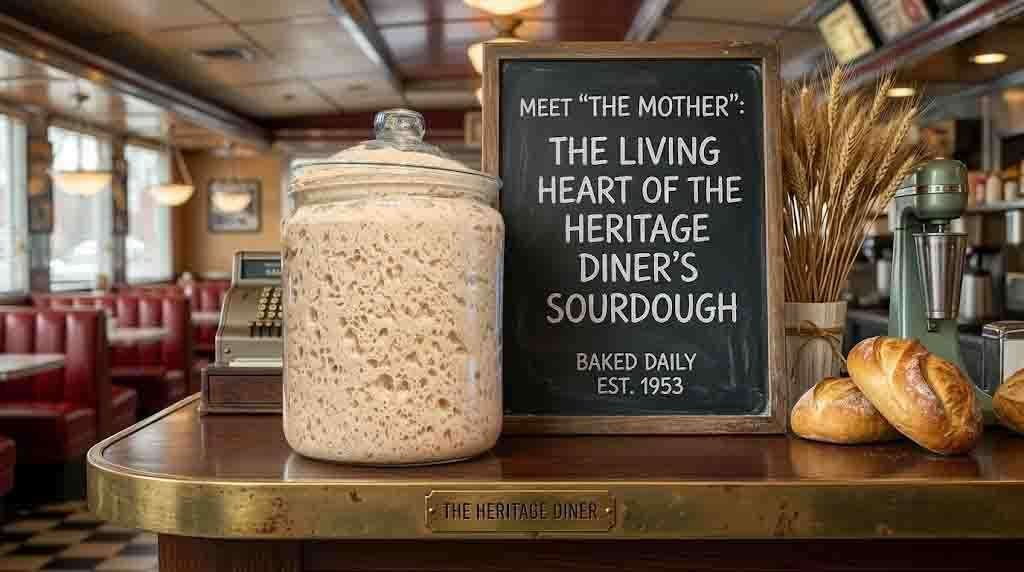
Walk through our front door at 275 Route 25A in Mount Sinai, and before you reach your booth, before the coffee lands on your table, before you even open the menu — you’ll see her. Sitting on a wooden board beside the cake case, tucked into a glass jar with a crystal knob lid, bubbling quietly and confidently: The Mother.
She is our sourdough starter. She is, in the truest biological sense of the word, alive. And she has been living right here at The Heritage Diner long enough to develop something that no commercial yeast packet could ever replicate — a character.
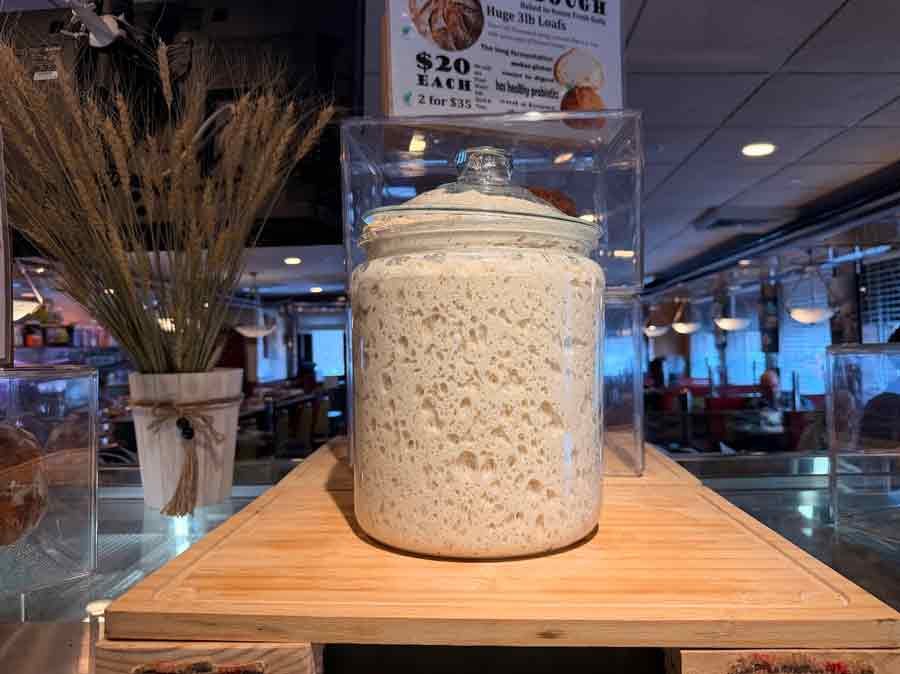
On the right mornings, when the temperatures have settled into that sweet fermentation window, she overflows. The jar cannot contain her. That overflow is not a mess to clean up — it’s a standing ovation. It means everything is working exactly the way it should. It means the wild yeast and lactic acid bacteria inside that glass are thriving, feasting on flour and water, transforming simple ingredients into something profound. We consider those mornings a good omen for the day ahead.
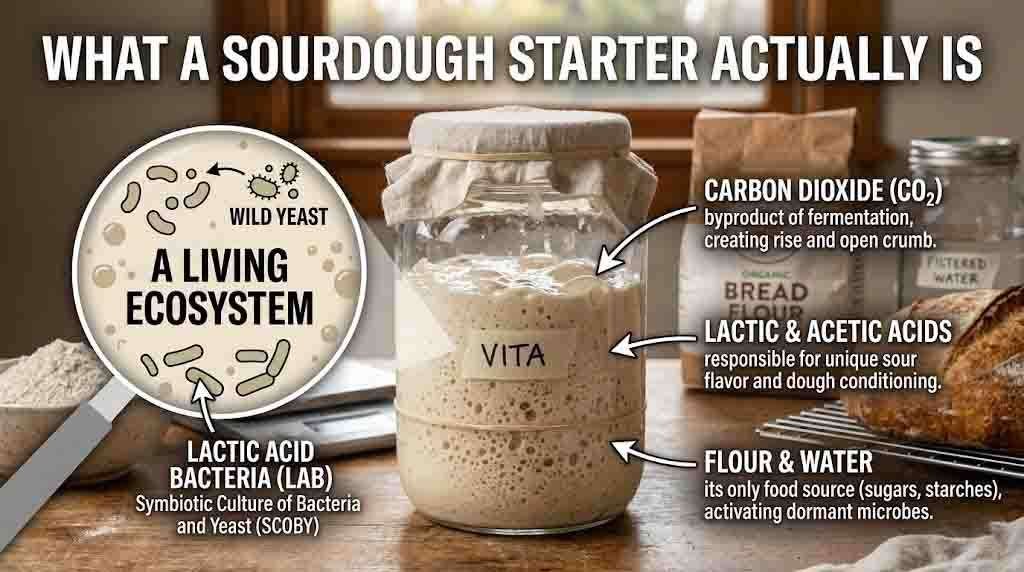
What a Sourdough Starter Actually Is
The Mother is not a recipe. She is an ecosystem.
At the most fundamental level, a sourdough starter is a fermented mixture of flour and water — but that description undersells it the way calling a symphony “organized sound” undersells Beethoven. Inside that glass jar lives a complex, self-sustaining community of wild yeast and lactic acid bacteria (LAB), the two workhorses of natural fermentation. The wild yeast produces carbon dioxide — the gas that lifts the dough and creates that signature open crumb. The lactic acid bacteria produce lactic and acetic acids — the compounds responsible for the tangy depth of flavor that distinguishes real sourdough from the commercial imitation.
What makes The Mother unique is that she is not interchangeable with any other starter. As researchers at the National Institutes of Health have noted, every sourdough starter carries its own distinct microbial fingerprint, shaped by the local environment, the flour, the water, the temperature, and the hands that tend it. (PMC, 2021). The Mother’s microbiome reflects this kitchen, this town, this North Shore air. You cannot replicate her in a laboratory. You can only nurture her over time.
That is precisely the kind of irreplaceable complexity we respect at The Heritage Diner.
The Science of the Slow Ferment — and Why It Matters for Your Health
We do not rush The Mother.
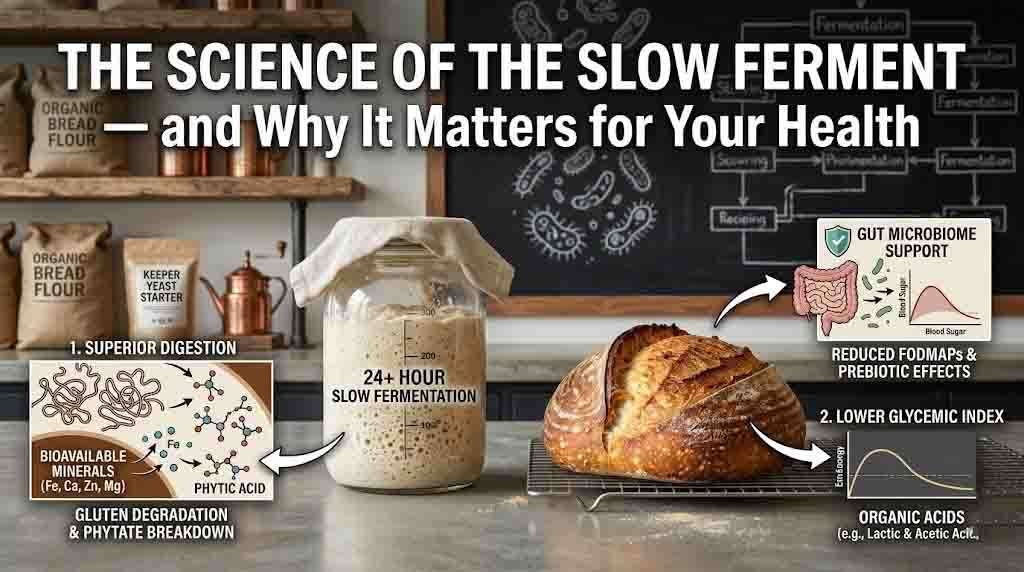
Our sourdough is slow cold-fermented — a process aligned with thousands of years of human baking tradition, and increasingly validated by modern nutritional science. The distinction between a fast-risen commercial loaf and a long cold-fermented sourdough is not just a matter of taste. It is a matter of biology.
During the extended cold fermentation process, lactic acid bacteria produce enzymes — most notably phytase — that break down phytic acid, an antinutrient naturally present in grain. Phytic acid, when left intact, blocks the absorption of key minerals like iron, zinc, magnesium, and calcium. The fermentation effectively neutralizes it, making those minerals more bioavailable to your body. (MDPI, 2023).
Beyond mineral absorption, the slow ferment also pre-digests some of the gluten. The LAB and wild yeast begin breaking down the protein structures in wheat that many people find difficult to process, which is why a significant number of individuals with mild gluten sensitivity find slow-fermented sourdough considerably easier to tolerate than conventional bread. (Mayo Clinic Health System).
Then there is the glycemic index. Sourdough produced through long fermentation has a measurably lower glycemic index than standard yeast-leavened bread — the fermentation alters the starch structure in a way that slows glucose absorption into the bloodstream, reducing the insulin spike that follows a typical bread serving. For anyone managing blood sugar or simply seeking sustained energy, this matters. (The Real Food Dietitians, 2024).
We mention these things not to make a health claim, but because we believe you deserve to know what you’re eating and why we chose to bake this way.
The Philosophy of Living Things
There is a Heideggerian concept worth borrowing here — the idea of Dasein, of being-in-the-world, of existing in genuine relationship with your environment rather than merely occupying space. The Mother embodies something close to this. She does not sit passively in that jar. She responds. She breathes. She expands when conditions are right and quiets when the temperatures drop. She has memory in her microbial composition that stretches back through every feeding, every ambient temperature shift, every change of season in this corner of Long Island.
The ancient Egyptians were the first recorded civilization to use sourdough fermentation, around 1500 BCE. For most of human history, this was simply how bread was made — slow, wild, alive. The industrial revolution replaced it with commercial dry yeast because speed was more profitable than quality. The culture of fermentation survived only in pockets: grandmother’s kitchens, artisan bakeries, small diners where someone still cared enough to maintain a starter across years.
We are one of those pockets.
The decision to commit to slow sourdough at The Heritage Diner is not a trend we are chasing. It is a philosophy about what food is supposed to do — nourish deeply, connect us to something older and more patient than ourselves, and taste like it was made by someone who gave it time.
From Starter to Your Table: The 3lb Loaf
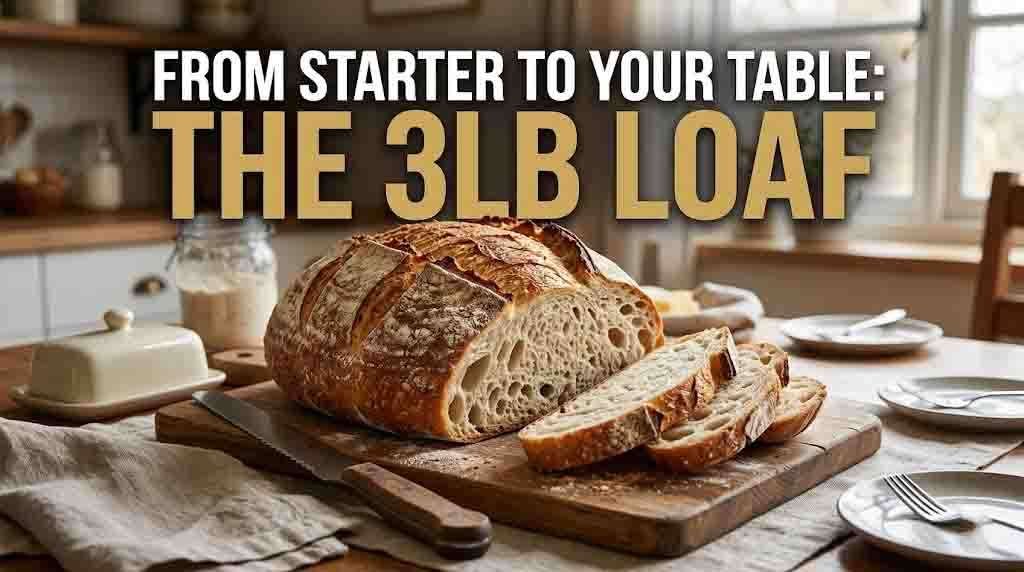
When The Mother has done her work, the result is our signature 3lb sourdough loaf, baked fresh in-house daily. We keep it simple: flour, water, salt, time, and The Mother herself. No additives. No shortcuts. No improvers. The loaves are sold at the diner for $20 each, or two for $35, and they go fast.
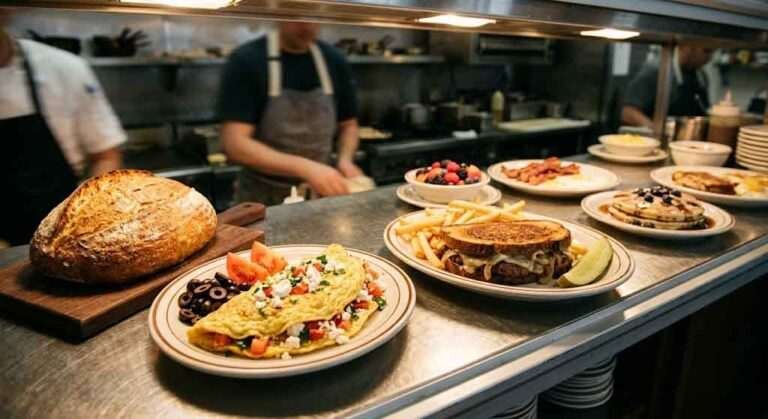
These loaves are not decorative. They are working bread. You’ll find them on our sandwich menu, beneath egg plates, alongside dinner dishes. The slow ferment creates a crust that crackles when you cut into it and an interior with that characteristic open, uneven crumb that only patient fermentation produces. The flavor has depth — a mild tang without bitterness, a wheaten earthiness that commercial bread simply cannot replicate.
A 3lb loaf is also, we would argue, the correct quantity of real bread for a household. It is substantial enough to last a few days (the acidity from fermentation naturally extends shelf life without preservatives), and satisfying enough that you won’t need to eat as much of it to feel full.
What It Means to Tend Something
Running a bespoke leather workshop and a quarter-century diner operation teaches you something essential about the nature of care: some things cannot be automated. You can build systems around them, you can optimize adjacent processes, but the core act of tending — feeding The Mother her flour and water each day, monitoring her temperature, watching for the overflow that signals peak activity — requires human attention. Attention paid over time.
The leather I work with at my studio follows the same logic. English bridle leather, when tanned correctly and maintained faithfully, develops a patina over years that mass-produced goods will never achieve. The material becomes more itself with time, not less. The Mother operates on the same principle. Every day she is fed, every loaf she leavens, she grows more complex, more expressive, more distinctly her.
This is what the word “artisan” is supposed to mean — not a marketing label, but a commitment to the irreplaceable value of time and care applied to a living process.
Come See Her
The next time you’re on Route 25A in Mount Sinai, come in and say hello — to us, and to her.
The Mother sits right there at the front, visible through the glass, doing what she has always done: working quietly, growing steadily, overflowing on the good days. You can ask us about her. We are genuinely happy to talk fermentation, food science, or the strange satisfaction of watching wild yeast do exactly what wild yeast has been doing for ten thousand years.
Then sit down, order something with the sourdough, and taste what patience actually produces.
The Heritage Diner is at 275 Route 25A, Mount Sinai, NY. Visit us at heritagediner.com. If you’d like to take a loaf home, our 3lb sourdough loaves are available daily while supplies last — $20 each, two for $35.
Some things are worth the drive.
Sources
- PMC / National Institutes of Health — Sourdough Microbiome Comparison and Benefits (2021)
- MDPI — Probiotics in the Sourdough Bread Fermentation: Current Status (2023)
- Mayo Clinic Health System — Sourdough Bread: Get Familiar with This Fermented Food
- The Real Food Dietitians — Is Sourdough Bread Healthy? (2024)
- PubMed — Sourdough Microbiome Comparison and Benefits