By Peter from The Heritage Diner | heritagediner.com/blog
Swedish has a word — aska — that translates simply to “ash.” Not the tree, but the residue. What remains after the fire has done its work. It is the kind of word that carries philosophical weight if you let it, and Chef Fredrik Berselius has let it carry the entire identity of his two-Michelin-starred restaurant in Williamsburg, Brooklyn. Ash is transformation. Ash is what endures when excess burns away. And in a culinary landscape where most New York restaurants chase spectacle and noise, Aska operates on the principle that the most extraordinary flavors emerge from restraint, from patience, from the slow chemistry of fire meeting earth.
Walking through the entrance at 47 South 5th Street, past the industrial corridor of what was once a 19th-century warehouse, you step into a world that feels more like a Scandinavian forest clearing than a Brooklyn dining room. Berselius designed it that way — intentionally, philosophically, with the same obsessive eye for “unseen details” that I understand from decades of running a diner and years of hand-stitching English bridle leather in my workshop. Every element at Aska, from the bare timber walls to the open kitchen to the greenhouse garden visible through the windows, speaks the same language: nothing is accidental, and everything is earned.
The Vision of Fredrik Berselius
Fredrik Berselius arrived in New York by way of Sweden, carrying with him the culinary DNA of the New Nordic movement that Magnus Nilsson, René Redzepi, and a generation of Scandinavian chefs had set into motion across Northern Europe. But Berselius was never interested in simple replication. He understood — the way any serious craftsman understands — that technique without terroir is merely performance (Redzepi, Noma: Time and Place in Nordic Cuisine, 2010).
Aska first materialized in 2012 as a modest operation, almost a culinary experiment, before Berselius closed the doors and spent years reimagining the concept from the ground up. When the restaurant reopened in 2016 at its current South 5th Street location, it was no longer a promising Nordic tasting room. It was a statement. The 19th-century warehouse had been transformed into a space where the raw industrial architecture of Williamsburg met the spare, luminous minimalism of Scandinavian design. Within two years, the Michelin inspectors awarded Aska two stars — a recognition that placed Berselius among the most accomplished chefs working anywhere in New York City (Michelin Guide, 2018).
What separates Berselius from his contemporaries is the depth of his commitment to locality. The majority of Aska’s ingredients are sourced within sixty miles of the restaurant, supplemented selectively by imported Nordic provisions — a particular caviar from Europe, specific grains, hand-harvested sea vegetables. The rooftop garden at the restaurant produces herbs, edible flowers, and microgreens that appear on plates hours after being cut. This is not the farm-to-table marketing language that has become nearly meaningless through overuse. This is a chef who physically tends soil on a Brooklyn rooftop because he believes proximity between hand and ingredient produces a flavor that no supply chain can replicate.
The Tasting Menu as Narrative Architecture
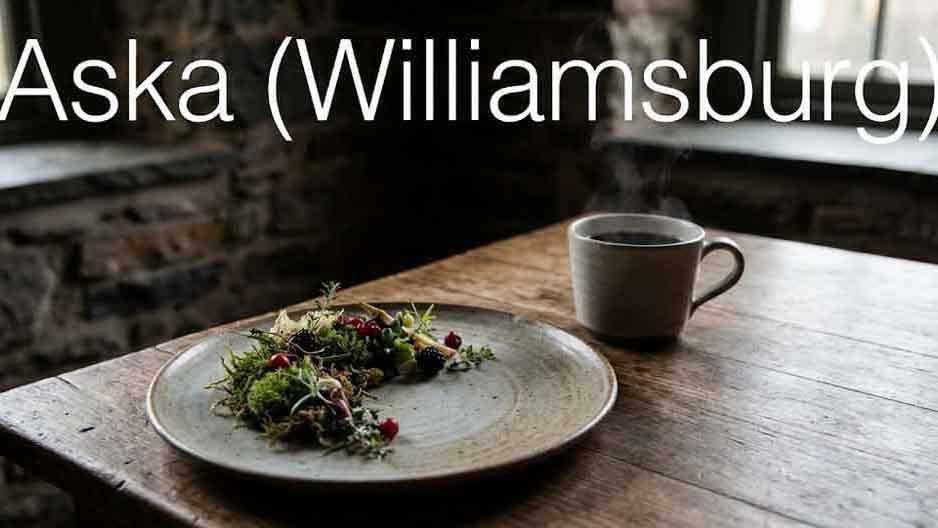
Dining at Aska is not a meal in the conventional sense. It is a sequence — a narrative told through somewhere between twelve and sixteen courses, each one building on what came before, each one designed to shift perception just enough that by the final plate, you are tasting the world differently than you did when you sat down.
The kitchen works with fermentation, smoking, curing, and dehydration techniques rooted in centuries of Nordic preservation traditions. Berselius approaches these methods not as novelty but as necessity — the same way a Scandinavian fishing village once approached salt-curing cod because winter was coming and survival demanded ingenuity. The result is food that carries extraordinary depth of flavor. A single course might involve ingredients that have been months in preparation: lacto-fermented vegetables, house-aged vinegars, dried mushrooms ground into powders so concentrated they deliver entire forest floors in a single dusting.
The wine pairing and the non-alcoholic pairing are both executed with serious intention. Sommeliers at Aska do not simply match grape to plate; they construct a parallel narrative through the glass, introducing biodynamic producers, obscure Nordic apple ciders, and fermented beverages that extend the kitchen’s philosophy of transformation into liquid form. Reviews consistently highlight this: “Both the wine pairing and the non-alcoholic pairing were outstanding,” as one diner noted, capturing the rare quality of a restaurant that respects the non-drinker’s experience as deeply as the oenophile’s.
The Space: Industrial Brooklyn Meets Nordic Clarity
Architecture tells the truth about a restaurant’s intentions in ways the menu cannot. At Aska, the converted warehouse creates a dialogue between the raw muscularity of Brooklyn’s industrial past and the serene discipline of Scandinavian design. Exposed beams, original brick, unfinished surfaces — these are not decorative choices but philosophical ones. Berselius preserved the bones of the building the way a restorer preserves the patina on an antique: by recognizing that authenticity lives in what you choose not to change.
The dining room seats roughly forty guests, a deliberate limitation that ensures intimacy and allows the kitchen to maintain absolute control over every plate that leaves the pass. An open kitchen arrangement means diners witness the choreography of service — the quiet, precise movements of a team that operates with the discipline of a string quartet. No shouting, no chaos, no performative urgency. Just concentration and craft.
The greenhouse element — visible, living, growing — connects the interior to a cycle that most urban restaurants sever entirely. Diners can see the herbs that will appear on their plates. They can see the garden where Berselius and his team work between services, their hands in soil, their attention split between what is ready to harvest and what still needs time. For anyone who has ever seasoned a cast-iron skillet properly, or waited the eighteen months it takes for a piece of English bridle leather to develop its full patina, this patience is instantly recognizable. Great things refuse to be rushed.
Community, Recognition, and the Williamsburg Context
Williamsburg has undergone one of the most dramatic neighborhood transformations in modern American urban history. What was once a working-class enclave of Hasidic communities and Puerto Rican families became, through the early 2000s, the global shorthand for artisanal culture, indie music, and, eventually, luxury real estate development (Roberts, The Brooklyn Brand, New York Times, 2017). In this context, Aska occupies an interesting position: a restaurant that arrived after the gentrification wave but operates completely outside its aesthetic vocabulary.
Aska does not brand itself. It does not chase Instagram visibility or cultivate the kind of scene-driven energy that characterizes much of Williamsburg’s dining corridor. Berselius built something that exists on its own terms — a quality that, from my vantage point as someone who has operated The Heritage Diner for twenty-five years in Mount Sinai, I recognize as the single most important factor in long-term survival. Restaurants that serve the culture of the moment die with the moment. Restaurants that serve their own standard endure.
The two Michelin stars speak to this. The James Beard Foundation recognition speaks to this. The consistent placement on “Best of New York” lists from publications including the New York Times, Eater, and New York Magazine speaks to this. But the most telling endorsement comes from the diners themselves — the kind of reviews that use words like “mind-blowing” and “magical” not as hyperbole but as honest attempts to describe an experience that exceeds the vocabulary typically available for discussing dinner. At a 4.6 rating across hundreds of reviews, Aska maintains the kind of sustained excellence that reveals a kitchen operating at championship level night after night.
Practical Details: Reservations, Pricing, and What to Expect
Aska operates a tasting-menu-only format, and securing a reservation requires planning. The restaurant accepts bookings primarily through Resy, and demand consistently outpaces availability — particularly for weekend seatings. This is a restaurant where you book weeks in advance, not days.
Pricing reflects the two-star Michelin caliber of the experience. The tasting menu runs in the range of $285 to $365 per person before beverage pairings, tax, and gratuity. Wine pairings and non-alcoholic pairings are additional. This is an investment, and it should be understood as one. You are not paying for dinner; you are paying for months of preparation, sourcing relationships built over years, a kitchen staff trained to a standard that most restaurants never approach, and an evening that will recalibrate your understanding of what food can communicate.
Address: 47 South 5th Street, Brooklyn, NY 11249
Neighborhood: Williamsburg, Brooklyn
Cuisine: New Nordic / Scandinavian Tasting Menu
Hours: Tuesday through Sunday, 5:00 PM – 11:00 PM. Closed Monday.
Reservations: Via Resy — strongly recommended well in advance.
Website: askanyc.com
Phone: (929) 337-6792
Michelin Stars: Two Stars
Price Range: $$$$
Dress Code: Smart casual. Williamsburg-appropriate elegance — no ties required, but respect the room.
Accessibility: Ground-floor entry; contact the restaurant directly for specific accommodation requests.
The Marcellino Standard and the Meaning of Craft
I write about restaurants like Aska not as a critic — I have no interest in awarding stars or rendering verdicts — but as a fellow craftsman who recognizes the particular intensity required to maintain excellence across thousands of repetitions. At Marcellino NY, when I hand-stitch a briefcase from English bridle leather using traditional saddle-stitching techniques, every stitch must hold the same tension as the one before it. There is no automation to catch my mistakes. There is no algorithm to optimize the process. It is hand, needle, thread, leather, and the accumulated knowledge of what happens when you repeat a motion ten thousand times with full attention.
Berselius works the same way. His kitchen does not rely on shortcuts or molecular gimmickry to manufacture surprise. The surprise at Aska comes from the depth of attention paid to ingredients that most kitchens overlook entirely — the particular sweetness of a root vegetable harvested after the first frost, the mineral complexity of seaweed dried at precisely the right temperature, the way a juniper berry releases its oils differently depending on whether it is crushed, toasted, or infused. This is the craft tradition applied to cuisine, and it produces results that no amount of technology can replicate.
Peter holds a graduate degree in Philosophy from Long Island University and The New School in New York City. He has spent twenty-five years behind the counter at The Heritage Diner in Mount Sinai and the last decade building Marcellino NY into a name recognized among the world’s most discerning clients. In 2026, he and his wife Paola, a licensed real estate broker, will launch Maison Pawli — a boutique real estate venture on Long Island’s North Shore built on the same philosophy that drives everything they do: that the things which endure are the things made with intention, crafted by hand, and rooted in place.
Aska is one of those things. Fredrik Berselius built a restaurant that burns away everything unnecessary and leaves only what matters. Ash, after all, is not destruction. It is essence.
Peter from The Heritage Diner writes about food, craftsmanship, and the culture of the North Shore and beyond from Mount Sinai, New York. The Heritage Diner has served the community at 275 Route 25A since 2000. Marcellino NY handcrafts bespoke English bridle leather briefcases from Huntington, NY — visit marcellinony.com. For apps and projects, visit x9m8.com.