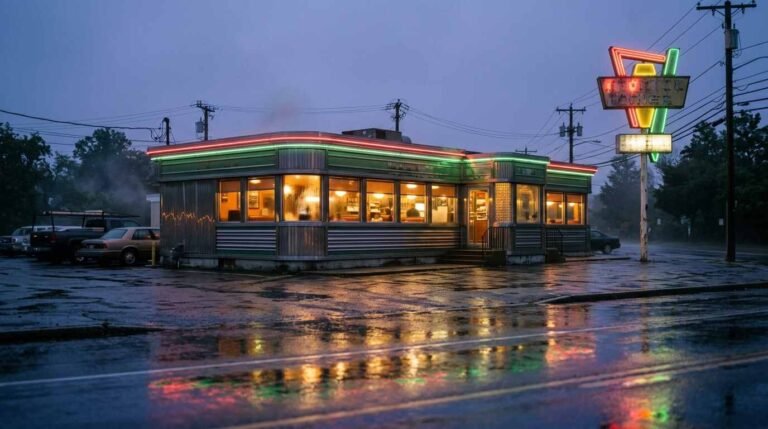
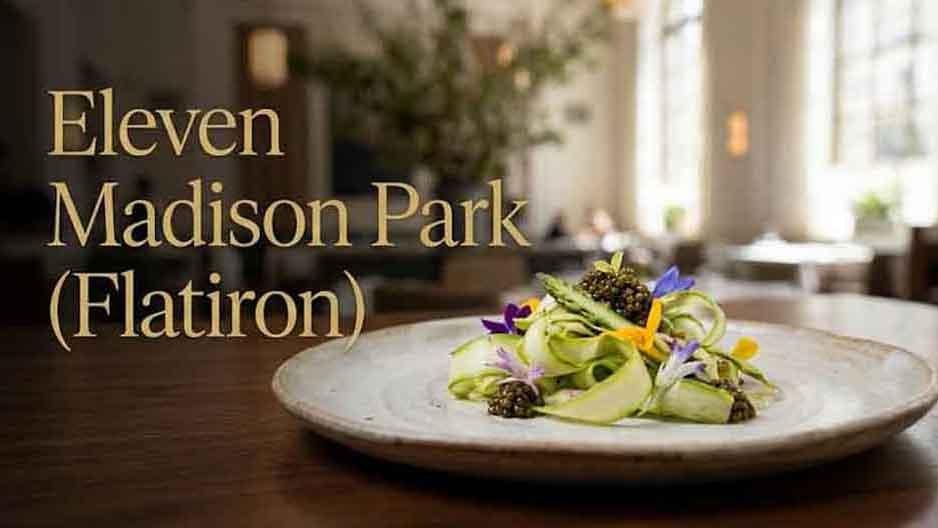
At the northeast corner of East 24th Street and Madison Avenue, where the scent of roasted vegetables carries across the polished travertine lobby of a building originally designed to scrape the clouds at one hundred stories, a single restaurant has spent the better part of three decades rewriting the rules of American fine dining. Eleven Madison Park is not merely a place where food is served. It is a philosophical argument about what hospitality owes the world — and what the world, in its hungriest and most uncertain hours, might owe hospitality in return. I have spent twenty-five years running The Heritage Diner in Mount Sinai, where a patty melt sizzling on a flat-top at six in the morning carries its own kind of gravity. And I can tell you this without equivocation: what Daniel Humm has constructed inside that Art Deco monument on Madison Square Park represents the rarest achievement in the restaurant business — a kitchen that has reinvented itself multiple times, at the height of its powers, and emerged each time more essential than before.
The Architecture of Ambition: A Building That Refused to Die
The structure that houses Eleven Madison Park is itself an object lesson in resilience. Designed in 1929 by Harvey Wiley Corbett for the Metropolitan Life Insurance Company, the Metropolitan Life North Building was conceived as a one-hundred-story skyscraper — a vertical colossus that would have eclipsed even the Empire State Building in the race for the tallest structure on Earth (Flatiron NoMad Partnership, 2022). Then came the crash. The stock market collapse of October 1929 and the grinding Depression that followed strangled the funding, and the tower was halted at twenty-nine stories, its steel skeleton strong enough to support seventy more floors that would never arrive. Construction limped forward in three stages over twenty years, finally completing in 1950 as a thirty-story Art Deco monument — clad in Alabama limestone, its vaulted corner entrances rising three stories high, its lobby finished in travertine and marble with coffered ceilings layered in aluminum leaf (Wikipedia, 2025). The building was added to the National Register of Historic Places in 1996 as part of the Metropolitan Life Home Office Complex, and later incorporated into the Madison Square North Historic District by the New York City Landmarks Preservation Commission in 2001.
I think about that architectural history often as someone who works with leather and real estate on Long Island’s North Shore. A building planned for the heavens, curtailed by catastrophe, then reimagined into something beautiful at a humbler scale — this is not failure. This is the patina of adaptation, the same quality that makes a hundred-year-old cast-iron skillet or a well-aged bridle leather briefcase infinitely more compelling than its factory-fresh counterpart. And it is precisely this kind of building — soaked in aspiration and scarred by history — that deserves to house a restaurant of equal ambition.
Danny Meyer, Daniel Humm, and the Transfer of a Legacy
Eleven Madison Park opened its doors in 1998 under the stewardship of Danny Meyer, the restaurateur whose Union Square Hospitality Group had already reshaped how New York City thought about dining with Gramercy Tavern and Union Square Cafe. Meyer understood something fundamental about the relationship between architecture and appetite: the soaring ceilings and monumental windows of the former Met Life lobby, looking out directly onto Madison Square Park, could transform a meal into an event without a single word being spoken (Resy, 2023).
In 2006, a young Swiss chef named Daniel Humm arrived at the restaurant, having earned four stars from the San Francisco Chronicle at Campton Place. He was joined by Will Guidara, a front-of-house visionary who would become his indispensable partner. Together, they began the slow, methodical process of elevating Eleven Madison Park from an excellent neighborhood fine-dining restaurant into a global institution. In 2011, they purchased the restaurant outright from Meyer’s group — a moment as significant in New York restaurant history as the passing of a deed on a storied property. You do not buy a restaurant from Danny Meyer lightly. You inherit a philosophy of hospitality alongside the lease (World’s 50 Best, 2022).
What followed was one of the most astonishing ascents in culinary history. The restaurant climbed the World’s 50 Best Restaurants list from its debut at number fifty in 2010 to the number one position in 2017. Along the way, Eleven Madison Park accumulated three Michelin stars (held continuously since 2012), four stars from The New York Times, six James Beard Foundation Awards including Outstanding Chef and Outstanding Restaurant, and a reputation for a particular brand of bespoke hospitality that Guidara would later codify in his bestselling book Unreasonable Hospitality (2022). The dining room became famous for its communal dishes, tableside presentations, and an almost uncanny ability to personalize each guest’s experience — a philosophy that anyone who has ever run a neighborhood restaurant, where you know every customer by name, can recognize as the highest-stakes version of what we do every morning at the counter.
In 2019, Humm and Guidara parted ways. Guidara departed, and Humm became the sole owner, renaming the hospitality group Daniel Humm Hospitality in 2024. The split stunned the fine-dining world, but Humm pressed forward with the kind of conviction that only comes from having already reached the summit and deciding the view is not enough.
The Plant-Based Revolution and Its Reckoning
When Eleven Madison Park reopened in June 2021 after fifteen months of pandemic closure, Daniel Humm made an announcement that sent shockwaves through the global restaurant industry: the tasting menu would be entirely plant-based. No butter. No eggs. No cream. No honey-lavender duck — the dish that had become the restaurant’s signature and a symbol of its pre-pandemic identity.
Humm framed the decision in terms both environmental and creative. In a public letter, he wrote that the current food system was unsustainable and that the pandemic had given him the clarity to pursue a different path (ElevenMadisonPark.com, 2025). His kitchen developed an entirely new culinary vocabulary — mille-feuille without butter, meringue without eggs, almond-milk ricotta, sunflower butter, koji stocks, whipped cashew cream, and what the team called “land caviar” made from tonburi, the seeds of a Japanese cypress tree. In 2022, Eleven Madison Park became the first restaurant in Michelin Guide history to earn three stars for an entirely plant-based menu — a distinction that, as Humm noted, felt like defying the very institution that had defined luxury dining for over a century.
The decision was polarizing. Critics and diners debated whether a $365 tasting menu without any of the traditional markers of luxury — truffles, wagyu, caviar, foie gras — represented genuine innovation or an expensive act of ideology. Business Insider reported in 2022 on struggles with employee turnover and low wages, alleging that despite the restaurant’s lofty ideals, kitchen staff started at fifteen dollars per hour while working eighty-hour weeks, and tipping was banned (Business Insider, 2022). The tension between aspirational philosophy and operational reality is one that every restaurateur — from a three-star temple on Madison Avenue to a diner on Route 25A — must navigate daily.
Then, in August 2025, Humm announced another pivot. Starting October 14, 2025, Eleven Madison Park would reintroduce select animal proteins as optional substitutions within a tasting menu that remained rooted in plant-based cooking. The signature honey-lavender duck returned. Guests could now choose between a fully plant-based experience or one that incorporated fish and meat into select courses. Humm described the shift as a move toward inclusivity: the all-or-nothing approach had been necessary to develop the team’s expertise, but it had also, unintentionally, kept people away — which, he admitted, was the opposite of what hospitality should accomplish (ElevenMadisonPark.com, 2025). In the leather trade, we call this “reading the hide” — understanding that even the finest material must yield to the hand that will carry it. The craft is in knowing when discipline serves the work and when it becomes its own obstacle.
The Dining Experience: What $365 Actually Buys You
Eleven Madison Park currently offers three tasting menu formats. The full tasting menu, priced at $365 per guest, delivers seven to eight courses over approximately two to three hours in the main dining room — a soaring, meticulously designed space renovated in 2017 by Brad Cloepfil of Allied Works, featuring artwork by Rita Ackermann, Daniel Turner, Sol LeWitt, and Olympia Scarry. The five-course menu runs $285 per guest for those seeking a shorter encounter. And the bar tasting menu, available in the lounge, provides four to five courses at $225 per guest over roughly two hours (ElevenMadisonPark.com, FAQ).
Wine pairings are available at $115 and $195 tiers, with a non-alcoholic beverage pairing at $85. Gratuity is not included — a change from the restaurant’s previous service-included model. All reservations are prepaid and non-refundable, booked through Resy on a rolling monthly basis, with new availability opening on the first of each month.
Bar seating is available on a first-come, first-served basis, where guests can order à la carte snacks, cocktails, and wine without committing to a full tasting experience. This accessibility matters. One of the quiet criticisms of ultra-fine dining is that it builds walls between the kitchen and the community. The bar at Eleven Madison Park, like a good diner counter, keeps the door cracked open.
In 2025, the Luxury Travel Book listed Eleven Madison Park as the most-searched Michelin-starred restaurant in the world — a testament to the global appetite for what Humm has built, even amid the philosophical debates surrounding his menu choices.
Clemente Bar: The Artist’s Studio Above the Cathedral
In October 2024, Humm opened Clemente Bar on the second floor above the main dining room — a collaboration with his close friend, the Italian neo-expressionist painter Francesco Clemente. Designed by Brad Cloepfil of Allied Works (who also oversaw the 2017 dining room renovation), the space draws inspiration from the legendary Kronenhalle bar in Zurich, where works by Picasso, Miró, and Klee hang alongside custom light fixtures by Diego Giacometti (Wallpaper, 2024).
Clemente created three large-scale original works for the space, including a ceiling fresco near the entrance that sets the tone before a single drink is poured. German artist Carsten Höller designed the mushroom-shaped lamps. Los Angeles designer Brett Robinson built the custom furniture. The cocktail program, led by beverage director Sebastian Tollius, divides its offerings into six categories — Fresh, Carbonated, Clarified, Whipped, Bold, and Zero Proof — with the signature Clemente Martini featuring vodka, gin, green curry, saffron, and olive, crafted specifically for its namesake artist (Michelin Guide, 2024).
The food menu at Clemente Bar remains entirely plant-based, featuring elevated bar snacks like thrice-fried potatoes with rosemary and lemon, avocado pockets with sushi rice and finger lime, and the “Agedashi Dogg” — a block of fried tofu on a potato roll that reimagines the New York street hot dog through a vegan lens. An intimate eight-seat chef’s counter called The Studio offers a ninety-minute, five-course tasting menu with cocktail pairings for those who want a deeper experience without the formality of the main dining room below.
Clemente Bar is open daily from 5 p.m. to 1 a.m. Reservations are available through Resy, but walk-ins are welcome at the bar. As someone who has spent three years building bespoke briefcases for clients at Marcellino NY — understanding that the best collaborations happen when craft meets art without either domain compromising its integrity — I find the Clemente Bar concept deeply resonant. It is proof that a restaurant can expand its vocabulary without diluting its accent.
When the Kitchen Became a Commissary: COVID and the Soul of Service
Perhaps the most defining chapter in Eleven Madison Park’s history has nothing to do with tasting menus or Michelin stars. When COVID-19 forced the restaurant to close its doors in March 2020, Humm did not retreat. Within weeks, he converted the kitchen into a full-time commissary in partnership with Rethink Food — a nonprofit he co-founded in 2017 to address food insecurity by reducing restaurant waste and redirecting it toward communities in need (NYC Food Policy Center, 2021).
At its peak, the Eleven Madison Park kitchen was producing three thousand meals per day — roasted chicken with rice and cauliflower, braised veal cheek with couscous and roasted carrots, pasta with romesco sauce and house focaccia — delivered by Rethink Food to hospitals including New York-Presbyterian and to community centers across all five boroughs, particularly in the Bronx and Brooklyn, neighborhoods devastated by the pandemic (CNN, 2020). American Express sponsored the initial partnership. Former staff who had been laid off were rehired through Rethink to work the line. Humm launched EMP at Home, a meal-kit program where each purchase funded ten donated meals, ultimately contributing to over four hundred thousand meals donated by March 2021 (NYC Food Policy Center, 2021).
In April 2021, Eleven Madison Park launched a food truck in partnership with Rethink Food, distributing up to two thousand free meals per week in underserved neighborhoods across the Bronx and Brooklyn, prepared with the same ingredients and care as the restaurant’s fine-dining menu (Robb Report, 2021). The restaurant continues to support Rethink Food through produce donations from Magic Farms — its exclusive upstate supplier since 2021 — and hosts the nonprofit’s annual gala.
I mention this not as an aside but as the central fact of Eleven Madison Park’s character. Any restaurant can earn stars. Very few will turn their Michelin-starred kitchen into a soup kitchen when the city needs it most. That decision reveals more about a restaurant’s philosophy than any tasting menu ever could. At The Heritage Diner, we have served Mount Sinai for twenty-five years through recessions, storms, and a pandemic of our own. We know what it means when the doors stay open not for profit, but for principle. What Humm did during COVID was the restaurant industry’s finest hour, and it happened on Madison Avenue.
Reservations, Contact, and Essential Details
Address: 11 Madison Avenue, New York, NY 10010 (northeast corner of East 24th Street and Madison Avenue, directly across from Madison Square Park)
Phone: +1 (212) 889-0905
Website: elevenmadisonpark.com
Clemente Bar: clementebar.com
Reservations: Available via Resy. New reservations open on the first of each month for the following month. Waitlist available through the Resy app.
Menu Options (as of October 2025): Full Tasting Menu — $365/guest (7–8 courses, ~2–3 hours); Five-Course Menu — $285/guest; Bar Tasting Menu — $225/guest (4–5 courses, ~2 hours); Wine Pairing — $115 or $195; Non-Alcoholic Pairing — $85.
Clemente Bar Hours: Daily, 5 p.m. – 1 a.m. Walk-ins welcome at the bar; lounge and Studio reservations via Resy.
Dress Code: Smart casual. No formal dress code is enforced, but the atmosphere and price point encourage guests to dress for the occasion.
Accessibility: Ground-floor dining room entrance. Contact the restaurant directly for specific accessibility needs.
Gift Cards: Available for purchase; contact Marcia Regen (mregen@hummhospitality.com) for Braille gift cards or redemption questions.
Cuisine: Plant-based foundation with optional animal protein courses (fish and meat) as of October 2025.
Michelin Stars: Three (held continuously since 2012)
DoorDash / Delivery: Not available. Eleven Madison Park is a dine-in-only experience.
Peter — owner of The Heritage Diner in Mount Sinai, NY, master leather craftsman at Marcellino NY in Huntington, and co-founder of Maison Pawli boutique real estate with his wife, broker Paola — holds graduate degrees in Philosophy from Long Island University and The New School University in NYC. He has spent twenty-five years studying the intersection of craft, community, and commerce from behind a diner counter on the North Shore of Long Island.