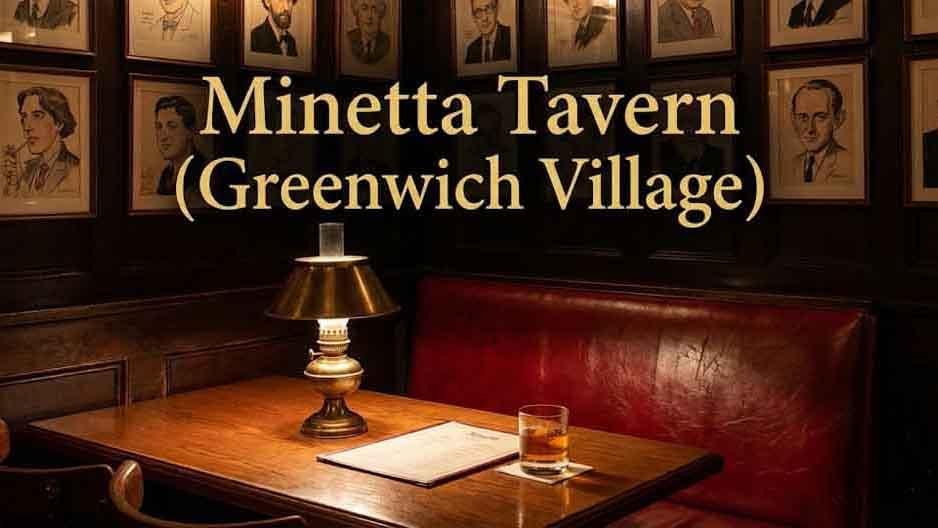
Eight decades of smoke, ink, and seared beef have settled into the wood-paneled walls of 113 MacDougal Street, and none of it has ever been cleaned away — deliberately. Minetta Tavern does not merely occupy its corner of Greenwich Village. It inhabits it, the way tree roots inhabit soil, the way a patina inhabits leather, the way a quarter-century of griddle seasoning inhabits a cast-iron flat-top. I say this as someone who has spent twenty-five years behind my own counter at The Heritage Diner in Mount Sinai, building exactly that kind of accumulation — the slow, irreversible embedding of a business into the nervous system of its community. Minetta Tavern is the New York City proof-of-concept for what happens when a restaurant refuses to be temporary. When it decides, against every economic pressure and cultural trend, to become permanent.
Founded in 1937 by Eddie “Minetta” Sieveri, the tavern takes its name not from its founder but from the Minetta Brook — a subterranean waterway that once ran southwest from 23rd Street to the Hudson River, cutting through what would become Washington Square Park before disappearing underground in the early nineteenth century (Untapped Cities, 2021). The brook is invisible now, buried beneath asphalt and brownstone foundations, but its name persists in the two crooked lanes that intersect just steps from the tavern’s front door: Minetta Lane and Minetta Street. There is a beautiful metaphor in this — a restaurant named for something hidden, something flowing beneath the surface, something that shaped the geography long before anyone thought to build on top of it. The best restaurants work exactly this way. What you see on the plate, the menu, the décor — that is the visible street. The real current runs underneath: the relationships, the sourcing decisions, the philosophical commitment to showing up every single day and doing the same thing with fractionally more precision than the day before.
The Literary Speakeasy That Became a Parisian Steakhouse
Before it was Minetta Tavern, the space operated during Prohibition as a speakeasy called The Black Rabbit, run by Eve Adams, who also operated Eve’s Hangout down the block at 129 MacDougal (Art Nerd New York, 2016). In a detail that defies belief, the basement of this very building is where DeWitt and Lila Bell Acheson Wallace published the first issues of Reader’s Digest, reportedly accessing their makeshift editorial office through a trapdoor in the tavern floor (Inside the Apple, 2008). The notion that one of America’s most widely circulated magazines was born beneath a speakeasy — that bootleg whiskey and mass-market publishing shared the same foundation — captures something essential about Greenwich Village’s DNA. This was never a neighborhood that separated its appetites from its ambitions.
When Sieveri officially opened the tavern in 1937, it became an immediate gravitational center for the literary and artistic communities already orbiting MacDougal Street. Ernest Hemingway, Ezra Pound, Eugene O’Neill, E.E. Cummings, Dylan Thomas, and Jack Kerouac all drank here (Wikipedia, 2025). But the tavern’s most consequential regular was its least distinguished: Joe Gould, a Harvard-educated homeless bohemian who claimed to be writing An Oral History of Our Time — a manuscript he boasted was longer than the Bible. Gould was such a fixture that the owners reportedly paid him in spaghetti to sit near the window so tourists could observe an actual Greenwich Village bohemian in his natural habitat (Art Nerd New York, 2016). He traded poems for martinis, received his mail at the bar, and performed his signature “Joseph Ferdinand Gould Stomp” — a hand-clapping, foot-thumping dance he claimed to have learned on a Chippewa reservation in North Dakota (Mr. Beller’s Neighborhood, 2008).
Joseph Mitchell, the legendary New Yorker staff writer, profiled Gould twice — first in 1942 under the title “Professor Sea Gull,” and again in 1964, years after Gould’s death, in the piece that became Joe Gould’s Secret. Mitchell’s devastating revelation was that the Oral History did not exist — not in any meaningful form. There were notebooks, fragments, compulsive repetitions of the same essays, but no magnum opus. The portrait of Gould that still hangs above the second booth to the left, directly opposite the bar, is a monument to both the romance and the tragedy of creative ambition — the distance between the story we tell about our work and the work itself. As someone who hand-stitches English bridle leather briefcases at Marcellino NY, each one requiring forty to sixty hours of labor, I find this distinction sacred. The object must exist. The craft must be real. The “oral history” of a bespoke piece is meaningless without the physical artifact to prove it.
Keith McNally and the Art of Resurrection
After Sieveri sold the tavern, it passed to Taka Becovic, a Montenegrin immigrant and former busboy who ran it as a family-style Italian restaurant through the 1990s and early 2000s (Wikipedia, 2025). Becovic maintained the original interiors — the wood paneling, the hand-painted murals of Village street scenes, the black-and-white photographs of famous patrons — but the restaurant gradually faded from cultural prominence. Sieveri returned every year for his birthday dinner until his death, a loyalty that speaks to the elemental bond between a founder and his creation. When rising rents finally forced Becovic out, the space caught the attention of Keith McNally, and everything changed.
McNally — born in 1951 in London’s working-class Bethnal Green, the son of a dockworker and a self-educated homemaker — had already established himself as the most consequential restaurateur in downtown Manhattan (Wikipedia, 2025). After emigrating to New York in 1975 with vague aspirations of filmmaking, he worked his way from oyster shucker to busboy to floor manager before opening The Odeon in Tribeca in 1980 with his brother Brian and then-partner Lynn Wagenknecht. The Odeon became the epicenter of 1980s downtown cool, drawing Jean-Michel Basquiat, Andy Warhol, Anna Wintour, and the Saturday Night Live cast. Over the next four decades, McNally built an empire — Café Luxembourg, Balthazar, Pastis, Morandi, Cherche Midi — that The New York Times would summarize with a single definitive phrase: “The Restaurateur Who Invented Downtown.”
McNally reopened Minetta Tavern in 2009, and Frank Bruni of The New York Times immediately awarded it three stars. The restaurant earned a Michelin star that it held from 2010 through 2018. McNally’s genius was not renovation but reanimation — preserving the original murals, the tin ceilings, the checkered floors, the dark wood paneling, while layering in the sensibility of a Parisian steakhouse. Red leather banquettes, soft globe lighting, an electric hum of something perpetually happening just out of view. In a 2025 interview with November Magazine, McNally articulated his philosophy with characteristic bluntness: “I never know if a restaurant is going to work until it’s open for business.” His memoir, I Regret Almost Everything, published by Simon & Schuster in 2025, traces the full arc of this unlikely journey from Bethnal Green to MacDougal Street.
What McNally understands — and what I have spent twenty-five years learning at The Heritage Diner — is that a restaurant’s atmosphere is not decoration. It is infrastructure. The “right feel,” as he calls it, is as structural as a load-bearing wall. You cannot bolt it on after the fact. It must be built into the foundation, the way a saddler builds tension into a hand-stitched seam. Every detail at Minetta — the weight of the silverware, the warmth of the lighting, the precise volume of conversation — has been calibrated to produce a specific emotional response. This is not hospitality. This is architecture.
The Black Label Burger: A Study in Restraint
No discussion of Minetta Tavern is complete without confronting the Black Label Burger, which has achieved a level of cultural significance usually reserved for landmark buildings and constitutional amendments. Priced at $38 on the current menu, it consists of a proprietary blend of prime dry-aged beef cuts from Pat LaFrieda — the legendary New York meat purveyor whose family has been in the business since 1922 — topped with caramelized onions on a sesame brioche bun from Balthazar Bakery, served with pommes frites (Minetta Tavern Menu, 2025). No cheese. No lettuce. No tomato on the patty. The burger’s power lies entirely in what has been removed.
The dry-aging process — which evaporates moisture from the beef while enzymatic activity breaks down connective tissue — concentrates flavor into something approaching the mineral intensity of a well-aged wine. The result is a patty with a pronounced umami depth, a buttery mouthfeel, and a complexity that cheese would obliterate rather than enhance. The caramelized onions provide sweetness and moisture without competing for attention. The brioche — slightly stale by design, then toasted to activate the sesame seeds and eliminate any contribution of its own moisture — functions as a structural element rather than a flavor one, absorbing the meat’s juices while providing architectural integrity (Shared Appetite, 2021; Nick Solares, 2010).
I think about this kind of disciplined restraint constantly in my leather work at Marcellino NY. When I build a briefcase from English bridle leather for a client — whether it is a Wall Street attorney or Tilman Fertitta — the temptation is always to add: another pocket, another strap, another decorative element. But the masters of any craft understand that excellence is subtractive. You remove everything that does not serve the essential purpose. The Black Label Burger is the culinary equivalent of a full-grain, vegetable-tanned leather panel with nothing on it but a hand-burnished edge — no paint, no filler, no cosmetic treatment. Just the material itself, prepared with enough skill that ornamentation becomes irrelevant.
The regular Minetta Burger, at $33 with cheddar, caramelized onions, and frites, is by all accounts an exceptional burger in its own right. But as former chef Riad Nasr once warned diners: once you have eaten the Black Label, there is no going back.
From Hemingway to Taylor Swift: The Unbroken Thread of Celebrity
Minetta Tavern’s relationship with fame is not the manufactured celebrity-magnetism of a velvet-rope nightclub. It is organic, almost geological — a slow accretion of cultural significance that compounds over decades the way interest compounds in a savings account. The literary generation that first claimed the tavern — Hemingway, Pound, Cummings, O’Neill, Thomas, Kerouac — established its gravitational field. Joe Gould and Joseph Mitchell’s New Yorker profiles broadcast that field to a national audience. McNally’s 2009 renovation recalibrated it for the twenty-first century.
Today, the tavern draws Taylor Swift, who dined there in November 2023 with Phoebe Bridgers and reportedly reacted to chef Laurent Kalkotour’s baked oysters by opening her eyes wide and exclaiming in astonishment (Billboard, 2023). Jerry Seinfeld, Brooke Shields, Jay McInerney, and Angelina Jolie have all been spotted at the restaurant (Mashed, 2026). McNally himself has become a celebrity of sorts, famous for his acerbic Instagram posts — including his public banning of James Corden in 2022 after the television host behaved rudely toward a server, a ban McNally lifted only after Corden apologized both privately and on his late-night show (Wikipedia, 2025).
What connects a homeless poet trading doggerel for gin in 1942 to a global pop star eating foie gras in 2023 is not status but magnetism — the pull of a space that has been imbued with so much accumulated human experience that it generates its own cultural gravity. My wife Paola and I think about this phenomenon constantly as we prepare to launch Maison Pawli, our boutique real estate venture on Long Island’s North Shore, in 2026. The properties that command the deepest loyalty — and the highest valuations — are never the newest or the most technologically advanced. They are the ones with provenance. The ones where the walls have absorbed something irreplaceable.
The Washington, D.C. Expansion and the Question of Replication
In December 2024, McNally opened a second Minetta Tavern in the Union Market district of northeast Washington, D.C. — his first and, he has stated, last replication of any of his New York restaurants (Axios, 2024). The D.C. location occupies a converted industrial building on Morse Alley, and McNally’s team spent three years constructing a near-identical reproduction of the original, from the tin ceilings down to the checkered floors. Chef Laurent Kalkotour, an Alain Ducasse alumnus who has worked with McNally for six years, created a menu that carries over the signature Black Label Burger and côte de boeuf while incorporating Old World additions like vol-au-vent and pied de cochon.
Above the restaurant sits the Lucy Mercer Bar, named for Franklin D. Roosevelt’s longtime mistress and decorated in the style of an eighteenth-century French salon — red velvet drapes, a wood-burning fireplace, intimate zinc bar, and a strict no-phones policy. McNally told Axios that the mistress theme was merely a “springboard to launch into the kind of semi-debauched dinners” depicted in Stanley Kubrick’s Barry Lyndon. The Washington Post reviewed the D.C. location in February 2025, noting that the experience delivered on the promise of the original.
The question of whether a restaurant can be replicated is one of the deepest in hospitality. McNally himself has historically resisted the impulse — Balthazar’s London outpost, which he opened in 2013, was by his own admission a miserable experience born of financial motivation rather than creative conviction. The D.C. Minetta represents something different: an attempt to transplant not just a menu and a design scheme but an atmosphere, which is the most fragile and least reproducible element of any great restaurant. It is the equivalent of asking whether a master craftsman can produce two identical briefcases. The answer, from my experience at Marcellino NY, is that he can produce two briefcases of equal quality — but they will never be identical, because the leather itself is a living material with its own grain, its own character, its own history. The best you can hope for is fidelity to the standard while accepting the inevitability of variation.
What Minetta Tavern Teaches About Permanence
Eighty-eight years is a staggering lifespan for any New York City restaurant. The economics of Manhattan real estate — where commercial rents can double or triple in a single lease cycle — have killed establishments far more famous and far better capitalized than a MacDougal Street tavern. What Minetta possesses that most restaurants do not is narrative density. Every surface, every photograph, every hand-painted mural is saturated with story. The portrait of Joe Gould above the second booth. The neon sign that has hung outside since the 1930s. The murals of Village street scenes that depict a New York that no longer exists anywhere except inside these walls. To sit at the bar at Minetta Tavern is to sit inside a living document of the city’s cultural history — not as a museum visitor, but as a participant, because the document is still being written, still accumulating new layers with every service.
This is the principle I have built my entire professional life around — at The Heritage Diner, at Marcellino NY, and in the real estate philosophy Paola and I are developing for Maison Pawli. A cast-iron skillet improves with use. English bridle leather develops its patina through handling. A neighborhood restaurant becomes indispensable through the sheer accumulation of mornings and evenings, regulars and strangers, burnt coffee and perfect omelets. The philosopher Martin Heidegger called this Zuhandenheit — “readiness-to-hand” — the quality of a tool or a space that has been so thoroughly integrated into human life that it disappears into the fabric of daily existence. You do not think about Minetta Tavern as a restaurant you are choosing to visit. You think about it as a place you are returning to, even if you have never been there before.
Keith McNally, in his memoir, quotes theater director Jonathan Miller’s observation that “only by recognizing the negligible could we understand the considerable” (City Journal, 2025). McNally traces this philosophy to his maternal ancestry — a long succession of French wood polishers whose craft of building texture through patient, repetitive application corresponds, he writes, to his own approach to restaurant design. The negligible details — the exact shade of the banquette leather, the weight of the bread basket, the angle at which the bar light catches the patina on the original 1937 woodwork — are what make the considerable achievement possible.
At 113 MacDougal Street, every detail has been attended to for nearly nine decades. The brook still flows beneath the street. The tavern still stands above it. And the unseen work — the work that defines a masterpiece — continues, one service at a time.
Peter — Heritage Diner, Mount Sinai, NY | Marcellino NY, Huntington, NY Peter holds graduate degrees in Philosophy from Long Island University and The New School in New York City.
Minetta Tavern 113 MacDougal Street, New York, NY 10012 Phone: (212) 475-3850 Website: minettatavernny.com Reservations: Via Resy Rating: 4.5 stars (Google, 2,740+ reviews)
Hours (NYC Location): Monday–Tuesday: 5:00 PM – 12:00 AM Wednesday–Friday: 12:00 PM – 3:30 PM, 5:00 PM – 12:00 AM Saturday–Sunday: 11:00 AM – 3:30 PM, 5:00 PM – 12:00 AM
Minetta Tavern DC 1287 4th Street NE (entrance on Morse Alley), Washington, DC 20002 Phone: (202) 235-0444 Website: minettataverndc.com
Delivery: Available via DoorDash and major delivery platforms (NYC location)