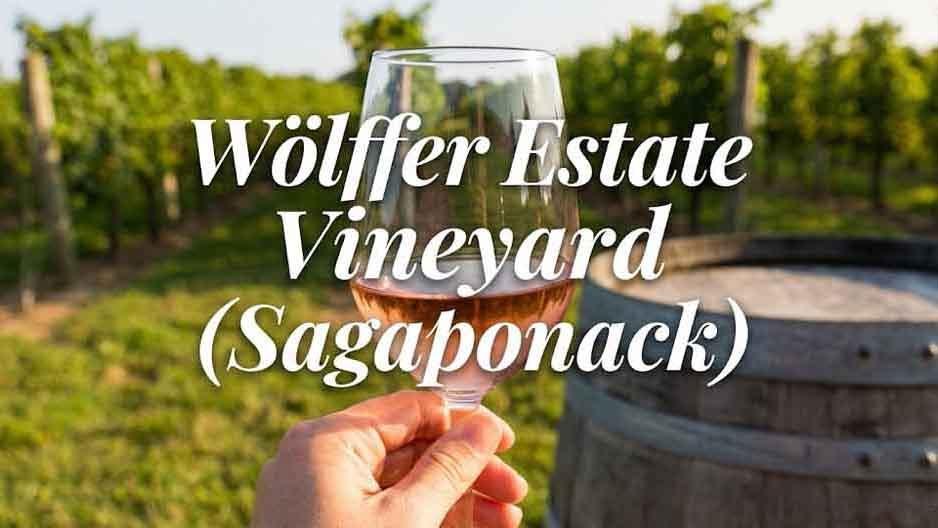
Fifty-five acres of sustainably farmed vine rows cut across what were once potato fields in one of the wealthiest zip codes in America, and the salt air drifting in from the Atlantic — just 2.6 miles south — carries with it the kind of terroir narrative that most New World wineries can only dream of fabricating. Wölffer Estate Vineyard does not fabricate. It has earned its reputation over more than three decades of relentless commitment to winemaking excellence, land conservation, and a hospitality ethos that has made it the cultural anchor of the South Fork’s agricultural identity. Founded in 1988 by the Hamburg-born venture capitalist Christian Wölffer, the estate has evolved from a single fourteen-acre parcel of farmland into a globally recognized wine operation spanning nearly 470 acres across four countries — and it has done so without ever abandoning the soil that started it all (Wolffer.com, 2025; Wine Spectator, 2009).
For someone like me — Peter, twenty-five years into running The Heritage Diner in Mount Sinai — there is a bone-deep recognition in Wölffer’s story. The idea that a former potato farm could become one of the finest producers on the East Coast through sheer vision, stubbornness, and respect for place is the same philosophy that has kept my griddle seasoned and my doors open since the late nineties. Christian Wölffer understood something that most entrepreneurs miss entirely: legacy is not inherited, it is cultivated. And it requires decades.
The Founder: Christian Wölffer and the Audacity of Vines
Christian Wölffer was not born into wine. He was born in Hamburg, Germany, on March 15, 1938, and by seventeen was already working as a bank trainee — the kind of restless, polyglot pragmatist who would later master six languages and manage sales forces for BASF across Mexico, Central America, and South America before pivoting to venture capital and Canadian real estate development (Mercury News, 2009; Wine Spectator, 2009). He arrived on Long Island in the late 1970s, purchasing a fourteen-acre parcel with a modest farmhouse in Sagaponack. The potato fields surrounding it offered no obvious clue that world-class wine grapes could thrive here.
But Christian had a convert’s conviction. After tasting a Chardonnay planted by a Sagaponack neighbor, he became captivated by the possibility of viticulture on the South Fork. In 1988, he asked vineyard consultant David Mudd to plant fifteen acres of vines — and what began as an experiment called Sagpond Vineyards would, within a decade, become the operation now known as Wölffer Estate Vineyard (Wine Seriously, 2015). By 1996, he had assembled 168 acres. In 1997, with the opening of the estate’s striking 12,000-square-foot winery — ocher stucco walls, terra-cotta floors, 100-year-old rough-hewn beams supporting the tasting room ceiling — the property was formally renamed, and the ambition became unmistakable.
His investment reportedly exceeded $15 million. His 2000 Premier Cru Merlot, priced at $100 per bottle, set a record as the most expensive Long Island wine ever released at that time (Decanter, 2009). Christian Wölffer was not dabbling. He was building a legacy designed to outlast him.
And then, tragically, it had to.
On New Year’s Eve 2008, while vacationing near Paraty, Brazil — roughly 100 miles west of Rio de Janeiro — Christian Wölffer was killed in a swimming accident at the age of seventy, struck by a motorboat while in the water. The wine world lost a larger-than-life figure, and the Wölffer family was left to decide the future of an estate that had only just turned its first profit that very year (Wine Spectator, 2009; 27East, 2009).
The Next Generation: Joey, Marc, and the Business of Legacy
The transfer of ownership was neither immediate nor simple. Christian’s estate had to be sorted, and his executors initially lacked faith in the younger generation’s ability to sustain the operation. But by January 2013, two of his four children — Joey Wölffer and Marc Wölffer — completed the purchase of their siblings’ interests and assumed joint ownership (New York Cork Report, 2013). They brought aboard winemaker Roman Roth as a full partner, and the transformation from passion project to thriving commercial enterprise began in earnest.
Joey Wölffer, now Chief Brand Officer and Co-Owner, grew up between European and American cultures — her mother’s family includes the founders of the Marks & Spencer retail empire in Britain. She was twenty-six and living in Manhattan when her father died, and the decision to leave her career and devote herself to the vineyard was anything but obvious. As she later told Vogue at the estate’s thirty-fifth anniversary celebration in 2023, the emotional weight of the responsibility was immense, but the results speak for themselves (Wolffer.com, 2023).
Marc Wölffer, co-owner and currently residing in Salzburg, Austria, oversees the estate’s international expansion, which now includes vineyards in Mendoza, Argentina, and Mallorca, Spain, as well as a major sourcing partnership with growers across 1,750 acres in Côtes de Provence, France (Wolffer.com, 2025). The global footprint is ambitious, but the identity remains rooted in Sagaponack.
Together, Joey and Marc introduced what would become one of the most commercially successful wines in the New York market: Summer in a Bottle Rosé, launched in 2013 and now recognized as the fastest-growing rosé in New York City. The wine — featuring an eye-catching bottle design and a slightly rounder, fruitier profile than the estate’s Gold Label rosé — has achieved something rare: it became a genuine cultural phenomenon in the Hamptons and beyond, consistently selling out each summer (Wine Enthusiast, 2023; Moras Wines, 2025). The line has since expanded to include a Côtes de Provence Rosé, a Loire Valley Sauvignon Blanc, and limited-edition collaborations including a recent partnership with NARS cosmetics for a co-branded bottle release (Wolffer.com, 2025).
Roman Roth: The Winemaker as Institution
No profile of Wölffer Estate is complete without understanding the singular influence of Roman Roth, the estate’s winemaker since 1992 and now a full partner. Born in Rottweil in Germany’s Black Forest, Roth began his apprenticeship at age sixteen at the Kaiserstuhl Wine Cooperative, went on to work at Saintsbury Estate in California and Rosemount Estate in New South Wales, Australia, and earned his Master Winemaker and Cellar Master degrees from the College for Oenology and Viticulture in Weinsberg, Germany (Wolffer.com, 2025; Wine Seriously, 2015).
Roth was named Winemaker of the Year at the 2003 East End Food & Wine Awards by the American Sommelier Society, and his stewardship of Wölffer’s portfolio has produced extraordinary recognition: Wine Advocate has awarded the estate two 94-point ratings — the highest on the East Coast at the time — and Wine Spectator selected The Grapes of Roth Merlot 2010 for its Top 100 Wines of 2015 list. Perhaps most remarkably, the Perle Chardonnay 2012 was served at the White House during a dinner hosted by President Barack Obama for German Chancellor Angela Merkel (US Menu Guide, 2019; Vineyards.com, 2025). The estate has also been nominated for American Winery of the Year by Wine Enthusiast — a distinction that places it in conversation with the most celebrated producers in the country (Northforker Vacation Guide, 2020).
Working alongside Roth is Vineyard Manager Richie Pisacano, who has meticulously tended the estate’s fifty-five acres since 1997. The two form a partnership so close that Pisacano’s own wine brand, Roanoke Vineyards, is produced by Roth — a testament to mutual respect and shared philosophy (Wine Seriously, 2015).
Terroir: Bridgehampton Loam, Atlantic Breezes, and Bordeaux Conditions
Wölffer Estate occupies a singular position in Long Island winemaking — it is one of only three vineyards located in the Hamptons appellation, and the only vineyard on the East End producing wine internationally (Long Island Wine Country, 2025). The terroir here is distinctly different from the North Fork’s flatter, sandier profiles. The estate sits on undulating topography with two overlapping soil types: Bridgehampton loam on the flatter ground and Haven soils on the lighter hillsides. Where the two converge, the micro-terroir produces conditions that winemakers describe as Bordeaux-like (Vineyards.com, 2025; Wine Seriously, 2015).
The Atlantic Ocean sits 2.6 miles to the south, providing maritime breezes that moderate temperature extremes and extend the growing season. The combination of mineral-rich soil, ocean influence, and the estate’s carefully oriented vine rows — planted running both north-to-south and east-to-west depending on sun exposure — yields grapes with the balance of ripeness and acidity that has become Wölffer’s signature. The estate grows Merlot, Chardonnay, Cabernet Franc, Cabernet Sauvignon, and smaller plantings of Trebbiano, Pinot Noir, and Vignole (Wolffer.com, 2025).
Annual production now exceeds 50,000 cases of wine and hard cider, a figure that represents remarkable growth from the 16,500 cases Christian Wölffer was producing at the time of his death (Long Island Wine Country, 2025; Wine Spectator, 2009). The No. 139 Cider line — including Dry White, Dry Rosé, Botanical, and seasonal varieties — has opened an entirely new product category for the estate, made from New York State apples sourced from the historic Halsey Apple Orchard.
Conservation and Sustainability: Farming for the Next Century
Christian Wölffer’s legacy extends well beyond winemaking. In 2001, he permanently protected 115 acres of the estate’s farmland and equestrian land by selling the development rights to Southampton Town and Suffolk County, with the Peconic Land Trust facilitating the transaction. This conservation easement ensures that the vineyard and surrounding agricultural land can never be developed — a decision that, in one of the most development-pressured real estate markets in the world, represents an extraordinary act of long-term thinking (Peconic Land Trust, 2019).
The estate is a founding member of Long Island Sustainable Winegrowing (LISW), the first sustainable vineyard certification program in the eastern United States. Certification required implementing approximately 200 sustainable grape-growing practices, covering soil management, integrated pest management, nutrient management, and cultural practices including hand leaf-removal. Wölffer is also developing an on-site composting program to reuse manure, grass clippings, winery pomace, and other farm byproducts, and is actively researching renewable energy integration (Just Energy, 2024; Peconic Land Trust, 2019).
This commitment to stewardship resonates with anyone who believes in building enterprises that outlast the founder. At The Heritage Diner, I have spent a quarter-century understanding that a business is only as durable as its respect for the community and landscape that sustain it. Wölffer’s conservation decisions are not marketing — they are architecture for permanence.
The Experience: Tasting Room, Wine Stand, and Beyond
Visiting Wölffer Estate is an exercise in sensory immersion. The main Tasting Room, renovated in March 2017, is perched on a rise overlooking the vineyard to the east and the rolling Hamptons landscape to the west. Seated tastings are available by reservation and feature the estate’s award-winning wines alongside seasonal small plates, cheese, and charcuterie sourced from local producers. Private sommelier-led experiences include cellar access and pours from the reserve library. The room’s interior — rough beams, French doors opening to a stone terrace, old-world charm married to contemporary hospitality — is considered among the most beautiful tasting spaces on Long Island (Wolffer.com, 2025; Tock, 2025).
Around the corner on Montauk Highway, the Wine Stand has become one of the most beloved summer institutions in the Hamptons. Walk-ins are welcome, no reservations needed, and the atmosphere is deliberately casual: blankets on the lawn, live music on weekends, bottles of rosé chilling in the late afternoon light as the sun sets over the vines. It is the kind of gathering place that makes you understand why the French have a word — terrasse — for the art of sitting outside and doing absolutely nothing productive while drinking something excellent.
The estate also operates Wölffer Kitchen locations in Amagansett and Sag Harbor — the latter being the first winery-owned restaurant on the East End — and maintains the 120-acre Wölffer Estate Stables, a world-class equestrian facility with 80 stalls, 30 paddocks, an indoor jumping ring, and a Grand Prix field. The stables are open year-round and reflect Christian Wölffer’s equal passion for horses and wine (Expedia, 2025; Vineyards.com, 2025).
Practical Information
Address: 139 Sagg Road, Sagaponack, NY 11962
Phone: (631) 537-5106
Website: wolffer.com
Tasting Room Hours: Monday–Thursday: 12:00 PM – 6:00 PM Friday–Saturday: 11:00 AM – 8:00 PM Sunday: 11:00 AM – 6:00 PM
Reservations: Available via Tock
Wine Stand Location: 3312 Montauk Highway, Sagaponack, NY (walk-ins welcome)
Wine Clubs: Membership includes complimentary tastings, 15% off every bottle, exclusive wine releases, and invitations to private events.
Private Events: The estate accommodates customized events across the 55-acre vineyard property. Contact the events team directly at (631) 537-5106 x24.
Online Shop: store.wolffer.com
Social Media: @wolfferwine on Instagram (104K+ followers)
DoorDash / Delivery: Wine shipping available direct from the estate to select states.
Accessibility: Wheelchair accessible.
Note: Pets are not permitted (service animals recognized by the ADA are welcome). Buses, limousines, and large vans are not permitted in the parking lots. Reservations accommodate parties of up to 8; groups of 8 or more are welcome at the Wine Stand.
Wölffer Estate Vineyard stands as proof that the most enduring enterprises are built not on trends but on terroir — on the conviction that a place, tended with intelligence and patience, will eventually speak for itself. Christian Wölffer purchased potato fields and saw Bordeaux. Roman Roth arrived from the Black Forest and heard music in the cellar. Joey and Marc inherited grief and transformed it into one of the most dynamic wine brands on the East Coast. The vine rows at 139 Sagg Road have been producing fruit for nearly four decades now, and the Atlantic still sends its breezes across the loam every morning, and the development rights are permanently gone, and the land is protected, and the wine keeps getting better. That is what a century-minded legacy looks like — not the flash of a single brilliant vintage, but the quiet accumulation of seasons.
— Peter, The Heritage Diner, Mount Sinai, NY Briefcase maker, Marcellino NY