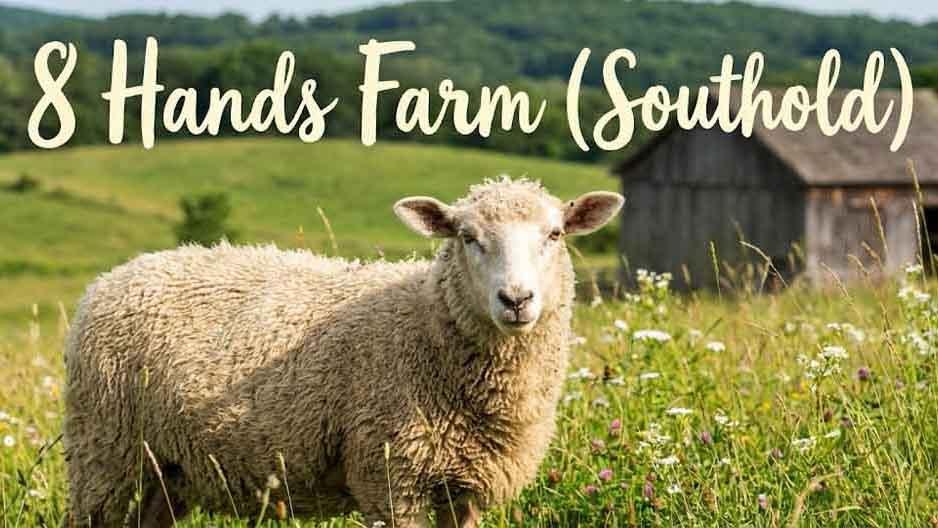
Twenty-eight acres of conserved North Fork farmland, a flock of Icelandic sheep visible from the road, and the scent of house-cured charcuterie drifting from a converted potato barn — 8 Hands Farm is not a restaurant in the conventional sense. It is something rarer. It is a working agricultural operation that feeds you directly, where the distance between the animal on the pasture and the meat on your plate can be measured in footsteps rather than supply chain miles. Founded in 2011 by Tom Geppel and Carol Festa, two former Manhattan financial professionals who traded spreadsheets for sheep shears, 8 Hands has quietly become one of the most respected sustainable farming operations on Long Island’s East End. In an era of industrialized food production and frictionless delivery apps, this farm demands something of its visitors: that they slow down, learn the name of the animal they’re eating, and reckon with what the American food writer Michael Pollan once called “the true cost of cheap food” (Pollan, The Omnivore’s Dilemma, 2006). As someone who has spent twenty-five years running The Heritage Diner in Mount Sinai — sourcing ingredients, managing a kitchen, and watching the food landscape evolve from a front-row seat on Route 25A — I can tell you that operations like 8 Hands represent the highest aspiration of what a local food economy can be.
A Documentary, a Decision, and a Fallow Mattituck Field
The origin story of 8 Hands Farm reads like something out of an independent film, which is fitting because an independent film is precisely what started it. In 2008, Tom Geppel and Carol Festa watched Robert Kenner’s documentary Food Inc., the landmark exposé on the environmental and ethical failures of corporate agriculture that shocked American audiences and earned an Academy Award nomination (Kenner, Food Inc., 2008). The film disturbed them enough to act. Carol suggested they raise food for their own family. Tom took the idea further — why not raise it for others too?
The couple had no farming background. Tom was a tax consultant commuting daily from Mattituck to Manhattan. Carol had worked as a stock market research analyst. But they had two children — Olivia and Max — and a conviction that the industrial food model was broken. They started by leasing a fallow field from Pindar Vineyards in Peconic, a patch of land overrun with invasive mugwort that Tom had to clear by hand before a single sheep could graze. They bought Icelandic sheep and began learning by doing, the old way, through trial and failure and early mornings. The name came naturally: four family members, eight hands.
By 2011, their ambition outgrew that borrowed field. The Peconic Land Trust — the nonprofit conservation organization that has protected over 10,000 acres of Suffolk County farmland from development since its founding in 1983 — offered the Cox Lane farmstead for sale through its “Farms for the Future Initiative” (Peconic Land Trust, 2011). The Trust had purchased the 27.53-acre property from Joe Macari Sr. in 2007 and simultaneously sold the development rights on 25 acres to the Town of Southold, ensuring the land could never be subdivided for housing. Tom and Carol acquired the acreage, including a circa 1930s farmhouse and several barns, and 8 Hands Farm as it exists today was born.
The Animals: Heritage Breeds and Pasture-First Philosophy
Walk the grounds of 8 Hands and you encounter a menagerie that feels pulled from another century. The operation is home to roughly 150 Icelandic sheep — a breed dating back over a thousand years to the Norse settlement of Iceland — along with approximately 100 Tamworth pigs, heritage breed chickens, goats, and seasonal flocks of ducks and turkeys. Every animal lives on pasture, eating what its biology was designed to process. The sheep graze freely. The pigs root through soil for supplemental nutrition. The chickens hunt and peck across open fields from May through November, when the pasture is actively growing, and receive organic feed to complement their foraging.
This is not a marketing exercise. The commitment to animal welfare carries real financial consequences. The meat birds at 8 Hands take approximately twelve weeks to mature — double the timeline for industrially raised chickens — because they are genuine free-range birds given room and time to develop naturally. The animals are processed at a USDA-inspected facility in upstate Canaan, New York, approved by the Animal Welfare Institute, which further increases costs. Tom Geppel has been characteristically direct about this reality, telling Northforker in 2017 that the farm’s chickens sell for eight dollars per pound and explaining that this reflects the actual cost of raising food responsibly (Northforker, 2017).
During lambing season in April, the Icelandic flock can swell from 80 to 200 animals, with as many as fifteen lambs arriving in a single day, often as twins or triplets. Tom has described assisting with difficult deliveries as one of the steepest learning curves of his farming life — the kind of education no textbook can provide.
The Farm Store, Butcher Shop, and the Art of Charcuterie
The on-site farm store — a converted potato barn with views toward Cutchogue Harbor and Robins Island — functions as the commercial heart of the operation. Inside, a wraparound glass butcher case displays rotating selections of fresh, farm-raised cuts: rack of lamb, pork shoulder, heritage sausages, and an array of in-house charcuterie that has earned national attention. The butcher shop opened in late 2016, marking a significant evolution from the farm’s earlier model of selling vacuum-sealed frozen meats.
The culinary talent behind much of this work has been chef Julien Shapiro, a Shoreham-Wading River High School graduate who studied under Hugo Desnoyer, one of Paris’s most celebrated butchers. Shapiro, whom The Washington Post described as a “charcuterie master,” joined 8 Hands full-time in 2016 after serving as sous chef at the acclaimed North Fork Table and Inn in Southold (The Washington Post; Northforker, 2016). His approach centers on Old World technique and what is known as seam butchery — separating meat by cutting along its natural joints rather than sawing through bone. The result is a butcher case that more closely resembles a Parisian charcuterie than anything typically found on Long Island: country pâtés, smoked beef eye round, jambonneau pressed in antique French molds, and seasonal preparations that change with the farm’s output.
Beyond the butcher case, the store carries pastured eggs, organic produce from the farm’s kitchen gardens, sourdough breads, prepared meals including coq au vin and ratatouille, handmade pasta crafted with the farm’s own eggs, fermented beets, and fiber products — handspun yarn, knitted goods, and artisanal soap — made from the Icelandic sheep’s wool. The Google review profile, which carries a 4.7 rating across 164 reviews, consistently highlights the quality of the meats, the warmth of the staff, and the experience of shopping on a working farm.
Fyr & Salt: Wood-Fired Dining Comes to the Farm
In a development that has deepened 8 Hands’ identity as a culinary destination, chefs Max Mohrmann and Jonathan Shearman — the duo behind Fyr & Salt, a wood-fired private dining and catering venture — took over the farm’s café and market operations. The partnership, rooted in personal connections to both 8 Hands and neighboring farms like Deep Roots, represents a natural alignment of philosophies. Shearman, who spent over eight years with 1943 Pizza Bar and Rolling in Dough, and Mohrmann share a commitment to letting seasonal ingredients speak through simple preparation over open flame (Northforker, 2023).
Their café menu changes constantly, driven by what the farm produces week to week. Featured dishes have included za’atar lamb meatballs over garlic scape yogurt with cucumber, olive, and feta salad — the lamb pasture-raised on the property, mixed with house eggs and sourdough breadcrumbs, seasoned with herbs from the garden (James Lane Post, 2024). The food truck, which operates on weekends during the warmer months, serves breakfast and lunch from the same farm-fresh inventory. Visitors have praised everything from the chilaquiles to the breakfast sandwiches to the apple cider soft serve. Fyr & Salt also hosts private wood-fired dining events on the farm and has collaborated with Slow Food East End and Bedell Cellars on multi-course tasting dinners featuring the farm’s provisions alongside local wines and craft cocktails from Doublespeak.
Since 2024, 8 Hands has also opened its grounds for private events. The barn extends to a spacious brick patio that can be tented for additional seating, making it one of the North Fork’s most distinctive venues for intimate gatherings.
Conservation, Community, and the Larger Mission
What distinguishes 8 Hands from many farm-to-table operations is its relationship to the land conservation movement that has shaped the North Fork’s identity for decades. The farm exists on preserved agricultural land — acreage that the Peconic Land Trust and the Town of Southold jointly ensured would remain farmland in perpetuity, protected from the residential development that has consumed so much of Long Island’s open space over the past half-century. Suffolk County’s farmland preservation program, established in 1974, was the first in the nation to purchase development rights on agricultural land, and the 8 Hands property is a direct beneficiary of that vision (Peconic Land Trust, 2023).
The farm’s media profile reflects its growing stature within the sustainable agriculture community. The New York Times profiled livestock farming’s evolution on Long Island in 2015, featuring the operation, and returned in 2017 with a piece on the North Fork’s pastured poultry movement. CBS New York’s The Dig series documented the farm’s regenerative practices in 2022. Newsday, Northforker, and News 12 Long Island have all produced features. Tom Colicchio’s Small Batch restaurant in Garden City sources directly from 8 Hands, a relationship the restaurant highlights as central to its philosophy (Small Batch, 2025).
The farm also maintains deep ties to the Slow Food movement, hosting educational tours, partnering with the Cutchogue-New Suffolk Free Library for community events, and participating in the Peconic Land Trust’s public programming, including behind-the-scenes walking tours where visitors meet the animals and learn about the realities of sustainable farming from Tom and Carol directly.
Visiting 8 Hands Farm: What You Need to Know
8 Hands Farm is open Thursday through Saturday from 9:00 AM to 5:00 PM and Sunday from 10:00 AM to 2:00 PM. The farm is closed Monday through Wednesday. The café, butcher shop, and farm store are all accessible during operating hours. Private dining events and farm tours are available by arrangement.
Address: 4735 Cox Lane, Cutchogue, NY 11935
Phone: (631) 494-6155
Email: 8handsfarm@gmail.com
Website: 8handsfarm.com
Fyr & Salt (Café & Private Dining): fyrandsalt.com
Instagram: @8handsfarm | @8handsfood | @fyrandsalt
Google Rating: 4.7 stars (164 reviews)
Yelp: 150 photos, 59 reviews
Good for: Families, food enthusiasts, farm-to-table sourcing, private events, educational tours
The Unseen Architecture of Honest Food
Tom Geppel once told a reporter that farming is one of the few professions where you work with your heart, your hands, and your head at the same time (CBS New York, 2022). That observation stays with me. The phrase could just as easily describe running a diner for a quarter century, or hand-stitching a leather briefcase in a workshop, or any enterprise where the quality of the finished product depends entirely on the care invested in its invisible stages — the steps no customer ever sees but every customer eventually tastes, feels, or understands. Carol Festa’s parents, who labored in blue-collar jobs and wanted a different life for their daughter, initially questioned the decision to farm. Carol has acknowledged as much publicly. But there is a difference, as she has noted, between farming out of necessity and farming out of conviction. The Geppel-Festa family chose this life deliberately, and that choice — renewed every morning at dawn, through lambing season and drought and the relentless economics of small-scale agriculture — is what gives 8 Hands Farm its unmistakable character.
The North Fork has never lacked for vineyards, tasting rooms, or weekend destinations. What it has lacked, and what 8 Hands quietly provides, is proof that a family can still build a viable agricultural business on Long Island by doing everything the hard way, the honest way, the slow way. That proof, like the Icelandic sheep grazing on Cox Lane, is visible to anyone willing to drive out and look.
Peter is the owner of The Heritage Diner in Mount Sinai, NY, where he has spent twenty-five years at the intersection of food, community, and craft. He holds graduate degrees in Philosophy from Long Island University and The New School.