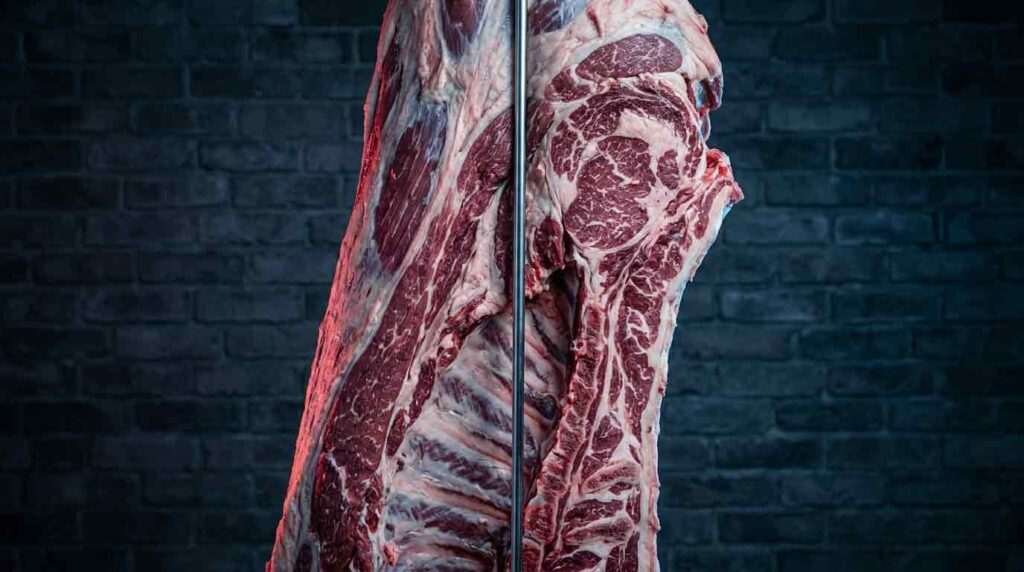
Every side of beef begins its journey the same way — a carcass split lengthwise through the backbone, then halved again between the 12th and 13th ribs, yielding four quarters of raw potential. From there, a skilled butcher breaks the animal down into its large foundational sections, the primal cuts, before those are further worked into the steaks, roasts, and braises that end up in your shopping cart or on your dinner plate. Most consumers engage with beef only at that final stage — the plastic-wrapped package bearing a name like “chuck roast” or “sirloin tip” — without any understanding of the geography that produced it. That’s a gap worth closing, because the anatomy of the steer is the single most powerful tool a home cook or informed diner can carry into the kitchen.
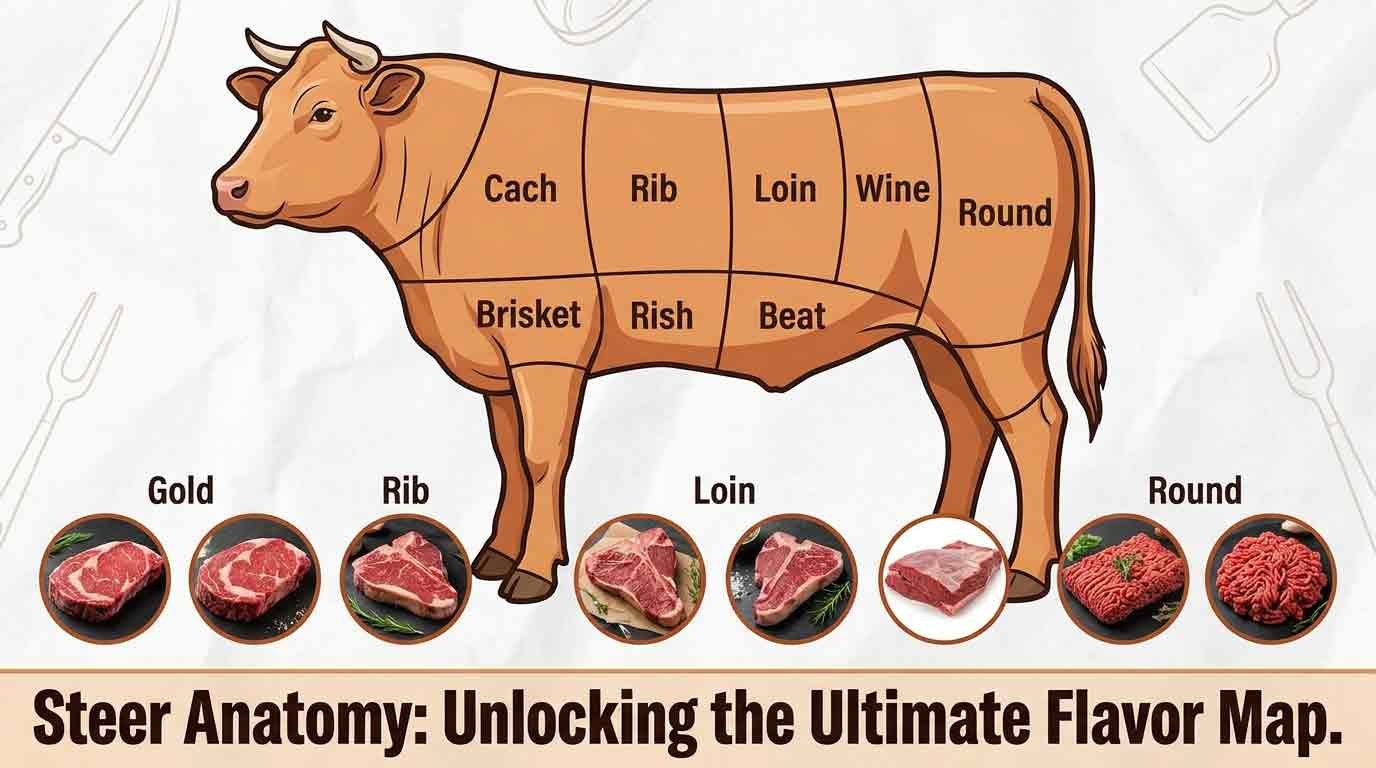
There are eight universally recognized primal cuts of beef in the American butchering system: the chuck, rib, loin, sirloin, round, brisket, plate, and shank. Each tells a story of muscle use, connective tissue, fat distribution, and appropriate cooking method. Understand the story, and you’ll never again wonder why your flank steak came out tough or why your short rib melted after four hours on low heat. The steer explains everything — if you know how to read it.
The Forequarter: Where Flavor Earns Its Name
The front half of the steer — comprising the chuck, rib, brisket, plate, and shank — is where the animal does most of its work. Shoulders bear weight. Legs propel movement. Chests support hundreds of pounds of body mass. That exertion builds muscle, and muscle builds collagen, the fibrous connective tissue protein that makes these cuts resistant to a quick sear but extraordinary after a long braise.
Chuck originates at the neck and shoulder and runs through the upper arm to just past the fifth rib, accounting for roughly 26% of the usable meat on the animal — the single largest primal (Christensen Ranch, 2025). Because the shoulder is one of the most heavily exercised regions of the steer, chuck is rich in connective tissue and intramuscular fat alike, a combination that rewards patience. A chuck roast braised low and slow at 300°F for four hours undergoes a chemical transformation: collagen, once the source of its toughness, dissolves into gelatin at temperatures between 160°F and 180°F, coating muscle fibers with a silky, rich moisture that no lean, tender cut can replicate (ScienceofCooking.com; Napoleon Grills, 2025). From the chuck come the flat iron steak, the Denver steak, and the beloved 7-bone roast — and the majority of the ground beef sold in America.
Brisket lies just below the chuck, covering the steer’s breastbone and pectoral muscles. It is the only primal regularly sold as a whole cut — the “full packer brisket” beloved by pitmasters and competition smokers everywhere. Because the chest supports the animal’s weight throughout its entire life, brisket contains a dense concentration of collagen cross-links. Those cross-links become increasingly thermostable with animal age, which is why a young steer’s brisket will yield faster than one from an older animal (ScienceDirect, 2020). The reward for patience here is a crust-encased, smoke-lacquered slab of beef that pulls apart at the table — one of the most expressive cooking achievements in American culinary culture.
The plate and shank round out the forequarter. The plate — the belly of the animal just beneath the ribs — delivers the skirt steak, the cut of choice for fajitas and carne asada, and is the source of beef bacon when trimmed lean. The shank, cut from the four legs of the animal, represents only about 4% of the steer but produces some of its most gelatinous, intensely flavored meat. Osso buco, the Italian preparation of cross-cut veal or beef shank braised with aromatics, is essentially a masterclass in collagen extraction — the marrow-filled bone contributing depth to the surrounding braising liquid that no other cut can match (Weber Grills, 2023).
The Rib: Twelve Feet of Marbled Royalty
Between the fifth and twelfth ribs — the precise zone where the forequarter ends and the distinction of the rib primal begins — lies some of the most coveted beef on the animal. The rib primal accounts for approximately 9% of the steer (Weber Grills, 2023) and is defined by a quality almost completely absent from the forequarter: profound, evenly distributed marbling.
Marbling — the intramuscular fat that appears as white striations within the muscle — is not merely decorative. When a marbled steak hits a hot surface, that fat begins to melt at around 130–140°F, internally basting the muscle fibers with rendered lipid and releasing fat-soluble flavor compounds into every bite (Wild Country Meats, 2025). The result is juiciness, tenderness, and a flavor density that leaner cuts simply cannot generate. The USDA recognizes this, using marbling as the primary determinant of its quality grading system — Prime, Choice, Select, and Standard — with grades assessed by certified graders who examine the ribeye muscle cross-section between the 12th and 13th ribs (USDA Agricultural Marketing Service).
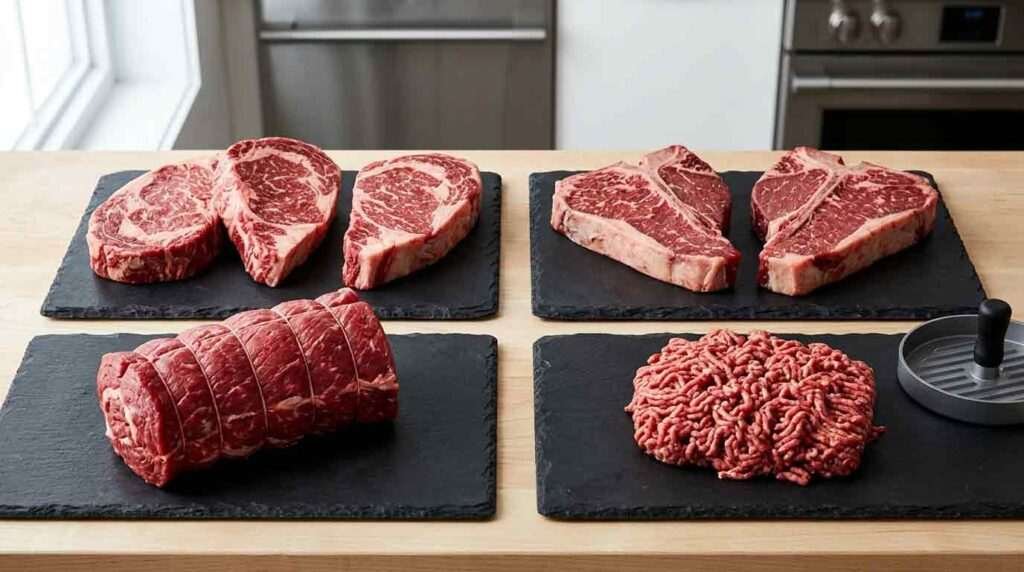
Only 5–7% of U.S. beef qualifies for the USDA Prime designation (Wild Country Meats, 2025). Prime beef is where the rib primal lives most comfortably. From it come the ribeye steak — rich, fatty, and forgiving of heat — the prime rib roast (also called a standing rib roast), rib short ribs ideal for Korean-style galbi or low-temperature braising, and beef back ribs best suited for indirect smoking. The rib primal rewards high, direct heat for steaks and slow, indirect cooking for ribs — two entirely different methods serving two entirely different expressions of the same magnificent cut.
The Short Loin and Sirloin: The Epicenter of Tenderness
Just behind the rib, along the top of the animal’s back and away from any heavy muscular work, sits the loin — the source of the most expensive, most tender, and most famous steaks in the world. The short loin alone, accounting for roughly 8% of the steer, contains the entire tenderloin (Weber Grills, 2023), the long, narrow muscle that runs along the spine and performs so little work during the animal’s life that it accumulates almost no connective tissue. The result is the filet mignon — technically a portion cut of the tenderloin — celebrated for a buttery texture that requires no mechanical tenderization, no marinade, and no extended cooking time.
The short loin also yields the T-bone and Porterhouse steaks, which are essentially the same anatomical cross-section cut at different points along the loin. Both contain a T-shaped bone separating the New York strip on one side from a portion of the tenderloin on the other. The distinction between T-bone and Porterhouse is a matter of the tenderloin’s size: the USDA requires the tenderloin portion of a Porterhouse to measure at least 1.25 inches across at its widest point — giving the diner a meaningful section of the most tender muscle on the animal alongside the bolder, fattier strip (BBQGuys; USDA standards).
The sirloin, positioned just behind the short loin moving toward the rear of the animal, is slightly less tender but still lean and flavorful. Top sirloin yields steaks well suited to grilling; bottom sirloin produces the tri-tip — a triangular muscle with a devoted following in California’s Santa Maria barbecue tradition — and the bavette, a flat, loose-grained steak gaining popularity for its assertive beef flavor and reasonable price.
The Round: The Working Rear Leg
At approximately 27% of the steer’s usable meat, the round is the largest single primal and among the most misunderstood (Weber Grills, 2023). It encompasses the hind leg of the animal, from the hip down through the rump, comprising four primary muscles: the top round, bottom round, eye of round, and knuckle (also called the sirloin tip). Because the rear legs drive the animal’s locomotion, these muscles are heavily exercised, lean, and relatively low in connective tissue — which creates a paradox. Unlike brisket or chuck, round cuts lack the collagen content to benefit from long braising; instead, they’re best roasted to medium-rare and sliced thin against the grain to shorten the muscle fibers mechanically (Redefine Meat, 2024).
The round is the source of most commercial roast beef, bottom round corned beef, and a large portion of the American jerky market, where its leanness and uniform texture make it ideal for thin, consistent strips. Eye of round, the leanest and most cylindrical of the sub-primals, is often mistaken for tenderloin by less experienced buyers — both are similar in shape, but their eating experiences diverge dramatically without the correct cooking approach.
The Flank and Plate: The Belly’s Bold Contribution
Below the loin and sirloin, on the underside of the animal, the flank and plate primals produce some of the most flavor-forward, texturally demanding cuts in the butcher’s case. The flank steak — the sole retail cut from the flank primal — is a wide, boneless sheet of muscle with long, thick fibers and minimal fat. It has traditionally been a budget cut, though growing consumer demand for lean protein has elevated its price considerably in recent years (BBQGuys; Clover Meadows Beef, 2025). Cooked quickly over high heat, rested, and sliced emphatically against the grain, flank steak rewards with a bold, intensely beefy flavor. Ignore the grain — cut with it — and you’ll struggle through something closer to rope than dinner.
The plate, directly below the rib primal and above the flank, gives us the skirt steak — the thinner, more marbled diaphragm muscle prized across Mexican, Korean, and Argentine culinary traditions. It also produces the short plate ribs that have become a fixture in high-end American barbecue, where 72-hour sous vide preparations or 12-hour offset smoke sessions have elevated them to a premium restaurant staple.
Understanding Cooking Method as a Function of Anatomy
Every primal cut carries an implied instruction based on its location on the animal. The rule is elegant and essentially universal: the more a muscle worked during the animal’s life, the more collagen it contains, and the more time and moisture it requires to become tender. The least-worked muscles — those along the spine and away from the limbs — are naturally tender and require only quick, high-heat cooking to express their best qualities.
This is not philosophy; it’s biochemistry. Muscle fibers begin to denature and tighten at around 104–140°F, expelling moisture. Collagen begins its conversion to gelatin at 160°F and continues transforming well past 180°F — but only with sufficient time (Brew & Feed, 2024; ScienceofCooking.com). A chuck roast pulled from the oven at 145°F will be simultaneously overcooked in its muscle fibers and under-converted in its collagen: tough in two different directions at once. The same roast carried to 200°F and held there for hours will emerge fork-tender, its collagen now a rich, trembling gelatin that has basted the meat from within.
Dry-aging adds another layer of complexity to this equation. When subprimal cuts are rested under controlled humidity and temperature for a minimum of three weeks, natural enzymes begin breaking down the collagen that holds muscle fibers together, tenderizing the beef before it ever meets heat. Simultaneously, moisture evaporates from the surface, concentrating flavor compounds and producing the distinctive nutty, umami-forward notes associated with premium dry-aged beef — flavors that range from aged cheese undertones to deep, almost mineral richness depending on aging duration (SteakAger; Oreate AI Blog, 2025). It is, essentially, time itself functioning as a chef.
A Consumer’s Field Guide: From Butcher Case to Kitchen
Armed with the geography of the steer, navigating a butcher case becomes intuitive. When you pick up a package labeled “chuck eye steak,” you know you’re getting a shoulder-adjacent cut with good marbling and enough flavor to grill or pan-sear — as long as you don’t expect filet mignon tenderness. When you choose a bone-in short rib, you’re committing to time: three to four hours of braising minimum to convert that connective tissue into something genuinely extraordinary. A sirloin steak tells you that you can grill it hot and fast, rest it, and eat well without ceremony. A round roast tells you to slice it thin and cold, or slow-roast it to medium-rare and serve it European-style with a sharp mustard.
The beef industry has not always made this easy. Cuts are frequently renamed across regional markets, butcher traditions, and marketing campaigns — a flat iron in one shop may appear as a “butler steak” in another; a Denver steak may be labeled a boneless chuck short rib elsewhere (BBQGuys). The underlying anatomy, however, does not change. Once a consumer understands where on the animal a cut originates, the name becomes secondary. The geography is the instruction.
A full-sized steer yields approximately 490 pounds of retail cuts — a remarkable return of protein, fat, collagen, and marrow from a single animal (BBQ Champs, 2022). Every primal, every sub-primal, every secondary cut has a rightful place at the table when cooked with the method its structure demands. The misunderstood round roast, the patient brisket, the magnificent rib roast waiting in a dry-aging chamber — they are all expressions of the same animal, governed by the same biological logic, rewarding to anyone who takes the time to understand them.
The steer, it turns out, is an extraordinarily generous teacher. You only have to know how to ask.
Sources:
- Christensen Ranch. (2025). Beef Cuts Diagram | Beef Primal Cuts | Cuts of Beef. https://www.christensenranch.com/cuts-of-beef/
- Weber Grills. (2023). The Anatomy of a Steer. https://www.weber.com/US/en/blog/burning-questions/the-anatomy-of-a-steer/weber-29498.html
- BBQGuys. Basic Cuts of Beef | Primal Cuts & Best Uses. https://www.bbqguys.com/a/39986/grillabilities/basic/cuts-of-beef
- Clover Meadows Beef. (2025). A Guide to Cuts of Beef & How to Cook Different Cuts. https://www.clovermeadowsbeef.com/cuts-of-beef/
- BBQ Champs. (2022). Guide to Beef Cuts: Primal & Sub Primal Cuts. https://bbqchamps.com/beef-cuts/
- Redefine Meat. (2024). Cow Meat Diagram Explained. https://www.redefinemeat.com/blogs/cow-meat-diagram-explained-redefine-meat/
- Wild Country Meats. (2025). Marbling vs. Tenderness: Key Differences. https://www.wildcountrymeats.com/marbling-vs-tenderness-key-differences/
- Napoleon Grills. (2025). The Science of BBQ – How Collagen Affects Tenderness. https://www.napoleon.com/en/us/grills/blog/science-bbq-how-collagen-affects-tenderness
- SteakAger. (2024). The Science Behind Dry-Aging. https://steakager.com/blog/the-science-behind-dry-aging
- USDA Agricultural Marketing Service. Carcass Beef Grades and Standards. https://www.ams.usda.gov/grades-standards/carcass-beef-grades-and-standards
- Brew & Feed. (2024). The Science of Slow Cooking Meat: Unlocking Tenderness and Flavor. https://brewandfeed.com/blogs/spice-blog/the-science-of-slow-cooking-meat-unlocking-tenderness-and-flavor
- ScienceDirect. (2020). Relationship between meat quality and intramuscular collagen characteristics. https://www.sciencedirect.com/science/article/abs/pii/S030917402030807X