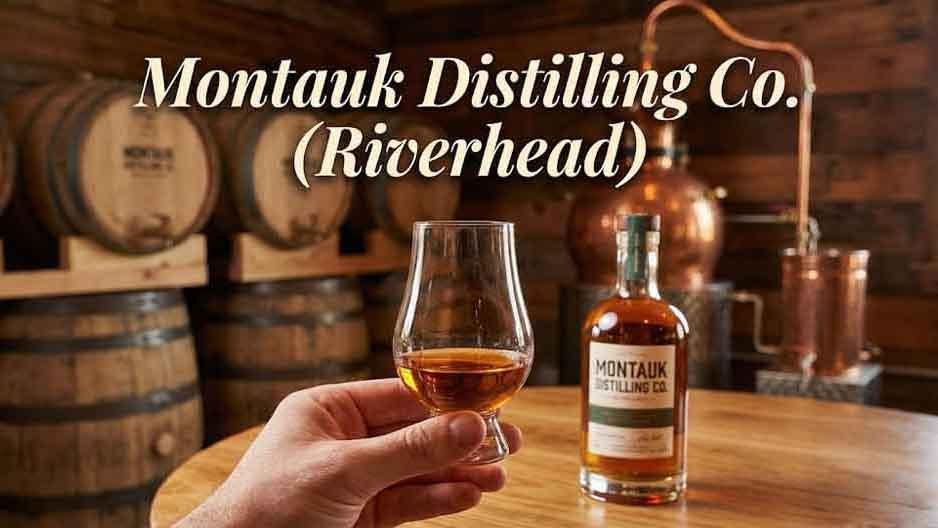
Rebellion, in the hands of a craftsman, smells different. Walk through the garage doors of a 1931 firehouse on East Second Street in Riverhead, and you are met with the low, sweet heat of fermenting grain, the cool industrial logic of copper and steel, and the unmistakable conviction of people who decided that Long Island’s spirits deserved to be taken seriously. Montauk Distilling Co. did not arrive as a concept — it arrived as a statement. Founded in 2013 by owner Leucio Iacobelli, the company began as Hampton Rum Co. in Westfield, New York, before relocating its full production operation to Riverhead in 2020, planting its flag inside a building that Riverhead’s fire department called home from 1931 until 2008 (Montauk Sun, 2020). The address has changed. The ambition has not.
The Building That Earns Its Own Introduction
Before a single bottle is opened, the firehouse at 24 E. 2nd Street commands attention. Designed by architect William Sidney Jones and built in 1931, the structure served the Riverhead Fire Department for more than seven decades before standing vacant after the department’s departure in 2008. A developer eventually acquired and refurbished the property, and in 2017 it was officially declared a historic landmark — a designation that carries real weight on the East End, where authenticity is currency (Cork & Barrel Club, 2025). What Iacobelli recognized when he acquired his half of the building in 2019 was something beyond real estate opportunity: a vessel whose bones were already saturated with community memory, civic duty, and decades of collective trust. That kind of provenance cannot be manufactured. It can only be inherited responsibly.
Today, the firehouse is shared with North Fork Brewing Company, turning the entire structure into what might be the most compelling craft beverage destination on Long Island’s East End. The tasting room occupies the front with a full bar, open seating, and a garage door that rolls up to an outdoor terrace — preserving the building’s kinetic, industrial character rather than sanitizing it. On the wall, the names of former firemen who once worked the station are displayed in full view, a gesture of acknowledgment that costs nothing and means everything (Northforker, 2020).
Origin Story: From “The End” to the Beginning
The name is not accidental. Montauk — “The End,” as locals have always called it — represents the geographic and psychological terminus of Long Island, a place where the Atlantic makes its final argument and where people tend to feel something more acutely than they do elsewhere. Iacobelli and his family spent summers there, absorbing the light off Fort Pond Bay and the particular rhythm of a community that has always measured time in tides rather than traffic. That emotional geography became the brand’s north star: craft spirits that carry the character of a coastline in every pour (Montauk Distilling Co., 2025).
The company holds a NYS Farmer’s D Licensed Farm Distillery classification, a designation that reflects its commitment to New York-sourced ingredients from grain to botanical. Every spirit in the lineup — milled, mashed, fermented, and distilled on-premise — begins with raw materials grown within New York State. This is not a marketing posture. It is an operational discipline that constrains the brand in all the right ways, forcing an engagement with local agriculture and seasonal variability that industrial distilleries simply do not encounter (Montauk Distilling Co., 2025).
The Spirits Portfolio: A Lineup Built on Principle
The flagship expressions tell you everything about the brand’s philosophy. Modico Vodka — one of the company’s self-described MVPs — aims to deliver premium character at an accessible price point, a position that requires genuine technical discipline to execute. More immediately distinguished is the 71st Regiment Gin, named for the original regiment stationed at Montauk Point following the Spanish-American War in 1898. Crafted with 17 locally sourced botanicals through a dual process of maceration and gin basket distillation, the spirit achieves classical juniper clarity while layering in softer notes of honeysuckle, rose petal, lavender, and peppercorn — a botanical complexity that requires careful sequencing to achieve without one element overwhelming the others (Riverhead Liquor Mart, 2025). CEO Tom Joyce has called it arguably the best gin made in America, and the confidence is not hollow.
Beyond gin and vodka, the portfolio extends to bourbon, rum, and whiskey — all produced in small batches that reflect the deliberate, low-volume approach that defines serious craft production. The company’s award-winning rums draw visitors to the Riverhead tasting room from across the region, occupying a category that has historically been underrepresented in the northeast American craft spirits conversation (PRNewswire, January 2025).
Growth, Distribution, and What 2025 Signals
Montauk Distilling has entered a deliberate expansion phase without abandoning the principles that defined its earliest years. In January 2025, the company announced significant new account wins and secured a beverage alcohol industry advisor with more than two decades of brand-building experience across prestige and accessible spirits verticals — someone who has created and exited two of his own brands and worked with hundreds of companies on identity and growth strategy (PRNewswire, January 2025). The hire signals not a departure from craft culture but a maturation of it: the recognition that superior product alone does not create market presence.
By April 2025, Montauk Distilling announced a strategic distribution partnership with Cellier Wines Distributing, a family-owned boutique importer and wholesaler, unlocking expanded reach across New York and New Jersey markets. Combined with existing partnerships through McLaughlin and Moran in Rhode Island and Community Craft Spirits in Florida, the footprint now spans the Northeast and into the Southeast — a meaningful geographic arc for a distillery still operating out of a 3,000-square-foot historic firehouse (PRNewswire, April 2025). The lesson here mirrors what I have watched play out in other industries: meticulous craft and patient expansion are not contradictions. They are sequential phases of the same discipline.
The Tasting Room Experience: Education, Community, and the Long Table
What distinguishes the Montauk Distilling experience from a standard bottle shop or bar visit is its layered engagement model. Visitors can pursue a tasting flight — originally offered at $14 for four samples across the gin, vodka, and rum range — or explore the full bar service that now includes a curated cocktail menu. Tours of both the distillery and the historic firehouse are available, an offering that transforms the visit from consumption to education. Live music anchors the event programming, and the space hosts private events, seasonal pop-ups, and celebrations that position it as a genuine community anchor rather than a transactional retail experience (Montauk Distilling Co., 2025).
The family-friendly atmosphere is intentional and reflects a broader understanding of what a third-place destination must accomplish: it needs to work for the couple on a date night, the group of professionals decompressing on a Friday, and the family curious about how their local spirits are actually made. Few establishments in Suffolk County manage that tonal range successfully. Montauk Distilling does.
Provenance as Strategy: Why Local Sourcing Is Not a Trend
The American craft spirits industry grew at a compound annual growth rate of approximately 20% between 2010 and 2020, driven in significant part by consumer appetite for provenance — the desire to know where something came from and why that geography matters (Distilled Spirits Council of the United States, 2022). Montauk Distilling was already operating on that principle before the trend found its language. Every botanical in the 71st Regiment Gin, every grain mash that feeds the bourbon program, traces back to New York agriculture. Head Distiller Matt Ellis — a North Fork native who apprenticed under Master Distiller Brandon Collins before joining the MDCO team — brings a practitioner’s knowledge of local growing conditions and a commitment to sustainable production methods, including water recapture and returning byproduct grain to local farms as animal feed (Montauk Sun, 2020).
This is a closed-loop philosophy. It is also, as the craft beverage market continues to mature past its initial novelty phase, the only defensible long-term position. Consumers who sought “local” in 2015 as a lifestyle preference are seeking it in 2025 as an ethical commitment. The distilleries that built genuine agricultural relationships early will inherit that loyalty. Montauk Distilling built those relationships from day one.
Riverhead’s Renaissance and the Role of the Firehouse
Riverhead, the seat of Suffolk County government and the geographic gateway to the North Fork wine country, has undergone a sustained revitalization over the past decade. The conversion of the Second Street Firehouse into a craft beverage destination is one of the more resonant chapters in that story — an adaptive reuse that preserved architectural integrity while generating genuine foot traffic and economic energy for the surrounding blocks. The Long Island Aquarium draws visitors to the waterfront; the Suffolk Theater anchors the arts corridor; and establishments like Montauk Distilling and North Fork Brewing in the firehouse create the kind of layered destination economy that sustains a downtown through seasonal variation.
For anyone navigating the North Shore and East End from the Setauket or Mount Sinai corridor east through the North Fork, Riverhead’s Second Street has become a genuine stop rather than a pass-through. That shift reflects the cumulative effect of businesses like Montauk Distilling choosing to invest in community architecture rather than simply occupying commercial space.
Montauk Distilling Co. is not merely a purveyor of well-made spirits. It is a living argument that craftsmanship, local identity, and long-term institutional commitment produce something that industrial scale never can: a place that feels like it belongs exactly where it stands. The firehouse walls hold decades of civic memory. The copper stills hold the agricultural character of New York. And every pour — whether the botanical complexity of the 71st Regiment Gin or the clean restraint of Modico Vodka — delivers on the promise that was made in 2013: smooth, sophisticated, supreme.
Montauk Distilling Co. 24 E. 2nd Street, Suite B, Riverhead, NY 11901 Phone: (631) 727-6326 Website: montaukdistillingco.com
Hours: Thursday: 2:00 PM – 6:00 PM Friday: 12:00 PM – 8:00 PM Saturday: 12:00 PM – 8:00 PM Sunday: 12:00 PM – 6:00 PM Monday–Wednesday: Closed