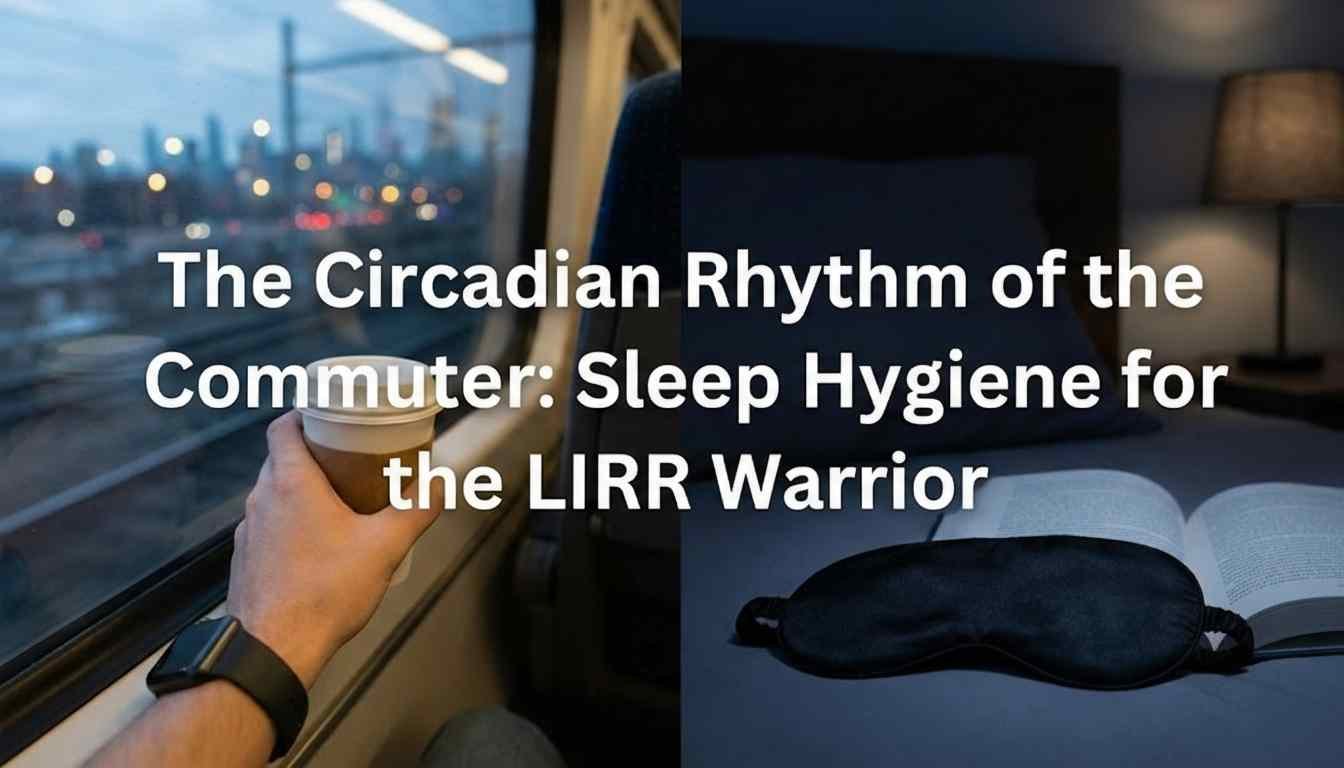
Somewhere between Smithtown and Penn Station, a man in a good suit closes his eyes. Not to sleep — there isn’t time, or rather, there isn’t the right kind of time — but to rest in that particular liminal way that commuters develop after years of the same route, the same hum of the rails, the same 6:14 departure that demands a 5:30 alarm. He has, without any academic understanding of what he’s doing, developed rituals. Coffee at a precise moment. A specific playlist. A window seat on the south side of the car where the morning sun won’t hit his face during the eastbound ride home. He has built, intuitively, a kind of personal chronobiology — the science of biological time — into the architecture of his daily life.
I’ve watched this man every morning at The Heritage Diner for twenty-five years. He’s a lawyer, or a consultant, or a financial analyst, or a contractor who drives to the Port Jefferson Branch. He comes in early — sometimes 5:45, always before 7:00 — and he orders something real. Not a protein bar. Not a chain coffee in a paper sleeve. He orders eggs and sourdough toast and a proper cup of coffee, and he does it at the same table, on the same days, with the same half-distracted look of someone who is mentally already on that train, already in the city, already in the meeting that will define his morning. What he doesn’t realize is that this breakfast ritual — the timing, the protein, the light streaming through the diner windows onto his face — is doing something to him at a cellular level. It is setting his clock.
The Suprachiasmatic Nucleus and the 5:14 a.m. Alarm
Every cell in the human body contains its own timepiece. These peripheral clocks are coordinated by a master oscillator housed in the suprachiasmatic nucleus (SCN), a pair of tiny brain regions sitting above the optic chiasm in the anterior hypothalamus, roughly the size of a grain of rice and governing virtually every rhythmic process in the human body — from cortisol secretion and core body temperature to immune function, insulin sensitivity, and the regulation of mood itself. The SCN is exquisitely sensitive to light, particularly blue-spectrum morning light, which resets the clock daily to precisely 24 hours (Journal of Clinical Investigation, 2021).
The LIRR warrior — carrying some 81 million trips collectively with his fellow commuters in 2025 alone, a nine percent increase over the prior year according to MTA ridership data — runs a chronic experiment on his own SCN without knowing it. The problem isn’t the commute itself. It’s the misalignment: the alarm that fires before his body has completed its sleep architecture, the artificial light of the train car that neither suppresses nor properly stimulates the circadian cue his biology requires, the late dinner eaten at 9:15 p.m. after the return train arrives, the phone scrolled in bed until 11:30. Each of these behaviors sends a contradictory signal to the same master clock, creating what chronobiologists call internal desynchrony — a state in which peripheral organs operate on different time codes than the SCN, and the human being walking around in that body feels, at a level he cannot fully articulate, like something is perpetually off.
Research published in npj Digital Medicine in 2024, drawing on over 50,000 days of wearable data from more than 800 participants, found measurable bidirectional links between circadian disruption markers and mood deterioration — and this was in a study population of physicians, not Long Island commuters grinding six-day weeks and LIRR delays into a professional life that demands peak cognitive performance by 9:00 a.m. The implications for the commuter class are significant and largely ignored.
Social Jet Lag: The Invisible Tax on the Commuter’s Brain
There is a term in sleep science that captures the commuter’s condition precisely: social jet lag. Coined by chronobiologist Till Roenneberg at Ludwig Maximilian University, it describes the gap between the body’s natural sleep timing — governed by genetics and the SCN — and the sleep timing that social and professional obligations impose. Most adults have a genetically preferred sleep timing that runs later than the workweek demands. Force an evening chronotype to wake at 5:30 a.m. five days a week to catch the 6:14 out of Mount Sinai, and you create a physiological state equivalent to crossing two time zones every Monday morning and returning every Friday night.
The accumulated debt from this chronic misalignment is not trivial. Americans who slept under seven hours on weekdays showed a 21 percent rate of moderate to severe depressive symptoms, compared to 7 percent among those sleeping seven or more hours — a threefold difference driven entirely by duration, before even accounting for timing and alignment quality. Sleep deprivation among workers costs the U.S. economy an estimated 1.23 million lost workdays annually (NapLab, 2025). Circadian disruption can increase the risk for the expression and development of neurologic, psychiatric, cardiometabolic, and immune disorders — a cascade of consequences that no productivity app or morning cold plunge fully reverses.
I think about this often when I’m breaking down the kitchen at Heritage at night after a long service. There is something almost philosophical about the body’s insistence on its own timing — its refusal, despite professional obligation and caffeine and sheer American willpower, to be fully fooled. Heidegger wrote about Dasein, about Being as fundamentally temporal — the human being as a creature constituted by time, always already oriented toward past and future. The circadian rhythm is the biological expression of this truth: we are not outside of time, managing it from a position of rational control. We are creatures inside time, organized by it at a molecular level, and the commuter who ignores this is not being disciplined. He is being expensive — to his health, his judgment, and, ultimately, his family.
What the Diner Knows That Sleep Apps Don’t
Twenty-five years of serving early-morning customers has given me a functional understanding of circadian biology that predates my reading of the research. I know, from observation alone, which customers perform well on early schedules and which ones are fighting their own biology every morning. The ones who thrive share several behaviors that the science now confirms.
They eat at consistent times. Breakfast is not optional or delayed; it happens within two hours of waking, because food timing is the second most powerful circadian synchronizer after light. Research from the American Heart Association’s scientific statement on circadian health confirms that meal timing sends direct signals to peripheral clocks throughout the body, and that eating late at night — the commuter’s near-universal sin — actively disrupts the alignment between the SCN and metabolic organs (American Heart Association, Circulation, 2024). The slow-fermented sourdough we bake fresh daily at Heritage — available as three-pound loaves and served in our sandwiches and egg plates — is, beyond its flavor and digestibility, a genuinely good circadian breakfast food. The fermentation process creates organic acids that slow glucose release, moderating the blood sugar curve that, when spiked and crashed by a pastry or nothing at all, disrupts morning alertness and contributes to the afternoon energy collapse that drives the commuter to his third coffee at 2:00 p.m.
They get morning light. Not from a phone screen — from actual photons of sufficient lux, preferably outdoors or through a window facing east. The SCN’s light sensitivity peaks in the first two hours after waking, and morning light exposure is the single most potent way to anchor the circadian clock to a consistent schedule. Commuters who drive to the station in daylight and sit on the south-facing side of east-bound trains are receiving this input almost accidentally. Those who work from darkened home offices until noon are systematically suppressing it. The difference in afternoon productivity, sleep onset timing, and general mood is not small.
They have a non-negotiable cutoff. Not for work — for screens, stimulation, and food. The blue-light emission from phones and laptops suppresses melatonin secretion for up to three hours after exposure, according to research published in Translational Psychiatry, pushing sleep onset later and compressing the total sleep window available before the 5:30 alarm. Every professional who scrolls LinkedIn in bed at 11:00 p.m. is making a biochemical decision with consequences that will arrive at 2:45 p.m. the following afternoon, in the form of a cognitive fog that no amount of espresso fully penetrates.
The Leather Craftsman’s Argument for Consistent Rhythm
When I’m working on a Marcellino NY briefcase — pulling the thread through English bridle leather from J&E Sedgwick in a hand-saddle stitch that will outlast every machine-stitched alternative on the market — I am operating in a kind of flow state that requires a very specific neurological condition. Not alertness, exactly. Not caffeinated urgency. Something closer to what Csikszentmihalyi described as the complete absorption of skilled attention: cognitive resources flowing without friction into the work at hand, without the noise of fatigue or the background static of a body running on disrupted rhythms.
That state is not accessible on poor sleep. I know this not from theory but from the experience of trying to achieve fine craft work on nights when I’ve pushed too late, or mornings when I’ve risen too early without adequate recovery. The leather knows. The stitch spacing becomes inconsistent. The tension in the thread is wrong. The hand reads the hide differently, less accurately, when the brain is running a sleep deficit.
The analogy to professional performance is exact. A lawyer preparing for deposition, a real estate broker negotiating a complex close, an analyst building a financial model — all are engaged in high-precision cognitive work that is degraded in measurable, specific ways by circadian disruption. Research from Frontiers in Endocrinology (2024) links circadian misalignment specifically to impaired glucose tolerance, which translates functionally to reduced prefrontal cortex performance — the executive function region that governs exactly the kind of judgment, attention control, and probabilistic reasoning that distinguish a competent professional from an exceptional one.
The difference between a $3,000 machine-stitched briefcase and a $9,000 Marcellino piece is not materials alone — it is the accumulated hours of a craftsman operating at the peak of his attentional capacity, in a physiological state that permits genuine mastery. Sleep hygiene, in this framework, is not a wellness trend. It is a professional competitive advantage.
The North Shore Commuter’s Protocol
There is no single protocol for sleep that works universally, because chronotype varies genetically, commute lengths vary by branch, and household demands are not negotiable. But the structural principles drawn from circadian biology are consistent, and they translate directly to the LIRR commuter’s specific conditions.
Anchor your wake time before everything else. The research is unambiguous: consistent wake time is more important than consistent bedtime in stabilizing the circadian clock. If the 5:30 alarm is unavoidable Monday through Friday, the worst thing you can do is sleep until 9:00 on Sunday — the chronobiological equivalent of flying to London for the weekend and returning Monday morning. The “sleep debt payback” narrative is largely a myth; what weekend oversleeping actually buys is a Monday morning that feels like jet lag, because it is.
Front-load your food intake. Breakfast within 90 minutes of waking, lunch as the largest meal of the day when possible, and dinner as early as the commute allows — ideally before 7:00 p.m. This pattern aligns food timing with the metabolic peak of the circadian day and reduces the peripheral clock disruption caused by late eating. For the commuter who cannot manage an early dinner Monday through Thursday, this is a Friday-through-Sunday repair strategy that meaningfully shifts the weekly average.
Protect the transition window. The 90-minute period before intended sleep is the most critical and most chronically abused interval in the commuter’s day. Screen brightness should be reduced — ideally to red-spectrum night modes or eliminated entirely. The ambient temperature of the sleep environment should drop toward 67 to 68 degrees Fahrenheit, the range that optimally triggers core body temperature decline, which itself signals sleep onset. Alcohol, understood in popular culture as a sleep aid, actually suppresses REM sleep and fragments the second half of the night, producing a morning that arrives too early regardless of the clock time.
Treat the commute as a buffer, not a deficit. The train ride — 50 to 90 minutes depending on the branch — can be structured as a circadian asset rather than a loss. Facing east in the morning puts natural light on the face. Noise-canceling headphones with a consistent playlist train the brain to associate the sonic environment with focused transition rather than stress. Limiting phone use to reading rather than social media reduces cortisol-spiking stimulation at an hour when cortisol should be naturally peaking through its own circadian mechanism, not being artificially amplified.
The Heritage Standard: Designing a Day That Lasts
My wife Paola and I have spent a great deal of time over the past several years thinking about what makes a home — and by extension a life — genuinely livable rather than merely impressive. As we prepare to launch Maison Pawli in 2026, our boutique real estate venture focused on the North Shore luxury market, the question of daily architecture has become central to how we talk about property. A home that is beautiful but orients the master bedroom toward street noise and western afternoon sun is a home that undermines the sleep of the people living in it. A home with a kitchen designed around a breakfast counter in the path of east-facing morning light is a home that, almost invisibly, supports the circadian health of everyone in it.
The same design thinking applies to the professional day itself. The LIRR warrior who has built a career worth protecting — who carries a Marcellino case and owns a North Shore property and makes decisions that matter — is operating in a physical and temporal environment that either supports or degrades his capacity. The circadian rhythm does not negotiate. It does not care about Q4 targets or the deposition scheduled for 9:00 a.m. It operates on biological time, the oldest technology on earth, and it rewards the professionals who work with it rather than against it with something that no productivity optimization software can replicate: the sustained capacity for genuine excellence, day after day, year after year.
Twenty-five years behind the counter of The Heritage Diner has taught me that the people who last — who thrive rather than merely survive — are not the ones running the hardest. They are the ones who have learned to run in alignment with something deeper than ambition. They eat well, consistently, at reasonable hours. They sleep with intention. They protect the quiet margins of the day — the early morning, the evening transition — as the craftsman protects the hours in which his hands are most true.
The suprachiasmatic nucleus has been running this experiment for two hundred thousand years of human evolution. The Long Island Rail Road has been running since 1834. The body is older, and it is patient, and it will always win in the end.