
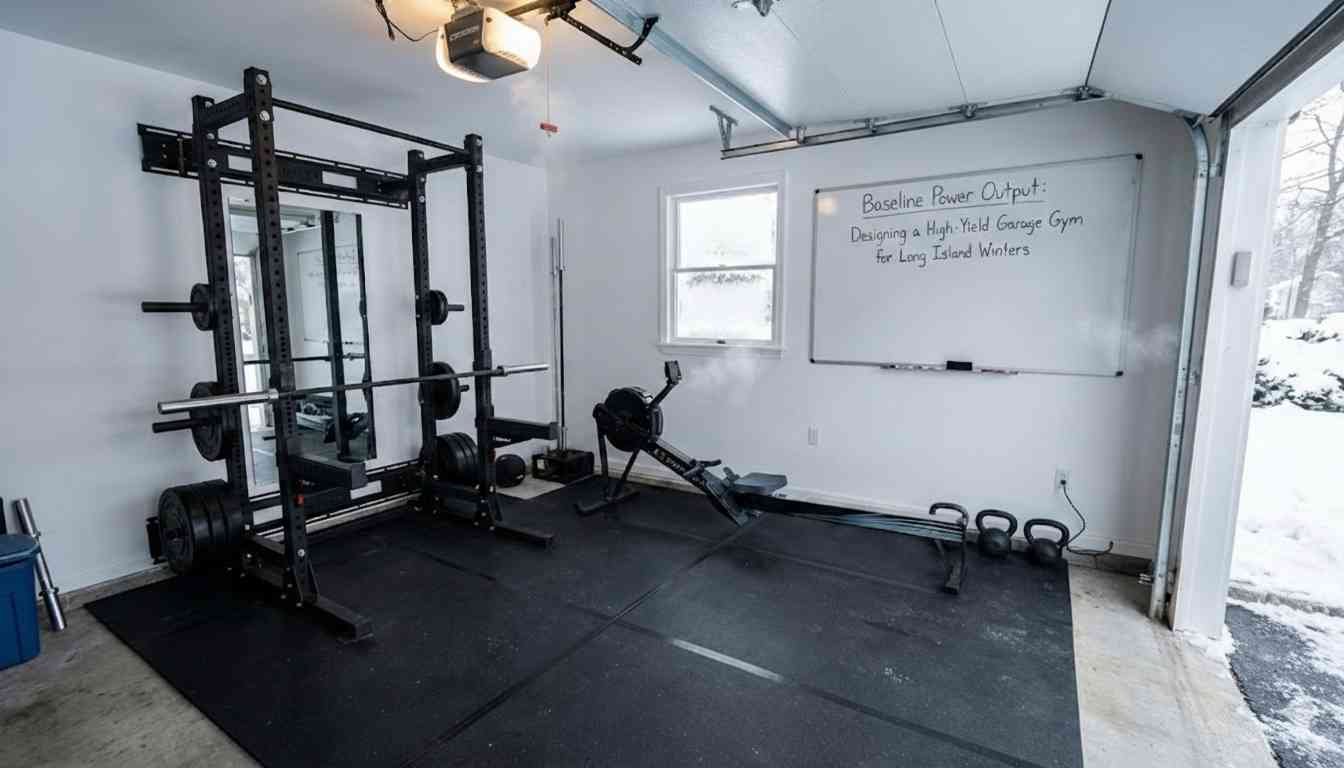
Cold is the great equalizer. It doesn’t care about your ambitions, your program, or the deadlift PR you’ve been chasing since September. On a February morning in Mount Sinai — when the wind drags off the Sound and settles over everything like a wet wool blanket — the gap between the person who trained and the person who didn’t comes down to one decision made the previous summer: did you build the gym, or did you put it off again?
I’ve been in the hospitality business for twenty-five years. The Heritage Diner doesn’t close because it’s cold. Marcellino NY doesn’t pause production because the tanning room gets drafty in January. The discipline that runs those two operations — the belief that infrastructure built correctly the first time pays forward for a decade — is the same philosophy that should govern every square foot of a serious garage gym on the North Shore. You don’t react to winter. You design for it before the first frost.
This isn’t a listicle about buying a space heater. This is a guide to building a training environment that functions at full capacity through the heart of a Long Island winter, where temperatures regularly drop into the teens, the wind chill makes outdoor work genuinely dangerous, and the seasonal pull toward inertia is strong enough to kill most fitness habits by mid-January. What follows is the infrastructure, the equipment hierarchy, and the operational mindset to make that space perform at baseline power output — every session, every month of the year.
The Thermal Envelope: Why Insulation Is the Foundation, Not the Afterthought
Every craftsman understands that the quality of the finished product depends entirely on the preparation of the substrate. In leather, you don’t skip the conditioning step and expect the hide to accept a finish evenly. In the diner kitchen, you don’t start building a sauce on a cold pan and wonder why it never develops depth. In a garage gym, you don’t bolt a heater to the wall of an uninsulated shell and expect to train comfortably. Heat generation without thermal containment is money dissolving into the atmosphere.
On Long Island, the Department of Energy classifies us in climate zone 4A — mixed humid — which means our insulation targets need to be meaningful. For garage walls, R-13 is the practical minimum using standard 2×4 framing with fiberglass batts, though if you’re doing this once and doing it right, R-19 with 2×6 framing or closed-cell spray foam is the answer. The ceiling is where most people underinvest: an uninsulated garage ceiling is a heat exhaust vent. The ideal target for northern climates is R-19 in walls and R-60 in ceiling insulation — numbers that sound aggressive until you consider that inadequate ceiling insulation will cost you more annually in heating than the upgrade would have cost upfront.
The garage door itself deserves specific attention. A standard thin-panel door is thermally negligible. A multi-layered approach combining radiant acoustic insulation with a NASA TECH garage door insulation kit can achieve an R-value of 13 on the door for a fraction of the cost of replacement. The threshold seal at the floor line matters too — that gap between the door bottom and the slab is where cold air enters at ground level and where rubber flooring temperatures crash fastest. Seal it.
Rockwool Comfortbatt is worth specifying by name for anyone doing walls and ceiling: it’s fire-resistant, doesn’t allow mold or fungus growth if it gets wet, and adds sound insulation — a genuine benefit on a residential property where a 5:30 AM squat session shouldn’t wake the neighborhood. Check with your local Suffolk County building department before framing new walls; some insulation work in an attached garage may require a permit.
Heating Systems: Choosing the Right Architecture for Your Square Footage
Once the thermal envelope is sealed, the heating equation becomes manageable. The question isn’t whether a heater will work — it’s which system architecture matches your space, usage frequency, and budget.
For a 400-to-600 square foot single-car garage — the most common configuration on Long Island — a 4,000-to-5,600 watt electric heater is adequate in a moderate climate zone, scaling to 6,000-to-7,500 watts in colder conditions. Most hardwired garage heaters run on 240V circuits. If your panel doesn’t already have a 240V circuit in or near the garage, budget an additional $300 to $600 for an electrician to run the line. This is not optional work you defer — it is the backbone of a functional heated space.
Three heating architectures are worth understanding:
Infrared Electric Heaters heat objects directly rather than cycling the air. Your barbell, your plates, your bench surface — they warm up rather than remaining icy even as the ambient air climbs. For garage gyms where you’re moving through equipment quickly, infrared is superior to forced-air because it eliminates the sensation of cold contact on every grip surface. Units from brands like Dr. Infrared and NewAir mount to the ceiling or wall, stay out of the training floor, and operate silently.
Ductless Mini-Split Systems represent the premium option and the permanent one. A ductless mini split provides both heating and cooling, creating year-round comfort, and is efficient and safe compared to alternatives like propane, which should not be used in enclosed training spaces. If you’re in the gym six days a week and this space is a long-term investment, a mini-split — installed by a licensed HVAC contractor — is the architecture that eliminates the problem entirely rather than managing it seasonally.
Radiant Floor Heating is the most elegant solution for anyone building from the slab up or undertaking a full renovation. Heat rises uniformly from the floor surface, eliminating cold spots and making rubber flooring feel genuinely warm underfoot. The installation cost is the barrier, but for a space you intend to use for the next twenty years, the math often works.
One operational note that applies regardless of system: allow fifteen to twenty minutes of pre-heat before your first working set. A properly insulated 400-square-foot space will hold heat efficiently once established, but asking your body to perform at full capacity against a cold thermal environment from the first moment of training is a recipe for soft tissue problems.
Flooring: The Thermal and Mechanical Foundation
Bare concrete in a Long Island winter is a liability. It conducts cold upward into every piece of equipment resting on it, creates a slip hazard when temperature differentials cause condensation, and offers zero energy absorption for dropped weight. This is one of the few places where the upgrade pays off in three directions simultaneously: thermal performance, equipment longevity, and injury prevention.
Horse stall mats — 3/4 to 1 inch thick, available at Tractor Supply — do a solid job of buffering the temperature of the cold floor and are priced reasonably enough to tile a full two-car garage for under $300. They’re vulcanized rubber, handle dropped iron without cracking, and can be cleaned with minimal effort. For a more finished aesthetic, interlocking rubber tile systems from Rogue, Titan, or IncStores offer the same thermal barrier in a more polished configuration.
The floor is also where you define your training zones. A power rack station, a conditioning zone for barbell cycling or SkiErg work, a recovery corner with a foam roller and a mat — spatial planning at the floor level creates an environment that functions as a gym rather than a garage with some equipment pushed against the walls.
Equipment Hierarchy: What to Prioritize in a Cold-Climate Build
The mistake most people make in building a garage gym is buying accessories before infrastructure. A sled, a set of rings, resistance bands — all useful, none essential. The architecture of a high-yield training environment in a climate like Long Island’s follows a specific hierarchy:
A power rack with integrated pull-up is the irreducible core. Everything else is optional until that frame is bolted down. Rogue, Rep Fitness, and Titan all manufacture units appropriate for residential use; the Rep FI-1000 or Rogue R-3 represent the quality floor for serious training. Cold climates introduce one specific consideration: steel becomes brittle at extreme temperatures, and knurling on barbells becomes aggressively sharp when cold-contracted. Warm the bar before you grip it — a few minutes beside the infrared heater or brought inside the house the night before eliminates this entirely.
Bumper plates handle the cold better than iron because the rubber compound buffers temperature change. If you’re doing any Olympic lifting or high-rep deadlifts where plates contact the floor, bumpers are the specification. A calibrated steel barbell and a set of iron plates handle everything else — powerlifting movements, accessory work, carries.
For conditioning in a space where running outside is genuinely not an option from December through February, a SkiErg or rowing ergometer earns its square footage. Both are vertical or minimal-footprint machines that generate cardiovascular output equivalent to outdoor endurance work without requiring weather tolerance. The Concept2 SkiErg mounted to a wall — $900 new, available used for considerably less — is arguably the most efficient watts-per-square-foot conditioning tool available for a home gym.
The Warm-Up Protocol: Cold-Weather Physiology and the Cost of Skipping It
Heidegger wrote about “thrownness” — the condition of finding yourself already in a situation not of your choosing. A Long Island winter is a form of thrownness. You did not choose the temperature. You did not choose the wind off the Sound. What you choose is the response.
Cold weather changes performance measurably — muscles are slower to activate, connective tissue is less pliable, and the margin for injury narrows when you skip warm-up in favor of loading the bar immediately. The operational protocol for a cold-climate garage session should be non-negotiable: ten minutes of general movement before touching a loaded barbell. Jump rope, kettlebell swings at sub-maximal weight, a structured dynamic mobility sequence — the specific activity matters less than the principle that body temperature must be elevated before joints are asked to move under load at range.
This is not weakness or excessive caution. It is the same logic that governs every other craft I’ve operated: the leather must be brought to room temperature before tooling begins. The dough must come to temperature before it goes into the oven. Materials under cold stress respond differently than materials in their optimal range. The body is no different.
The Psychological Architecture: Why the Garage Gym Survives What the Commercial Gym Doesn’t
There is something that happens to a person’s training consistency when the commute to the gym is thirty feet rather than thirty minutes. I’ve watched it across the decades I’ve been in the hospitality business — the friction of the journey is often what kills the habit, not the absence of desire. January at a commercial gym is a phenomenon. February at that same gym is a different story. By March, the parking lot is half-full again, and the people who were always there are still there.
The garage gym removes the decision point. There is no weather-check, no commute calculation, no parking situation. The only question is whether you will walk into the space. In a properly designed, thermally controlled training environment, the answer is almost always yes — because the space works, because it’s warm, because it’s yours.
This is what a hundred-year philosophy looks like applied to a training practice. You build the infrastructure once, correctly, with quality materials and thoughtful design. You don’t renegotiate with the cold every February. The environment was designed for the conditions, and the conditions are simply conditions.
The Investment Framework: What It Actually Costs to Do This Right
Honesty about cost is respect for the reader’s intelligence. A properly built, high-performance garage gym for Long Island winters requires an investment in the range of $8,000 to $15,000 for a complete build — thermal envelope, heating system, flooring, and equipment. That range compresses dramatically when you phase the build: insulate first, add equipment over eighteen months, upgrade the heating system as budget allows.
For context: a commercial gym membership in Suffolk County averages $50 to $80 per month. Over ten years, that’s $6,000 to $9,600 — for access to a space you don’t control, equipment you don’t own, and hours that are someone else’s decision. The garage gym, built once and built correctly, delivers training access for the next twenty to thirty years. The economics favor ownership at every time horizon beyond five years.
February doesn’t move. The Sound doesn’t warm until April. But a properly built training environment in your garage — insulated to R-30 at the ceiling, heated by an infrared system that brings the space to 65 degrees in fifteen minutes, floored with 3/4-inch vulcanized rubber, anchored by a rack that will outlast the house it sits in — doesn’t negotiate with any of that. It simply works.
That is baseline power output: the reliable, repeatable performance of a system designed for its actual conditions rather than ideal ones. Build the gym. Train through February. The person you are on the other side of the cold is the person you built the infrastructure to become.