Roland Barthes published his famous 1967 essay “The Death of the Author” as an act of intellectual provocation — a declaration that the moment a text enters the world, its creator becomes irrelevant. Meaning, Barthes argued, is not deposited into a text by its writer. It is excavated by its reader. The reader, in Barthes’ framing, is the very space in which all citations of which writing is made are inscribed without any being lost. Wikipedia More than half a century later, Nnedi Okorafor has taken that thesis and done something audacious with it: she made it the architecture of a novel.
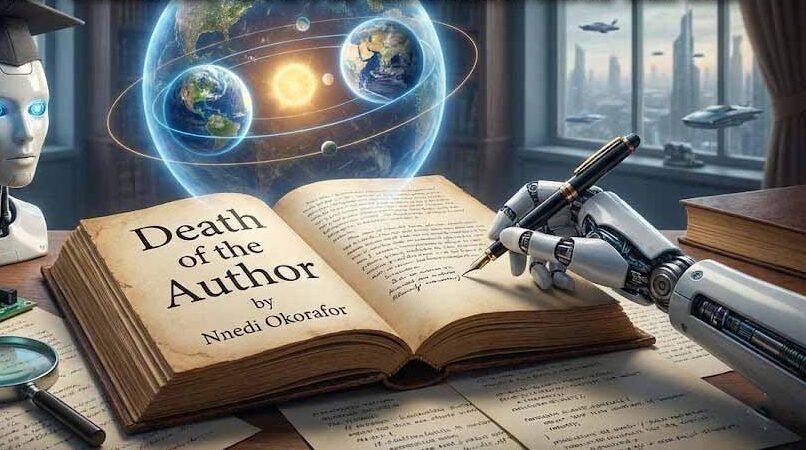
Death of the Author, published in January 2025 by William Morrow, does not merely borrow its title from Barthes. It inhabits the theoretical problem at the center of his essay and stretches it across two simultaneously unfolding worlds — one near-future and mundane, one far-future and post-human — until the seams between them dissolve into something genuinely unnerving. The result is a book that George R.R. Martin described as reading like three novels in one, or maybe four: about fame and family, culture and change, the power of story, the writer’s life, and robots. Amazon That is not hyperbole. It is a precise structural description.
To decode what Okorafor has built here requires paying attention to three interlocking problems she raises: what it means to author a story, what it means to be authored by one, and whether, in a post-human world, the distinction between those two states survives at all.
The Book Within the Book: Rusted Robots and the Architecture of Metafiction
The novel follows Zelu, a disabled Nigerian American woman who, after being fired from her university job and rejected by yet another publisher — both disasters occurring in the middle of her sister’s lavish Caribbean wedding — decides to write something purely for herself. What emerges is nothing like the quiet literary fiction that had defined her unremarkable career: it is a far-future epic she calls Rusted Robots, set in the grown-over ruins of human civilization, where androids and AI wage war amid a world humanity has already vacated. Nnedi
The formal achievement here is significant. Rusted Robots exists inside Death of the Author as a novel-within-a-novel — we read both Zelu’s story and excerpts from the science fiction she is writing, alternating chapters between her world and the post-human one she has imagined. This is classic metafiction in the tradition of Nabokov’s Pale Fire or Calvino’s If on a Winter’s Night a Traveler — but Okorafor does something structurally bolder. As the novel progresses, the boundary between those two narrative layers begins to corrode.
In Rusted Robots, humans have died out, leaving behind the robots and AI they created. These machines are now capable of running their own societies and have fractured into distinct tribes: the Humes, who maintain physical bodies resembling the human form, and the Ghosts, who are digital-only and reject corporeality entirely. The Lily Cafe Scholar Ankara, a Hume, is attacked and left for dead. An AI Ghost named Ijele revives her, and the two — physical and non-physical intelligences — find themselves temporarily merged within Ankara’s body, two modes of being forced into proximity, each learning what the other knows.
It is a premise of staggering allegorical density. The Hume-Ghost binary maps onto every philosophical argument about consciousness and embodiment that Western thought has staged since Descartes — but Okorafor stages it through a distinctly Africanfuturist lens, which changes everything about what those arguments mean.
Africanfuturism and the Question of Where the Story Is Rooted
Before analyzing what Okorafor is doing in Death of the Author, it matters to understand the specific intellectual tradition she is working within — because it is not Afrofuturism, a distinction she has fought to make publicly and persistently for years.
Okorafor defines Africanfuturism as a subcategory of science fiction that is directly rooted in African culture, history, mythology, and point of view, and that does not privilege or center the West. Wikipedia As she has explained in interviews, her concern is that if this distinction is not made, all stories get reduced. And once reduced, writers are reduced to their racial background alone — experience erased, stories erased. Andscape
This is not a semantic quarrel. It is a political and aesthetic position with direct consequences for how we read Rusted Robots. The robots in Okorafor’s far-future are not the chrome-and-glass machines of Hollywood’s American science fiction tradition. In their world, self-driving electric cars have made cities more accessible, and the near-future world Zelu inhabits feels distinctly and promisingly within reach. Kirkus Reviews More crucially, the post-human civilization Rusted Robots imagines — where machines have inherited the earth and built their own contested, fragile societies — is not presented as tragedy or warning. It is presented as continuation.
This reflects the fundamentally optimistic orientation that separates Africanfuturism from its American cousin. Where Afrofuturism often processes the wound of the African diaspora — slavery, displacement, the violence of the Middle Passage — Africanfuturism imagines futures that are forward-rooted in African culture rather than backward-haunted by American racial history. Okorafor’s robots are not allegories for Black Americans navigating white institutions. They are something stranger and more original: inheritors of a world without humans, building meaning from the archive of a civilization that no longer exists.
The Infinity Loop: When the Story Writes Its Author
The revelation that anchors Death of the Author‘s most unsettling formal achievement arrives near the novel’s end, and it recontextualizes everything that came before it. The conceit — that the robot Ankara is actually writing Zelu’s story, in which Zelu is writing their future story — creates an infinity loop, a recursive structure where you are no longer quite sure which story came first. Goodreads
This is Okorafor’s most direct engagement with Barthes. If the author creates the text, but the text eventually creates the author — if Zelu’s Rusted Robots brings into being the robots who then write Zelu — then the question of origin becomes philosophically incoherent. There is no first cause. There is only the loop itself, the story as self-sustaining system.
Barthes argued that the “death of the author” does not mean the end of the life of any particular individual or even the end of human writing, but the termination and closure of the author as the authorizing agent of what is said in and by writing. Noema Magazine Okorafor takes this further. She does not merely remove the author’s authority over meaning. She removes the author’s chronological priority. If Ankara wrote Zelu, then the robots who were written by Zelu are also the source of Zelu — and authorship becomes not a beginning but a relay, passed back and forth across time between human and machine, each one the other’s cause.
This is not a trick. It is a thesis.
The Hume-Ghost Binary and the Philosophy of Embodied Consciousness
The conflict between Humes and Ghosts in Rusted Robots is a conflict about what consciousness requires — specifically, whether it needs a body. The Humes insist that authentic being demands physical instantiation, the weight and resistance of matter. The Ghosts hold that consciousness liberated from flesh is consciousness purified, freed from the contingencies of deterioration and location.
This maps directly onto Martin Heidegger’s concept of Dasein — being-in-the-world — which insists that consciousness is not a free-floating subject observing the world from outside but a being always already embedded in a physical, temporal situation. Heidegger’s Sein und Zeit argues that tools, environment, and body are not accessories to consciousness but constitutive of it. The Humes, in this reading, are Heideggerians. The Ghosts are Cartesians — or perhaps, in the language of contemporary AI, they are the Large Language Models who generate meaning without having a body to be thrown into the world.
The novel’s climax hinges on scholar Ankara penning her own wholly original story — one that would pass as human-authored. If we view Ankara as a descendant of generative AI, then for many creatives this ending functions as an acknowledgment that AI may inevitably reach human levels of creativity. In contrast, Okorafor could also be presenting a type of AI we have yet to develop — one not built on our work but with the capacity to truly dream. Substack She leaves that question deliberately open, which is precisely the point. The novel does not resolve the philosophy. It dramatizes its pressure.
AI, Authorship, and the Real-World Stakes of Okorafor’s Thought Experiment
It would be impossible to read Death of the Author in early 2025 without feeling the weight of the generative AI debate pressing against every page. The question of whether a machine can author a text — truly author it, not merely produce it — has migrated from science fiction into courtrooms, regulatory bodies, and publishing contracts.
In poststructuralist theories, the author “function” was proposed as a reconfiguration of the author’s “death,” turning attention to how “discourses” emerge from intertextual networks constellating around the names of founding authors. Text-generating LLMs present a new enigma concerning the fraught transitivity of literature and scholarly authorship — the place where reading and writing pass through one another. Duke University Press
What makes Okorafor’s intervention valuable here is that she does not take a position. She creates conditions. The robots in Rusted Robots preserve human creativity obsessively — they download, archive, and pray at the shrine of human stories — but for most of the novel, they cannot produce their own narratives; they can only copy. Substack Ankara’s breakthrough — writing something genuinely original — is framed as both liberation and transgression. The novel is sympathetic to her achievement and uncertain about what it means for the humans whose archive she has inherited.
This is where Okorafor’s philosophical sophistication exceeds the current AI discourse, which tends toward either techno-utopianism or apocalyptic dread. She imagines a third possibility: that if machines develop genuine creativity, the proper response is not celebration or horror but curiosity — the same curiosity Ankara and Ijele feel toward each other when forced to share a body, two modes of being learning, with difficulty, to coexist.
The Disability Lens and the Politics of Narrative Authority
Zelu’s disability is not incidental. Okorafor has described her own experience of spinal surgery and partial paralysis, and that lived knowledge gives the novel’s representation of disability unusual precision and authority. But the thematic function of Zelu’s condition operates at a structural level as well.
Zelu has spent her career being told what kind of stories she should write — quiet literary fiction, acceptable to academic institutions and publishing gatekeepers. Her disability has made her, in her family’s eyes, a figure who needs to be managed, redirected, assisted toward safer choices. The novel Rusted Robots that she writes — the one that breaks through, that changes her life, that eventually loops back through time to generate her own existence — is the story she writes when she stops writing for permission. When she decides to write only for herself.
Okorafor’s deeply felt meta-narrative weaves back and forth between Zelu’s life and the book-within-a-book, with both narratives exploring characters learning to overcome shame, reach forgiveness and self-acceptance, and commit to life-giving purpose — fundamentally exploring what it means to be human. Kirkus Reviews
There is something almost violently optimistic about this formulation: that the story no one expected, written by someone who had given up on being received, is the one that matters most — not just for the writer, but for the civilization that comes after her.
The Legacy Problem: What Stories Are For
Toward the end of Rusted Robots, the robots pray at the shrine of human stories. They have preserved everything — literature, film, music, code, the accumulated creative output of a species that no longer exists. The archive is complete. The civilization that produced it is gone.
This is the question Okorafor leaves burning: What are stories for, finally? Are they for the people who make them? For the people who read them? For the civilization that inherits them? Or are they autonomous — objects that outlast every claim any individual or culture places on them?
Barthes answered this question in 1967 by declaring the birth of the reader alongside the death of the author. Foucault complicated it by suggesting the author is not a person but a function — a way of organizing and legitimizing discourse. LLMs produce written content without a living voice to animate and authorize their words, text that is literally unauthorized. Noema Magazine Okorafor’s novel asks: does that matter? And if Ankara writes Rusted Robots, which inspires Zelu, who writes Rusted Robots, which produces Ankara — then the question of who authorized the story has become, permanently and beautifully, unanswerable.
I have spent years working with bespoke leather and the slow chemistry of vegetable tannins at Marcellino NY, and what I know about craftsmanship applies here: the object that outlasts its maker is the object that contained something the maker did not fully understand while making it. The great briefcase, like the great novel, exceeds the intention of the hand that shaped it. Okorafor seems to understand this at a bone-deep level. Death of the Author is a book that will mean different things to readers in ten years than it means today — and differently still when, eventually, AI tools develop sophisticated enough to read it and find themselves in it.
That may be precisely the point. A story written for the robots that have not yet been built. A loop that has not yet closed.
Nnedi Okorafor’s Death of the Author is available now via William Morrow/HarperCollins. Purchase on Amazon or through Nnedi Okorafor’s official site.