
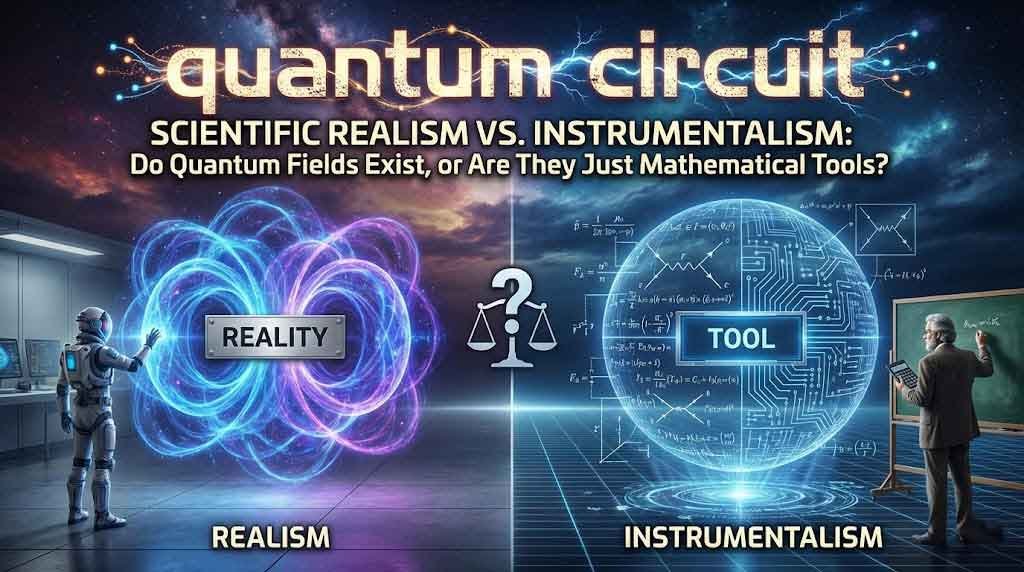
Physics has always attracted two kinds of minds: those who want to know what the world is made of, and those who are satisfied knowing what the world does. For most of human history, this distinction barely mattered. Newton’s apple falls, the equation predicts its speed, and whether gravity is a “real thing” or a “useful concept” feels like a question for philosophers with too much time and too little data. Then quantum mechanics arrived, and suddenly the question became inescapable — and perhaps unanswerable.
At the center of this tension is Quantum Field Theory (QFT), arguably the most successful scientific framework ever constructed. Its predictions align with experimental data to one part in a billion. It gave us the Higgs boson, quantum electrodynamics, and the entire Standard Model of particle physics. And yet, despite this staggering empirical success, QFT cannot answer the simplest question we might ask of it: Are quantum fields real?
This is not a question about whether QFT is useful. It clearly is. The question is whether, when physicists write equations describing the electromagnetic field, the quark field, the Higgs field — they are describing something that actually exists in the universe, independent of human observation and mathematical convention. Or are they drawing a very sophisticated map, one that navigates perfectly, but corresponds to no actual territory?
This is the debate between scientific realism and scientific instrumentalism, and in the domain of quantum physics, it is anything but resolved.
The Two Camps: What Realists and Instrumentalists Actually Claim
Scientific realism is not a naïve claim. It does not assert that our current theories are final or complete. What it does assert, in the words of philosopher Anjan Chakravartty in the Stanford Encyclopedia of Philosophy (2017), is that our best confirmed scientific theories give us approximately accurate knowledge of the world — including the parts of the world we cannot see. A realist looks at the electron, admits it cannot be directly observed, and nonetheless insists it exists: it has charge, mass, and spin regardless of whether a physicist is measuring it.
Instrumentalism, by contrast, is a form of anti-realism. It holds that scientific theories are instruments — powerful, refined, indispensable instruments — for predicting and organizing observable phenomena. A theory is not “true” or “false” in any deep metaphysical sense. It is either useful or not useful. The philosopher Pierre Duhem introduced this perspective formally in 1906, arguing that theories do not reveal hidden aspects of nature but rather summarize regularities we observe. According to the instrumentalist, asking whether a quantum field “really exists” is like asking whether the number five exists — it is a category error, a confusion of the map for the territory.
Scientific Anti-Realism, also called Scientific Instrumentalism, is the claim that we cannot know that science gives us an accurate picture of a real, physical world, but instead that science is a great language whereby we can discuss and make predictions about our experience — best considered a useful tool for modeling and prediction, but not a way to get to reality.
The critical insight here is that instrumentalism doesn’t require us to be skeptics about science. It only asks us to be precise about what scientific success means. Predicting outcomes is not the same as describing reality. A map of Manhattan that reliably gets you from the Upper West Side to Wall Street does not need to be a literal photograph of every molecule of pavement to do its job.
The Quantum Field Theory Problem: What Are We Even Talking About?
To appreciate why this debate becomes acute in QFT, we need to understand what a quantum field actually is — or rather, what the formalism describes.
In classical physics, a field is intuitive. The electromagnetic field assigns a force-vector to every point in space. It is a physical thing, and Maxwell’s equations describe how it evolves. When Faraday imagined lines of force stretching through empty space, he was being a full-throated realist: something is there.
Quantum Field Theory inherits this field language but transforms it into something stranger. In QFT, a quantum field is a mathematical entity that exists throughout spacetime and gives rise to particles as its excitations. What we call a “particle” — an electron, a photon, a quark — is not a tiny billiard ball. It is a discrete vibration, a ripple, in a field that pervades all of space. There is no electron separate from the electron field. The particle is what happens when the field is disturbed at a particular energy.
This is strange enough. But the complications multiply. QFT taken seriously in its metaphysical implications seems to give a picture of the world which is at variance with central classical conceptions of particles and fields, and even with some features of quantum mechanics itself. The vacuum state — empty space — is not empty at all in QFT. It seethes with zero-point energy and virtual particle fluctuations. Particle number is not conserved. What counts as a particle depends on the observer’s state of motion (the Unruh effect). These are not theoretical curiosities. They are testable features of the theory.
So when we ask whether quantum fields “exist,” we are asking whether this mathematically rich, empirically precise, conceptually bizarre structure corresponds to something in the world. And that is where the two camps diverge sharply.
Einstein, Bohr, and the Century-Long Argument
The tension between realism and instrumentalism in quantum physics is not new. It crystallized in one of the most famous intellectual confrontations of the twentieth century: Albert Einstein versus Niels Bohr.
Einstein was a committed realist. For him, there had to be a description of physical reality that was complete, local, and determinate — independent of observation. His famous phrase “God does not play dice” was not a theological claim but an ontological one. He could not accept that physics would stop at the description of probabilities. If the wave function only described what we know about a system rather than what the system is, something was wrong — or incomplete.
Bohr disagreed with a profundity that was almost exasperating to physicists who wanted a clear answer. Bohr’s complementarity directs itself toward a type of anti-realism where words like “particle” or “wave” do not designate anything about material objects or their properties — they have no ontological status, they are only a description of certain experiments. For Bohr, the question “What is the electron doing when we’re not looking?” is not a deep question awaiting a deeper answer. It is a malformed question. Physics describes experimental contexts, not underlying realities.
The irony, as scholarship has since revealed, is that both Einstein and Bohr may have been realists in ways that departed from the crude instrumentalism that came to dominate post-war physics. The conventionalistic form of instrumentalism that dominated major post-World War II developments in quantum physics is not an outgrowth of the Copenhagen school, and despite the schism created by the Bohr-Einstein disagreements, both their philosophical stands were very much opposed to conventionalistic instrumentalism. The culture of “shut up and calculate” — of treating QFT purely as a computational device — was not philosophically mandated by the founding fathers. It was a sociological convenience that allowed physics to sprint forward while deferring the harder metaphysical questions indefinitely.
The Realist’s Best Case: The No-Miracles Argument and Structural Realism
The most compelling argument for scientific realism is deceptively simple: if quantum fields weren’t describing something real, why would they work so well?
This is the no-miracles argument, advanced forcefully by philosopher Hilary Putnam. It holds that the extraordinary predictive success of our best theories would be a miracle — a cosmic coincidence of the highest order — if those theories were not at least approximately tracking the truth about the world. When quantum electrodynamics predicts the anomalous magnetic moment of the electron to eleven significant figures and experiments confirm it, calling that a lucky accident strains credibility past the breaking point.
But contemporary realists have become more careful and more nuanced than a simple “the theory is true, therefore the entities are real” position. The dominant sophisticated position today is structural realism, which traces its lineage to Henri Poincaré and has been developed in detail by philosophers James Ladyman, John Worrall, and others. Broadly construed, structural realism is the thesis that our best scientific theories tell us only about the structure of the world, to be contrasted with traditional scientific realism which attempts to find a complete ontology of individual objects and properties in scientific theories.
The structural realist does not insist that quantum fields are “things” in the ordinary sense — objects with intrinsic properties sitting in space. Instead, they argue that what QFT correctly describes is the relational and mathematical structure of reality. The field equations encode real structural features of the world, even if we cannot say what the field “is” in terms of concrete stuff. Despite a concerted effort by philosophers of physics, an ontology of individual objects and properties — of the sort sought by traditional realists — has not been forthcoming in QFT. This should be troubling for the traditional realist, but is just what the structural realist expects.
This is an intellectually sophisticated position, but it leaves a nagging question: if the structure is all we can know, and the structure is mathematical, are we sliding back toward instrumentalism through the side door?
The Instrumentalist’s Best Case: Renormalization, Effective Theories, and Ontological Silence
The instrumentalist case, meanwhile, is strengthened considerably by some of the internal features of QFT itself.
Consider renormalization — one of the most successful and most philosophically troubling techniques in all of physics. In its earliest formulations, QFT produced nonsensical infinities when calculating certain quantities. Renormalization is the procedure by which these infinities are absorbed into redefined parameters, producing finite, accurate results. It works. It works astonishingly well. But its original critics, including Dirac and Feynman himself, found it deeply unsatisfying from a realist standpoint. If the theory requires us to subtract infinities from infinities and call the result physical, how confident can we be that the objects in the theory correspond to actual things in the world?
This concern deepens when we consider the concept of effective field theories (EFTs). In the 1970s a program emerged in which the theories of the standard model of elementary particle physics are considered as effective field theories, which describe relevant phenomena only in a certain domain since the Lagrangian contains only those terms that describe particles which are relevant for the respective range of energy. EFTs are inherently approximative and change with the range of energy considered.
In other words, our best QFTs are not claims about fundamental reality at all scales. They are descriptions of what happens at the energies we have access to. The effective field theory perspective suggests that quantum fields are emergent phenomena, valid only at specific scales. If a field theory is replaced by a different field theory at higher energies — as has happened repeatedly in the history of physics — the realist must ask: which field was the real one?
The instrumentalist answers: neither, and that’s the point. The theories are scaffolding. They are magnificent, precise, and useful scaffolding — but scaffolding nonetheless.
There is also the extraordinary problem of unitarily inequivalent representations in algebraic QFT, which has no classical analogue. A single physical system can be described by multiple, mathematically inequivalent representations, all empirically adequate, with no principled way to select a unique structure as the “real” one. The problem of unitarily inequivalent representations threatens to undermine the possibility of QFT providing a unique structure for the world. This is deeply uncomfortable for the realist, who wants to say that science converges on a single true description. For the instrumentalist, it is simply confirmation that the theory is a tool that can be wielded in multiple ways.
A Third Path: Ontic Structural Realism and the Relational Universe
Between the poles of naïve realism and deflationary instrumentalism, a third possibility has attracted serious attention in the philosophy of physics: that what exists are not objects but relations and processes. This view — ontic structural realism — takes the structural realist insight to its logical limit. It does not merely say we can only know structure. It asserts that structure is what there is.
In this framework, quantum fields are not things that have properties. They are nodes in a web of relations — patterns of causation, interaction, and symmetry. This position suggests that QFT describes the structure of reality rather than its objects. Quantum fields are not things but relational entities defined by their interactions.
This resonates with recent work applying Hegelian ontological logic to QFT, where researchers have argued that what is relevant is not individual objects but the field of relations that makes them effective in the first place. The universe, on this view, is not a collection of things. It is a collection of relationships, and what we call “fields” are the most fundamental layer of those relationships we have thus far mapped.
There is something philosophically compelling about this — and something that connects back to a very old intuition in both Western and Eastern metaphysics, the idea that relation precedes substance, that the dance exists before the dancer. Whether this amounts to a form of realism or merely a more sophisticated instrumentalism is a question that remains genuinely open.
What Physics Itself Suggests
It is worth noting what working physicists actually believe, insofar as we can gauge it. The dominant attitude through most of the twentieth century was, as Richard Feynman memorably put it, to “shut up and calculate.” This is instrumentalism in its most pragmatic form — not a philosophical commitment but a professional strategy. The machinery works; do not interrogate the machinery.
By the 1980s, physicists regarded not particles but fields as the more fundamental reality, and no longer even hoped to discover what entities and processes might be truly fundamental to nature — perhaps not even the field itself. That honest acknowledgment from within the physics community — that the field may not be the final ontological unit — is itself a kind of reluctant instrumentalism. Even the best map might not be the territory. The territory might not have the kind of structure that maps can capture.
Yet the no-miracles argument does not dissolve easily. The fact that QFT’s formalism correctly predicts the Casimir effect — the measurable force between two uncharged conducting plates arising from quantum vacuum fluctuations — is a remarkable confirmation that something about the vacuum field description is tracking reality. These are not phenomena inferred from theoretical convenience. They are measured in laboratories. The field, or whatever it is, leaves fingerprints.
The Stakes of the Question
At first glance, this debate might seem like an academic exercise — important for philosophers and theorists, irrelevant to anyone else. But the stakes are higher than they appear.
How we answer the question of what quantum fields are shapes how we pursue physics going forward. If fields are real, we have reason to push toward a complete ontology — to demand that a theory of quantum gravity, for instance, tell us what space and time fundamentally are, not merely how to compute observables. If fields are tools, we can remain agnostic about the deeper structure and focus on expanding the predictive reach of our mathematical machinery.
The history of science suggests that the realist impulse — the insistence that our theories point to something real — has been extraordinarily productive. It motivated Einstein’s search for general relativity. It drove Dirac to predict antimatter before anyone had seen it, on the grounds that his equation required it to exist. The realist bet paid off there spectacularly.
But the history of science also shows the dangers of ontological overconfidence. The luminiferous ether was once considered not a hypothesis but a necessity — the medium through which light, being a wave, must travel. Michelson and Morley showed it did not exist. The caloric fluid of heat theory, the phlogiston of combustion chemistry: confident realist ontologies swept away when the evidence turned. This is Laudan’s famous pessimistic meta-induction — the track record of scientific ontologies being overturned should make us cautious about the current ones.
Perhaps the most honest position is the one articulated implicitly by the structural realist tradition: hold loosely to the ontology, hold firmly to the structure. The equations of QFT encode something real about the world. Whether “the electron field” will survive as a fundamental ontological category in the next revolution of physics — the one that reconciles quantum mechanics with general relativity — is genuinely unknown. That it captures something about the causal structure of reality seems hard to deny.
The Question That Refuses to Resolve
Quantum fields, in the end, occupy a peculiar philosophical position. They are not like the atoms that Democritus imagined — discrete, solid, individual. They are not like Newton’s gravity — an invisible force acting at a distance. They are not like Maxwell’s ether — a medium that turned out not to exist. They are extended, non-local, observer-dependent in some formulations, and capable of generating every particle in the Standard Model from excitations of the same fundamental kind of mathematical object.
Whether this constitutes a description of reality or a description of our best predictions about reality is a question that cannot be settled by running another experiment. More data will not resolve it, because it is not a question about data. It is a question about what we mean when we say something “exists” — what it would take for a field that cannot be seen, touched, or directly detected to be a genuine constituent of the universe rather than a useful fiction.
Realism and instrumentalism, in this domain, are not merely philosophical positions. They are two different ways of inhabiting the world — two different stances on what it means to understand something rather than merely use it. The physicist who insists the Higgs field is real and the philosopher who calls it a calculational convenience are not disagreeing about the data. They are disagreeing about what the activity of physics is fundamentally for.
That is, perhaps, the deepest question the quantum revolution has left us. Not what the universe is made of — but whether the question itself is one science can ever answer.
Sources
- Chakravartty, Anjan. “Scientific Realism.” Stanford Encyclopedia of Philosophy. Stanford University, 2017. https://plato.stanford.edu/archives/sum2017/entries/scientific-realism/
- Kuhlmann, Meinard. “Quantum Field Theory.” Stanford Encyclopedia of Philosophy. Summer 2023 Edition. https://plato.stanford.edu/archives/sum2023/entries/quantum-field-theory/
- Prugovečki, E. “Realism, Positivism, Instrumentalism, and Quantum Geometry.” Foundations of Physics 22 (1992): 143–186. https://doi.org/10.1007/BF01893610
- Dorato, Mauro, and Laudisa, Federico. “Realism and Instrumentalism about the Wave Function.” arXiv, 2014. https://arxiv.org/pdf/1401.4861
- Glick, David. “The Ontology of Quantum Field Theory: Structural Realism Vindicated?” Studies in History and Philosophy of Science, 2016. https://doi.org/10.1016/j.shpsa.2016.06.007
- Yan, C. “A Functionalist Mixed Approach to the Ontology of Quantum Field Theories.” European Journal for Philosophy of Science 14, 36 (2024). https://doi.org/10.1007/s13194-024-00599-0
- Gasparinetti, et al. “Ontologies for Quantum Field Theory.” Philosophy Compass, 2025. https://compass.onlinelibrary.wiley.com/doi/abs/10.1111/phc3.70061
- Hernández Castilla. “Ontology in Quantum Field Theory Through Hegel’s Science of Logic.” Theoria, 2025. https://onlinelibrary.wiley.com/doi/10.1111/theo.70037
- Da Silva, Branco. “Einstein’s Local Realism vs. Bohr’s Instrumental Anti-Realism.” Griot: Revista de Filosofia 21, no. 2 (2021): 332–348. https://www.redalyc.org/journal/5766/576666994022/html/
- Frigg, Roman. “Ontological Aspects of Quantum Field Theory” (review). Roman Frigg Philosophy Archive. https://romanfrigg.org/wp-content/uploads/writings/QFT_Review_long.pdf
- Saatsi, Juha (ed.). Scientific Realism and the Quantum. AHRC Research Project, University of Leeds. https://ahc.leeds.ac.uk/philosophy-research-innovation/dir-record/research-projects/368/scientific-realism-and-the-quantum