Before the Iron Throne became a meme, before dragons were CGI centerpieces and fan theories filled entire subreddits, the world George R.R. Martin built worked because of people. Ordinary people — hungry, frightened, morally imperfect people — navigating a world indifferent to their survival. That tension, that grit, is what elevated Game of Thrones from prestige television to cultural phenomenon. And then, predictably, the machine grew too large for its own mythology, and the story collapsed under the weight of spectacle without substance. House of the Dragon was a genealogy lesson delivered with a flamethrower: visually magnificent, emotionally exhausting, occasionally brilliant, and perpetually strained by its obligation to serve a franchise rather than a story.
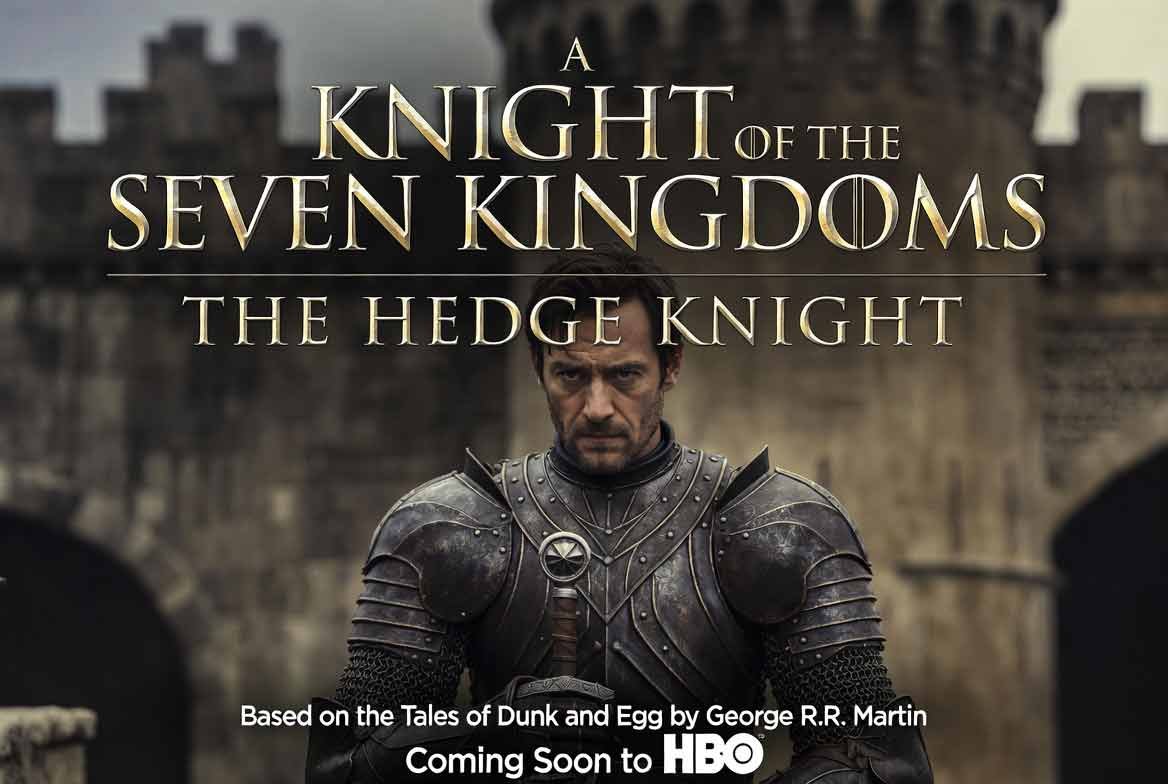
A Knight of the Seven Kingdoms, which premiered on HBO on January 18, 2026, does something no installment of the franchise has managed since the first season of Game of Thrones: it gets small. Deliberately, gracefully, beautifully small. And in doing so, it becomes the richest and most rewarding entry into Martin’s world since Ned Stark walked through the gates of King’s Landing with his honor intact and his head still attached.
The Source Material: Three Novellas and a Universe in Miniature
The foundation of the new series is Martin’s Tales of Dunk and Egg, a trio of novellas published between 1998 and 2010. The Hedge Knight (1998), The Sworn Sword (2003), and The Mystery Knight (2010) were collected into a single illustrated volume — titled A Knight of the Seven Kingdoms — in 2015, with artwork by Gary Gianni. The stories follow Ser Duncan the Tall, a lowborn hedge knight from the slums of Flea Bottom, and his improbable squire Egg — who is, in secret, Prince Aegon Targaryen, the boy who would one day become King Aegon V. Their adventures span roughly 90 years before the events of the main novels, set in an era when House Targaryen still sits the Iron Throne, though its grip has grown considerably less firm since its last dragon drew breath.
Martin has long expressed a desire to write between six and twelve Dunk and Egg stories in total, and according to showrunner Ira Parker — who co-created the series with Martin — the author has already outlined plans for 10 to 12 additional unpublished novellas beyond the three that exist. HBO’s stated intention, at least publicly, is to adapt only the published works. Parker, however, envisions a longer arc, telling The National in January 2026 that he imagines releasing four stories, then four more a decade later, and the final four a decade after that. Whether HBO’s appetite for the property outlasts its current enthusiasm remains to be seen. What matters now is that the first season, six episodes adapted from The Hedge Knight, is a work of surprising restraint and uncommon humanity.
Dunk and Egg: An Unlikely Chemistry Built on Contrast
The genius of Martin’s original novellas — and the reason the HBO adaptation works as well as it does — lies in the structural tension between its two protagonists. Ser Duncan the Tall (played with lumbering, earnest decency by Irish actor Peter Claffey, formerly of Bad Sisters and Small Things Like These) is a man of limited pedigree and enormous conscience. He was taken in as a boy by Ser Arlan of Pennytree, an aging hedge knight who wandered the roads of Westeros taking what tournaments and small coin he could find. When Ser Arlan dies at the story’s opening, Dunk inherits his horse, his armor, and a knighthood of ambiguous legal standing. He rides toward the tournament at Ashford Meadow hoping, simply, to prove himself worthy of the vows he took.
Egg, played by Dexter Sol Ansell with a child’s piercing directness, is the inverse of everything Dunk represents. He is small where Dunk is enormous. He is royal where Dunk is common. He has been sheltered within a dynasty while Dunk has scraped along its outer edges. Yet there is something in each that the other lacks — and Martin, ever the astute observer of power and its discontents, builds his entire narrative on that gap. The bond between a hedge knight without a house and a prince without his crown is not sentimentality; it is the genuine article. It earns its warmth through conflict, through betrayal, through the slow accumulation of shared hardship.
When the truth of Egg’s identity is revealed — that the shaved-head boy who volunteered as his squire is actually Aegon Targaryen, a prince of the royal blood — Dunk feels not elevated but deceived. That beat is everything. It refuses the easy read. Most stories would play the royal reveal as wish fulfillment. Martin plays it as a crack in the foundation of trust. What follows is not a celebration but a renegotiation, and the audience understands that this friendship will cost both of them something real.
The Political Architecture: Westeros Under Daeron II
To fully appreciate what A Knight of the Seven Kingdoms is doing, one must understand the political climate in which it takes place. The series is set in 209 AC — approximately 13 years after the conclusion of the First Blackfyre Rebellion and roughly 100 years before the events of Game of Thrones. The Targaryen dynasty still holds the Iron Throne under King Daeron II, but the house is a diminished and fractured version of what it once was.
The last of the Targaryen dragons died during the civil war known as the Dance of the Dragons (depicted in House of the Dragon), which left the dynasty structurally weakened and dynastically vulnerable. Without dragons, the Targaryens are, as one character notes, merely “incestuous aliens and tyrants” — a reminder that their authority was always, at its core, the authority of unmatched destructive power. Strip that away and what remains is bloodline, tradition, and a family with a dangerous habit of eating its own.
Daeron II himself, the reigning king during the events of Season 1, represents the scholarly, diplomatic wing of Targaryen rule — a man who united Dorne with the Seven Kingdoms through marriage rather than conquest, and who worked systematically to undo the corruption of his father, Aegon IV. His eldest son and heir, Prince Baelor Breakspear (played with tremendous gravity by Bertie Carvel), is everything the franchise’s architecture demands of a just successor: brave, wise, politically astute, and possessed of a Dornish mother — a detail that still generates whispered resentment among lords who viewed Dorne’s integration as cultural dilution.
The Shadow of the Blackfyre Rebellion
The event that hangs over every scene of A Knight of the Seven Kingdoms like smoke after a wildfire is the First Blackfyre Rebellion — a civil war that, while concluded before the series begins, has left the kingdom in the condition that sociologists might describe as post-traumatic fragility. Understanding the Blackfyres is not optional trivia. It is the lens through which the entire political texture of the show must be read.
Daemon Blackfyre was born a bastard to King Aegon IV — a man so notorious for his appetites that Westerosi historians recorded him as Aegon the Unworthy — and his cousin, the imprisoned Princess Daena Targaryen. Aegon IV publicly bestowed upon Daemon a Valyrian steel sword named Blackfyre, long regarded as a symbol of Targaryen kingship, and then on his deathbed legitimized all of his bastard children, throwing the line of succession into open question. The symbolism was unmistakable. To many lords, a warrior king with classic silver-gold Targaryen features and the ancestral blade in hand was a more compelling vision of monarchy than the intellectual Daeron II, whose Dornish associations made him politically suspect.
The rebellion that followed divided great houses, devastated the countryside, and culminated in the Battle of the Redgrass Field in 196 AC, where Daemon was killed alongside two of his sons. Daeron II survived, but the victory was not clean. Aegor Rivers, known as Bittersteel, fled to Essos and founded the Golden Company — an organization of exiled warriors created with the explicit purpose of eventually returning a Blackfyre to the Iron Throne. The Blackfyre Rebellions would continue for five more cycles, their final chapter playing out in the War of the Ninepenny Kings, just 25 years before Robert’s Rebellion.
Showrunner Ira Parker has said that the Blackfyre Rebellions are “in and out of their lives for Dunk and Egg, all the way up until pretty late,” with the Second Blackfyre Rebellion factoring heavily into the second novella. “We are 15 years outside of a massive civil war,” Parker told Variety, “and so there’s still a lot of those lingering resentments. There are certainly a lot of open wounds left.” Young Egg’s instinct to fantasize about slaying “the Blackfyre bastards” during a childhood game is not childish bravado — it is the internalized ideology of a dynasty still processing its near-destruction.
As one analysis of the show’s lore notes, what emerges from the Blackfyre conflict is “not merely a personal rivalry but an ideological fracture. Some lords see in Daeron excessive conciliation and weakness. In Daemon, they see the promise of a return to a militarized, aristocratic past.” That tension — between a reforming, diplomatic monarchy and a nostalgic, militaristic counter-claim — is not merely a Westerosi problem. It is a perennial human one. Martin has always been interested in the ways history repeats itself, in how legitimate grievances become corrupted instruments of ambition, in how war resolves nothing and scars everything.
The Tone Shift: Why Restraint Is the Show’s Greatest Achievement
One reviewer on IMDb captured the tonal shift with precision: “If Game of Thrones was a feast with greasy fingers, goblets of wine, blood on the tablecloth, and House of the Dragon was a genealogy lesson delivered with a flamethrower, then A Knight of the Seven Kingdoms is a roadside stew in a dented pot. Humble. Honest. Surprisingly soulful.”
That restraint is not an accident. It is a structural choice that reflects both the nature of Martin’s source material and a conscious artistic decision by showrunner Parker to resist the franchise’s default setting of operatic maximalism. The season consists of six episodes — lean, purposeful, and uninterested in spectacle for its own sake. The stakes are personal rather than apocalyptic. A hedge knight defends a puppeteer girl. A prince-in-disguise earns his calluses. A trial by combat determines not the fate of kingdoms but the honor of two men in a muddy meadow.
Rotten Tomatoes reported a 93% approval rating from critics based on 155 reviews, with the consensus reading that the show “is a welcome return to Westeros that works better in the buddy-comedy arena rather than solely slaying its competition.” The Metacritic score of 74/100 reflects a minority view that the series lacks the grand stakes of its predecessors — a critique that entirely misses the point. The show is not smaller because it lacks ambition. It is smaller because smallness is its argument. The great men of Westeros — the princes, the lords, the claimants to the throne — keep breaking the world. Dunk and Egg walk through the wreckage, doing what they can.
Egg’s Destiny and the Long Game of the Targaryen Line
One of the subtler pleasures of A Knight of the Seven Kingdoms for students of the franchise is watching young Aegon Targaryen — this shaved-head, runaway boy — through the foreknowledge of what he will become. Egg eventually becomes King Aegon V, known to history as Aegon the Unlikely: a reformer king who championed the rights of the smallfolk, attempted (fatally) to restore dragons to the Targaryen line through sorcery, and whose reign ended in the catastrophic fire at Summerhall. He and Dunk both die at Summerhall. The story of their friendship is therefore a tragedy in the classical sense — not in the sense that it ends badly, but in the sense that we know it ends, and the knowing makes every scene between them shimmer with a particular kind of grief.
There is also, threaded through the show’s connective tissue, the presence of characters who will resurface generations later. Prince Maekar, Egg’s volatile and ambitious father, is the grandfather of the Mad King, Aerys II. The shadowy figure of Brynden Rivers — known as Bloodraven, one of Aegon IV’s legitimized bastards and a ferocious Targaryen loyalist — will eventually become the Three-Eyed Crow who trains Bran Stark in Game of Thrones. According to showrunner Parker, Martin has provided outlines for twelve unpublished Dunk and Egg stories, suggesting the franchise has the raw material to sustain many more seasons if the appetite exists.
The show is, at its best, a reminder that the grand arcs of history are composed entirely of specific, personal moments. The Targaryen dynasty falls in Game of Thrones not because of any single catastrophic decision but because of a thousand smaller corruptions — pride, fear, misplaced loyalty, the intergenerational transmission of trauma. In the meadows and back roads where Dunk and Egg ride, those corruptions are just beginning their slow work.
What the Show Gets Right About Martin’s Vision
Martin has described himself not as an architect but as a “gardener” — a writer who plants seeds and follows where they lead, who values the organic development of character over the mechanical execution of plot. The Dunk and Egg stories are the purest expression of that sensibility. They are road stories, essentially: two people, a horse, the open road, and whatever moral complication awaits at the next inn. The violence, when it comes, is not thrilling. It is costly. People die who should not die. Victories feel contaminated by what they required.
The HBO adaptation, to its considerable credit, honors that sensibility. It does not inflate the material. It trusts it. It gives its actors room to be still, to let scenes breathe, to allow silence to do the work that lesser productions would fill with music or action. Peter Claffey’s Dunk is not a hero in the modern sense — he is a good man in a bad world, which is both more interesting and more fragile. Dexter Sol Ansell’s Egg is not a precocious archetype but a specific child, with specific blindspots, carrying the weight of a dynasty in his back pocket while pretending to be someone else.
Season 2, which will adapt The Sworn Sword and began filming in Belfast, Northern Ireland in December 2025, is expected to arrive in 2027. HBO has confirmed it intends to make the show an annual series. If the creative team sustains the discipline they demonstrated in Season 1, Westeros has its most compelling franchise entry in a decade.
The genius of Tales of Dunk and Egg — and by extension, the HBO adaptation — is that it illuminates the grand sweep of Westerosi history not from the battlements of power but from the road beneath them. You do not need to understand the full lineage of House Targaryen to feel the weight of what Dunk carries. But if you do understand it — if you know that the boy riding beside him will die in a fire he started trying to bring dragons back into the world — then every moment of warmth between them becomes something quietly unbearable. That is what great historical fiction does. It does not merely dramatize the past. It makes the past legible as loss. Martin understood that when he wrote the first word of The Hedge Knight in 1998. HBO, at long last, understands it now.
Sources
- Wikipedia. A Knight of the Seven Kingdoms (TV series). https://en.wikipedia.org/wiki/A_Knight_of_the_Seven_Kingdoms_(TV_series)
- Wikipedia. Tales of Dunk and Egg. https://en.wikipedia.org/wiki/Tales_of_Dunk_and_Egg
- A Wiki of Ice and Fire. Dunk and Egg. https://awoiaf.westeros.org/index.php/Dunk_and_Egg
- Gizmodo. “How the Altered Ending of ‘A Knight of the Seven Kingdoms’ Hints at Changes for Season 2.” https://gizmodo.com/knight-of-the-seven-kingdoms-episode-6-ending-explained-egg-maekar-2000725396
- Gizmodo. “The History of the Rebellion That Nearly Broke House Targaryen.” https://gizmodo.com/knight-of-the-seven-kingdoms-blackfyre-rebellion-explained-2000722082
- Dexerto. “How the Blackfyre Rebellions Impact Dunk & Egg in Knight of the Seven Kingdoms Season 2.” https://www.dexerto.com/tv-movies/knight-of-the-seven-kingdoms-blackfyre-rebellions-impact-dunk-egg-season-2-3322977/
- Den of Geek. “A Knight of the Seven Kingdoms Timeline Explained.” https://www.denofgeek.com/tv/a-knight-of-the-seven-kingdoms-timeline-explained/
- Collider. “The Blackfyre Rebellion: Key History Behind ‘A Knight of the Seven Kingdoms’.” https://collider.com/knight-of-the-seven-kingdoms-blackfyre-rebellion-explained/
- Miscelana. “Blackfyre Rebellions and the Targaryen Succession Crisis.” https://miscelana.com/2026/02/12/blackfyre-rebellions-and-the-targaryen-succession-crisis/
- CBR. “A Knight of the Seven Kingdoms Finally Reveals the Bloodiest War in Westeros History.” https://www.cbr.com/blackfyre-rebellion-a-knight-of-the-seven-kingdoms/
- SlashFilm. “A Knight Of The Seven Kingdoms: The Blackfyre Rebellion, Explained.” https://www.slashfilm.com/2099734/knight-of-the-seven-kingdoms-blackfyre-rebellion-explained/
- Tom’s Guide. “A Knight of the Seven Kingdoms Season 1 Finale Recap.” https://www.tomsguide.com/news/live/a-knight-of-the-seven-kingdoms-season-1-finale-live
- Rotten Tomatoes. “A Knight of the Seven Kingdoms: Premiere Date, Cast, Trailers & More.” https://editorial.rottentomatoes.com/article/everything-we-know-about-a-knight-of-the-seven-kingdoms/
- Deadline. “A Knight Of The Seven Kingdoms: Game Of Thrones Prequel Unveils Final Trailer.” https://deadline.com/2025/12/a-knight-of-the-seven-kingdoms-trailer-1236574492/