Every plate of salmon tells a story — one that begins long before the fish arrives at a kitchen. It is a story of ocean health, carbon cycles, genetic integrity, and the hard economics of feeding a planet of eight billion people without destroying the system that feeds it. The debate between organic aquaculture and wild-caught seafood sits at the intersection of ecology, food science, and consumer ethics, and it resists the clean, decisive answers most people want.
In 2024, the United Nations Food and Agriculture Organization (FAO) confirmed what many had long anticipated: for the first time in recorded history, more seafood was produced through aquaculture than captured from the wild. Global aquaculture accounted for 51 percent of aquatic animal production in 2022, surpassing wild fisheries in output (FAO, State of World Fisheries and Aquaculture, 2024). That milestone is not a triumph of technology over nature so much as it is a symptom — of overextended oceans, of populations that have doubled their per capita seafood consumption since 1960, of wild fisheries under strain that no amount of good intentions has been able to fully reverse.
The question for the consumer standing at a fish counter, or for the restaurateur sourcing a menu, is no longer simply wild or farmed. It is: which sourcing decision does the least ecological damage, and how do you even begin to know?
The State of Wild Fisheries: What “Wild-Caught” Really Means in 2025
The romance of wild-caught seafood — of a deckhand hauling Atlantic halibut from cold water under a gray sky — is real, but it obscures an increasingly difficult reality. The Monterey Bay Aquarium’s Seafood Watch program has documented that roughly 90 percent of the world’s fisheries are now fully exploited, over-exploited, or have collapsed. The FAO’s 2024 SOFIA report reinforced the same finding: progress toward sustainable wild fisheries management is “either moving much too slowly or has regressed.”
Wild-caught fish feed and grow on their own, requiring no land, no freshwater, and no artificial feed — which means their baseline environmental footprint, in theory, is extraordinarily low. Small pelagic species like anchovies and sardines represent the ideal case: one hamburger, according to researchers at American University led by Dr. Jessica Gephart, has roughly the same carbon footprint as nine pounds of wild sardines (Oceana, 2021). That figure, if you sit with it, is staggering.
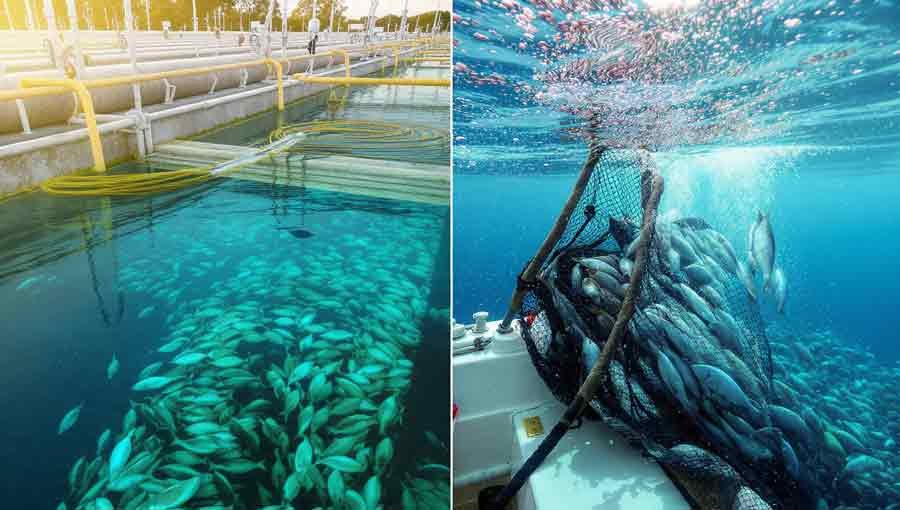
But the method of capture changes everything. Bottom trawling — dragging heavy nets across the seafloor to dislodge crustaceans and flatfish — is among the most environmentally destructive practices in modern food production. A 2024 study published in Frontiers in Marine Science estimated that between 1996 and 2020, trawling released somewhere between 8.5 and 9.2 billion tonnes of CO₂ from disturbed seabed sediments. The ocean floor is one of the planet’s critical carbon sinks; trawling plows through it with a regularity and scale that remains difficult to fully comprehend. The WWF found that 92 percent of discarded fish in EU fisheries were linked to trawling operations (Impakter, 2024).
Bycatch — the unintentional capture of non-target species — compounds the problem. When fishing fleets set out for tuna, they don’t catch only tuna. Sea turtles, dolphins, juvenile fish of dozens of species, and even seabirds get swept into nets designed for one thing and used indiscriminately on another. Globally, millions of tons of marine life are discarded as bycatch each year, much of it dead before it ever reaches the surface.
Line-caught wild fish, by contrast — particularly from well-managed, short-haul fisheries in U.S. and European waters — represent a meaningfully different environmental proposition. Properly managed line fisheries with healthy stocks, verified traceability, and low bycatch rates can offer genuinely sustainable wild seafood. The challenge is that a consumer has almost no reliable way to distinguish line-caught wild salmon from trawl-caught wild salmon once it reaches a retail package.
What Is Organic Aquaculture, and Does the Label Mean Anything?
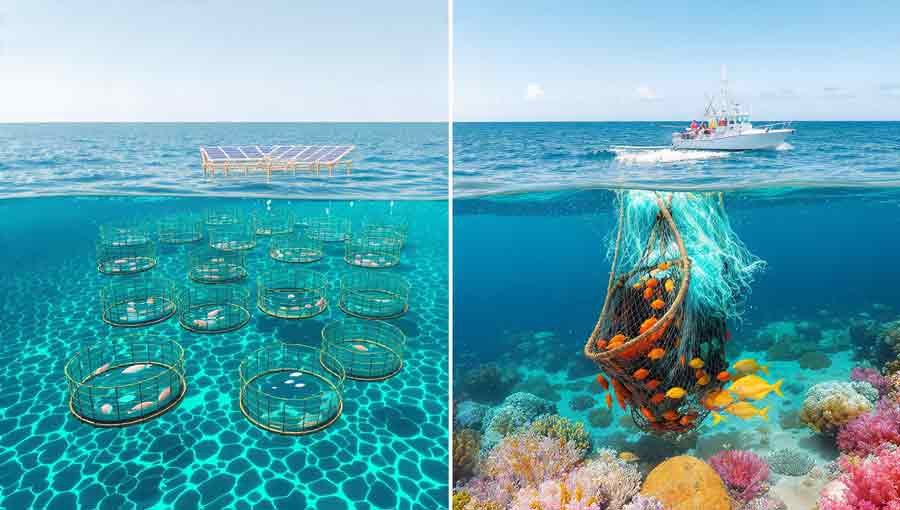
Aquaculture is the controlled farming of fish, shellfish, and aquatic plants. “Organic” aquaculture is a subset that applies standards similar to those used in terrestrial organic farming: prohibitions on synthetic pesticides, requirements for non-GMO feed, mandates around stocking density, and restrictions on antibiotic use. In the United States, the USDA has not finalized a comprehensive organic aquaculture standard, which means the term “organic” on farmed seafood sold domestically carries less regulatory weight than it does for beef or produce. Internationally, certifications from organizations like the Aquaculture Stewardship Council (asc-aqua.org) carry the most credibility — the ASC, jointly founded by the World Wildlife Fund and the Dutch Sustainable Trade Initiative, assesses farms across 17 species groups for environmental and social responsibility.
The environmental impact of aquaculture is heavily species-dependent. Farmed shellfish — oysters, clams, mussels, and scallops — are arguably the most environmentally beneficial commercially available protein on the planet, full stop. They require no feed inputs; they filter feed on plankton naturally present in the water column. In doing so, they actually clean the surrounding marine environment, removing excess nitrogen and phosphorus. A 2024 review published in the Journal of the World Aquaculture Society found that farmed bivalve mollusks emit approximately 1,414 kg of CO₂ equivalent per ton — compared to 11,400 kg of CO₂ equivalent per ton for wild-caught bivalves, where the energy expenditure of harvesting becomes the dominant factor (Li et al., 2025). Farmed shellfish are a rare example of aquaculture that is, in most credible assessments, better for the planet than its wild-caught equivalent.
Carnivorous farmed fish — salmon and shrimp being the most prominent — present a far more complicated picture. The overwhelming majority of aquaculture’s carbon footprint, roughly 70 percent, comes not from the energy used to run the farm but from the feed itself (Hognes et al., cited in Li et al., 2025). Salmon require fish-based feed — fishmeal and fish oil derived from wild-caught smaller fish — meaning that intensive salmon aquaculture still places pressure on wild fish stocks in the form of feed inputs. Farmed shrimp in Asian pond systems generate substantial methane emissions from anaerobic decomposition of uneaten feed and waste on pond floors, a dynamic Oxford researcher Joseph Poore described as “the perfect environment for methane production.”
Recirculating Aquaculture Systems (RAS), which operate as fully closed land-based facilities with water filtration and no connection to open water, represent the frontier of responsible aquaculture technology. RAS eliminates the risk of fish escape and genetic pollution, eliminates disease transmission to wild populations, and allows farms to be located near urban consumers, reducing transportation emissions. The tradeoff is energy intensity: RAS facilities require substantial electricity for water circulation and temperature regulation, meaning their carbon footprint is closely tied to the emissions profile of their regional power grid. A RAS farm in Norway powered by hydroelectricity looks very different environmentally from the same facility drawing on a coal-heavy grid.

The Carbon Ledger: A Species-by-Species Reckoning
Carbon footprint comparisons between wild-caught and farmed seafood produce results that defy simple generalization. According to a life-cycle analysis published in ScienceDirect (2022), wild Alaskan pink and sockeye salmon products sold in the U.S. market had 46 to 86 percent lower greenhouse gas emissions than farmed Norwegian salmon products — a dramatic differential driven by the feed-intensive nature of salmon aquaculture and the long cold-chain transportation involved in shipping Norwegian farmed salmon to American markets (ScienceDirect, 2022).
Farmed rainbow trout, according to a Scientific Reports study conducted in Finland (2025), generated 3.7 kg of CO₂ equivalent per kilogram — the highest of any species assessed — while Baltic herring caught with fish traps generated only 0.7 kg of CO₂ equivalent per kilogram. The carbon cost of feed was responsible for 60 percent of the farmed trout’s total emissions.
Farmed shrimp present a similar complication. Wild-caught shrimp carry a CO₂ footprint of roughly 7.04 kg per kilogram of protein; farmed shrimp come in around 9.43 kg per kilogram — higher in part because of the methane generated in pond-based production systems (Li et al., 2025, Journal of the World Aquaculture Society).
Against these figures, the context of land-based protein is essential. Beef generates somewhere between 17 and 26 kg of CO₂ equivalent per kilogram of product, depending on production method. Even intensive farmed salmon, at roughly 4 kg of CO₂ per kilogram, is a fraction of that footprint. The choice is rarely between a perfect option and an imperfect one; it is almost always between gradations of impact.
Disease, Escape, and the Fragility of Genetic Integrity
Beyond carbon, aquaculture carries two ecological risks that are harder to quantify but potentially more consequential: the spread of disease to wild populations, and the escape of farmed individuals into natural habitats.
Farmed fish kept in high-density net pens in open water are susceptible to rapid disease proliferation. Sea lice — a parasitic copepod that attaches to fish skin and gills — are a documented hazard in conventional salmon aquaculture, and infestations in farm pens have been directly linked to elevated sea lice burdens on wild salmon migrating past those facilities. Chemical pesticides used to control sea lice, including toxic compounds, have been found in elevated concentrations in waterways adjacent to Scottish aquaculture sites. The FAO’s guidelines adopted in May 2024 call for better management of these inputs, but enforcement remains uneven across jurisdictions.
Fish escapes from net pens introduce a genetic dimension to the problem. Farmed salmon have been selectively bred over generations for fast growth and docility, traits that diverge significantly from the attributes that enable wild salmon to survive and reproduce in natural ecosystems. When farmed fish escape and interbreed with wild populations, the resulting offspring carry a diluted fitness profile. The Seafood Watch program identifies genetic pollution from farm escapes as one of the primary risks it evaluates when rating the sustainability of farmed salmon operations.
RAS systems and closed-containment aquaculture eliminate both risks by definition. The fish cannot escape; there is no open-water vector for disease transmission. This is one reason that some of the most sustainability-focused aquaculture practitioners globally are pivoting toward land-based closed systems despite their higher capital costs.
Certifications Worth Knowing: MSC and ASC
For consumers and procurement professionals navigating this complexity, two certification programs stand above the field in rigor and recognition.
The Marine Stewardship Council (msc.org) certifies wild-caught fisheries against three core principles: stock health, minimized environmental impact, and effective fisheries management. The blue MSC fish label on a product means the wild catch is certified sustainable, traceable, and independently audited. The MSC updated its Fisheries Standard to version 3.1 in 2024, strengthening requirements around bycatch, shark finning, gear loss, and stock health. Notably, the new standards include a provision that fisheries convicted of fraud or crimes are ineligible for certification — a clause that speaks to the ongoing problem of mislabeling in global seafood supply chains. A 2016 DNA study found that 30 percent of globally sampled seafood products had some form of species misdescription; products carrying MSC certification were accurately labeled 99 percent of the time in a 2019 MCS follow-up study.
The Aquaculture Stewardship Council (asc-aqua.org) performs the equivalent function for farmed seafood, covering 17 species groups including salmon, shrimp, tilapia, bivalves, and seabass. ASC certification assesses environmental responsibility — water quality, stocking density, antibiotic use, and ecosystem impact — as well as social standards for workers and local communities. The ASC was jointly founded by the World Wildlife Fund and the Dutch Sustainable Trade Initiative, and its auditing process is designed to be transparent and public. Businesses that source ASC-certified seafood can verify the provenance of their product through a chain-of-custody standard that traces it from farm to processing to retailer.
Neither certification is above scrutiny. Critics of the MSC have argued that its funding model — wherein certified fisheries pay for the privilege of using the label — creates structural incentives to certify borderline operations. Those concerns have been noted, debated, and partially addressed through the 2023 and 2024 standard revisions. No certification system is a guarantee; it is a floor, not a ceiling. But in the absence of transparent origin labeling on most retail seafood, MSC and ASC marks remain the most reliable indicators available to the average buyer.
The Shellfish Exception: An Unqualified Environmental Win
It bears separate emphasis that farmed shellfish — oysters, mussels, clams, and scallops — sit in an entirely different ecological category from farmed finfish or shrimp. They require no feed. They filter ambient plankton. They sequester carbon in their shells as they grow. They improve water clarity and reduce harmful algal blooms in the bays and inlets where they are farmed. Their carbon footprint is negligible compared to nearly any other commercially available protein.
Farmed oyster and mussel operations along the Northeast U.S. coastline — Long Island Sound, Peconic Bay, Narragansett Bay — are among the most environmentally constructive food production systems operating in the region. A well-run shellfish farm is, by any serious ecological accounting, restorative rather than extractive. This is not a nuanced case. Shellfish aquaculture is, for the environmentally conscious eater, an unambiguous recommendation.
Making the Decision at the Counter
The answer to the question of organic aquaculture versus wild-caught is not a single answer. It is a matrix of decisions shaped by species, method, geography, and certification.
As a practical guide: prioritize farmed bivalves — oysters, mussels, clams — from certified ASC operations or local farms with verified responsible practices. For wild-caught fish, look for the blue MSC label and favor line-caught or trap-caught species from well-managed North American and European fisheries over trawl-caught alternatives. For farmed finfish, demand ASC certification and exercise particular skepticism toward unlabeled farmed salmon and shrimp from systems without documented environmental oversight.
Avoid wild-caught seafood sourced from unverified supply chains that may involve trawling, high-bycatch gear, or fisheries operating in chronically over-exploited regions. And recognize that a single species may carry a dramatically different environmental profile depending on where and how it was caught or farmed — a truth the Monterey Bay Aquarium’s Seafood Watch guide is specifically designed to help consumers navigate.
The oceans are not an inexhaustible resource, and the aquaculture systems that are replacing them are not uniformly sound. But within that constraint, informed sourcing decisions made by enough consumers, enough restaurants, and enough institutional buyers genuinely move markets. The seafood industry responds to purchase signals. The signals are worth making deliberately.
Sources:
- FAO. (2024). The State of World Fisheries and Aquaculture (SOFIA) 2024. Food and Agriculture Organization of the United Nations. fao.org
- Gephart, J.A., et al. (2021). The environmental performance of blue foods. Nature, 592, 397–402. oceana.org
- Li, et al. (2025). Carbon footprint assessment and reduction strategies for aquaculture: A review. Journal of the World Aquaculture Society. onlinelibrary.wiley.com
- ScienceDirect. (2022). Fished or farmed: Life cycle impacts of salmon consumer decisions. sciencedirect.com
- Scientific Reports. (2025). The greenhouse gas emissions of the most remarkable Finnish fish product chains. nature.com
- KNKX Public Radio. (2024). The environmental and climate impacts of aquaculture and fish farms. knkx.org
- Mongabay. (2024). For the first time ever, we’re farming more seafood than we’re catching: FAO. news.mongabay.com
- Impakter. (2024). Farmed Fish Overtakes Wild Catch for the First Time. impakter.com
- World Wildlife Fund. Sustainable Seafood for People and Planet. worldwildlife.org
- Marine Stewardship Council. MSC FAQs. msc.org
- Aquaculture Stewardship Council. asc-aqua.org
- Sustainable Fisheries UW. The Environmental Impact of Food & Seafood. sustainablefisheries-uw.org
- FoodPrint. Climate-Friendly Seafood — Is There Such a Thing? foodprint.org
- The Fish Site. Assessing the carbon footprint of aquaculture. thefishsite.com
- Atwood, T.B., et al. (2024). Atmospheric CO₂ Emissions and Ocean Acidification from Bottom-Trawling. Frontiers in Marine Science. frontiersin.org