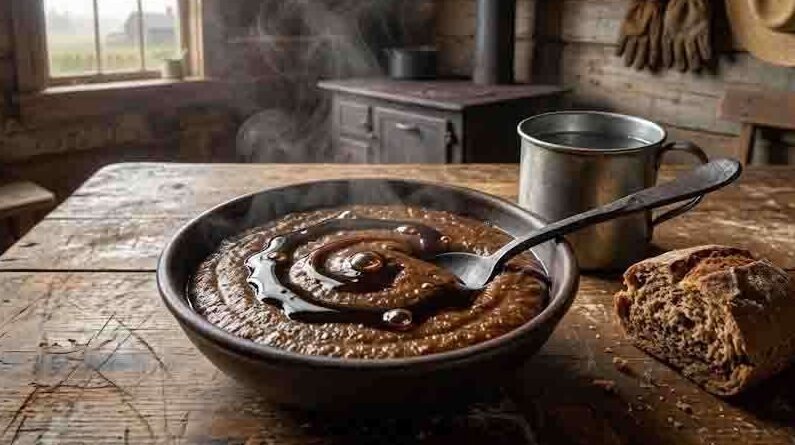
Long before the North Fork became synonymous with Chardonnay and farm-to-table weekend brunches, the eastern reaches of Long Island were fueling a very different kind of morning ritual. Before the sun crested over Peconic Bay, before the mist lifted off the potato fields and the cauliflower rows that would make Suffolk County one of the most productive agricultural regions in the northeast, a man rose in the dark, pulled on his work clothes, and ate his breakfast from a bowl. That breakfast — thick, bitter, calorie-dense, and made from two of the cheapest ingredients on the continent — was cornmeal mush drizzled with blackstrap molasses. It was unglamorous and deeply functional, and it powered the hands that built the East End as we know it today.
Understanding this dish means understanding the specific geography of hunger that shaped 19th-century American agricultural labor — and the unlikely nutritional wisdom buried inside what was, by any estimation, a poor man’s meal.
The East End at Work: Suffolk County’s Agricultural Century
The completion of the Long Island Rail Road connected the East End to New York City, turning Suffolk County into a breadbasket for urban residents. Farmers began specializing, with Suffolk leading in vegetables and livestock. By the mid-1800s, the North Fork and surrounding regions were operating at full agricultural intensity — cordwood, wheat, then potatoes and cauliflower rolling out by the railcar to feed a swelling city.
Farm laborers of the era received only about $12.00 a month and board — but a thrifty, hardworking farm laborer could hope to buy his own farm from his earnings. That board — the meals provided alongside the meager wage — was not a luxury arrangement. It was subsistence provisioning designed around one objective: get the man back into the field tomorrow. Cornmeal mush with blackstrap molasses was one of the central fixtures of that daily provisioning.
The land these farmhands worked had deep agricultural roots. The farming tradition of the North Fork predates the early European settlers who purchased land in the summer of 1640. Before them, the Native Americans of the region grew corn and domesticated crops indigenous to the Americas. Corn was never simply a cash crop on Long Island — it was the substrate of survival, woven into the soil and the diet of every class of people who ever worked this land.
The Architecture of the Bowl: What Cornmeal Mush Actually Is
Cornmeal mush is exactly what it sounds like: ground dried corn simmered in water or milk until it thickens into a dense, porridge-like mass. Its aliases across American history are numerous — hasty pudding in New England, suppawn among the Dutch settlers of New York, polenta in the Italian immigrant communities that would eventually arrive on Long Island’s East End in the late 1800s.
In frontier outposts and on farms, families gulped down a bowl of porridge that had been cooking slowly all night over the embers. By the nineteenth century, the usual farmhand breakfast consisted of cornmeal mush with molasses. The overnight cooking method was not incidental — it was strategic. A farmhand’s morning had no margin for elaborate preparation. The pot was set before bed, the embers banked low, and by four or five in the morning there was something hot and ready to eat before the animals were fed.
The pudding took hours to cook, begun the night before and left in a covered kettle to simmer slowly. It had to be stirred often, and the stirrers were called “porridge paddles.” Those paddles — thick wooden implements worn smooth by repetition — were as much a fixture of the 19th-century farm kitchen as the iron stove itself.
The grain itself carried its own history of adaptation. Corn became a dietary staple across the colonial region — wheat, the grain primarily used in English bread, was difficult to grow in the northeast and expensive to import, making cornmeal the practical substitute for a majority of the working population. On Long Island’s sandy, well-drained soils, corn thrived where wheat struggled. The East End farmhand was eating locally by necessity, centuries before it was a philosophy.
Blackstrap Molasses: The Bittersweet Engine
The molasses that ran over the top of that bowl was not the mild, pleasant syrup most people know from baking. Blackstrap molasses is the product of the third and final boiling of sugarcane juice, the thick, dark remnant left after most of the sugar has been extracted. Its bitterness is much greater than regular molasses, and it is sometimes used in baking, to produce ethanol, as an ingredient in cattle feed, or in yeast production. That it was also a staple of the working poor says everything about the economics of 19th-century sweeteners.
Blackstrap molasses has been imported from the Caribbean Islands since the time of the first settlers. Because it was much more affordable than refined sugar, it was the most popular sweetener in America until the late 19th century. In fact, it was so popular that the British crown passed the Molasses Act of 1733 to discourage colonists from trading with the West Indies. That legislation contributed to a chain of colonial grievances that would eventually feed the American Revolution — making blackstrap molasses, in some small and bitter way, a catalyst for American independence.
For the Long Island farmhand, molasses arrived by trade from the Caribbean and was cheaply available at general stores and farm commissaries throughout Suffolk County. It required no refrigeration, kept indefinitely, and cut the chalky monotony of plain cornmeal with a dark, complex sweetness that carried hints of smoke and iron.
What those farmhands couldn’t have articulated in nutritional terms, but what their bodies understood intuitively, was that blackstrap was doing something important beyond flavor.
The Accidental Nutritional Science of a Peasant Breakfast
Modern nutritional analysis has revealed what the 19th-century farmhand discovered through brute daily necessity: the combination of cornmeal and blackstrap molasses is, by accident, a surprisingly functional meal for people engaged in hard physical labor.
Unlike highly refined sugars, molasses contains significant amounts of vitamin B6 and minerals, including calcium, magnesium, iron, and manganese — one tablespoon provides up to 20% of the recommended daily value of each of those nutrients. Blackstrap is also a good source of potassium. For men swinging tools through Suffolk County fields from dawn to dusk, magnesium supported muscle function, potassium prevented cramping, and iron kept the blood oxygen-carrying capacity needed for sustained physical exertion.
One tablespoon of blackstrap molasses contains 20% of the iron a person needs each day. Iron deficiency, if left untreated, leads to extreme fatigue, weakness, and shortness of breath — conditions that were quietly common in working-class populations of the era whose diets otherwise centered on salted pork and bread. The iron in that morning bowl was not a luxury supplement; it was the difference between a functional workday and one spent in fog.
Cornmeal, meanwhile, delivered the caloric density that sustained hours of labor. Ground from dried field corn, it provided complex carbohydrates that digested slowly, providing steady energy rather than the sharp spike-and-crash of refined sugars. The germ of the corn kernel — present in stone-ground varieties that would have been standard in 1800s rural Long Island — also contributed B vitamins, including niacin. Pellagra, the niacin-deficiency disease that devastated southern populations eating processed cornmeal, was far less prevalent in communities still using traditional stone-ground meal.
The breakfast was not designed by anyone. No chef assembled it. No physician prescribed it. It arrived at the 19th-century farm table through the convergence of poverty, agricultural availability, and the slow empirical wisdom of communities that learned — over generations — what kept people alive and working.
The Triangular Shadow Behind the Bowl
No discussion of blackstrap molasses can be complete without acknowledging the system that made it so cheap and abundant. From the 1600s to the early 1800s, traders sold African slaves to Caribbean sugar plantations in exchange for barrels of molasses. Ships then carried the molasses to New England, where it was turned into rum. The traders carried that rum to West Africa, where they used the liquor to barter for more slaves.
The affordability of blackstrap molasses — the very quality that made it the standard sweetener for every working-class table in colonial and 19th-century America — was not the product of efficient markets alone. It was the product of enslaved labor on Caribbean sugar plantations. Every bowl of mush sweetened with molasses on a Long Island farm in the 1840s or 1860s was, however distantly, connected to that history. The farmhand eating his breakfast before dawn was separated from that system by geography and time, but not by the supply chain that filled the barrel at the general store.
Food history that ignores this dimension is incomplete. Acknowledging it doesn’t diminish the authenticity of the dish or the hardship of the people who ate it — it deepens our understanding of how American agricultural labor, at every level, existed within an interconnected web of exploitation that ran from the Caribbean to the North Shore.
Revival and Relevance: What This Dish Means Now
There is a quiet revival of interest in heritage grains and traditional preparation methods happening across the East End and the broader American food landscape. Stone-ground cornmeal from small-batch mills has returned to farmer’s markets and specialty food stores. Blackstrap molasses, long dismissed as a relic or a folk remedy, has been rediscovered by the natural food community for exactly the mineral density that made it valuable in the first place.
The farmhand’s breakfast — made from two ingredients that cost almost nothing and required only patience and an overnight fire — holds its own against the wellness industry’s more expensive interventions. A bowl of properly cooked stone-ground cornmeal mush, finished with a tablespoon of unsulfured blackstrap molasses and a small knob of good butter, delivers iron, magnesium, potassium, B vitamins, and sustained caloric energy in a form the body understands.
Those who farm on Long Island today are largely descended from those who have farmed there since the 17th century. Much of what we know about life on these early farms comes from family traditions and from journals and diaries kept by women. Those journals record what was eaten because food was inseparable from survival — there was nothing casual or recreational about feeding a family or a crew of farmhands. The women who set those pots on the fire before midnight, who stirred them in the dark, who ladled them out before sunrise, were practicing a form of nutritional engineering without the vocabulary to call it that.
The East End has changed immeasurably since the era of the $12-a-month farmhand. Where fields of cordwood and cauliflower once stretched east toward the Peconic, vineyards and weekend estates now occupy the landscape. The Long Island Rail Road that connected Suffolk’s breadbasket to New York City now carries a very different class of passenger. But the soil is the same soil. The morning light breaks over the same bay. And the simplest, most enduring truth of this landscape — that the land feeds people, and that feeding people well requires nothing more than understanding what the ground can give — remains unchanged.
A bowl of cornmeal mush with blackstrap molasses is not a nostalgic curiosity. It is a document. It tells you who worked this land, what they needed to survive, and what intelligence exists in a tradition that predates nutritional science by two hundred years.
The next time you pass a farm stand on Route 25A or spot a field of cover crops between the vineyards on the North Fork, consider what was growing there before the tasting rooms arrived. Consider who ate breakfast in the dark before working that ground. And consider whether the simplest meals — the ones built from necessity rather than preference — might still have something to teach us.
Sources
- Food Timeline, Colonial America History Notes: foodtimeline.org
- OUPblog, “You Are What You Eat: The All-American Breakfast” (2006): blog.oup.com
- Wikipedia, “Molasses”: en.wikipedia.org/wiki/Molasses
- WebMD, “Health Benefits of Blackstrap Molasses”: webmd.com
- Dr. Axe, “Blackstrap Molasses Benefits, Nutrition, Recipes”: draxe.com
- Coastal Review, “Molasses: A Bittersweet Part of NC History” (2022): coastalreview.org
- LI Seek, “Exploring Long Island NY Farms – History, Agritourism”: liseek.com
- Long Island Genealogy, “Reflections on Suffolk County Pre-History”: longislandgenealogy.com
- Forest Hills Tuv Ha’Aretz CSA, “From Ducks and Potatoes to Wine and CSAs”: foresthillstuvcsa.com
- AgroCouncil, “Agricultural and Maritime History of Eastern Long Island”: agrocouncil.org
- Colonial American Life Blog, “Early American Food and Drink”: colonial-american-life.blogspot.com
- Afroculinaria, “A Few Antebellum African American Recipes”: afroculinaria.com