France gave the world the Croque Monsieur somewhere around 1910 — ham, Gruyère, clarified butter, a special grilling iron, and a Parisian café that understood simplicity was its own form of sophistication. A century later, America took that idea, added turkey, switched the pan for a deep fryer, and dusted the whole thing with powdered sugar. The result was one of the most gloriously contradictory sandwiches ever put on a diner menu: the Monte Cristo.
It shouldn’t work. Powdered sugar on turkey and ham sounds like a culinary misfire. But the Monte Cristo doesn’t just work — it demands your full attention from the first bite. Crisp, golden batter on the outside. Molten Swiss cheese pulling apart in long strings. Savory meat tempered by the sweetness of the dusting and a ramekin of raspberry jam on the side. This is what happens when American ingenuity gets comfortable in a kitchen and stops apologizing for wanting more.
Where the Monte Cristo Came From
The first documented reference to a “Monte Cristo Sandwich” appeared in an American restaurant industry publication in 1923. A year later, the Los Angeles Times published the earliest known recipe: bread, cream cheese, ham, dipped in beaten egg, fried in hot butter. Simple enough, but the foundation was laid.
Throughout the 1930s to 1960s, American cookbooks played with variations under names like “French sandwich” and “toasted ham sandwich” — all croque monsieur cousins looking for an identity. The sandwich found one when the Blue Bayou Restaurant at Disneyland began serving its deep-fried version in 1966. Disneyland’s Monte Cristo — turkey, ham, Swiss cheese, battered and fried, dusted with powdered sugar, served with berry preserves — turned a regional curiosity into a national icon. Diners across the country eventually followed.
The genius of the American adaptation wasn’t just the deep fryer. It was the turkey. Adding a second protein transformed the sandwich from a snack into a meal. Combined with the egg batter instead of a simple pan-fry, the texture shifted entirely — crunch on the outside, custard warmth on the inside — something the French original never attempted.
The Architecture of the Sandwich
A proper Monte Cristo is a triple-decker. Three slices of bread, two layers of filling: Swiss cheese anchors both levels, with ham on one and turkey on the other. Some versions use Dijon mustard spread on the inner bread slices; others go with a thin layer of mayonnaise. Both serve the same structural purpose — moisture barrier, flavor amplifier.
The bread matters more than most people think. White sandwich bread is traditional, but sourdough and challah have become respected alternatives. Challah brings a slight sweetness that works naturally with the powdered sugar finish. Sourdough adds a tang that cuts through the richness of the fried batter. At Heritage, where our slow-fermented sourdough loaves go into nearly everything worth eating, the question isn’t whether to use sourdough — it’s how to honor the sandwich’s structure while doing it.
Before the batter, compress the sandwich. Wrap it, weight it for five minutes. This keeps the layers together when the sandwich hits hot oil and prevents the whole thing from disintegrating mid-fry.
The Batter: Where It All Happens
The batter is the difference between a Monte Cristo and a fried sandwich. Pancake batter is the classic choice, and it works because it creates a thick, pillowy shell that crisps under heat while staying light enough not to overwhelm the filling. Some cooks thin the batter with milk or club soda for a lighter exterior. Others use beer batter for depth of flavor — a small amount of hops bitterness plays surprisingly well against the sweetness of the powdered sugar finish.
The egg custard method — beaten eggs with half-and-half — is closer to French toast territory and produces a thinner, more delicate crust. Both are legitimate. The deep-fried pancake-batter version is the one that made Disneyland famous. The pan-fried custard version is what you’d find in the original Brown Derby cookbook from 1949.
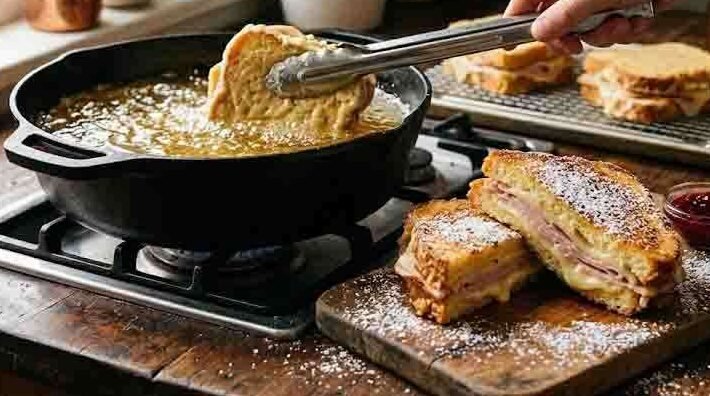
Oil temperature is everything. Too low and the batter absorbs grease before it can set. Too high and the exterior burns before the cheese melts inside. The target is 350°F — hot enough that the batter seizes immediately on contact, forming that protective shell while the interior has time to reach temperature. Two to three minutes per side in a deep fryer. Watch the color, not the clock.
The Sweet-Savory Equation
What separates the Monte Cristo from every other fried sandwich is the finish. Powdered sugar, applied while the sandwich is still hot, melts slightly into the crust and creates a barely-there sweetness that resets the palate between bites. The jam — traditionally raspberry or strawberry preserves — goes on the side. You dip, or you don’t. Most people dip.
This sweet-savory balance is older than the sandwich itself. Think of salt and honey on fresh bread, or the way candied pecans sit on a salad with blue cheese. The tongue registers sweet and savory simultaneously and responds with something that reads as “more.” The Monte Cristo understood this instinctively, which is probably why it survived a century of food trends, health movements, and menu rotations.
The pairing logic extends to drinks. A sparkling wine or champagne cuts through the richness cleanly. A dry lager does the same work in a more casual register. For brunch, a French 75 is almost too appropriate — it shares the same cultural lineage.
The Heritage Version
At The Heritage Diner, we’ve made versions of the Monte Cristo over the years that follow the classic blueprint: turkey breast, ham, Swiss cheese, triple-decker, battered and fried. The sourdough goes in when we want something with more character — the slow fermentation gives the bread structural integrity that holds up to the batter without becoming dense.
The powdered sugar stays. The jam stays. Some things don’t need improvement. What changes is the sourcing: real roasted turkey, not deli-processed. Ham with actual texture. Swiss that melts properly instead of turning rubbery. The batter is seasoned — a pinch of salt, a whisper of nutmeg, sometimes a small pour of sparkling water for lift.
The result is a sandwich that respects its history while being cooked by people who care about the details. A Monte Cristo made carelessly is just a fried sandwich. Made with attention, it becomes the thing it was always supposed to be: comfort food with a point of view.
Making It at Home
The Monte Cristo rewards patience at every stage. Build the sandwich, compress it, chill it briefly. Mix your batter — pancake mix thinned slightly with milk or sparkling water, seasoned with salt. Heat your oil to 350°F, using a thermometer. Dip the sandwich, let the excess batter drip off, and lower it gently into the oil. Fry until deeply golden, two to three minutes per side if deep-frying, slightly longer if pan-frying in butter.
Drain on a wire rack — not paper towels, which trap steam and soften the crust. Dust immediately with powdered sugar while hot. Serve with raspberry jam on the side. Cut diagonally, because the cross-section matters and you’ve earned the visual.
It’s not a weeknight sandwich. It’s a weekend project, a Sunday brunch centerpiece, a dish you make when you want to feed people something they’ll remember. The Monte Cristo has survived a hundred years for exactly that reason.
Sometimes the best dishes are the ones that shouldn’t make sense. The Monte Cristo borrowed from the French, ran it through an American kitchen, and landed somewhere entirely its own — a deep-fried thing dusted with sugar that manages to taste like exactly what you needed. That’s not an accident. That’s a century of cooks understanding that the right combination of textures, temperatures, and contrasting flavors creates something bigger than its ingredients. It’s a lesson the Monte Cristo has been teaching since 1923, one golden, powdered bite at a time.