Cold water brings out the best in certain things. The bridle leather that comes out of English tanneries reaches its peak suppleness in winter. A cast-iron skillet, properly seasoned, only improves with temperature. And the Peconic Bay scallop — Argopecten irradians irradians, to give it its full scientific name — is harvested between the first Monday in November and March 31st, in waters cold enough that baymen returning to North Fork docks do so with red hands and earned money.
These are not supermarket scallops. They are not the bleached, sodium tripolyphosphate-treated discs sitting in milky puddles at the fish counter of a chain grocery. Peconic Bay scallops are pulled from the estuary waters between Long Island’s North and South Forks — the same Great and Little Peconic Bays that Native American communities, including the Shinnecock Indian Nation, were harvesting as far back as 1,000 to 1,500 years ago. Archaeological evidence from Robins Island, Shelter Island, and Orient confirms what any Long Islander who has tasted them already knows: there is no substitute. Beginning in the 1870s, the Peconic Bay scallop fishery became a genuine economic engine for coastal communities along the East End, commanding prices that today reach $25 to $30 per pound for fresh-shucked meat — when you can get them at all.
The fishery has not had an easy century. A series of devastating brown tide algal blooms that began in 1985 collapsed populations from an annual average harvest of 300,000 lbs to a catastrophic 53 lbs by 1996. Restoration efforts led by Long Island University and Cornell Cooperative Extension, beginning in earnest in 2006, helped bring the population back — by 2014 and 2015, annual landings reached 88,500 and 60,000 lbs respectively. But a parasite first documented in 2019, compounded by rising water temperatures, triggered yet another collapse. The U.S. National Oceanic and Atmospheric Administration declared the Long Island scallop fishery a federal fishery disaster in 2021. The 2025 season opened, per the Suffolk Times, with Charlie Manwaring of Southold Fish Market describing the harvest plainly: “The season sucks. Period.”
Which is precisely why, when you find them — when someone at Braun Seafood Company in Cutchogue or Southold Fish Market has them in the case — you treat them with the respect they’ve earned. You do not bread them. You do not drown them in cream sauce. You pan-sear them, properly, and let the thing speak for itself.
What Makes the Peconic Bay Scallop Different
Understanding what you’re cooking is not a luxury — it is the foundation of cooking it correctly.
The Peconic Bay scallop is a northern subspecies of the Atlantic bay scallop, and it is meaningfully different from the large, rubbery sea scallops that show up on most restaurant menus. Bay scallops run roughly 40 to 80 pieces to a pound — small, sweet, and delicate. Where a sea scallop can tolerate a slightly extended sear, a bay scallop punishes imprecision with a rubbery, mealy texture. They cook in under three minutes total. The margin for error is narrow.
The sweetness that Peconic Bay scallops are famous for is not a marketing construct. It reflects the chemistry of the cold, clean estuary water of the Peconic, which is part of the Peconic Estuary Reserve — one of the most biologically significant estuaries in the Northeast. The scallop’s flavor is also partly a function of what it feeds on in those eelgrass beds: microscopic phytoplankton filtered from the water column. A scallop from a treated, chemical-soaked water supply tastes different because it is different, at a molecular level.
Haskell’s Seafood, one of the specialty retailers that carries Peconic Bay scallops during season, describes them accurately as having a “naturally savory-sweet” quality with a “lush texture unique to their smaller size.” That texture — firm at the exterior crust, yielding and almost translucent at the center — is the goal. Getting there requires understanding a few non-negotiable principles.
The First Rule: Dry Is Not Optional
Moisture is the enemy of the sear. This cannot be overstated.
When a scallop hits a hot pan carrying surface moisture, the water steams before the Maillard reaction — the chemical process responsible for the golden-brown crust — can occur. The result is a gray, boiled-looking scallop with no crust, no caramelization, and no structural contrast between exterior and interior. The scallop essentially poaches itself in its own expelled water.
Peconic Bay scallops, because they are wild-caught, hand-shucked, and untreated with STP, will generally be drier than their commercial counterparts by default. But even these require proper preparation. Remove them from their packaging, spread them on a paper-towel-lined plate, layer another paper towel on top, press gently, and refrigerate uncovered for at least 30 minutes. Longer is better. You want the surface of each scallop to feel almost tacky — that is the texture of a scallop ready to sear.
If you have acquired “wet” scallops — chemically treated to absorb water — the kitchen scientists at America’s Test Kitchen recommend soaking them in a mixture of one quart cold water, one-quarter cup lemon juice, and two tablespoons of salt for 30 minutes before the drying process. The lemon-salt solution draws excess moisture back out. Pat dry thoroughly after.
The Pan and the Fat: Choosing Your Heat Vessel
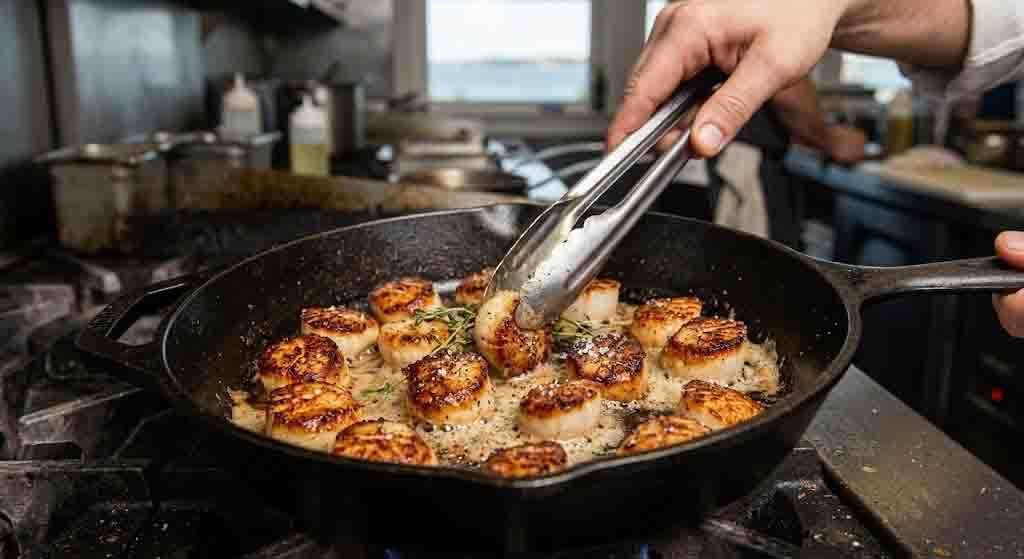
A heavy stainless steel or cast-iron pan is the correct instrument here. Not non-stick. Non-stick pans, by design, are built to prevent the very surface chemistry you are trying to achieve — they will not reach the temperatures necessary for proper caramelization, and the scallops will cook rather than sear.
Cast iron holds and distributes heat with the kind of consistency that is forgiving of minor variations in burner output. Stainless steel responds faster to temperature adjustments, which matters when you are cooking something as time-sensitive as a bay scallop. Either is correct; both require the same preparation: preheat the pan over medium-high heat until it is genuinely hot before anything touches it.
For fat, the standard approach is a combination of a high-smoke-point oil — avocado, grapeseed, or canola — and unsalted butter. Start with the oil alone, since butter burns at the temperatures required to initiate the sear. Add the oil, let it shimmer, and when the first scallop placed in the pan sizzles immediately on contact, the pan is ready. Butter comes later, introduced after the flip, used to baste and finish rather than to cook from the start. The butter browns during this phase — achieving what the French call beurre noisette, a hazelnut-colored foam with a rich, nutty sweetness — and this becomes, effectively, your sauce.
Do not crowd the pan. Bay scallops, given their small size, make overcrowding tempting. Resist. Scallops in contact with each other will steam rather than sear. Cook in batches if necessary, keeping the first batch warm in a low oven.
The Sear: Timing, Discipline, and Restraint
Season the scallops with kosher salt and freshly cracked black pepper immediately before they go into the pan — not ahead of time, as salt draws moisture.
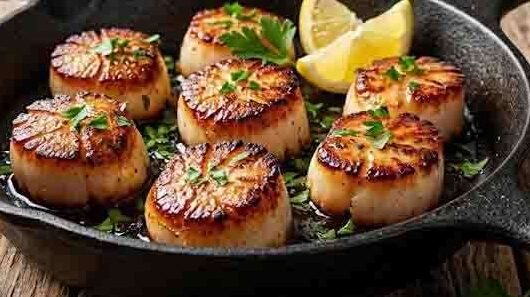
Place each scallop flat-side down with deliberate spacing. Then do nothing. This is the part that most home cooks fail. The instinct is to check, to nudge, to peek beneath. Suppress it entirely. A properly hot pan with dry scallops will release the scallop cleanly when the crust has formed — attempting to flip before that moment will tear the surface and eliminate the crust you are trying to build. The scallop tells you when it’s ready to turn.
For bay scallops specifically, the first side takes approximately 90 seconds to two minutes over high heat. You will see the bottom third of the scallop turn opaque white — that is your visual cue to flip. The second side needs only 60 to 90 seconds. The goal is a scallop that is golden on both faces and just barely translucent at the very center — it will continue cooking from residual heat after it leaves the pan. An internal temperature of around 115°F at removal will carry over to the ideal 120 to 125°F at service. Overcooking produces a rubbery result; the scallop’s adductor muscle contracts aggressively with extended heat.
Remove the scallops to a warm plate. In the same pan, reduce heat slightly, add a tablespoon of unsalted butter, let it foam and begin to brown, then add a squeeze of fresh lemon juice and — if you want an additional aromatic layer — a minced shallot or fresh thyme. Scrape the browned bits from the pan into the sauce. This is your pan sauce, built in 90 seconds from what the scallops left behind.
Plating: The Architecture of Restraint
The Peconic Bay scallop is not a vehicle for other ingredients. It is the ingredient.
Plating should reflect that. A bed of lightly dressed arugula with lemon vinaigrette provides bitterness that cuts the sweetness of the scallop. A smear of white bean purée, or creamy polenta made with good stock, provides the starchy foundation the richness of the butter sauce requires. A few leaves of flat-leaf parsley scattered over the plate for color.
What does not belong: heavy cream sauces, aggressive spices, char, or anything that asks the scallop to disappear into a larger composition. The Peconic Bay scallop costs $25 to $30 a pound, is available for roughly five months a year under optimal conditions, and in recent seasons has been genuinely scarce. Its role on the plate is primary, not supporting.
A dry white wine — Sauvignon Blanc, Chablis, or a North Fork Chardonnay — alongside the plate is not a recommendation but a near-obligation. The acidity does the same work as the lemon juice in the pan sauce: it lifts, it brightens, and it clears the palate between bites.
Where to Source Them and When to Move
The Peconic Bay scallop season opens the first Monday of November and runs through March 31. By the new year, availability at markets west of Riverhead begins to thin considerably, and by late January, even the reliable North Fork purveyors may have gaps between deliveries.
Braun Seafood Company in Cutchogue and Southold Fish Market on the North Fork are the two most consistently cited sources among local baymen and chefs. If you are further west and cannot make the trip, South Bay Seafood offers individually blast-frozen Peconic Bay scallops shipped directly — a reasonable option given that the scallops are hand-shucked and frozen individually rather than in a mass block, preserving texture.
Ask your fishmonger directly: are these Peconic Bay scallops, or bay scallops from Maine or the Carolinas? The price differential tells you immediately — Peconic Bay scallops at market will be significantly more expensive. If the price seems too low, it is.
A Living Ingredient in a Fragile Ecosystem
Cooking any ingredient responsibly begins with understanding where it comes from and what it costs the natural world to produce it.
The Peconic Bay scallop’s biology is extraordinary. It is a functional hermaphrodite — capable of releasing both eggs and sperm during a single spawning event — with a lifespan of only two years. It spawns between late May and early June, larvae spending roughly two weeks free-swimming before settling into eelgrass beds. Restoration scientists from Stony Brook University, Cornell Cooperative Extension, and Long Island University have spent years seeding millions of hatchery-raised larvae into the Peconic Estuary to support the wild population.
The parasite microsporidia, compounded by warming water temperatures attributed to climate change, continues to challenge recovery efforts. As New York State Assemblyman Fred Thiele stated in 2022 regarding the ongoing collapse: “On eastern Long Island, our environment is our economy.”
Buying Peconic Bay scallops from North Fork baymen and fishmongers is not merely a culinary decision — it is an act of economic support for a coastal community and a commercial fishery that is fighting, season by season, to survive.
The scallop in your pan carries that weight. Cook it accordingly.
Sources: Wikipedia — Peconic Bay Scallops | Peconic Estuary Partnership — Restoring the Peconic Bay Scallop | The Gotham Center for NYC History — The Jewel of Eastern Long Island | The Suffolk Times — 2025 Scallop Season | North Forker — Peconic Bay Scallop Season | Culinary Hill — Pan-Seared Scallops Technique | Well Seasoned Studio — Pan Sear Guide | Northforker — Bistro 72 Peconic Bay Scallop Recipe