Making real New York pastrami is a nine-day process, and every single day earns its place. Brine the brisket, rub it down with black pepper and coriander, smoke it low and slow, then steam it until the meat practically falls apart. That’s the whole game. Get that right, pile it on rye with melted Swiss and a swipe of brown mustard, and you’ve got one of the greatest sandwiches ever put together. Skip a step or rush the clock and you’ve got roast beef.
Here’s what actually happens and why it works.
Where Pastrami Came From
Pastrami didn’t start in New York — it started much further east. The technique goes back to Ottoman horsemen who preserved meat by packing it in their saddlebags with salt and spice. The method worked its way through Turkey and into Romania, where Jewish communities used it on goose meat because that’s what they had. When Romanian Jews started arriving in New York in the late 1800s, goose was hard to find and expensive. Beef navel was cheap and everywhere, so they made the switch and never looked back.
Who made the first American pastrami sandwich is still a fight. Sussman Volk — a Lithuanian immigrant butcher on Delancey Street — claimed he got a pastrami recipe from a Romanian friend around 1887 and started selling sandwiches out of his shop. Katz’s Delicatessen, open on the Lower East Side since 1888, says that story is theirs. Either way, the same few blocks of Manhattan gave us one of the most iconic sandwiches in the world. (Wikipedia — Pastrami on Rye; The Forward, 2022)
The Brine
This is where pastrami becomes pastrami and not just smoked brisket.
You submerge the meat in a seasoned brine — water, kosher salt, sugar, pickling spice, garlic, pepper, coriander — for five to seven days minimum. Katz’s brines their beef for three full weeks. The brine pulls into the meat and changes it at a deep level: flavor, texture, and that pink color you see when you slice a good pastrami.
The pink doesn’t come from the smoke. It comes from Prague Powder #1 — a pink curing salt that’s 6.25% sodium nitrite mixed with regular salt. The sodium nitrite reacts with the proteins in the beef and locks in both the color and the cured flavor. It also keeps the meat safe at low smoking temperatures. You can’t get that flavor from salt alone, and you can’t fake the pink. (AmazingRibs.com; Tasting Table)
One thing people get wrong: don’t trim all the fat off before you brine. Leave about 1/8 inch on the cap. That fat keeps the brisket from drying out during the smoke, and the curing salt needs it to be thin enough to actually penetrate into the meat. Leave more than that and the center may not cure properly at all.
The Rub and the Smoke
After the brine, you rinse the brisket and soak it in fresh cold water for a few hours to take back some of the salt. Then you coat it in the rub: cracked black pepper and cracked coriander, roughly equal parts. That’s the core of it. You can add garlic powder, paprika, a little brown sugar. Press it in hard and let the brisket sit in the fridge overnight uncovered before it goes on the smoker.
The smoker runs at 225°F to 250°F. Cherry or oak wood work well — nothing too heavy. You’re looking for 4 to 6 hours until the internal temperature hits around 165°F. Around that temperature, the meat will stall — the thermometer stops climbing and just sits there. This throws a lot of first-timers off. It’s normal. What’s happening is that the tough connective tissue inside the brisket is starting to break down, and that process takes energy. The meat essentially cools itself through evaporation while the collagen converts. Wait it out. (Science of Cooking; Napoleon Grills)
Why 205°F Is the Number
Brisket is a hard-working muscle. It holds up a big portion of the animal’s weight, so it’s full of connective tissue — specifically collagen. Raw collagen is tough and chewy. But cook it long enough at the right temperature and it turns into gelatin, which is what makes a great pastrami slice so tender it practically melts.
That conversion starts around 160°F, but it takes time. You can’t rush it with high heat — the water in the meat will escape before the collagen has a chance to fully break down. The goal is to hold the brisket in the 160°F–205°F range long enough for that conversion to finish all the way through. 205°F is the sweet spot. Past that and you start losing too much moisture. Pull it at 185°F and it’ll slice fine but it won’t have that jiggle — that soft, silky give that separates good pastrami from great pastrami. (Napoleon Grills; BBQHost.com)
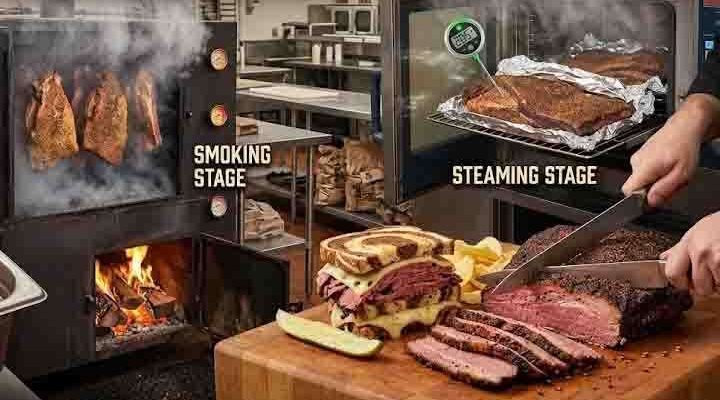
For pastrami specifically, you pull the brisket off the smoker at 165°F and finish it in steam. Put it on a rack in a pan with about an inch of water, seal it tight with foil, and put it in a 275°F oven until you hit 200°F–205°F internally — another two to three hours. The steam keeps the bark from drying out and speeds up the final collagen breakdown without killing the moisture. This is the difference between pastrami and a Texas brisket: the steam is not optional.
At Katz’s, the pastrami goes through: three weeks in brine, three days in the smoker, three hours boiling, and then it sits in a steam table at the counter until it’s carved to order. The meat is so tender it nearly jiggles when you touch it. That’s the standard. (Katz’s Delicatessen — katzsdelicatessen.com)
Building the Sandwich
Pastrami. Swiss. Brown mustard. Rye bread. Pickle on the side.
The smoked-and-steamed brisket stacked hot and thick against the mild, slightly nutty melt of Swiss cheese — that combination works because the richness of the meat needs something to anchor it. The mustard cuts through the fat. The rye holds everything together without getting soggy. The pickle resets your palate between bites.
Pastrami with Swiss is technically non-kosher — you’re mixing meat and dairy — which is why it lives in kosher-style delis rather than strictly kosher ones. Katz’s is kosher-style, which is how the pastrami Swiss ends up on the menu alongside the Reuben.
Don’t overlook the bread. A good deli rye with a tight crumb and caraway seeds isn’t just a vehicle — it’s structural. The bread needs to handle the steam and juice from the hot pastrami without falling apart. A soft sandwich loaf won’t cut it here.
The Home Timeline
Days 1–7: Brine a 4–6 lb brisket flat (fat cap trimmed to 1/8 inch) in a seasoned solution with Prague Powder #1, kosher salt, brown sugar, pickling spice, garlic, and cracked pepper. Flip it daily. Keep it in the fridge the whole time.
Day 8: Rinse, soak in fresh cold water 2–3 hours, pat dry. Apply the rub — black pepper, cracked coriander, garlic powder — and put it back in the fridge uncovered overnight.
Day 9: Smoke at 225°F–250°F to 160°F–165°F internal, about 5–7 hours. Cherry or oak wood.
Day 9, continued: Move to a rack in a covered pan with an inch of water, seal with foil, finish in a 275°F oven to 200°F–205°F internal. Rest 30 minutes. Slice against the grain.
Pile it on good rye with mustard, melt Swiss over the top, and put a half-sour pickle on the side. Nine days of work. Four minutes to eat it. Worth every hour.
The pastrami Swiss on rye has been sitting on deli counters in New York for well over a hundred years. No reinvention. No seasonal menu. Just brisket, brine, smoke, steam, and time. That kind of staying power doesn’t happen by accident — it happens because the process is correct and the result delivers every single time.
Sources: Katz’s Delicatessen; Wikipedia — Pastrami; Wikipedia — Pastrami on Rye; The Forward — Does Pastrami Come from New York or Texas? (2022); AmazingRibs.com — The Science of Curing Meats Safely; Napoleon Grills — The Science of BBQ: How Collagen Affects Tenderness; Tasting Table — What Is Prague Powder #1; Jess Pryles — How to Make Pastrami; Ted Merwin, Pastrami on Rye: An Overstuffed History of the Jewish Deli, NYU Press (2015)