
Leather does not lie. Given enough time, enough use, enough life — it tells the truth about where it has been, who carried it, and whether it was made to endure or made to impress. That quiet honesty is what makes the conversation between Marcellino NY and Berluti so fascinating. Both brands have staked their reputations on the beauty of aged leather. But they arrive at that beauty by very different roads — and the distance between those roads is the distance between fashion and philosophy.
Paris, 1895: The House That Painted Time
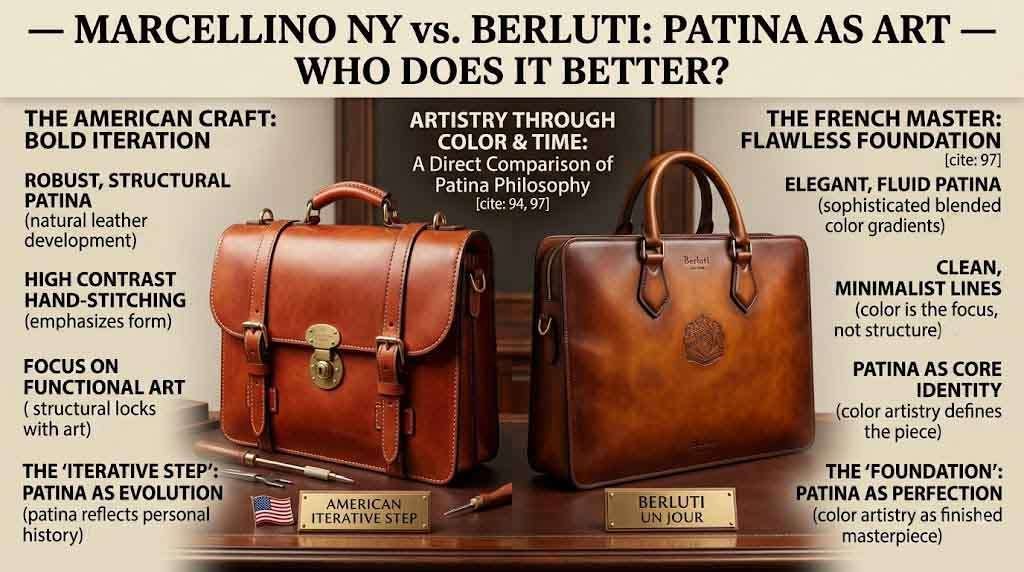
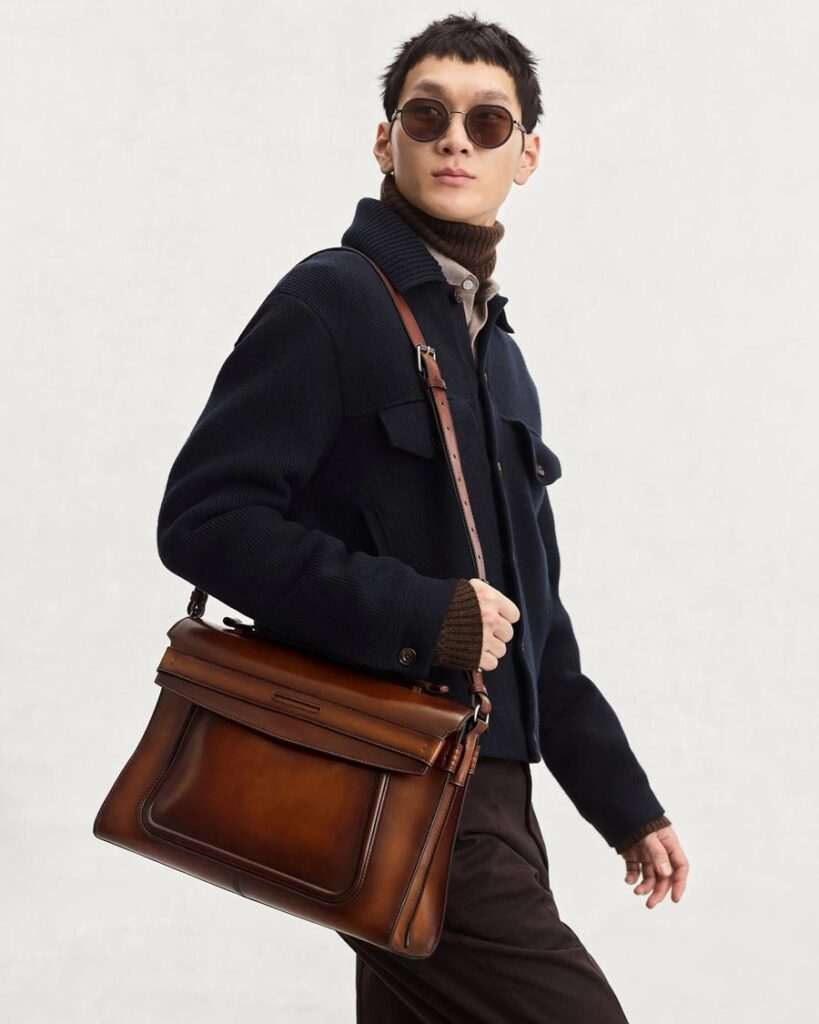
Alessandro Berluti arrived in Paris as a young cabinetmaker-turned-shoemaker from Italy, and from his first atelier on the Left Bank, he built a house that would become synonymous with one idea above all others: that leather is a canvas. His granddaughter Olga Berluti took that idea further than anyone could have imagined. In the 1980s, Olga invented the patine — a hand-applied layering of pigmented waxes, essential oils, and smoke treatments on Berluti’s proprietary Venezia calfskin — and with it, she gave wealthy men permission to wear color in an era when their wardrobes barely admitted brown.
The Venezia leather itself, perfected with an Italian tannery by 1993, undergoes a dual tanning process: first mineral salts bind the collagen fibers, then vegetable tanning from chestnut, quebracho, and black wattle barks brings suppleness and depth. The result is a full-grain, uncoated calfskin so absorbent and transparent it can hold color the way cathedral glass holds light. Berluti’s colourists — there are nearly sixty of them — work in a kind of controlled poetry. They begin with a smoke treatment to darken seams and contrast the edges, then build layer upon layer of pigmented wax with a cotton cloth, working in circular motions, building depth like a glazed oil painting. The names they give these patinas — Shanghai Night, Autumn Leaf, Saint-Emilion — tell you everything about the ambition. This is leather treated as fine art.
And the market agrees. A Berluti Deux Jours briefcase in patinated Venezia leather lists north of $3,800. The waitlist for bespoke shoes can stretch to a year or more. Jacques Lacan owned a pair. Yves Saint Laurent commissioned a blue-brown so specific that only Olga could reproduce it. The house currently operates roughly sixty boutiques worldwide and belongs to the LVMH empire. By every commercial measure, Berluti’s manufactured patina is an unqualified success.
But there is a question that success cannot answer: whose story is the leather telling?
English Bridle Leather and the Logic of Earned Beauty
English bridle leather was never meant to impress anyone on a runway. It was built for the field — for horse tack, saddles, and working bridles that had to hold under pressure, exposure, and daily punishment. Its tanning process is vegetable-based, using natural bark tannins, after which the hide is hot-stuffed — saturated with waxes, oils, and tallows driven deep into the fiber under heat — giving the leather a characteristic density, a matte sheen, and a near-imperviousness to the elements. It does not arrive soft. It does not arrive beautiful. It arrives stiff, almost reluctant, like a craftsman on his first day who hasn’t yet decided whether he trusts you.
That is entirely the point.
The patina that develops on English bridle leather over months and years of use is not applied. It is drawn out. Natural oils from the owner’s hands migrate into the surface. Sunlight pulls depth into the grain. Daily handling softens the structure while the wax content preserves the form. Scratches and scuffs, rather than signaling neglect, absorb into the surface and become part of a visual record — a timeline written in leather. No two pieces age identically, because no two lives are identical. The patina is not a colorist’s vision of who you should be. It is an honest record of who you actually are.
Marcellino NY: Bespoke Craft for the Long Game
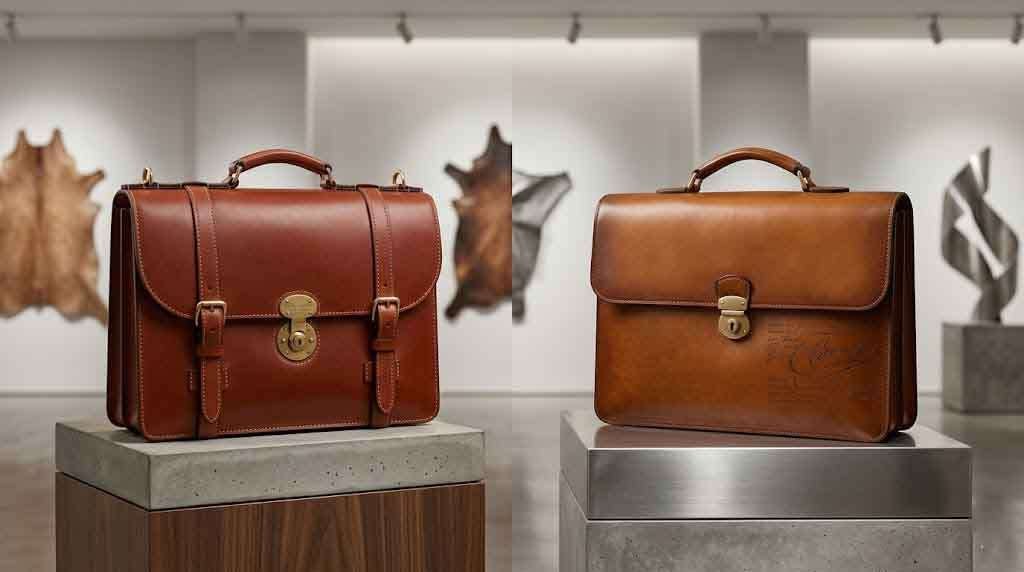
Marcellino NY builds its briefcases from English bridle leather for exactly this reason. The Wallace, the flagship piece, is constructed by hand — every stitch placed with intention, every edge burnished to a finish that will outlive the decade. The current lead time exceeds six months, not because of marketing scarcity, but because there is only one set of hands doing the work. Clients who commission a Marcellino briefcase — lawyers, physicians, architects, the occasional name you’d recognize — understand that they are not buying a finished object. They are beginning a relationship with a material that will change, slowly and faithfully, in response to their life.
At $3,000–$4,000 for the Wallace, the price point sits squarely alongside Berluti’s Deux Jours. The comparison is appropriate. But it inverts the logic entirely. Berluti gives you the conclusion first — a patina already interpreted, already beautiful, already aged — and asks you to inhabit it. Marcellino gives you the raw sentence and asks you to write the rest yourself.
The founder of Marcellino NY, Peter, has spoken about this distinction as more than aesthetic preference — it is a philosophical position. Having spent decades working with English bridle leather as a craftsman and as someone who spent years building a restaurant from nothing with his father, he understands that the things worth having are the things that require time. The Heritage Diner, now in its twenty-fifth year in Mount Sinai, has never operated on the logic of manufactured warmth. Regulars know that a room earned its character the same way good leather does — through accumulated moments, not art direction.
Manufactured Beauty vs. Metabolized Beauty
Here is the central distinction, stated plainly: Berluti’s patina is manufactured beauty. Marcellino’s patina is metabolized beauty.
Neither word is pejorative. Berluti’s process is genuinely extraordinary — the skill of their colourists is real, the Venezia leather is one of the finest substrates ever developed for leatherwork, and the results are objects of undeniable visual power. But the patina is, at its core, a simulation of age. It creates the appearance of a life lived without requiring the leather to actually live one. Talbinio Berluti first noticed the effect by watching moonlight fall on shoes in his shop window — beautiful, yes, but it was the light doing the aging, not the owner’s hands.
English bridle leather, hot-stuffed and patient, refuses to simulate. The white bloom of wax that surfaces in colder months is not art direction — it is chemistry. The darkening along the handle where a briefcase is gripped daily is not a colourist’s interpretation of wear — it is wear. Every mark, every softening, every shift in tone is a timestamp. Philosophers have a word for this kind of object: authentic. Not in the marketing sense. In the Heideggerian sense — a thing that reveals itself over time, that discloses its nature through use rather than presentation.
The r/BuyItForLife community and menswear traditionalists have always understood this intuitively, even without the vocabulary. There is a reason the most coveted aged briefcases on those forums are never the ones that arrived looking aged. They are the ones that got that way.
The Price of the Story
At comparable price points, the choice between a Berluti Deux Jours and a Marcellino Wallace is not a choice between quality and quality. Both are exceptional. It is a choice between two entirely different relationships with an object.
Berluti is asking: Do you want the most beautiful version of aged leather that our colourists can imagine for you?
Marcellino is asking: Do you want leather that will become the most accurate record of your own life that any material can produce?
The Berluti client is buying into a house — its history, its mythology, its sixty boutiques, its LVMH backing, its famous former clients. That is a legitimate and pleasurable thing to purchase. There is real artistry in what Berluti’s colourists do. But the house’s story is, ultimately, their story. The leather tells their idea of beauty.
The Marcellino client is buying a blank document. The leather, in year one, is stiff and unassuming. By year five, it has the depth and presence of something that has been somewhere. By year ten, it is irreplaceable — not because it is rare in the market sense, but because it is utterly singular in the personal sense. No one else on earth has a briefcase that looks exactly like yours, because no one else has lived exactly your life.

One Is Fashion. The Other Is Time Made Visible.
Berluti produces objects of exceptional beauty through the artistry of its craftspeople. That beauty peaks at purchase — or close to it — and the leather’s future aging will be, in some sense, a negotiation with what has already been done to it.
Marcellino produces objects that are, at purchase, barely begun. Their beauty is deferred, accumulated, earned. The leather asks something of you: carry it, use it, bring it through years of work and travel and whatever your life amounts to, and it will keep the record faithfully. There is no simulation involved. The patina you develop is a direct consequence of who you are and how you live.
At $3,800 for the Berluti Deux Jours, you are buying someone else’s extraordinary vision of aged leather.
At $3,000–$4,000 for the Marcellino Wallace, you are buying the capacity to produce your own.

Neither is wrong. But only one of them is telling your story.
Sources:
- Berluti, The Art of the Patina — berluti.com
- Berluti, The Science of Leather — berluti.com
- Savoir Flair, Built to Last: Berluti’s 130-Year Lesson in Permanence — savoirflair.com
- Esquire Singapore, Fast Forward: The Allure of the Berluti Patina — esquiresg.com
- Maxwell-Scott, What Is Leather Patina? The Art of Ageing Leather — maxwellscottbags.com
- Patina Project, Wickett & Craig English Bridle — patinaproject.com
- Filly & Fox, English Bridle Leather vs Regular Leather — fillyandfox.co.uk
- Tsuchiya Kaban, Cordovan or Bridle? — tsuchiya-kaban.com