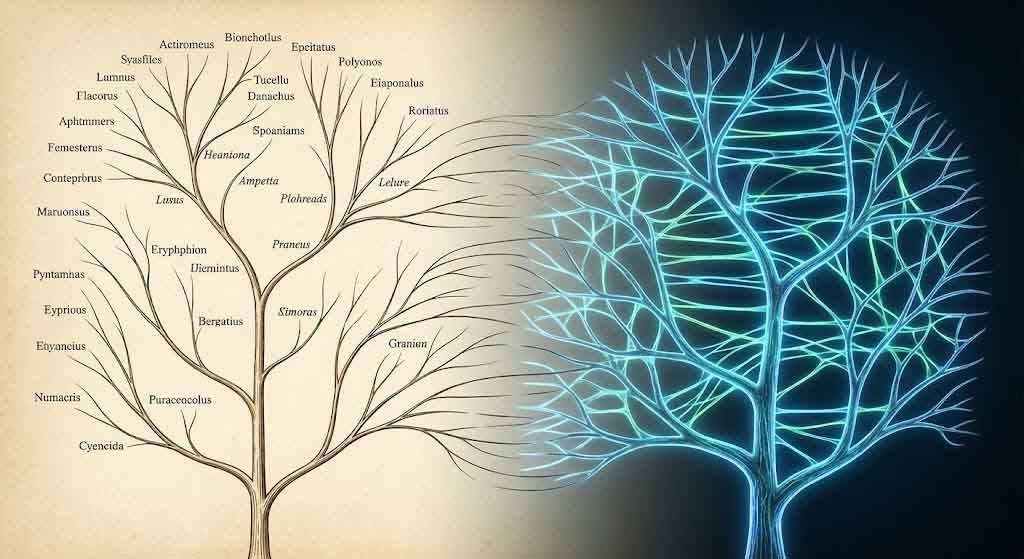
On a page in his private notebook, sometime around 1837, Charles Darwin sketched the most consequential doodle in the history of science. It was crude — a handful of branching lines fanning upward from a single trunk, scrawled above the words “I think.” That little diagram became the organizing metaphor for all of biology: the tree of life, with every species occupying its own twig, every lineage diverging neatly from a common ancestor, never touching again.
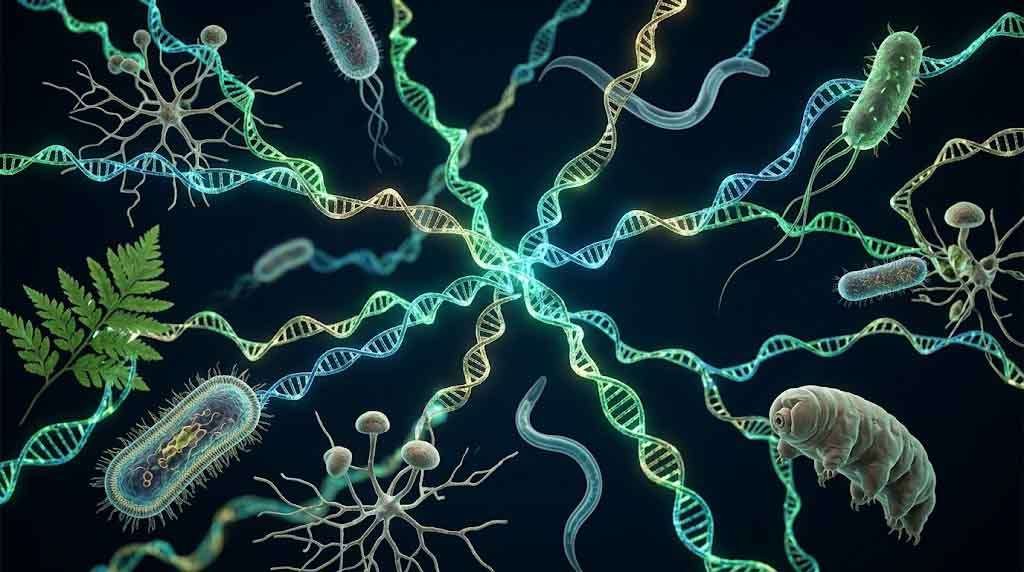
For a century and a half, the tree held. It was elegant, intuitive, and wrong — or at least profoundly incomplete. Because while Darwin’s branches do diverge, they also reconnect. Genes don’t just flow downward from parent to offspring. They move sideways, jumping between unrelated organisms like contraband slipped across a border. Bacteria trade genes with other bacteria the way neighbors trade sugar. Viruses stitch their code permanently into the genomes of animals. Fungi pass genetic material to plants. And roughly eight percent of your own DNA — more than four times the amount that codes for proteins — arrived not through any ancestor but through ancient viral infections that stitched themselves into the human germline millions of years ago.
The phenomenon is called horizontal gene transfer, and it is rewriting the story of evolution itself.
The Vertical Assumption
Classical evolutionary theory operates on a single core premise: inheritance is vertical. Parents pass genes to offspring, offspring pass genes to their offspring, and the whole process unfolds like a branching river system flowing in one direction — forward through time, always diverging, never merging. Trace any two species backward and their lineages will eventually converge at a common ancestor, the way two tributaries meet at a single headwater.
This model worked beautifully for animals and plants. It produced phylogenetic trees of breathtaking precision, allowing biologists to map the relationships among millions of species using the molecular sequences of shared genes. Carl Woese, working at the University of Illinois in the 1970s, used ribosomal RNA sequences to propose what seemed like the final word on life’s architecture: three great domains — Bacteria, Archaea, and Eukarya — all branching from a single root.
But even as Woese was drawing his elegant three-domain tree, the evidence for a messier reality was already accumulating. And it had been accumulating for decades.
The First Cracks
The earliest hints that genes could move sideways came not from evolutionary theorists but from microbiologists fighting infectious disease. Frederick Griffith’s famous 1928 experiment showed that dead bacteria could somehow pass traits to living ones — a phenomenon he called transformation. By 1959, Japanese researchers had documented antibiotic resistance jumping between entirely different species of bacteria. But these findings were treated as curiosities, quirks of the microbial world that had little bearing on the grand narrative of evolution.
Then came genome sequencing.
When scientists began reading the complete genetic blueprints of microorganisms in the 1990s and 2000s, the tree started to buckle. Organism after organism revealed genes that didn’t belong — sequences whose evolutionary history told a completely different story than the rest of the genome. The archaean Archaeoglobus fulgidus became a famous early example: by every cellular marker, it was a textbook member of the Archaea, yet its genes for the enzyme HMGCoA reductase were unmistakably bacterial in origin. The organism had somehow acquired bacterial genes and woven them into its own genome, where they functioned perfectly well.
This wasn’t a single anomaly. It was everywhere. As W. Ford Doolittle argued in his landmark 1999 paper in Science, the deeper scientists looked, the more they found that individual genes within a single organism could trace back to wildly different ancestors. A genome wasn’t a unified document of one lineage’s history. It was a mosaic — a patchwork of pieces acquired from multiple sources across billions of years.
The Three Mechanisms
Bacteria have three primary ways of swapping genetic material outside of normal reproduction, and understanding them reveals just how fluid the microbial world really is.
Conjugation is the most dramatic. One bacterium physically connects to another through a structure called a pilus — essentially a molecular bridge — and injects a copy of a plasmid, a small circular loop of DNA that replicates independently of the main chromosome. Plasmids frequently carry genes for antibiotic resistance, which means a single conjugation event can transform a vulnerable bacterium into a resistant one in minutes. This is not gradual Darwinian adaptation. It is instant genomic upgrade.
Transformation is more passive but no less consequential. When bacteria die and their cells rupture, they release naked DNA into the surrounding environment. Nearby bacteria can absorb these fragments directly through their cell membranes and integrate them into their own genomes. Some species are naturally competent — hardwired to take up environmental DNA as a routine part of their biology.
Transduction involves a third party: bacteriophages, the viruses that infect bacteria. When a phage hijacks a bacterial cell and begins replicating, it occasionally packages fragments of the host’s DNA into new viral particles by mistake. When those particles infect a new cell, they deliver not just viral genes but chunks of the previous host’s genome. It is accidental gene transfer, mediated by an organism that isn’t even alive in any conventional sense.
More recently, researchers have identified a fourth mechanism — outer membrane vesicles, tiny bubbles that bacteria shed from their surfaces, carrying DNA that can be absorbed by other cells. This pathway, described in studies published as recently as 2025, adds yet another channel to an already crowded network of genetic exchange.
The Superbug Crisis
None of this is abstract. Horizontal gene transfer is the engine driving one of the most urgent public health crises of the twenty-first century: the global spread of antibiotic-resistant bacteria.
When a single bacterial strain develops resistance to an antibiotic through random mutation, that resistance remains confined to its descendants — a slow, vertical process. But when the gene conferring that resistance sits on a conjugative plasmid, it can leap sideways into entirely different species within hours. Resistance to one antibiotic in a strain of Salmonella can jump to Staphylococcus, then to Klebsiella, then to E. coli, each time broadening its reach. Whole packets of genes conferring multidrug resistance can transfer in a single event, creating what public health researchers now call “superbugs” — organisms resistant to nearly every available treatment.
A 2025 study in Nature Communications used machine learning analysis of nearly one million bacterial genomes integrated with over 20,000 environmental samples to map how resistance genes flow between species. The findings confirmed that genetic compatibility and ecological co-occurrence — particularly in the human microbiome and wastewater systems — are the primary drivers of resistance gene transfer. Hospitals, in particular, function as hothouses for this kind of exchange, concentrating diverse bacterial species under intense antibiotic pressure and accelerating the sideways movement of resistance genes.
Current projections estimate that antimicrobial-resistant infections could cause ten million deaths annually by 2050 if the trajectory continues unchecked. Horizontal gene transfer is not the only factor, but it is the accelerant — the mechanism that converts isolated resistance events into global pandemics of untreatable infection.
You Are Eight Percent Virus
Perhaps the most unsettling revelation of the genomic era is that horizontal gene transfer isn’t restricted to bacteria. It has shaped the human genome itself.
Approximately eight percent of human DNA consists of sequences derived from ancient retroviruses — so-called human endogenous retroviruses, or HERVs. These are not active infections. They are fossils, molecular remnants of retroviruses that infected the germ cells of our primate ancestors over the last hundred million years, integrated their genetic code into the host genome, and then got passed down through every subsequent generation like any other gene.
Most of these viral relics have accumulated so many mutations that they are functionally inert — broken copies of genes that once served the virus but now sit silently in our chromosomes. But not all of them are silent. Some have been “domesticated,” co-opted by the host for entirely new purposes. The protein syncytin-1, essential for the formation of the human placenta, is derived from an ancient retroviral envelope gene. Without that viral insertion, mammalian pregnancy as we know it might never have evolved.
The numbers are staggering in context. Only about 1.5 to 2 percent of the human genome codes for proteins. Viral-derived sequences occupy four times that space. As David Quammen put it in his 2018 book The Tangled Tree, we are “composite creatures” — mosaics assembled from pieces that arrived from entirely different branches of life. And that’s before accounting for mitochondria, the energy-producing organelles in every human cell, which are themselves the descendants of captured alpha-proteobacteria absorbed through an act of ancient endosymbiosis billions of years ago.
The Rotifers Who Cheat Death
If you want to see horizontal gene transfer operating at its most extraordinary in the animal kingdom, look at bdelloid rotifers — microscopic freshwater invertebrates that haven’t had sex in over sixty million years.
By every rule of evolutionary theory, bdelloids should be extinct. Asexual reproduction is supposed to be an evolutionary dead end, leaving organisms unable to generate the genetic diversity needed to adapt to changing environments and outrun parasites. Yet bdelloids have diversified into over 450 species across the globe, thriving in habitats from Antarctic ice to tropical moss.
Their secret appears to be horizontal gene transfer on a scale unprecedented among animals. Studies published in Science and BMC Biology have found that eight to fourteen percent of bdelloid transcripts are of non-metazoan origin — genes acquired from bacteria, fungi, and plants. The leading hypothesis is that bdelloids pick up foreign DNA when they recover from desiccation. These animals can survive being completely dried out for years; when they rehydrate, the double-strand breaks in their chromosomes that occur during drying get repaired, and environmental DNA fragments get stitched in alongside the native sequence.
A 2024 study in Nature Communications added a remarkable twist: when bdelloid rotifers are attacked by a fungal pathogen, horizontally acquired genes are over twice as likely to be upregulated as native genes. Among the most strongly activated are gene clusters resembling bacterial antibiotic synthesis pathways. Bdelloids appear to be fighting fungal infections using weapons borrowed from bacteria — genetic armaments that no animal genome could have produced on its own.
These microscopic creatures have, in effect, replaced sex with theft. And it works.
From Tree to Web
So what replaces Darwin’s tree? Biologist Johann Peter Gogarten has suggested that the tree metaphor should give way to a net or a web — a structure that preserves the branching, diverging pattern of vertical inheritance while acknowledging the horizontal connections that stitch those branches together. Others prefer the image of a tangled thicket, a structure with a general upward trajectory but with roots and branches that weave and fuse in unexpected patterns.
The philosophical implications run deep. If different genes within a single organism trace back to different ancestors, then what does “ancestry” even mean? There was no single last universal common ancestor — no single organism that contained all the genes shared by life today. Instead, there was a community of ancient cells, exchanging genetic material so freely that the very concept of individual lineage dissolves into a haze of collective molecular history. As one research team described it, each contemporary molecule has its own individual history and traces back to its own molecular ancestor, which may have existed in a completely different organism than the molecular ancestors of the gene sitting right next to it on the chromosome.
This doesn’t destroy Darwinian evolution. Natural selection still operates. Descent with modification still explains the broad patterns of life’s diversity. But horizontal gene transfer adds a second axis — a lateral dimension of innovation that Darwin never imagined. Evolution doesn’t just move forward through time. It moves sideways across species, reshuffling the deck in ways that can be sudden, dramatic, and world-altering.
The Fermi Paradox piece on this blog explored whether the universe’s silence might itself be a kind of data. The same principle applies here. The messiness of the tree of life isn’t a failure of the model. It is the data — telling us that life is stranger, more interconnected, and more resourceful than any single metaphor can contain.
Darwin’s tree was a beginning. The tangled web is closer to the truth.
Sources
- Doolittle, W. F. “Phylogenetic Classification and the Universal Tree.” Science, 284(5423), 1999.
- Gogarten, J. P., Doolittle, W. F., and Lawrence, J. G. “Prokaryotic Evolution in Light of Gene Transfer.” Molecular Biology and Evolution, 19(12), 2002.
- Gladyshev, E. A., Meselson, M., and Arkhipova, I. R. “Massive Horizontal Gene Transfer in Bdelloid Rotifers.” Science, 320(5880), 2008.
- Quammen, David. The Tangled Tree: A Radical New History of Life. Simon & Schuster, 2018.
- Eyres, I., et al. “Horizontal Gene Transfer in Bdelloid Rotifers Is Ancient, Ongoing and More Frequent in Species from Desiccating Habitats.” BMC Biology, 13(90), 2015.
- Nowell, R. W., et al. “Bdelloid Rotifers Deploy Horizontally Acquired Biosynthetic Genes Against a Fungal Pathogen.” Nature Communications, 15, 2024.
- Rasmussen, J. A., et al. “Genetic Compatibility and Ecological Connectivity Drive the Dissemination of Antibiotic Resistance Genes.” Nature Communications, 16, 2025.
- Wachino, J., et al. “Horizontal Gene Transfer Systems for Spread of Antibiotic Resistance in Gram-Negative Bacteria.” Microbiology and Immunology, 69(7), 2025.
- Szöllősi, G. J., et al. “Gene Transfers Can Date the Tree of Life.” Nature Ecology & Evolution, 2, 2018.
- Grandi, N., and Tramontano, E. “Human Endogenous Retroviruses Are Ancient Acquired Elements Still Shaping Innate Immune Responses.” Frontiers in Immunology, 9, 2018.
- Nelson, P. N., et al. “Demystified: Human Endogenous Retroviruses.” Journal of Clinical Pathology, 56(1), 2003.