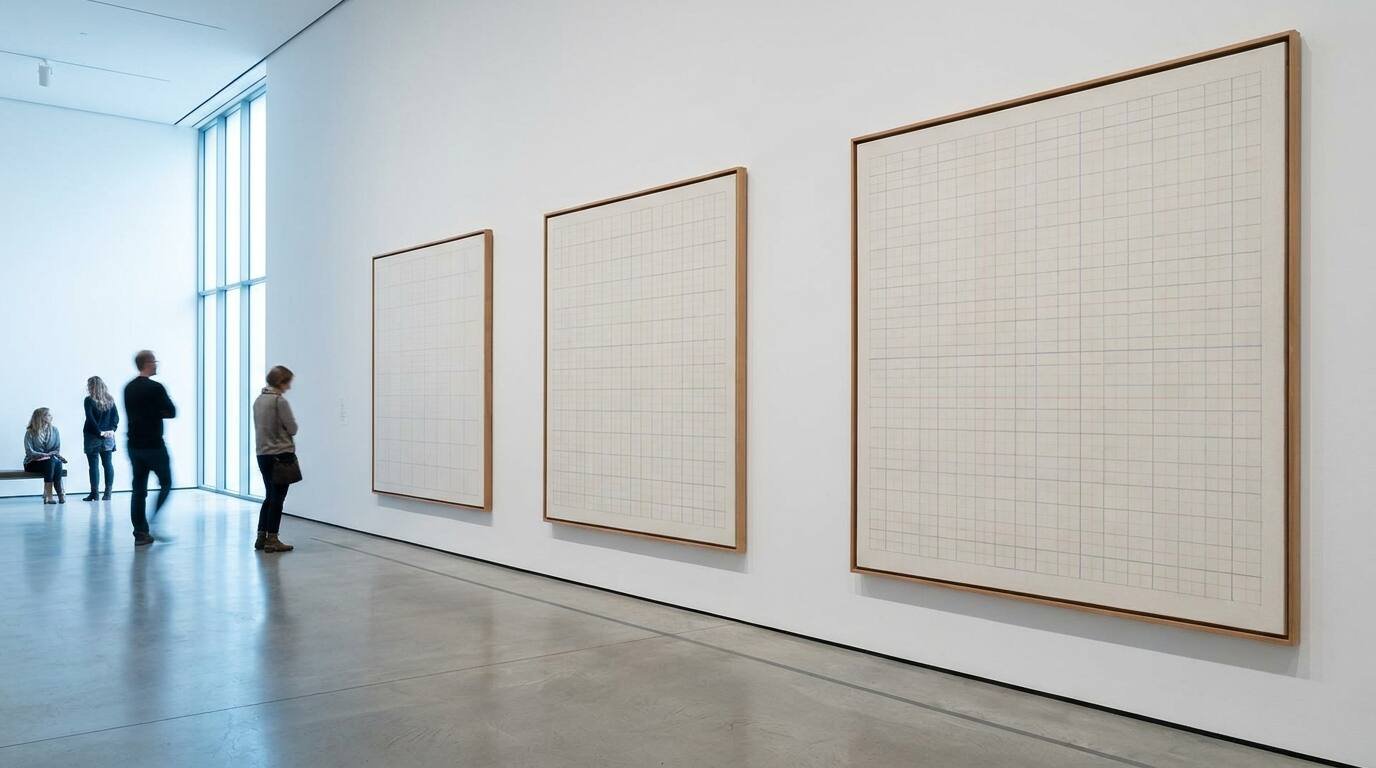
Somebody’s paying thirty million dollars for what looks like ruled notebook paper on linen. Either the art world is insane or there’s something happening in those lines that doesn’t photograph.
Both things can be true, and with Agnes Martin, both things are. The art market has distortions built into it the way a funhouse mirror has distortions built into it — systematically, and in a way that flatters certain things and grotesques others. But Martin’s prices are not solely a market distortion. They represent, with unusual honesty, the auction consequence of genuine rarity meeting genuine spiritual weight. The work earns a significant portion of its price. The market does the rest, the way markets always do.
Understanding why requires understanding what Martin was actually doing on those canvases, which is not what it looks like from three feet away or in reproduction.
New Mexico, Solitude, and the Decision to Leave New York Behind
Agnes Martin was born in Saskatchewan in 1912, came to the United States in 1932, and spent the most consequential years of her early career in the downtown Manhattan neighborhood of Coenties Slip, where she kept company with Ellsworth Kelly, Robert Indiana, and Cy Twombly. She was already recognized. Her grid paintings of the early 1960s were included in the Guggenheim’s landmark 1966 Systemic Painting exhibition, hung alongside Sol LeWitt and Donald Judd as examples of emergent minimalism. She was, by any reasonable measure, at the beginning of a major institutional career.
In 1967, she stopped painting and left New York.
She spent eighteen months traveling by truck through the United States and Canada with no fixed destination, eventually settling in the mesa country near Taos, New Mexico, where she built an adobe house with her own hands and lived largely alone for the next three decades. She stopped not because she had failed but because she had succeeded past the point where New York’s particular energy was useful to her. The noise of art world recognition, critical positioning, collector relationships — all of it was interference. She left to find the signal.
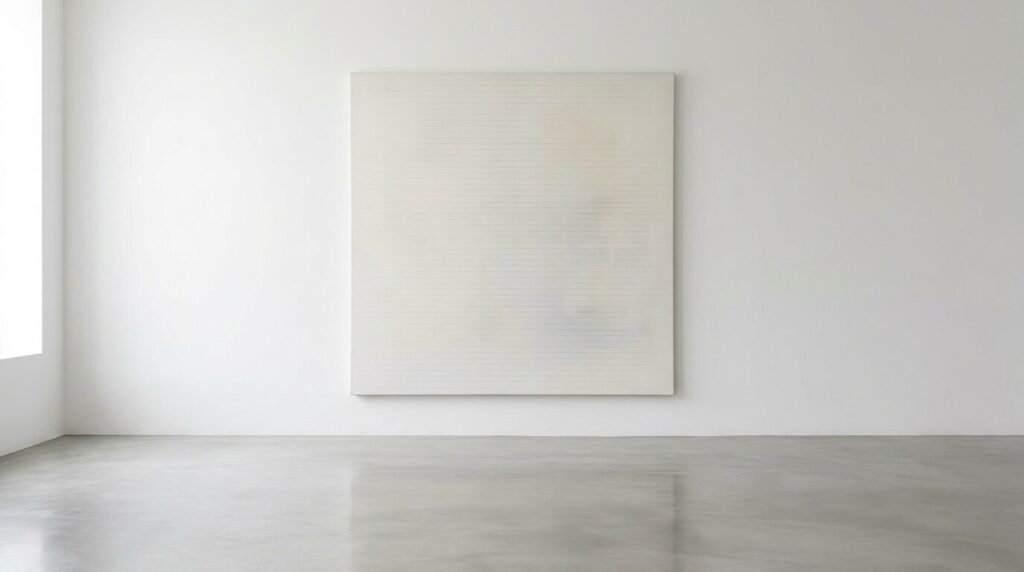
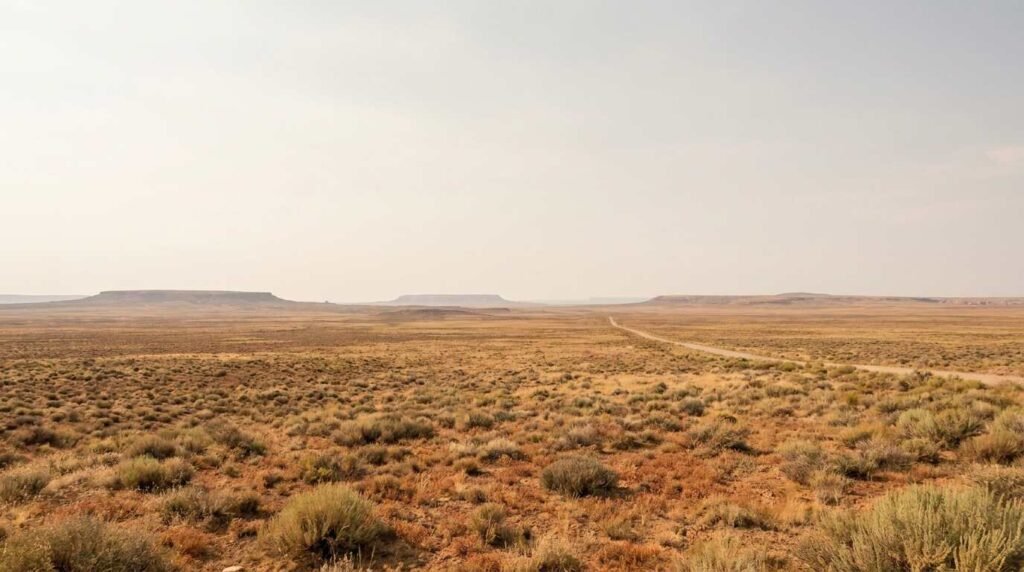
New Mexico gave her what she went looking for. The mesa landscape — horizontal, immense, pale, silent — translated directly into the work. Her canvases from the Taos years are quieter than the New York grids, more suffused with light, more insistently horizontal. The geography became the grammar. She painted the same thing she was looking at. She just stripped everything down to its essence first.
Martin was represented by Pace Gallery for much of her later career. She was awarded the Golden Lion for Lifetime Achievement at the Venice Biennale in 1997 and the National Medal of Arts in 1998. She turned down a retrospective at the Whitney Museum of American Art because she did not want a printed exhibition catalogue, fearing that critical language would damage the viewer’s direct encounter with the work. That refusal tells you most of what you need to know about her priorities.
What a Grid Actually Does When You Look at It Long Enough
A grid, in the hands of most artists, is a structural device. Organization. Scaffolding. With Martin, the grid was the subject.
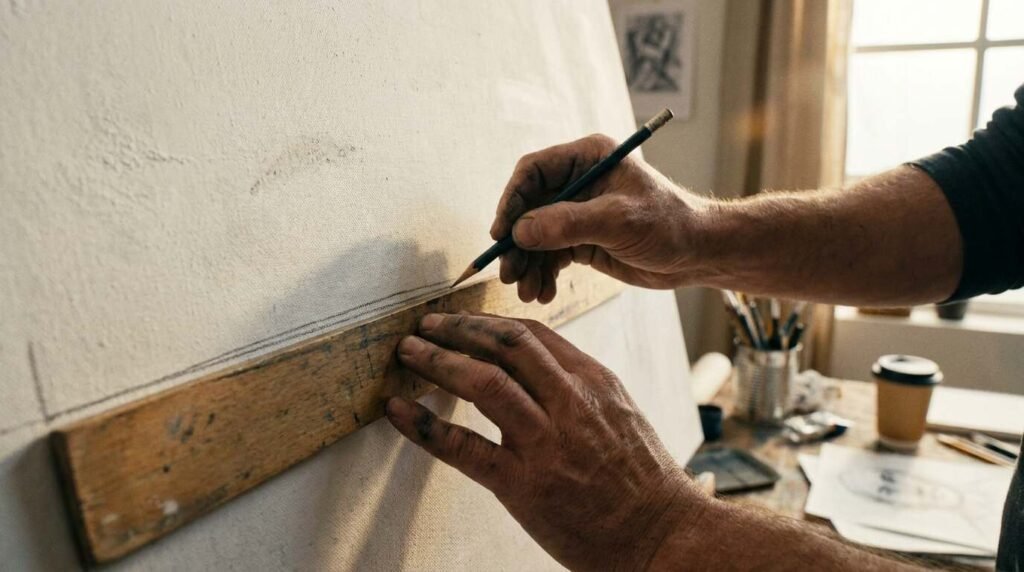
Her breakthrough work from the early 1960s involved six-by-six-foot square canvases covered in dense, fine graphite grids — hundreds of small rectangles drawn by hand, with a straightedge but not mechanically, so that each line carried the trace of the human hand that made it. Up close, the grids are never perfectly uniform. There are slight variations in pressure, in spacing, in the weight of the pencil. The work is not manufactured perfection. It’s aspirational perfection — the record of a sustained attempt.
What happens when you stand in front of one of these paintings for ten minutes is not nothing. It’s something that’s extremely difficult to describe in language, which is partly why Martin resisted the art world’s critical apparatus so persistently. The grid doesn’t lock down your attention. It releases it. The eye moves across the surface, registers the slight variations, follows one line and loses it in another, and gradually enters a state that is closer to meditative suspension than to the active engagement most figurative art demands. You’re not following a narrative or decoding symbols. You’re being given conditions for a particular quality of attention.
Martin described this as the goal explicitly. “Without awareness of beauty, innocence and happiness,” she wrote in her collected Writings, “one cannot make works of art.” She was not using these words loosely. Beauty, in Martin’s framework, was not a decorative quality but a perceptual one — a state of being that the work could induce in the viewer if the work was made correctly. Making it correctly required the painter to achieve that state first, before touching the canvas. “I paint with my back to the world,” she famously said.
The Difference Between Minimalism and What Martin Said She Was Doing
The art historical record has Martin filed under Minimalism, which is accurate in formal terms and misleading in almost every other way.
Minimalism, as practiced by Donald Judd, Carl Andre, and Dan Flavin, was fundamentally about objects in space — about the physical reality of industrial materials, the specificity of spatial relationships, the refusal of illusion. It was materialist and anti-expressive by conviction. Judd’s stacks of aluminum boxes are not about feeling. They’re about the fact of the object.
Martin knew all of this. She exhibited alongside these artists. She understood the formal argument. And she rejected the emotional logic of it completely. Her grids are not about the fact of graphite lines on gessoed canvas. They are about what those graphite lines do to consciousness. She was, by her own account, a Taoist by temperament and a painter of inner states by vocation. She diagnosed the minimalist project accurately and then quietly went somewhere else entirely, using similar visual language to pursue a completely different aim.
This is why her work resists easy documentation. A photograph of a Martin canvas looks like a minimal, potentially dull gray rectangle. The experience of standing in front of the painting is of an entirely different order. The painter and critic Dore Ashton, reviewing Martin’s 1973 retrospective, noted that the paintings were “not about what you see, but about how you see.” That distinction is the entire argument.
How Mental Illness Shaped Her Practice Without Defining It
Agnes Martin was diagnosed with schizophrenia. This fact is documented, acknowledged by those who knew her, and treated with appropriate care in the critical literature — which is to say it is mentioned without being used as the explanation for everything, because the explanation for everything in her work is the work.
What the illness illuminates is the discipline the work required. Martin described hearing voices and working through episodes that could last weeks. She described the difficulty of maintaining the kind of sustained interior stillness that her paintings demanded — stillness that the illness interrupted. Her practice was not in spite of her mental state; it was a daily negotiation with it. The paintings are not transcriptions of mystical peace. They are the evidence that peace was achievable, momentarily, through rigorous attention.
After her death in 2004, the Harwood Museum of Art in Taos organized exhibitions examining Martin’s early work and the role of her mental health and sexuality — she was gay, private about it in the way of her generation, but known to those close to her — in shaping the arc of her career. The Harwood, whose permanent Martin gallery she designed herself, holds a room-size installation of her late paintings that is probably the closest available equivalent to encountering the work as she intended it.
Why Collectors Pay Eight Figures for a Canvas That Looks Blank
The supply is the beginning of the story. When Martin discovered the grid in 1960, she destroyed everything she had made before that point — a career spanning the 1930s through the 1950s, most of it gone. Of the grid paintings that survive, art dealer Arne Glimcher, who represented Martin at Pace, estimates that roughly half are held by institutions. Many of the remainder have been in private collections for decades. Very few come to market in any given year.
In May 2016, Orange Grove (1965) sold at Christie’s for $10.7 million against an estimate of $6.5 to $8.5 million — a result that represented a significant market shift. In November 2021, Untitled #44 sold at Sotheby’s for $17.7 million, nearly doubling the previous record. In November 2023, Grey Stone II sold at Sotheby’s for $18.7 million, the artist’s current auction record.
These prices reflect rarity and institutional demand operating in the same market simultaneously. Major museums continue to acquire Martin when pieces become available. Private collectors compete for the same pool of perhaps 60 surviving grid paintings. With each year, the math tightens further. Glimcher has estimated that no more than five of those original grids could realistically come to market over any given decade.
But there’s something beneath the supply-demand analysis that the market commentary usually skips. Martin’s work has become, for a significant cohort of collectors and curators, something they describe in terms that sound more like devotion than acquisition. People talk about Martin’s paintings the way people talk about certain kinds of music — as things that changed their relationship to time, to quiet, to looking. That’s not a common market outcome. Most art is admired. Martin’s work, at its best, is experienced. The difference is worth thirty million dollars to the people who’ve felt it.
Sources
– Agnes Martin — Wikipedia – Pace Gallery — Agnes Martin artist documentation – Sotheby’s — Agnes Martin artist biography and market data – ARTnews — Behind the Agnes Martin Market and Sotheby’s Record Sale (2023) – ARTnews — New Record Set for Agnes Martin at Sotheby’s (2021) – MyArtBroker — Agnes Martin Record Prices – Agnes Martin, Writings/Schriften (Hatje Cantz, 1992) – Guggenheim Museum Agnes Martin retrospective, 2016–2017