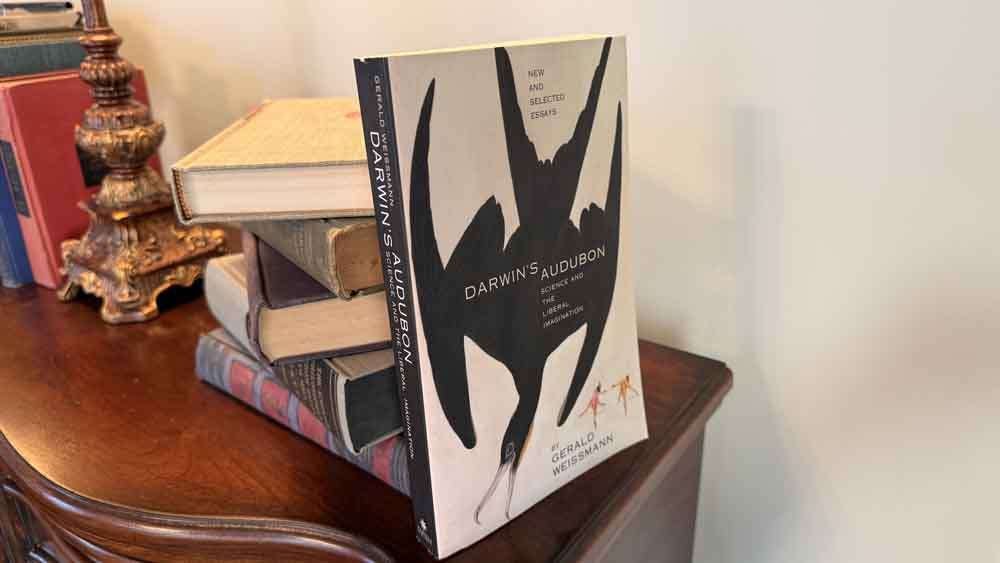
Gerald Weissmann was the kind of man who read Audubon’s watercolors the way most people read a sentence — hunting for meaning beneath the surface, following a thread to wherever it led. A physician, a biochemist, a Guggenheim Fellow, and the co-discoverer of liposomes, he also wrote essays published in the New Republic, the London Review of Books, and the New York Times Book Review. He was, in the truest sense, a person who refused to live inside one room. Darwin’s Audubon: Science and the Liberal Imagination — a retrospective of his best-known essays — is the record of that refusal.
The book’s argument is embedded in its title. Darwin studied Audubon’s watercolors with deep attention. The painter’s eye helped sharpen the naturalist’s thinking. Art and science were not two separate houses; they shared a wall, and the wall was thinner than most people supposed.
The Snow Problem
In 1959, the British physicist and novelist C. P. Snow delivered what became one of the most argued-over lectures of the twentieth century. Standing in Cambridge’s Senate House, he described a civilizational rift — what he called a “gulf of mutual incomprehension” between scientists and literary intellectuals. He called it the “two cultures” divide, and he worried it was making the West slower, duller, and less capable of solving real problems. The story goes that Snow turned to a group of educated people at a dinner party and asked how many of them could describe the second law of thermodynamics. The response, he wrote, was cold. And negative.
Weissmann spends the better part of his career answering Snow’s challenge — not in debate, but by demonstration. His 24 essays show, through careful and often playful scholarship, that the divide was always artificial. Scientists who paint, poets who practice medicine, naturalists whose field notebooks read like literature — these figures are not anomalies. They are the norm, once you know where to look.
The Essays Themselves
The range here is genuinely unusual. Weissmann moves from the relationship between Darwin and Audubon, to the poetry of William Carlos Williams cross-referenced against his unedited medical case books, to Oliver Wendell Holmes growing simultaneously as a physician and a poet. He writes about Marie Curie’s family across three Nobel prizes. He traces the strange wartime story of Gertrude Stein and Alice B. Toklas, sheltered in occupied France by a French fascist while the rest of the world burned. He takes on the history of Lyme disease, feminist critiques of science, and the treatment of homeless people with mental illness — topics that at first seem scattered, until you realize they are all versions of the same question: what happens when we stop talking to each other across disciplines?
The connective tissue is Weissmann’s voice, which is warm and authoritative without ever becoming ponderous. He was trained as a scientist but writes like someone who read deeply in literature and never quite got over it. His sentences have shape. His analogies are good. He is the kind of writer who earns the right to go where he pleases because the reader trusts him.
Publishers Weekly, in their original assessment of the book, described Weissmann as an essayist who bridges the gap between medicine and the muses “with wit, erudition” — and that captures something real. The wit is important. These essays are never grim. Even when the subject is dark — and some of it is — Weissmann maintains the disposition of someone genuinely delighted by knowledge.
Darwin, Audubon, and the Intelligence of Looking
The title essay is the centerpiece and the most quietly powerful piece in the collection. Weissmann’s argument is that Audubon’s extraordinary attention to birds — their posture, their motion, their particularity — likely influenced Darwin’s own way of seeing. Darwin did not just observe. He noticed. He looked the way a painter looks, not the way a cataloguer does. The question Weissmann poses, gently and without overstatement, is whether scientific insight might depend more on artistic sensibility than we usually acknowledge.
This lands differently if you’ve spent time thinking about what observation actually requires. Noticing something new in the world is not a mechanical act. It requires a kind of trained attentiveness that cuts across disciplines — the same quality in Audubon sketching a bird at dusk and Darwin sitting with a barnacle for years and finally seeing what no one had seen before.
On Being More Than One Thing
What Weissmann understood, and what his book quietly argues across 24 essays, is that the most interesting people have always resisted categorization. The physician-poet. The scientist-novelist. The naturalist-painter. These are not hyphenated curiosities. They are the rule, historically, among people who changed how we understand the world.
Nobel laureate Eric Kandel, one of the few scientists whose writing on art rivals his writing on neuroscience, called Weissmann “America’s most interesting and important essayist.” That’s a strong claim. But reading these pages, you feel its weight. Weissmann earned the title not through ambition but through range — through a lifelong willingness to follow an idea past the disciplinary border signs and see where it went.
There is something to that model worth holding onto. In a world increasingly organized by specialization and algorithm, the generalist who reads widely and connects things across domains is not an anachronism. That person may be more necessary than ever.
Readers interested in the broader Darwin question — specifically, how his theory of evolution continues to ramify through biology, culture, and philosophy — may find Horizontal Gene Transfer: Why Darwin’s Tree of Life Is Actually a Tangled Web a useful companion read from the Heritage Blog. And for those drawn to the philosophical strain running through Weissmann’s work, our review of The God Delusion by Richard Dawkins covers adjacent intellectual terrain — the tension between scientific reasoning and inherited belief — with equal intensity.
A Book for Readers Who Refuse to Stay in Their Lane
Darwin’s Audubon is not a long book, and it is not a difficult one. But it is substantive in the way good essays always are — it changes the furniture of your thinking. You finish it persuaded that C. P. Snow was wrong not about the fact of division but about its necessity. The divide between science and the humanities is not a law of nature. It is a habit. And habits, as any good physician knows, can be broken.
Weissmann died in 2019 at eighty-eight, having published eleven collections. He never lost the habit of crossing the border. Darwin’s Audubon is proof of what that kind of intellectual life looks like over time — not neat, not narrowly expert, but wide open and still asking questions on the last page.
You Might Also Like:
- Thus Spoke Zarathustra by Nietzsche — The Book That Rewired My Understanding of Everything
- Horizontal Gene Transfer: Why Darwin’s Tree of Life Is Actually a Tangled Web
Sources:
- Weissmann, Gerald. Darwin’s Audubon: Science and the Liberal Imagination. Basic Books, 1998. Amazon
- Publishers Weekly review of Darwin’s Audubon: publishersweekly.com
- Goodreads listing and description: goodreads.com
- Hachette Book Group publisher page: hachettebookgroup.com
- Snow, C. P. The Two Cultures and the Scientific Revolution. Cambridge University Press, 1959. Wikipedia overview: en.wikipedia.org
- Kandel, Eric. Quoted on Amazon author page: amazon.com